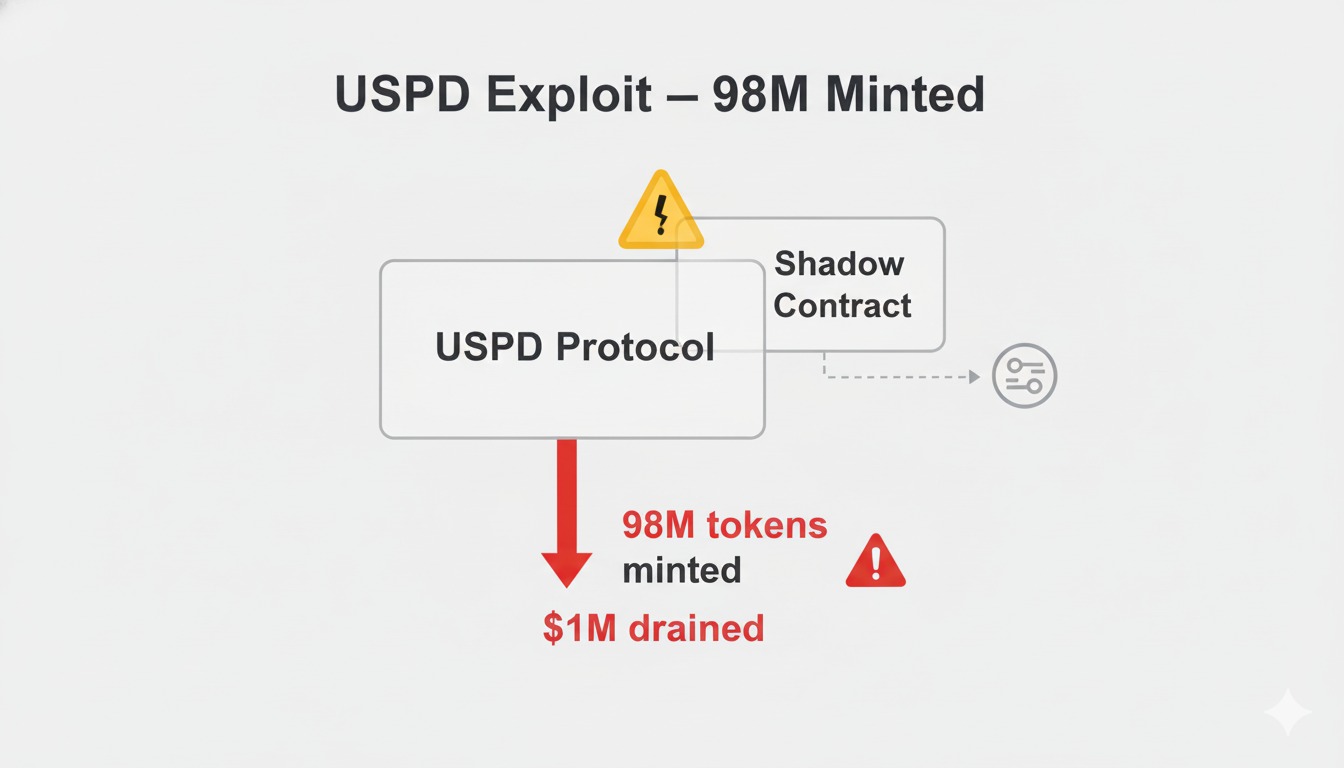
USPD stablecoin protocol confirmed a critical exploit resulting in 98 million tokens minted and $1 million drained after attacker planted shadow contract during September deployment.
The decentralized stablecoin protocol USPD confirmed a devastating security exploit that resulted in unauthorized minting of approximately 98 million USPD tokens and the draining of around 232 stETH, totaling over $1 million in losses. The breach, discovered on December 5, represents one of the most sophisticated attacks in DeFi history.
According to USPD.IO on X, the protocol issued an urgent alert warning users not to purchase USPD tokens and to revoke all approvals immediately. The exploit utilized a highly advanced attack vector that remained undetected for nearly three months despite rigorous security audits from top-tier firms.
September Attack Planted Months Before Execution
The attacker executed the initial phase on September 16 during the protocol's deployment. Using a Multicall3 transaction, the hacker front-ran the proxy initialization process and silently seized administrative rights before USPD's deployment script completed execution.
The protocol team emphasized that audited smart contract logic was not compromised. Security firms Nethermind and Resonance had conducted comprehensive reviews of the codebase, with all unit tests passing industry standards. The vulnerability stemmed from deployment procedures rather than code flaws.
What made the attack particularly insidious was the installation of a shadow implementation contract. This malicious proxy forwarded all calls to USPD's legitimate audited contract while simultaneously manipulating event payloads and storage slot information. The technique deceived Etherscan into displaying the verified audited contract as the active implementation.
The camouflage allowed the attacker to maintain hidden access for months. During this dormant period, verification tools and manual security checks failed to detect the compromised proxy architecture. The hacker waited patiently before activating the exploit to mint tokens and drain liquidity pools.
CPIMP Attack Vector Exploits Proxy Architecture
Security experts have designated this breach as a CPIMP attack, which stands for Clandestine Proxy In the Middle of Proxy. This emerging threat targets the narrow deployment window when proxy contracts initialize administrative permissions.
The attacker deposited approximately 3,122 ETH as collateral into the protocol. A critical bug in the system allowed the minting of ten times the appropriate token amount against the deposited collateral. This single transaction generated 98 million USPD tokens and provided access to drain 237 stETH from collateral reserves.
Part of the stolen assets were converted into roughly $300,000 worth of USDC through the Curve decentralized exchange. The protocol team has identified two primary addresses linked to the exploit: the infector wallet at 0x7C97313f349608f59A07C23b18Ce523A33219d83 and the drainer wallet at 0x083379BDAC3E138cb0C7210e0282fbC466A3215A.
USPD.IO stated on X that the team is collaborating closely with law enforcement agencies and whitehat security groups to trace stolen funds. Major centralized and decentralized exchanges have been notified to freeze transactions involving the flagged addresses.
Protocol Offers Bounty for Fund Recovery
The USPD team extended an offer to the attacker, proposing to treat the incident as a whitehat rescue operation. If the hacker returns 90% of the stolen assets while retaining a standard 10% bug bounty, the protocol will cease all law enforcement actions and consider the matter resolved.
USPD.IO communicated on X that they remain open to direct contact through any channel or on-chain fund return. The protocol expressed willingness to negotiate rather than pursue purely punitive measures.
Despite the severity of the breach, CoinMarketCap data shows the USPD stablecoin has maintained its peg to the U.S. dollar. However, trading volume declined by 20% within 24 hours following the exploit announcement, dropping to approximately $2.56 million.
The protocol issued a statement to its community acknowledging the devastating impact. According to USPD.IO on X, the team expressed frustration that rigorous audits and adherence to best practices failed to prevent the attack. They emphasized commitment to transparency and promised a comprehensive technical post-mortem detailing the exploit methodology.
DeFi Sector Faces Escalating Security Challenges
The USPD incident joins a troubling pattern of high-profile DeFi exploits in recent months. December has already witnessed over $100 million in combined losses across multiple platforms and exchanges.
Yearn Finance suffered two separate exploits affecting its yETH liquid-staking token in late November and early December. Attackers exploited unlimited minting vulnerabilities to drain approximately $12 million, though recovery efforts have successfully reclaimed $2.39 million for affected depositors.
Upbit, one of South Korea's largest cryptocurrency exchanges, confirmed a $30 million breach attributed to the Lazarus Group. The attackers reportedly posed as internal administrators to gain unauthorized access, contributing to over $1 billion in Lazarus-linked thefts throughout 2024.
Balancer protocol lost $128 million through a version 2 breach earlier this year and recently announced plans to reimburse approximately $8 million to liquidity providers. The Euler Finance hack in 2023 resulted in over $197 million in losses after stablecoins were systematically drained from lending pools.
The USPD breach highlights the evolving sophistication of proxy-based attack vectors that can bypass even comprehensive security audits. The incident underscores critical vulnerabilities in deployment procedures and proxy architecture governance that remain challenging to detect with current verification tools.
Security researchers warn that CPIMP-style attacks may become more prevalent as attackers exploit narrow deployment windows before security safeguards fully initialize. The combination of clandestine proxies, event manipulation, and storage spoofing represents an advanced threat requiring new defensive strategies.
**Key Takeaways: **
- Attacker planted shadow contract in September, minting 98M USPD tokens months later
- CPIMP attack bypassed audits from Nethermind and Resonance through proxy manipulation
- Protocol offers 10% bounty if hacker returns 90% of stolen $1M in assets
#USPDExploit #DeFiSecurity #CPIMPAttack #StablecoinBreach #CryptoHack
Stay updated on the latest cryptocurrency news on our homepage.
Explore more in Latest News Category.
Related reading:
Key Topics
Crypto New Live
admin@cryptonewslive.org
USPD Exploit: $1M Drained via Shadow Contract
USPD protocol suffers $1M exploit through CPIMP attack. Hacker planted shadow contract in September, minted 98M tokens after months of hiding.