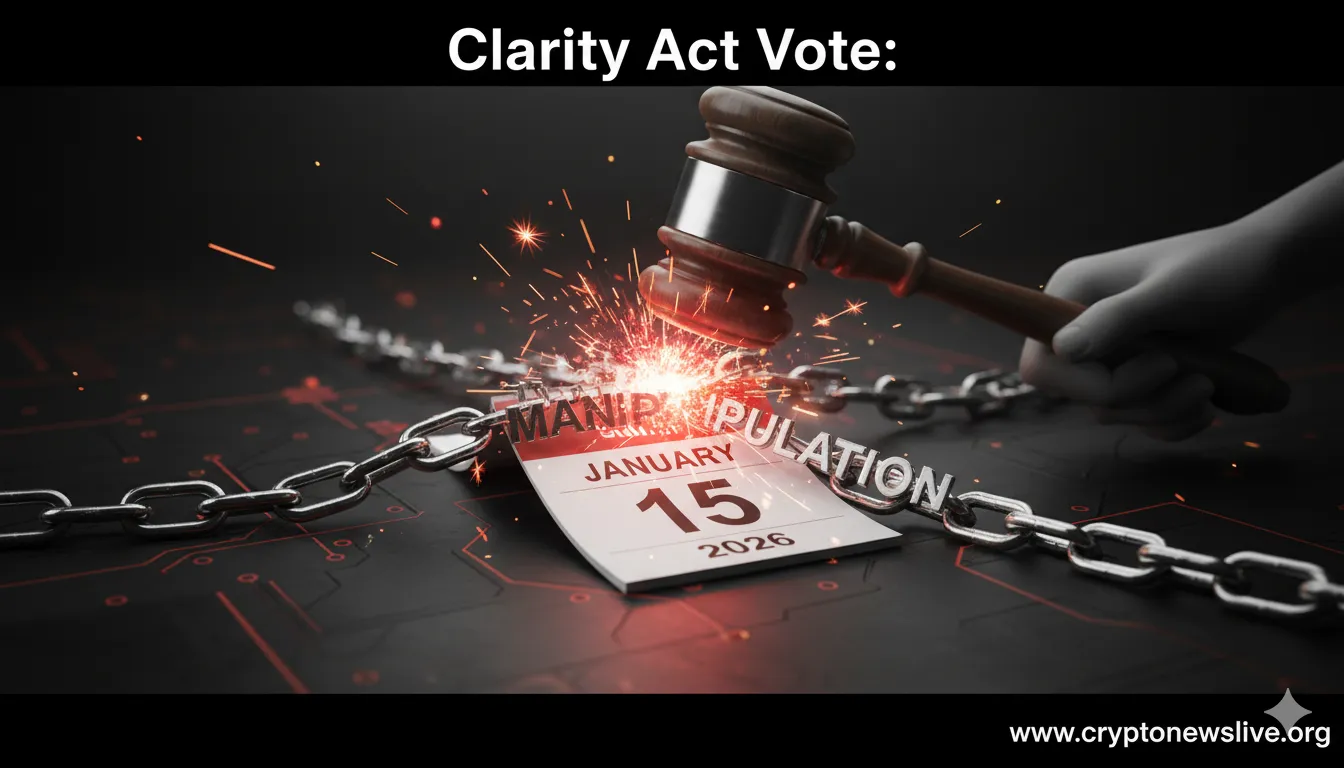
The Senate Banking Committee votes January 15 on the CLARITY Act, legislation aimed at ending crypto market manipulation through bans on wash trading, fake volume, and spoofing while requiring real-time monitoring and proof of reserves from U.S. exchanges.
The Senate Banking Committee votes on the CLARITY Act this January 15, setting the stage for a potential transformation in how cryptocurrency markets operate. The legislation targets manipulation tactics that have plagued digital asset trading, including the catastrophic October 10 liquidation event where over $100 billion vanished without clear accountability.
According to BullTheoryio on X, the bill focuses on stopping manipulation and bringing transparency to crypto markets through specific enforcement mechanisms. The legislation bans wash trading and fake volume while criminalizing spoofing and front running practices that have enabled large-scale market abuse.
October 10's $100 Billion Mystery Drives Regulatory Push
The October 10 crash remains crypto's most significant unexplained event. Bitcoin and altcoins collapsed simultaneously, triggering massive liquidations across the market.
"To this day, we don't know exactly how it started, we don't know which large entities blew up. There was no clear report, transparency or accountability," BullTheoryio stated on X.
Must Read: Bitcoin Liquidity Crisis Emerges as Year-End Trading Stalls
Since that event, crypto markets have exhibited abnormal behavior. Every price pump gets sold off completely. Positive news triggers dumps. Negative news creates sharper declines. Meanwhile, nearly every asset class outside crypto has reached new highs.
The CLARITY Act addresses this directly by requiring real-time monitoring tools for regulators and mandating proof of reserves with regular audits for U.S. exchanges. Crypto Rover claimed on X that manipulation could drop 70-80% once the act passes, though such specific projections remain disputed.
"With the Clarity Act, the manipulation in the crypto market is expected to drop 70%-80%," Crypto Rover tweeted.
You Might Also Like: Trump's Crypto Revolution: One Year Changed Everything
Congressional Bitcoin Purchases Signal Insider Confidence
Recent disclosures show strategic timing. A U.S. Congressman who sits on the Financial Services subcommittee for Digital Assets purchased $100,000 in Bitcoin. Congressman Byron Donalds, serving on the Senate Banking Committee, acquired $200,000 in Bitwise spot Bitcoin ETF holdings.
These purchases occurred just before reports emerged suggesting the bill's likely approval. If passed by the Senate Banking Committee, the legislation moves to a full Senate vote, then returns to the House, before reaching President Trump's desk. The timeline suggests final passage by March 2026.
Related: Bitwise's Wild 11-ETF SEC Blitz Shocks Crypto
The institutional implications extend beyond Bitcoin. Currently, institutions hold primarily Bitcoin due to regulatory clarity. Altcoins remain largely untouched by major capital allocators because rules remain undefined. The CLARITY Act could unlock institutional flows into alternative digital assets by reducing regulatory risk.
Critical Opposition Questions Effectiveness Claims
MastrXYZ challenged the narrative on X, arguing that no regulatory framework can deliver 70-80% reductions in manipulation.
"There is no such thing as a law that reduces market manipulation by 70% or 80%. No draft, no impact study, no regulatory authority has ever published such numbers," MastrXYZ posted on X.
The critic emphasized that the act doesn't alter exchange microstructure, leverage mechanisms, or liquidation engines. More critically, U.S. law holds zero jurisdiction over offshore exchanges like Binance, where most crypto volume occurs through USDT pairs and global arbitrage flows.
"October 10 was not only caused by regulatory uncertainty. It was caused by thin liquidity, aggressive leverage, cascading liquidations, and centralized exchanges controlling order books," MastrXYZ wrote.
Must Read: Bitcoin Breakout Looms: $80K Crash or $100K Moon?
The opposition highlights a fundamental challenge: price discovery in crypto remains global and dominated by centralized exchanges. Forced liquidations, internal market makers, opaque matching engines, and rehypothecation practices persist regardless of U.S. legislation.
Political figures purchasing Bitcoin or ETFs demonstrates narrative alignment rather than guaranteed market integrity improvements. Traditional finance never eliminated manipulation through regulation—it legitimized privileged access and institutional dominance.
January 15 represents a critical juncture. Whether the CLARITY Act delivers promised transparency or simply creates regulatory theater will depend on enforcement mechanisms and global coordination that extends beyond U.S. borders. The crypto market awaits concrete changes rather than legislative promises.
Key Takeaways:
- Senate Banking Committee votes on CLARITY Act January 15 to combat crypto manipulation through wash trading bans
- October 10 crash wiped $100B with zero accountability, driving regulatory push for transparency requirements
- Critics argue U.S. law can't control offshore exchanges where most crypto volume occurs through global arbitrage
Key Topics
Crypto New Live
admin@cryptonewslive.org
CLARITY Act Vote Jan 15: End Crypto Manipulation?
Senate Banking Committee votes Jan 15 on CLARITY Act targeting crypto manipulation. Could this end market abuse or is it regulatory theater?