Meteora is generating $722 million in annualized fees. Its token trades at $0.17 — down 85% from launch. And in less than 48 hours, another 7.22 million MET tokens will unlock into a market that just rallied 67% in seven days.
Something doesn’t add up. Either the protocol is wildly undervalued relative to its cash flows, or the token economics carry risks that the headline numbers don’t capture. We pulled data from six independent sources to find out which.
What Is Meteora? The Solana Liquidity Protocol Explained
Meteora is a decentralized exchange and liquidity infrastructure protocol built on Solana. It operates four distinct products: Dynamic Liquidity Market Makers (DLMM), Dynamic Automated Market Makers in two versions (DAMM V1 and V2), and a Dynamic Bonding Curve used for token launches.
Think of it as plumbing. When a trader swaps tokens on Solana, there’s a good chance the liquidity behind that trade flows through Meteora’s pools. The protocol doesn’t just run one AMM — it provides the underlying infrastructure that other projects build on top of. That distinction matters because infrastructure protocols tend to capture value differently than application-layer DEXes.
The MET token launched approximately 285 days ago via an IEO on BitMart, with a separate Launchpool event on OKX Jumpstart. The contract address is METvsvVRapdj9cFLzq4Tr43xK4tAjQfwX76z3n6mWQL on Solana.
MET Price Analysis: 67% Weekly Surge After Months of Consolidation
MET is trading at $0.1734 as of June 21, 2026, posting an 8.17% gain on the day. But zoom out and the numbers get more dramatic: +67% over seven days, +32% over 30 days. The token hit an all-time high of $0.622 in October 2025 and spent the following eight months grinding between $0.08 and $0.15 before this breakout.
The market cap sits between $83 million and $95 million depending on which supply figure you use (more on that discrepancy shortly). Fully diluted valuation runs around $172–$173 million against a max supply of 1 billion tokens.
Daily trading volume ranges from $33 million (CoinPaprika) to $68 million (Messari) — a volume-to-market-cap ratio between 37% and 74%. That’s aggressive for a mid-cap token and signals either strong trading interest or wash activity inflating the numbers.
MET 24-hour price action showing intraday momentum
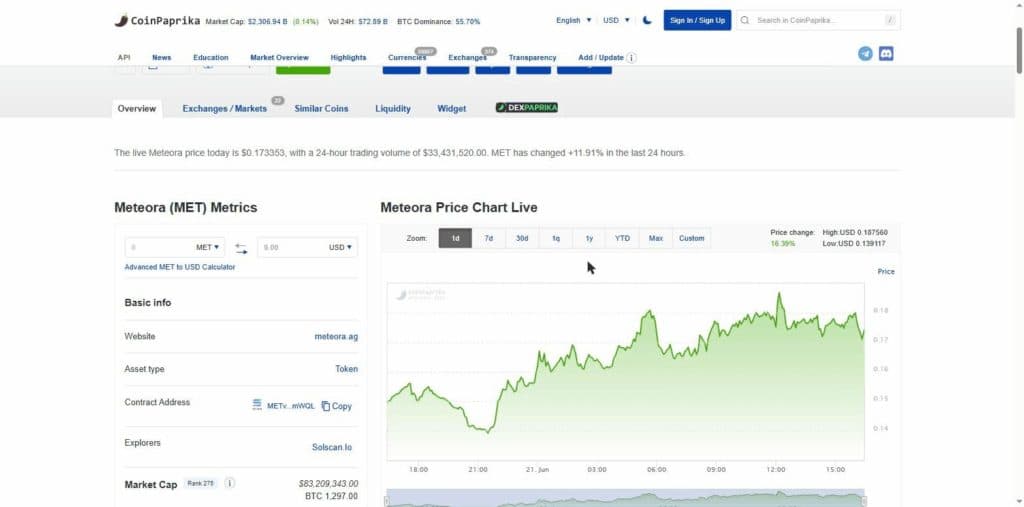
Source: CoinPaprika — captured June 21, 2026
Three-month price trend: recovery from the $0.08–$0.15 range
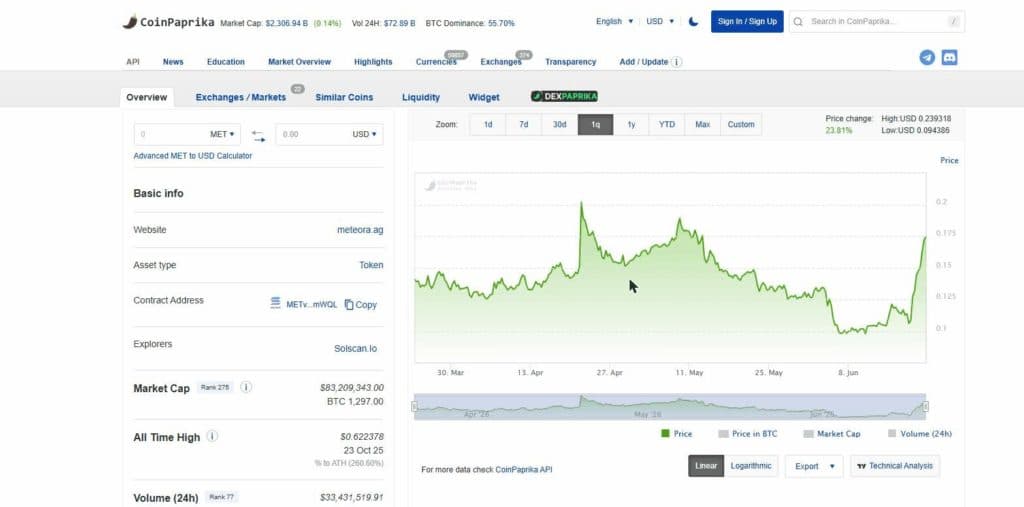
Source: CoinPaprika — captured June 21, 2026
One-year view: the full arc from ATH to consolidation to current recovery
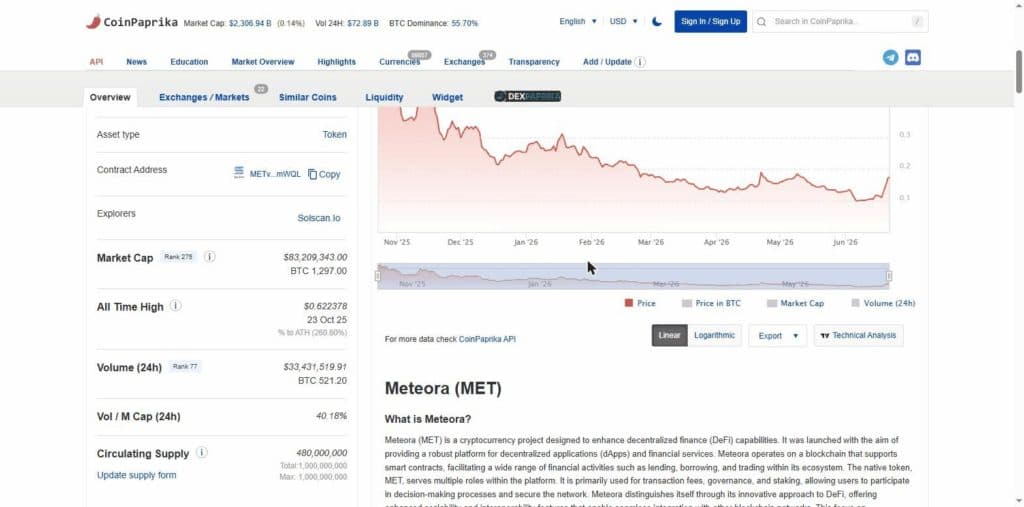
Source: CoinPaprika — captured June 21, 2026
Meteora’s 30-day volatility of 146% makes it one of the highest-beta plays in Solana DeFi. This is not a token for passive holders.
Full market data panel with rank, volume, and supply metrics
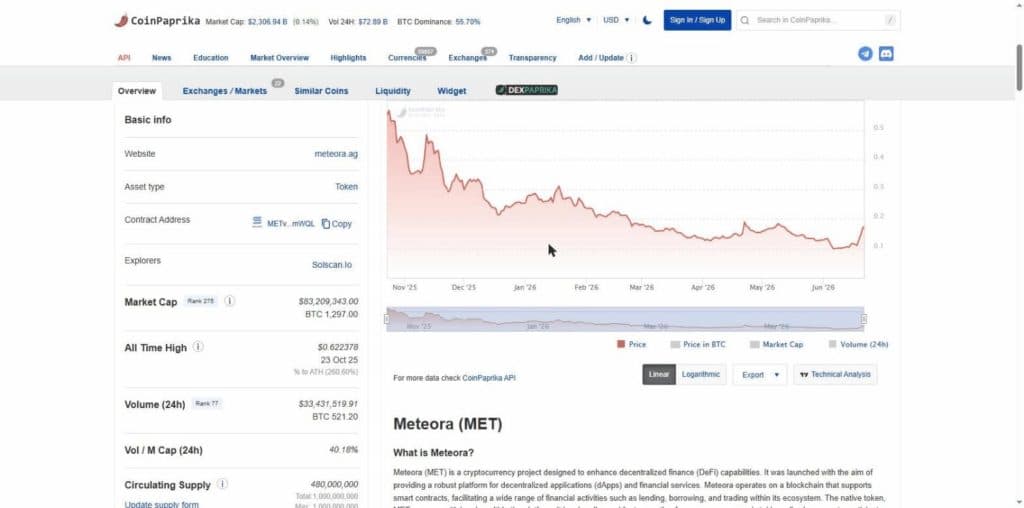
Source: CoinPaprika — captured June 21, 2026
MET Tokenomics: The $11 Million Supply Mystery
Three Sources, Three Numbers
Here’s a fact that should give any researcher pause: three reputable data aggregators report three different circulating supply figures for MET.
| CoinPaprika | 480 million circulating |
| Messari | 524.1 million circulating |
| CryptoRank | 546.06 million circulating |
| Gap | 66 million tokens (≈$11.4 million) |
The 66-million-token gap between the lowest and highest estimate is worth approximately $11.4 million at current prices. This likely reflects different methodologies for counting tokens in vesting contracts, buyback wallets, and protocol-controlled addresses. But for a token with a $90 million market cap, an 11% disagreement on basic supply data is a transparency red flag.
Vesting Schedule & Upcoming Unlock
MET follows a six-year linear vesting schedule. Current allocation:
| Ecosystem Reserve | 34% of supply (30.7% still locked) |
| Team Allocation | 18% of supply (16.3% still locked) |
| Mcap/FDV Ratio | 53.2% — nearly half the supply remains locked |
| IEO Price | $1.16 on BitMart (raised only $42,020) |
| Current ROI from IEO | -85.1% |
CATALYST ALERT: June 23, 2026 — 7.22 million MET ($1.25 million) unlock. This arrives 48 hours after a 67% weekly rally. Historically, tokens that surge into unlock events often retrace.
CryptoRank token sale data, vesting schedule, and unlock timeline
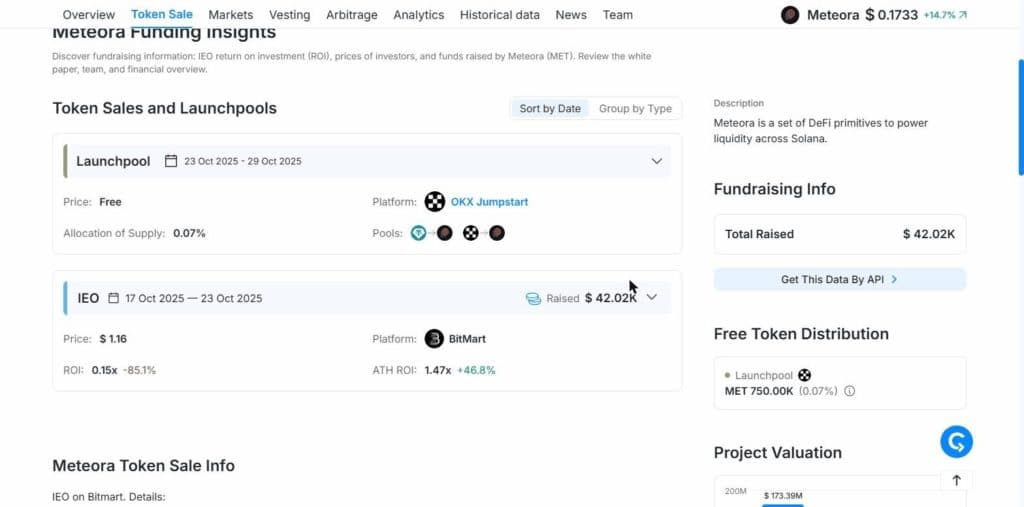
Source: CryptoRank — captured June 21, 2026
Meteora TVL and Protocol Revenue: The Bull Case in Numbers
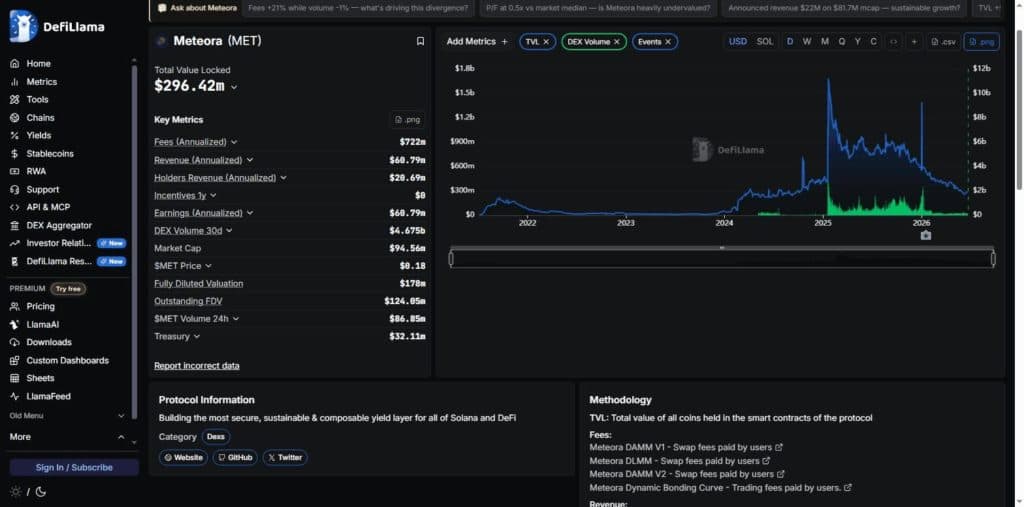
Strip away the token and look at the protocol as a business. The numbers tell a compelling story:
| Total Value Locked | $296.42 million |
| Annualized Fees | $722 million |
| Protocol Revenue | $60.79 million |
| 30-Day DEX Volume | $4.675 billion |
| Treasury Holdings | $32.11 million |
| Price/Revenue Ratio | ≈1.5x (vs. 15–20x for Uniswap) |
That last line is the one that stops you. A price-to-revenue ratio of 1.5x means the market values Meteora’s token at just 1.5 times the protocol’s annual revenue. For comparison, Uniswap’s UNI trades at roughly 15–20x revenue. Either Meteora is drastically undervalued by traditional DeFi metrics, or the market is pricing in structural risks — concentration, unlock dilution, regulatory exposure — that the revenue alone doesn’t capture.
Fee generation stands out. $722 million in annualized fees on $296 million TVL means the protocol turns over its locked capital more than twice per year in fees. That capital efficiency outpaces most top-30 DeFi protocols.
The $32 million treasury provides multi-year runway without needing to sell tokens, and the on-chain Buyback Wallet (visible in the Solscan data, holding $5.4 million in MET) shows the team actively managing token supply.
DeFiLlama protocol overview — TVL, fees, revenue, and product breakdown
Source: DeFiLlama — captured June 21, 2026
Developer Activity: Is the Meteora Team Still Building?
Yes. Actively.
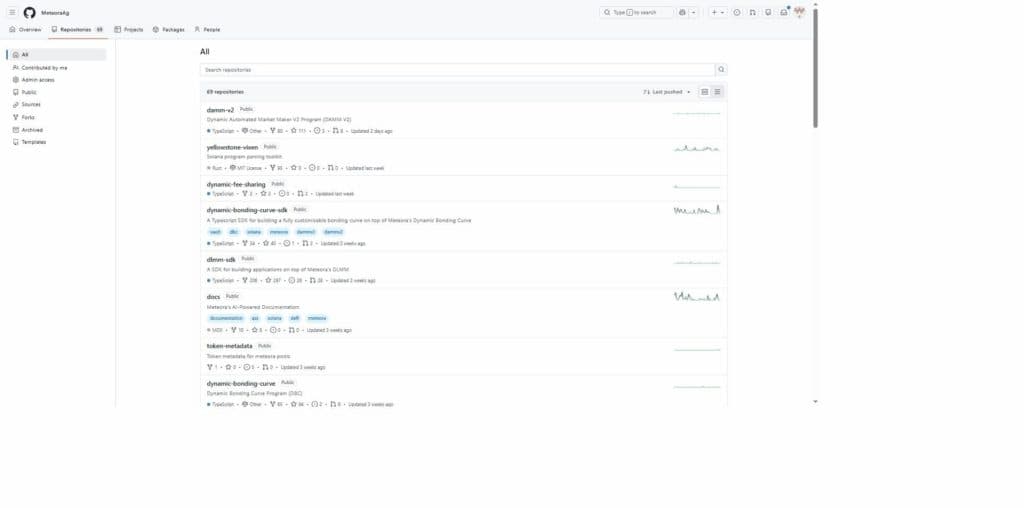
Meteora’s GitHub organization (MeteoraAg) is verified with 326 followers and 69 public repositories. The codebase spans four languages — TypeScript, Rust, Go, and JavaScript — a multi-language stack that signals engineering depth rather than a single-developer operation.
Key Repositories
| damm-v2 | Core DAMM V2 program — 111 stars, updated 2 days ago |
| dlmm-sdk | DLMM SDK — 297 stars, 206 forks, updated 2 weeks ago |
| dynamic-bonding-curve | DBC program — 94 stars, 65 forks |
| dynamic-bonding-curve-sdk | DBC TypeScript SDK — 40 stars, updated 2 weeks ago |
| docs | AI-powered documentation — MDX-based, updated 3 weeks ago |
The dlmm-sdk at 297 stars and 206 forks indicates genuine developer adoption — other projects are building on Meteora’s infrastructure. The damm-v2 repo updated within 48 hours of this report confirms ongoing core development.
One notable detail: the GitHub organization shows “no public members.” Every contributor’s profile is hidden. For a protocol managing $296 million, the team chooses anonymity at the code level. Common in DeFi, but worth flagging for due diligence.
Developer Activity Rating: HIGH — Multi-repo, multi-language, frequent commits, active community forks.
GitHub organization page showing 69 repositories sorted by recent activity
Source: GitHub (MeteoraAg) — captured June 21, 2026
Where Does Meteora Rank Among Solana DEXes?
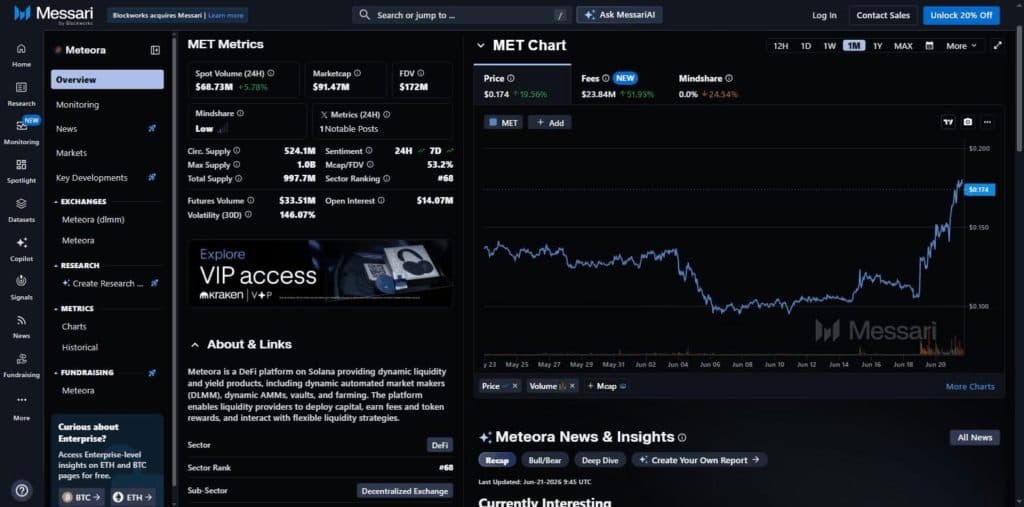
Messari provides the competitive context. Meteora ranks #68 in the overall DeFi sector and #16 among decentralized exchanges specifically. That places it in the upper tier of DEXes globally, though well below the household names.
| DeFi Sector Rank | #68 |
| DEX Sub-Sector Rank | #16 |
| Futures Volume (24h) | $33.51 million |
| Open Interest | $14.07 million |
| 30-Day Volatility | 146.07% |
| Mindshare | Low (1 notable X post in 24h) |
| Mcap/FDV | 53.2% |
The derivatives data reveals an underappreciated dimension. $33.51 million in futures volume and $14.07 million in open interest mean traders are actively betting on MET’s direction with leverage. When a 146%-volatility token has significant leveraged positioning, liquidation cascades become a real risk in either direction.
Messari’s “Mindshare: Low” rating is perhaps the most intriguing data point. Despite ranking #16 among all DEXes and generating fees that rival top-10 protocols, almost nobody is talking about Meteora on social media. This creates a potential asymmetry: if narrative attention catches up to fundamentals, the re-rating could be sharp.
Messari fundamental overview — metrics, sector ranking, and market data
Source: Messari — captured June 21, 2026
On-Chain Analysis: Who Holds MET Tokens?
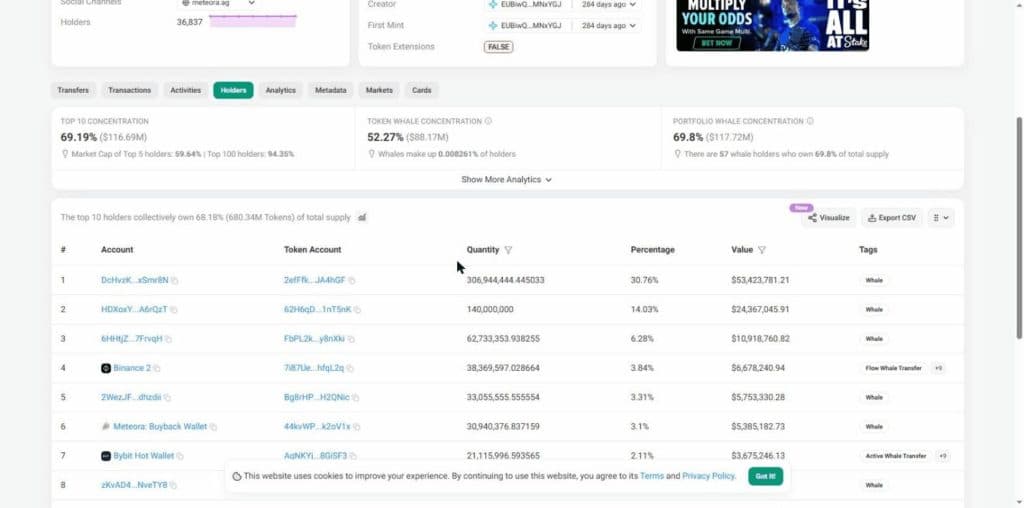
The on-chain distribution paints a picture of extreme concentration. Solscan data reveals:
| Total Holders | 36,837 |
| Top 10 Concentration | 69.19% ($116.69M) |
| Top 100 Concentration | 94.35% |
| Whale Holders (57 wallets) | Own 69.8% of total supply |
| #1 Wallet | 30.76% — 306.9M tokens ($53.4M) |
| #2 Wallet | 14.03% — 140M tokens ($24.4M) |
Two wallets control nearly 45% of the entire MET supply. The #2 wallet holds exactly 140,000,000 tokens — a round number that strongly suggests this is a team or ecosystem-controlled address rather than an organic accumulator.
Notable Wallet Activity
Exchange presence confirms genuine market access: Binance 2 holds 3.84% of supply (#4 overall), Bybit Hot Wallet holds 2.11% (#7). The Meteora Buyback Wallet at #6 with 30.9 million tokens ($5.4 million) is actively accumulating, and the Meteora Pool Authority at #9 manages protocol liquidity.
Transfer velocity is high. Transactions flow through Binance, OKX Router, and Titan Exchange every few seconds, with more than 1 million total transfers recorded since launch. The token minted 284 days ago, making it roughly 9.5 months old.
Solscan holder analysis — whale concentration and top wallet breakdown
Source: Solscan — captured June 21, 2026
Risk Factors: What Could Go Wrong
1. Whale Concentration
Two wallets holding 45% of supply creates single-entity sell pressure risk. If either wallet begins distributing, the impact on a $90M market cap token would be severe. The top-100 concentration of 94.35% means retail holders collectively own less than 6% of all tokens.
2. Token Unlock Pressure
With 47% of supply still locked across a 6-year vesting schedule, MET faces persistent dilution. The June 23 unlock is modest at 1.3% of circulating supply, but the cumulative effect of monthly unlocks on a token already down 85% from IEO price creates structural headwinds.
3. Supply Transparency
When three major aggregators can’t agree on circulating supply within an 11% margin, it signals insufficient transparency from the project regarding which wallets count as “circulating” vs. “locked.” This makes fundamental valuation unreliable.
4. Anonymous Team
A protocol managing $296 million in user deposits with zero publicly identified team members is not unusual in DeFi, but it limits accountability. Messari coverage and major exchange listings provide partial mitigation.
The Bottom Line: Is Meteora (MET) Undervalued or a Value Trap?
A protocol generating $722 million in annualized fees trading at a 1.5x price-to-revenue ratio is either the best-kept secret in DeFi or a token with structural problems the revenue number alone can’t fix.
The bull case writes itself: Meteora is a revenue machine with active development, strong TVL, and low market attention. If narrative catches up to fundamentals, the re-rating could be significant.
The bear case is equally clear: extreme whale concentration, persistent unlock dilution, opaque supply data, and an anonymous team managing hundreds of millions in user funds. The 85% decline from IEO price exists for reasons that strong fee revenue hasn’t reversed.
What’s not debatable is that Meteora merits attention. A Solana DEX ranking #16 globally, generating fees that rival protocols 10x its market cap, with 69 active GitHub repositories and a development team that shipped code within the last 48 hours — this is not a dead project trading on legacy hype. Whether the token captures that value is the open question.
Watch the June 23 unlock. Watch the whale wallets. And watch whether the mindshare gap starts to close.