A governance token for a decentralized reinsurance marketplace hit $1.04 on June 20, two days after going live on Binance. The RE token from Re Protocol opened at $0.40 on June 18 and hasn’t looked back.
That 160% climb in 48 hours.
Trading volume on the first two days crossed $200 million daily, according to data from CryptoRank. By June 20, 24-hour volume sat at $638 million with a market cap of $162.69 million and a fully diluted valuation of $1.01 billion. The token launched at an IEO price of $0.05 on June 17, making the current return on that initial sale roughly 1,939%.
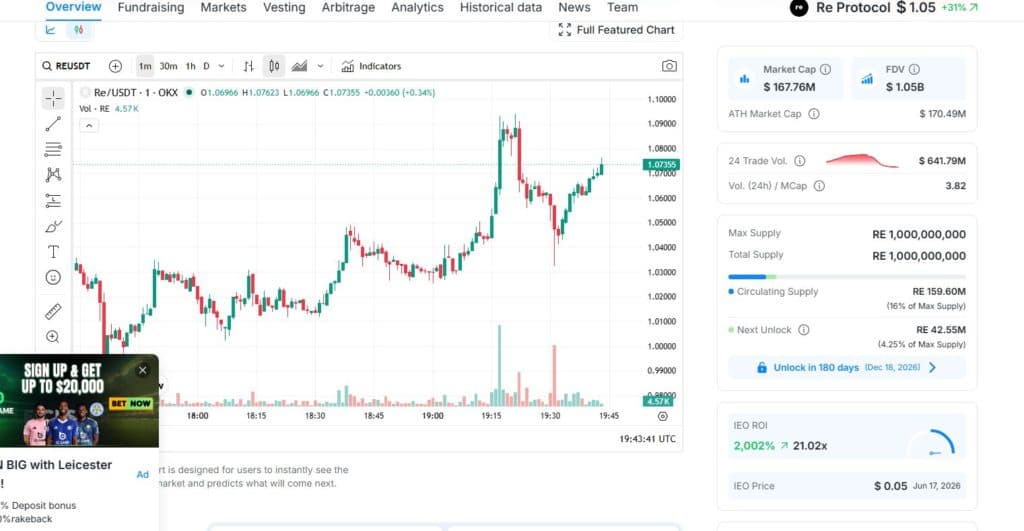
CryptoRank – RE Protocol market overview showing price, market cap, volume, and supply data. Captured June 20, 2026, 7:11 PM UTC.
Reinsurance Meets the Blockchain
Re Protocol does not fit the typical crypto launch template. Founded by Karn Saroya, who previously co-founded Cover, a Y Combinator-backed insurtech company, the project had a running business before it ever minted a token. Its reinsurance arm, Cover Re, works with more than 30 insurance partners and has written $409 million in premiums since inception, according to the Bitcoin Foundation’s analysis.
The protocol channels stablecoin capital into fully collateralized reinsurance contracts through licensed carriers. Users deposit USDC or USDe into what the project calls Insurance Capital Layers. Those deposits back real insurance policies covering homeowners, auto, and workers’ compensation in the United States. Premium income flows back to depositors as yield.
A $1 trillion global reinsurance market sits behind this. Most of it locked away from retail investors entirely.
On DeFiLlama, the protocol’s total value locked reads $272.08 million as of June 20. That figure includes on-chain deposits, off-chain capital through regulated trust structures, and premium receivables. Annualized fees stand at $6.67 million. The average APY across its two tracked pools comes to 9.51%.
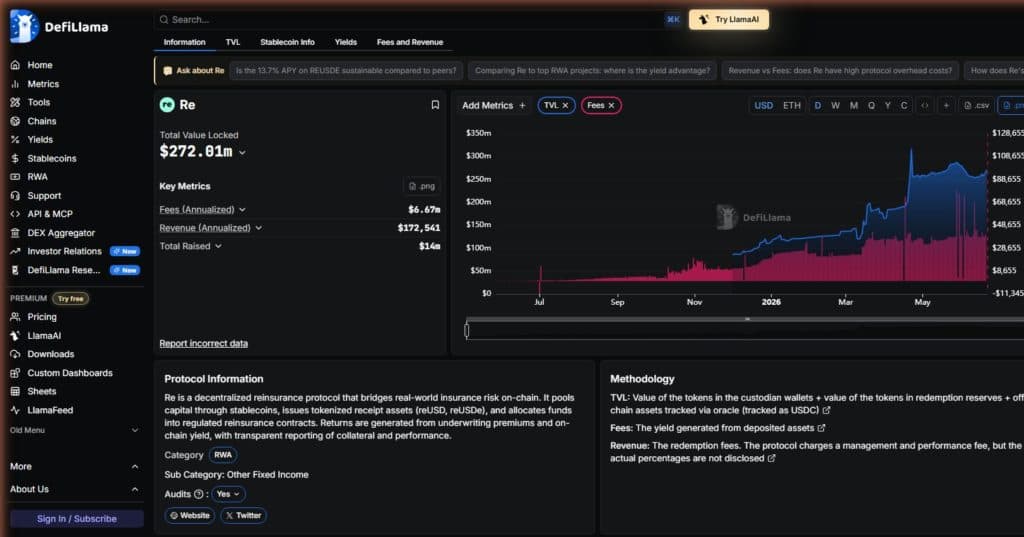
DeFiLlama – Re Protocol TVL chart showing growth from under $50M to over $272M. Captured June 20, 2026, 7:15 PM UTC.
An earlier Our Crypto Talk analysis from June 8 pegged the total at $465.69 million when off-chain capital and receivables were included separately. The DeFiLlama chart shows a sharp climb starting around March 2026, with TVL more than tripling from roughly $50 million to current levels.
$21 Million and Five Exchanges
Institutional backers lined up early. As TokenHunter posted on X:
> RE INVESTORS | RAISED: $21M. Institutional capital continues flowing into @re as the project secures $21M in funding from some of the biggest names in crypto investing. Investors: Electric Capital, Tribe Capital, Stratos, Framework Ventures, Morgan Creek Capital
Coinbase Ventures also took a strategic position, according to Reinsurance News. The IEO price was $0.05 per token on June 17, putting the launch ROI at 20.39x based on the current $1.03 price on CryptoRank.
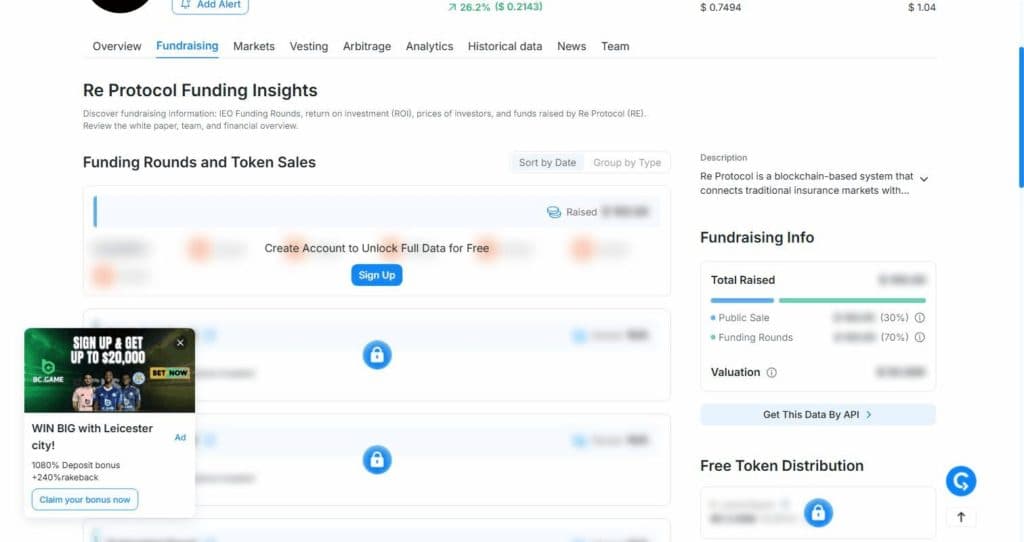
CryptoRank – RE Protocol fundraising data showing IEO price, ROI, and funding rounds. Captured June 20, 2026, 7:14 PM UTC.
Exchange coverage came fast. RE traded on Binance Alpha, KuCoin (which touted its world premiere listing), Coinbase, OKX Boost, and MEXC all within 24 hours of each other on June 18. Robinhood Crypto added RE the same day. Bybit followed. Binance applied a Seed Tag, marking it as an early-stage asset with higher volatility risk.
Only 159.6 million tokens circulate out of a maximum supply of 1 billion. That 16% float.
The Unlock Clock Starts Ticking
The next token unlock drops 42.55 million RE tokens, roughly 4.25% of the max supply, on December 18, 2026. CryptoRank data shows this 180-day cliff. Team and investor allocations sit under vesting schedules, though the project has not published full emission timelines. The Resilience Foundation’s announcement on X confirmed 95% of Season 1 participants are fully vested at TGE.
Season 2 rewards will allocate at least 3.5% of total supply to qualifying participants. With 84% of tokens still locked, future unlocks represent the single largest supply-side risk for holders watching the price. Every unlock event in crypto history has the potential to add sell pressure, and RE is no different.
A Nigerian retail trader holding altcoins on Binance who stumbled onto the RE listing might see the 20x IEO return and feel late. The vesting schedule suggests otherwise. Most of the supply has not entered the market.
Ghost Repositories and Missing Code
The Re Protocol GitHub organization tells a different story from the exchange hype. Three repositories. All forks. Zero original code.
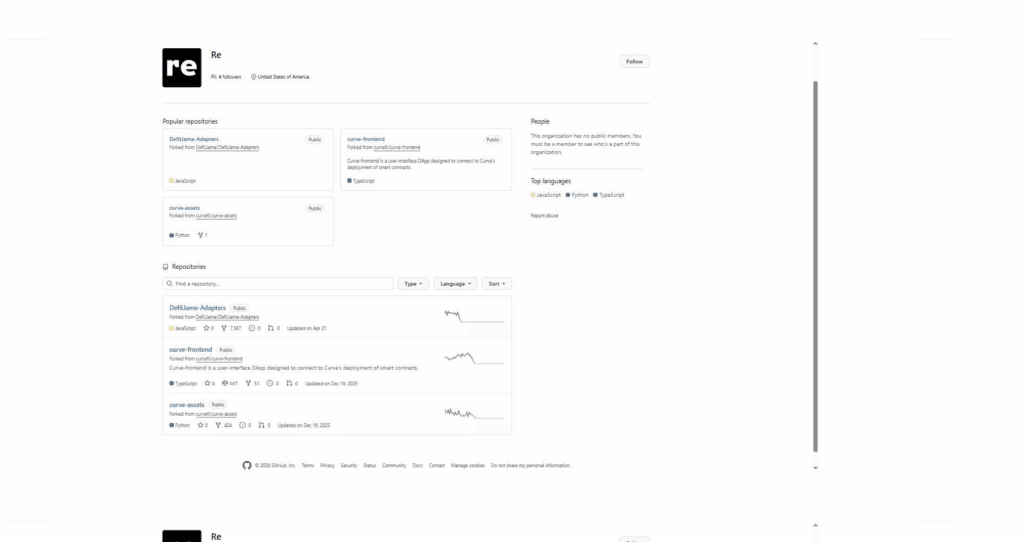
GitHub – Re Protocol organization showing 3 forked repositories with minimal activity. Captured June 20, 2026, 7:16 PM UTC.
DefiLlama-Adapters, a standard fork for listing on the TVL tracker, was updated April 21. The other two forks, curve-frontend and curve-assets, last saw commits in December 2025. No public members are visible. Four followers total. No original smart contract code, no protocol repositories, no audit reports posted to GitHub.
Developer activity assessment: LOW.
That does not automatically mean the project lacks development. Many crypto projects keep their core repositories private, especially those handling insurance-grade financial infrastructure. The protocol does claim audits exist, and DeFiLlama’s listing shows “Audits: Yes.” But the absence of any public codebase for a protocol managing $272 million in TVL is worth noting.
Chainlink Oracles and Layered Risk
The protocol’s architecture separates risk into tranches. reUSD functions as the senior tranche, targeting lower-risk yield with greater liquidity. reUSDe acts as the junior tranche, absorbing more risk for higher potential returns. If insurance losses occur, the reinsurer’s own equity takes the first hit. Then reUSDe. Then reUSD.
Daily price updates come through Chainlink oracles at UTC 00:00. Yield calculations blend the Secured Overnight Financing Rate for off-chain capital with 7-day trailing basis trade rates for on-chain portions. The whitepaper details multi-signature wallet controls over oracle configurations, redemptions, and asset management.
Re deployed on Ethereum, with DeFiLlama tracking it on X noting the protocol also runs on Avalanche, Base, and Arbitrum. The contract address is 0x526526528f35ac738177003b8773b402b8df8143 on Ethereum mainnet.
Who Covers the Covers
Re sits in an unusual competitive space. On the crypto side, Nexus Mutual handles smart contract insurance. On the traditional side, Swiss Re and Lloyd’s dominate with trillion-dollar books. Re wedges itself between them, offering on-chain capital providers access to regulated U.S. reinsurance treaties.
> How to become a solid crypto project: @re. Real yield via insurance. Community engagement. Raise $21M. The team didn’t build a role system. TGE without insider trading. $640M FDV on bear market. 5-to-6 fig user rewards. Becoming a quality product is easy
Not everyone agrees the execution matches the pitch. The all-time low of $0.407 on June 18 came hours after launch, a 35% crash from early trading levels before the recovery began. Thin initial liquidity on some pairs likely amplified that drop. CoinGecko showed just $16 in liquidity at one point on the Ethereum DEX pool, though centralized exchange depth was far deeper.

Google News – Search results for RE Protocol crypto. BeInCrypto published a price prediction; limited mainstream coverage found. Captured June 20, 2026, 7:17 PM UTC.
Three Risks That Could Break the Rally
Risk one: token unlock dilution. Only 16% of the total supply circulates. The December 2026 unlock adds another 4.25%, and subsequent unlocks could flood the market. Any project where 84% of tokens remain locked demands close monitoring of the release schedule.
Risk two: insurance market exposure. Traditional reinsurance carries its own risks, including catastrophic loss events, regulatory changes, and claims that exceed reserves. If a major hurricane season hits and Re’s treaties take losses, on-chain depositors could see their capital impaired. The layered tranche structure provides some protection, but the protocol’s relative youth means it has not been tested through a significant loss event.
Risk three: no public codebase. For a protocol controlling hundreds of millions in capital and deploying it into real-world contracts, the lack of open source code raises questions about independent verification. The project claims audits, but no public audit report links appear on GitHub. Messari’s profile for Re Protocol shows no token data at all.
Risk four: regulatory uncertainty. Re operates at the intersection of DeFi and licensed insurance, a space without clear global regulatory frameworks. Changes in U.S. insurance regulation or crypto policy could affect the protocol’s ability to maintain its partnerships with licensed carriers.