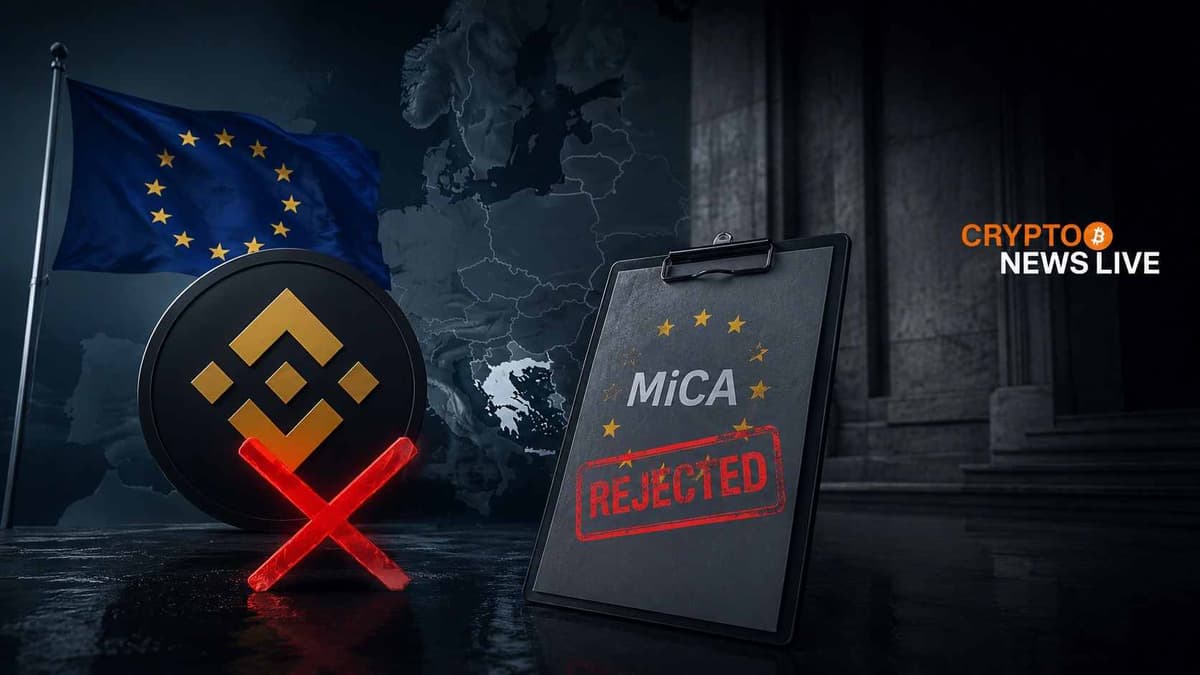
Binance MiCA licence rejection is coming. That is what two people familiar with the matter told Reuters on June 16. Greece’s Hellenic Capital Market Commission is set to turn down the world’s largest crypto exchange, potentially cutting off services to EU clients from July 1, 2026.
Three hundred million users worldwide. And the exchange may not have a single valid licence to operate inside the 27-nation bloc in two weeks.
The Greece Gamble That May Cost Everything
When Binance co-CEO Richard Teng publicly backed Greece as the exchange’s regulatory home in February, the logic seemed defensible. Greece’s workforce and security profile, he said, gave it an edge over larger financial centres. The exchange filed formally with the Hellenic Capital Market Commission in January 2026 through its Greek subsidiary, Binary Greece.
What Teng did not say publicly was that Germany had already issued over 45 MiCA licences by early 2026, and the Netherlands had cleared 22 more. Greece had granted zero. Binance skipped every jurisdiction where the process had proven functional and placed its entire European future in the hands of a regulator that had not approved a single application.
That choice now sits at the centre of the crisis.
Under the EU’s Markets in Crypto-Assets regulation, crypto firms must secure national authorisation to receive passporting rights across all 27 member states. One licence, one gateway. The transition period ends June 30. From July 1, any unlicensed platform risks enforcement, fines, or a full service halt.
What Binance Is Saying Right Now
The exchange pushed back hard on the Reuters report. A Binance spokesperson said the company spent 18 months working with regulators and believes it met every MiCA requirement. Their understanding, the spokesperson added, was that HCMC had completed its review and considered the application compliant.
“HCMC has given no formal indication of the contrary,” the spokesperson told Reuters.
As Richard Teng posted on X, the exchange remains committed to Europe and is still pushing for a path forward under MiCA:
“We are dedicated to securing our MiCA licence and remain ready to operate under a fair, predictable, and genuinely harmonised European framework. We will continue to keep users updated as we make progress.” (Richard Teng on X)
The HCMC declined to confirm or deny the rejection, citing confidentiality rules.
Users in the Middle, Deadline Closing In
For retail Binance users holding funds on the platform across France, Germany, Spain, and other EU states, the situation is immediate. The exchange has not yet specified what happens to accounts, pending trades, or withdrawals if the licence is formally denied before June 30.
As Binance posted on X, the focus right now is on minimising disruption:
“With the MiCA transition period ending, we are taking a prudent approach that puts customers first and gives users sufficient time and clarity. Our priority is to minimise disruption and keep users informed.” (Binance on X)
A further update before June 30 was promised. No specifics were given.
Binance also pushed back on the broader regulatory picture. As the official Binance account posted on X, the consequences extend well past one exchange:
“Any delay or distortion in the MiCA authorisation process risks reducing liquidity, weakening competition and user choice, and pushing activity outside the EU.” (Binance on X)
Bitcoin open interest across EU-facing exchanges climbed to $18.4 billion on June 13, per Coinglass data, a 12% rise from the prior week. A forced Binance exit from Europe would reshape where that volume lands.
The Compliance Clock
MiCA was built to do one thing: bring regulatory clarity to an industry that had largely operated outside national oversight. The framework that was meant to welcome exchanges into a unified European market may now be what removes the largest one.
Licensed competitors including Coinbase and Kraken already hold valid EU authorisations. Any Binance EU exit shifts volume toward those platforms, at least in the short term.
Still, a formal rejection has not yet been published. The HCMC has not spoken publicly. Binance says it is still working toward a resolution. The window before June 30 is narrow, but it has not closed.
An internal Binance source told Reuters the company intends to “support an orderly process and minimise disruption” to users, without providing specifics on what that process looks like if the licence is denied.
The question for EU-based retail traders watching this unfold is no longer whether Binance meets MiCA standards. It is whether the answer comes before the deadline does.