Charles Hoskinson dropped four videos in under 24 hours. By the time the last one landed, Cardano’s governance conversation had fractured along lines that won’t close quietly.
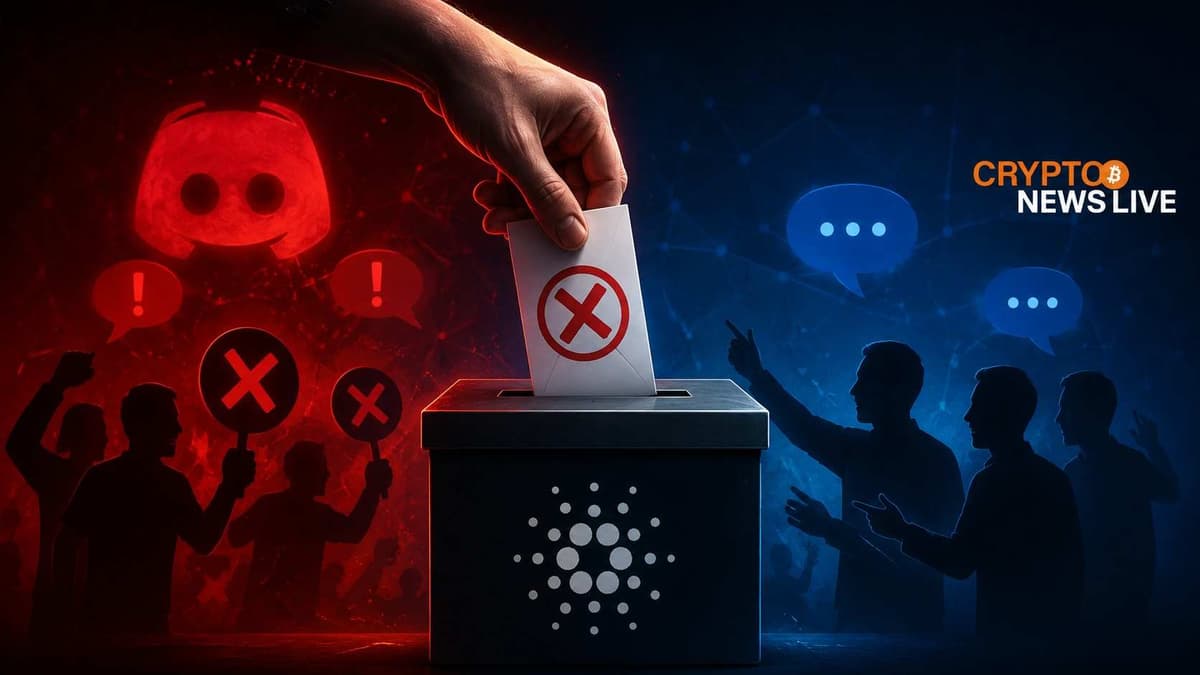
The core of what he proposed is this: a moderated, purpose-built Cardano governance Discord where ADA holders converge on growth definitions, constitutional updates, and treasury strategy. Anyone who refuses to join, and refuses to participate, faces an automatic NO vote on any funding proposal they submit, backed by a political party DRep Hoskinson says he intends to build into the ecosystem’s largest.
When “Join or Lose Funding” Becomes the Headline
YUTA, a Cardano community analyst posting on X, summarized the proposal across the three initial IOG Discord videos before Hoskinson’s fourth dropped.
“If you don’t join this Discord, you’ll be subject to an automatic NO vote by the DReps party, including Charles DRep. They aim to become the largest DRep and lead the ecosystem.”
YUTA added that the Discord could effectively become a requirement for treasury access, making participation something closer to a prerequisite than an option.
That reading triggered immediate pushback. Dave, posting on X as @ItsDave_ADA, called it disappointing and said the proposal ran against what most ADA holders understood governance to mean when they signed on.
The DRep community was sharper. Cerkoryn, a DRep posting on X as @Cerkoryn, pushed back directly, writing that centralizing governance discussions into a single Discord moves backwards, and that weaponizing voting power against non-members arguably violates a constitutional tenet.
The Argument Hoskinson Is Actually Making
His fourth video, broadcast from Colorado, was less an announcement and more a diagnosis. Hoskinson argued the ecosystem has no shared definition of growth. No KPIs. No unified strategy.
“You cannot develop a strategy or build a governance structure if you have no baseline definition of what you’re trying to achieve.”
He pointed to over 600 million ADA in treasury asks stacked against a 350 million ADA net cardano limit, with no coordinating logic behind them. That gap, he said, is what the Discord is designed to close — not by dictating answers, but by creating a structured space where answers can be reached.
He drew a direct comparison to Intersect, the governance organization that spent more than two years trying to do what he now wants the Discord to do. It didn’t work, he said, because Intersect became too many things at once. The Discord is meant to be one thing only: a place to define growth, then design government, then produce a budget.
The NO-vote mechanism, in his framing, is not a power move. It is a commitment test.
“Are you here to make Cardano better? Are you here to grow Cardano? Or are you just here to grandstand on Twitter?”
Bons, ADA North Pool, and the Censorship Question
Justin Bons, founder of Cyber Capital and a regular Cardano commentator on X, called the proposal dangerous.
“Attempting to centralize discussion in a place where discussion can be censored is dangerous. That is what led to BTC’s downfall, censoring Bitcointalk allowed them to control the narrative.”
ADA North Pool, posting as @adanorthpool on X, asked for clarification with a timestamp request, noting they hadn’t yet had time to review all three videos.
“Can someone confirm this is correct preferably with a timestamp?”
The question itself signals how fast the debate moved. Within hours of YUTA’s summary, the reply threads had drawn in DReps, builders, and critics who hadn’t yet watched the source material.
Hoskinson addressed the censorship reading in his fourth video. The code of conduct, he said, bans only behavior that derails the specific purpose of each session. Anyone trying to litigate past grievances or attack other members gets removed. Those who want to discuss the agenda item stay.
What Comes Next
Hoskinson committed to hiring staff, working with partners, and opening a closed beta before broadening access. The political party and DRep structure launch alongside that beta. His stated sequence: define growth, add it to the constitutional preamble, design an executive function, then push for a constitutional amendment ratified by an on-chain vote.
Every step, he said, requires consent of the governed. No part of the process moves forward without a community vote behind it.
Still, the risk is real. If the DRep bloc grows large enough to block funding unilaterally, proposals from builders who never joined the Discord face a structural disadvantage regardless of their merit. Cerkoryn’s constitutional concern sits on exactly that fault line.
Hoskinson’s counterpoint is blunt: governance without commitment produces nothing. Two years of decentralized chaos, developer exits, falling TVL, and project closures made that case for him.
The Discord hasn’t launched. The party doesn’t exist yet. But the conversation it triggered is already one of the sharpest governance splits the Cardano ecosystem has produced since CIP-1694.