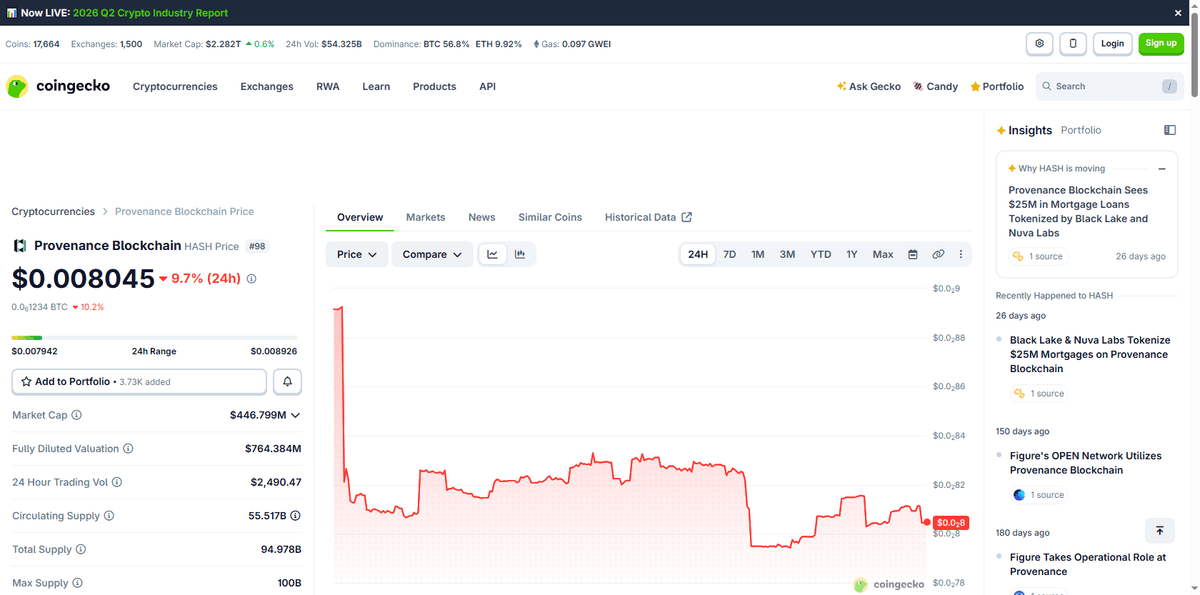
Provenance Blockchain markets itself as infrastructure real financial institutions can build on. On July 20, HASH, its native token, fell 9.7% while the two venues where it trades moved a combined $2,490 all day.
That is not a typo. CoinGecko splits the number two ways: $2,115 on Figure Markets, a centralized exchange, and $766 on Osmosis, a decentralized pool. Add them and you get less than what plenty of single retail trades move on a normal token in an afternoon. Provenance is not a normal token by market cap. It sits around $447 million.
A Drop With No Trade Behind It
The move did not happen in one clean candle. Hourly price data pulled from CoinGecko’s own API shows HASH slipping 6.76% between noon and 1pm UTC on July 19, steadying for most of a day, then losing another 3.73% between 5am and 6am UTC on July 20. Nothing dramatic in either window on its own. Stacked together, they account for most of the week’s decline.
What makes it strange is the volume moved the opposite direction. The rolling 24-hour figure sat near $6,600 on the morning of July 19. By the following morning it had fallen to roughly $3,400, and CoinMarketCap’s separate tracker put the drop at 76% over that stretch, independently. Price kept sliding while fewer dollars were even bothering to trade it. That is close to the textbook definition of a market with no real floor underneath it, thin enough that a handful of sells can walk the price down with nobody stepping in to absorb them.
Zoom out to three months and the pattern was already there. The chart is a mess of spikes and air pockets, price whipping several percent within single hours, down 27.3% over the period despite no shortage of news. That kind of noise is what happens when an asset’s daily volume rounds to a number a small business would consider a slow Tuesday.

No Announcement, No Hack, No Delisting
Checked and came up empty: CoinGecko’s own “Why HASH is moving” panel, which tracks news events tied to price action for the coin, has nothing newer than 26 days old. A search for Provenance or HASH news from the past day turned up nothing about an exchange delisting, an exploit, or a regulatory action. DeFiLlama shows no hack entry for the chain. None of the usual triggers apply here.
What did turn up was almost the opposite story. HASH jumped 16.54% on July 14, according to Pluang’s markets desk. It jumped again, 12.53%, the day before this drop, according to Trustnodes, pushing the market cap briefly to $490 million. Four days before that, Copper, an institutional crypto custodian, added support for HASH and Provenance’s YLDS stablecoin for its Swiss entity clients, per Crowdfund Insider, a real piece of adoption news with nothing bearish attached to it. None of it held. A token that can rip 12% one day on a few thousand dollars of volume can fall just as hard the next day on even less, and neither move says much about what the project is actually worth. It’s a pattern CryptoNewsLive has flagged before in other thin-liquidity tokens, where the size of the daily move says more about the empty order book than about the news of the day.
The Chain Underneath Is Not Struggling
Here’s the part that does not fit the usual thin-liquidity story. Provenance the blockchain, as opposed to HASH the token, looks like it’s having a good year. DefiLlama puts total value locked on the chain at $1.526 billion, up from roughly $300 million last November, close to a five-fold climb in eight months. Bridged TVL runs higher still, $2.536 billion. Stablecoin supply native to the chain sits at $119 million, and total capital raised across the ecosystem is logged at $45.2 million.
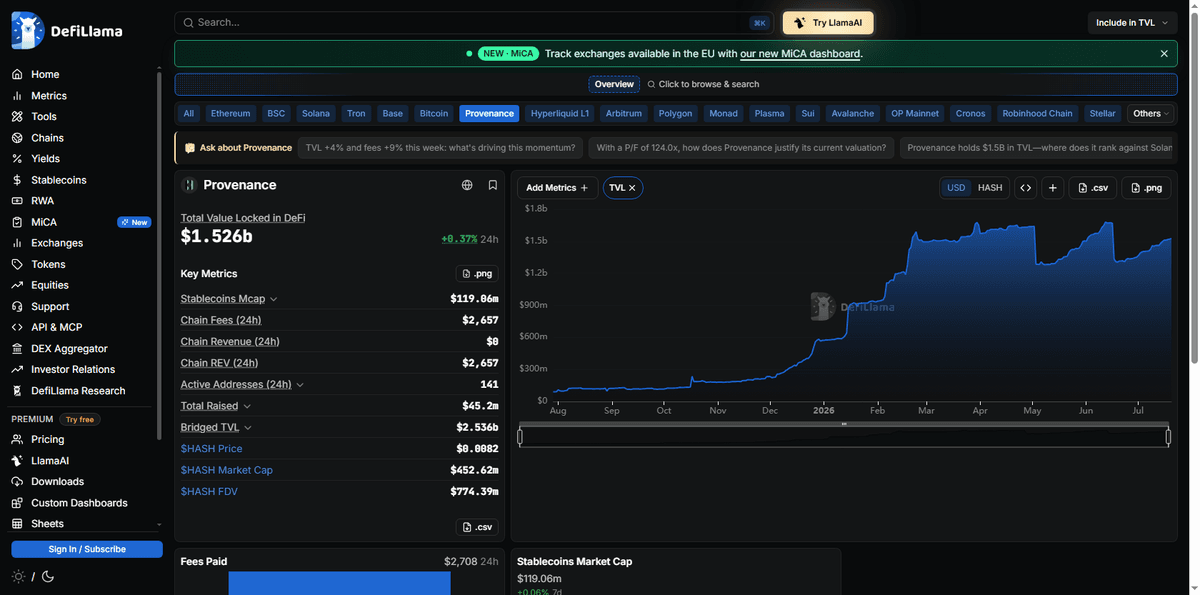
Chain fees over 24 hours came to $2,657, almost the identical figure to the token’s own daily trading volume, an odd coincidence worth noting rather than reading too much into. Revenue captured by the protocol itself, by contrast, showed as $0, with the fee total instead flowing through as validator reward, or REV, in DefiLlama’s terminology. Active addresses over the same 24 hours numbered 141. A chain built for institutions, carrying nine-figure sums in tokenized mortgages and lending products, was touched directly by fewer than 150 wallets that day, a gap in scale not unlike the one CryptoNewsLive found when DODO’s token price and its underlying business moved in opposite directions.
Two trackers cannot even agree on how much HASH exists. CoinGecko lists total supply at 94.978 billion against a 100 billion max. CoinMarketCap shows total and max supply as the same 100 billion, with circulating supply flagged as self-reported. Neither discrepancy is large enough to explain a 9.7% move by itself, but it underscores a token whose basic numbers are harder to pin down than they should be for something backing a billion-dollar chain.
None of the growth on the institutional side has shown up in how HASH trades. The gap between what Provenance is building and what its token does day to day, a token that like several others CryptoNewsLive has covered this month keeps testing fresh lows on almost no volume, is now wide enough that the two barely look related.