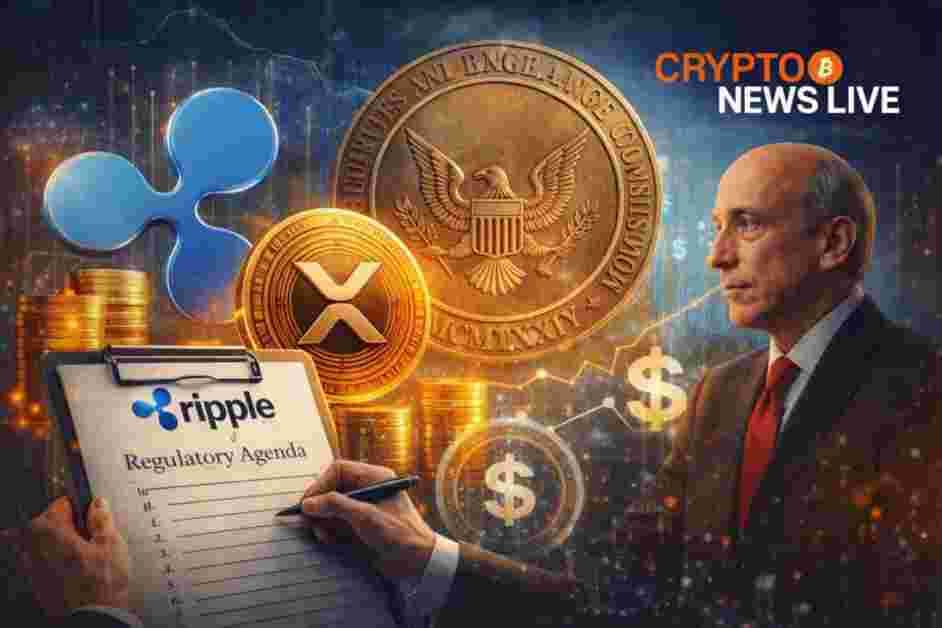
XRP stablecoin regulation SEC took a new turn on March 20, 2026. Ripple, its institutional arm Ripple Prime, and law firm Katten Muchin Rosenman LLP sat down with the SEC’s Crypto Task Force staff in Washington. The agenda: how crypto assets, payment stablecoins, and tokenized securities should be handled under existing broker-dealer rules.
The session came just three days after the SEC and CFTC jointly released guidance on March 17 that formally placed XRP in the digital commodity category. That move closed years of legal dispute between Ripple and the regulator. The company wasted no time. It walked straight from a courtroom victory into a policy negotiation.
As ChartNerdTA noted on X, the Crypto Task Force staff met with representatives from Ripple, Ripple Prime, and Katten Muchin Rosenman LLP, with the session covering approaches to addressing issues related to regulation of crypto assets, plus a focus on stablecoin rules.
Stablecoins as Cash, Not Securities
The heart of Ripple’s position sits on a simple argument. Payment stablecoins should be treated as cash substitutes rather than securities under broker-dealer regulations, the company told regulators. That distinction matters most in how firms calculate net capital. Under Rule 15c3-1, how an asset gets categorized directly affects how much haircut a firm takes against its balance sheet.
The SEC’s Division of Trading and Markets issued a February 19, 2026, FAQ on payment stablecoins under the net capital rule, allowing stablecoins to be held with a 2% haircut under certain conditions. Ripple acknowledged that guidance offered short-term clarity. But the company made clear it wants something broader, not a narrow carve-out for a single firm.
Ripple asked the SEC whether industry-wide guidance or firm-specific no-action relief is the preferred path forward, pushing for scalable regulatory frameworks. That question alone signals the shift in how Ripple now operates. It is no longer defending XRP in court. It is writing policy proposals for Wall Street.
Ripple Prime and a National Trust Bank in the Mix
Ripple Prime was formed after Ripple’s $1.25 billion acquisition of Hidden Road in 2025 and operates as the first crypto company-owned global, multi-asset prime broker, offering institutions clearing, prime brokerage, and financing across FX, digital assets, derivatives, swaps, and fixed income. That structure gave Ripple direct standing to engage the Task Force not as a token issuer, but as a registered financial intermediary.
In December 2025, Ripple received conditional approval for the Ripple National Trust Bank in Organization, a national entity purpose-built to manage stablecoin reserves under prudential supervision. That approval gave the stablecoin discussion a concrete institutional anchor. Ripple is not theorizing. It holds a pending charter.
The full SEC memo and Ripple’s March 20 submission are publicly available, confirming the meeting details and the agenda as filed.
Tokenized Securities Enter the Room
The stablecoin question was not the only item on the table. Ripple’s memo raises open questions around different forms of tokenization, including synthetic, custodial, and issuer-sponsored tokenized securities. The company’s position is that existing SEC rules should apply identically to tokenized instruments carrying the same economic and counterparty risk as traditional ones.
This is not Ripple’s first interaction with the SEC’s Crypto Task Force. Ripple Labs previously met with the Task Force on May 20, 2025, and submitted formal written input on January 9, 2026, advocating for a shift from subjective decentralization tests to a rights-based regulatory framework. The March 20 session builds directly on that prior work.
What changed this time is the legal ground beneath the conversation. Ripple’s Chief Legal Officer Stuart Alderoty stated the company always knew XRP was not a security and that the SEC has now confirmed what it is: a digital commodity. With that settled, Ripple’s focus inside that Task Force room was squarely on what comes next for the broader market.