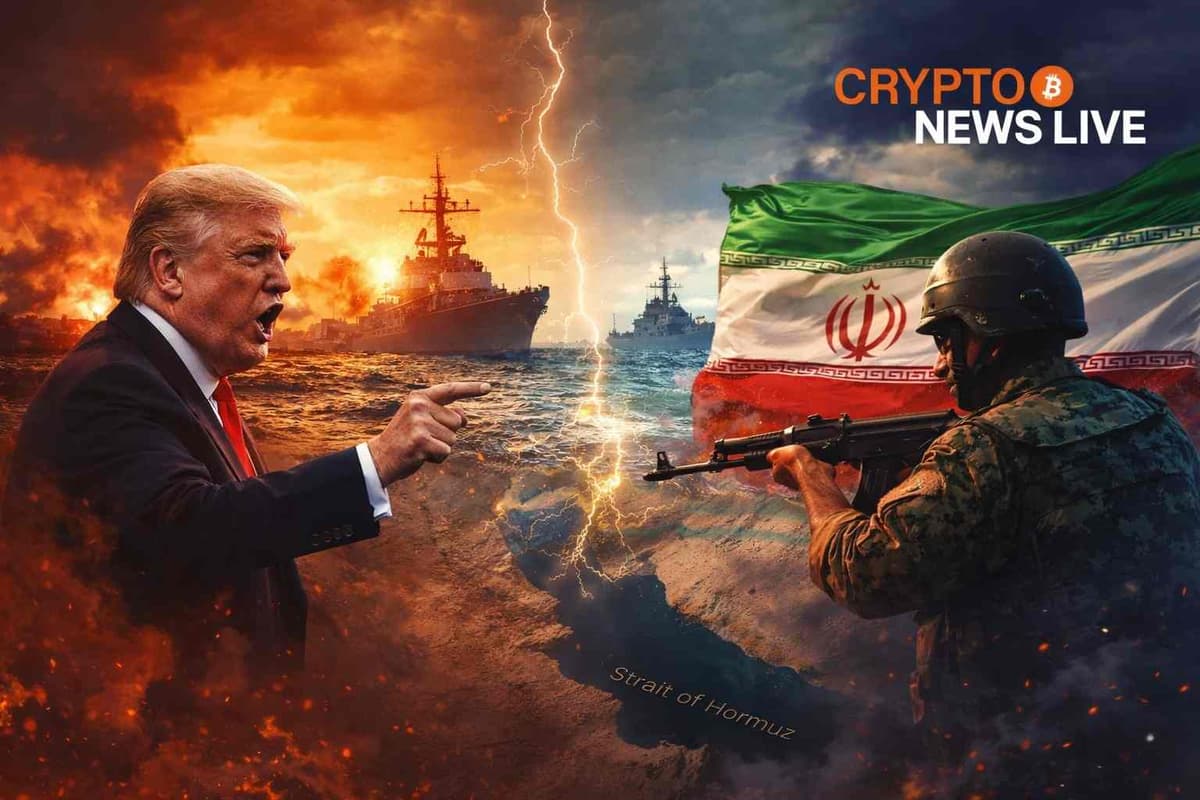
President Donald Trump issued a direct military threat to Iran on Sunday, demanding the Strait of Hormuz be opened unconditionally or face targeted U.S. strikes on Iranian power infrastructure. The ultimatum gave Tehran exactly 48 hours.
The statement from the White House on X was unambiguous. Trump stated the U.S. would “hit and obliterate” Iran’s power plants, starting with the largest, if the Strait was not fully open “without threat” within that window.
One Day, Four Different Positions
The ultimatum came after a day of rapid and conflicting signals. According to AshCrypto on X, Trump said Sunday afternoon he had no interest in a ceasefire with Iran. By that evening, he described himself as “winding down” the conflict. Then came a pivot toward “peace talks.” Hours later, the 48-hour strike threat landed.
That sequence compressed into a single news cycle. The Strait of Hormuz, a waterway handling roughly a fifth of global oil supply, sits at the center of the standoff.
Iran did not wait long to respond. The Islamic Revolutionary Guard Corps issued what it described as a final warning, saying any strike on Iranian infrastructure would trigger the destruction of “all energy, information technology, and water desalination infrastructure” belonging to the U.S. and Israel across the region. That warning came directly from the IRGC via IRTruePromise on X.
Tehran Draws Its Own Red Lines
The IRGC’s language was specific. Desalination plants, power grids, and IT infrastructure operated by American and Israeli interests in the region were all named as targets. It was not a vague posture. The statement framed it as the “last warning.”
Iran also signaled it would go after energy infrastructure if U.S. strikes hit Iranian power plants first, according to the account reported by AshCrypto on X. Both sides, in effect, threatened each other’s energy lifelines within hours of one another.
Trump’s original post, shared from the White House account on X, read in part: “If Iran doesn’t FULLY OPEN, WITHOUT THREAT, the Strait of Hormuz, within 48 HOURS from this exact point in time, the United States of America will hit and obliterate their various POWER PLANTS, STARTING WITH THE BIGGEST ONE FIRST.”
The Strait and What Hangs on It
The Strait of Hormuz has been a pressure point throughout the broader Iran-U.S. tensions. Iran has previously threatened to close the waterway as leverage. A closure, even a partial one, would send oil prices sharply higher and disrupt global supply chains.
Trump’s decision to tie military action directly to the Strait’s status is a shift from general deterrence language to a specific, time-bound condition. Whether that 48-hour window produces negotiation or escalation remained unclear as of publication.
The IRGC’s counter-threat, for its part, suggests Tehran is not stepping back. Any U.S. strike would draw a regional infrastructure response, the Guard warned, not just a strike-for-strike military exchange.