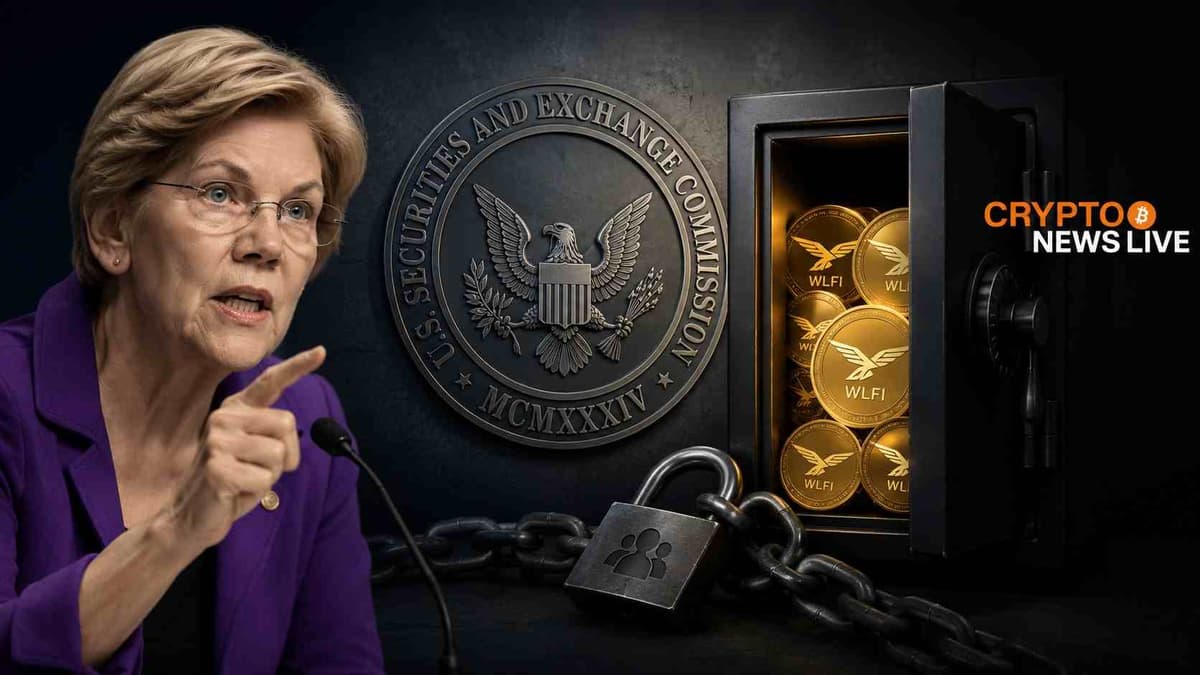
Senator Elizabeth Warren sent a formal letter to Paul Atkins, Chairman of the U.S. Securities and Exchange Commission, on May 14, 2026, calling for an investigation into World Liberty Financial over whether the company misled investors or broke securities law.
The timing was not accidental. Warren filed the letter the same day the Senate Banking Committee held its markup of the CLARITY Act, where her amendments targeting Trump family crypto conflicts were defeated along a 13-11 party line.
The senator, Ranking Member of the Senate Banking Committee, wrote that the SEC must enforce securities law regardless of political power. “The SEC must be willing to enforce the law even when potential wrongdoers include those with powerful political connections,” Warren stated in the letter published by the Senate Banking Committee.
The Dolomite Deal That Started It
In early April, World Liberty Financial deposited 5 billion WLFI tokens, nominally valued at roughly $440 million, into Dolomite, a decentralized lending protocol. The company pulled out $65.4 million of its own USD1 stablecoin and $10.3 million in USDC, bringing the total borrowed to $75 million.
Dolomite was co-founded by Corey Caplan, a WLF advisor who also serves as the company’s Chief Technology Officer. Warren’s letter to the SEC flagged the circular nature of the arrangement: WLF used its own governance token as collateral, on a platform run partly by its own insider, to borrow its own stablecoin. Regular WLFI token holders, meanwhile, had been explicitly barred from selling those same tokens.
The WLFI price dropped 10% to a record low of $0.0885 after news of the transaction emerged. The transaction was so large it drained Dolomite’s USD1 liquidity pool. Nicolas Vaiman, CEO of crypto analytics firm Bubblemaps, told Fortune that roughly 5% of WLFI’s entire supply is now sitting as collateral on Dolomite, and a forced liquidation would likely crash the token’s price further, leaving Dolomite depositors exposed to bad debt. Stablecoin depositors who had parked funds on the platform to earn yield found they could not withdraw their money.
A Vote That Was Not Really a Vote
Days after the Dolomite transaction, WLF proposed a token unlock schedule. Under the terms, nobody, including founders and early buyers, would be able to sell their holdings for at least two years. Warren described how the vote structure left investors in a bind.
Investors could accept a schedule they found unacceptable, or reject it and remain “locked indefinitely under prior terms, effectively removing any clear path to liquidity.” That framing, embedded directly in the letter to Atkins, is what sets Warren’s argument apart from a standard conflict-of-interest complaint. The governance mechanism itself, she argues, was structured to extract a forced choice from investors rather than a voluntary governance decision.
Early investors remain locked out of 80% of their token holdings, according to Warren’s letter, unable to sell into a market that has already moved against them.
Eswar Prasad, a professor of economics at Cornell University, put it plainly. “It is surreal to have the Trump family not only profiting off this financial venture that features glaring conflicts of interest but doing so in a way that blocks other investors from sharing in the gains,” Prasad said.
Warren Draws the Legal Line
WLF has raised approximately $715 million from token sales in total. The company filed a Form D with the SEC claiming the token issuance was not a securities offering. Warren’s letter challenged that position directly, citing the federal court ruling in SEC v. Telegram Group, which found that disclaimers “contrary to the apparent economic reality of a transaction” are not dispositive.
Warren asked Atkins five specific questions: whether the SEC evaluated the WLFI token as a security despite the Form D disclaimer, whether the agency investigated the Dolomite transaction for material misrepresentation, whether it examined what investors were actually told during fundraising, whether it assessed investor expectations around the token sales, and whether it contacted investors directly to understand what they were promised.
As Senator Elizabeth Warren posted on X, the letter was sent ahead of the CLARITY Act markup, where her amendments targeting Trump family crypto ties were defeated along 13-11 party lines. The SEC has been given a deadline of May 26, 2026, to respond.
WLF has not addressed the Warren letter directly as of publication.