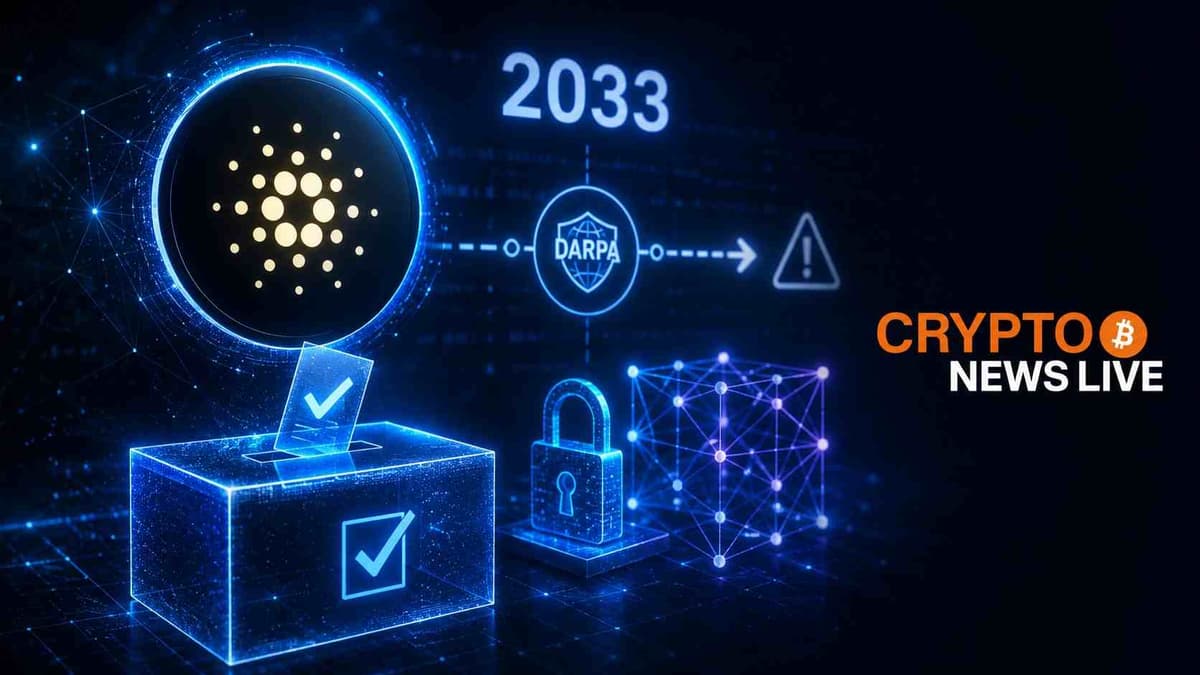
Charles Hoskinson went on Gokhshtein News Network and said something most blockchain founders are still avoiding. Cardano is not waiting to see how the quantum threat develops. The network is actively voting on a quantum strategy right now, with a lattice-based cryptography research proposal expected to land within the week.
That is not a roadmap item. That is a live governance process.
The Number Nobody Wants to Say Out Loud
Hoskinson put his odds on the table. As he told host Paul Gokhshtein on the podcast, he believes there is more than a 50% chance that a commercial-grade quantum computer capable of breaking current encryption exists by 2033. That figure is not coming from nowhere.
DARPA’s Quantum Benchmarking Initiative, a three-stage program tracking whether a utility-scale quantum computer can be built by 2033, has already moved 11 companies into Stage B. Those companies include IBM, IonQ, Quantinuum, and QuEra Computing. DARPA itself said in March 2026 that “it now seems likely that someone will build a utility-scale quantum computer by 2033.” That is a U.S. defense agency, not a blockchain researcher, drawing that conclusion.
Ethereum researcher Justin Drake told Gokhshtein on a prior appearance that he had previously put Q-Day at 2032. He has since moved that estimate forward, citing rapid advances in neutral atom computing. “My Q-day is going to come forward,” Drake said. “It’s not going to be 2032 anymore.”
Where Cardano Actually Stands
Hoskinson was specific about what post-quantum migration looks like for a proof-of-stake chain. Cardano must secure its VRF, its VDFs, and its zero-knowledge strategy. That is more moving parts than Bitcoin, which only needs to update its signature scheme and review hash sizes for Grover’s algorithm resistance.
Cardano is leaning on FIPS 203, 204, 205, and 206, the four post-quantum cryptography standards published by NIST that now govern U.S. government procurement. The lattice-based approach under those standards produces larger signature sizes than elliptic curve cryptography, sometimes 40 to 200 kilobytes versus under a kilobyte for existing schemes. That is the performance tradeoff every chain is staring at.
The advantage Cardano has, Hoskinson argued, is governance. When a contentious decision needs to be made, the network votes. A decision is reached. “We take a vote. A decision’s made. We move on,” he said during the interview. That process, already live through Cardano’s on-chain governance since the Plomin hard fork, is what separates Cardano’s quantum migration path from Bitcoin’s.
On the Midnight side, IOG is building Nightstream with Stanford and Microsoft researchers through the Linux Foundation’s LFDT group. That project is intended to give Midnight a post-quantum privacy foundation at the protocol level.
Bitcoin’s Problem Has No Clean Answer
Hoskinson spent significant time on what BIP-361 can and cannot fix. The proposal from developer Jameson Lopp and others would freeze quantum-vulnerable addresses and offer a zero-knowledge recovery path tied to BIP-39 seed phrases. The flaw is timing.
As of March 1, 2026, over 34% of Bitcoin’s entire supply holds exposed public keys, according to on-chain data cited in BIP-361 itself. The ZK recovery mechanism only works for wallets created after 2013, when BIP-39 became the standard. That leaves roughly 1.7 million BTC, including coins widely attributed to Satoshi Nakamoto, with no recovery path under the current proposal.
“There’s still 1.7 million coins that you can’t do that for because that standard didn’t exist until 2013. Bitcoin was created in 2009.” Charles Hoskinson, as posted on Gokhshtein’s channel and transcript.
Hoskinson also pushed back on the framing. BIP-361 is being described as a soft fork. He argues it is functionally a hard fork because it invalidates signature schemes currently in active use. Bitcoin has no formal on-chain governance to resolve that dispute. The result, he said, is some form of fragmentation is likely unavoidable.
BlackRock and other institutional Bitcoin holders with fiduciary obligations to shareholders are unlikely to accept a scenario where 20% of supply gets drained by a quantum-capable adversary and dumped onto open markets. That pressure, Hoskinson said, will push them toward advocating for a hard fork to freeze those coins entirely, even if the philosophical Bitcoin community resists.
What Cardano’s Governance Buys It
An ADA holder watching this debate does not need to care about the technical details of lattice cryptography. What matters is whether their chain can make a binding decision before the threat window closes.
Hoskinson’s argument is that Cardano already has that capability. Bitcoin does not. The next 12 to 24 months of DARPA’s QBI process will narrow the range considerably. If Stage C validation confirms a viable 2033 path, chains without active post-quantum migration plans will face a compressed timeline with no governance mechanism to act.