ETH trader sentiment on Binance just dropped to its worst level since September 2023. Sellers are running the show.
The taker buy/sell ratio fell to 0.91 this week, per CryptoQuant data. That number marks the most negative reading in more than two years. Aggressive sell orders on Binance futures are outpacing buyers by a margin not seen during last cycle’s low points.
The Number Everyone Keeps Ignoring
ETH is still trading near $2,100. It has pulled back roughly 9% in the past seven days, stuck inside a wide band that stretches from $1,500 to $4,000. That range has held for months, but the positioning inside it is getting extreme.
On X, crypto commentator matrixbt laid it out bluntly:
why is ethereum still at $2,000? this asset has had every opportunity. the merge happened, staking happened, layer 2s happened, dozens of giga bullish updates happened and even the ETF happened. fucking blackrock is in this now. the largest asset manager in the history of human civilization bought ethereum!
The frustration is real. BlackRock, the world’s largest asset manager, holds ETH exposure. Spot ETFs launched. And the price is sitting where it was at the bottom of the 2023 cycle.
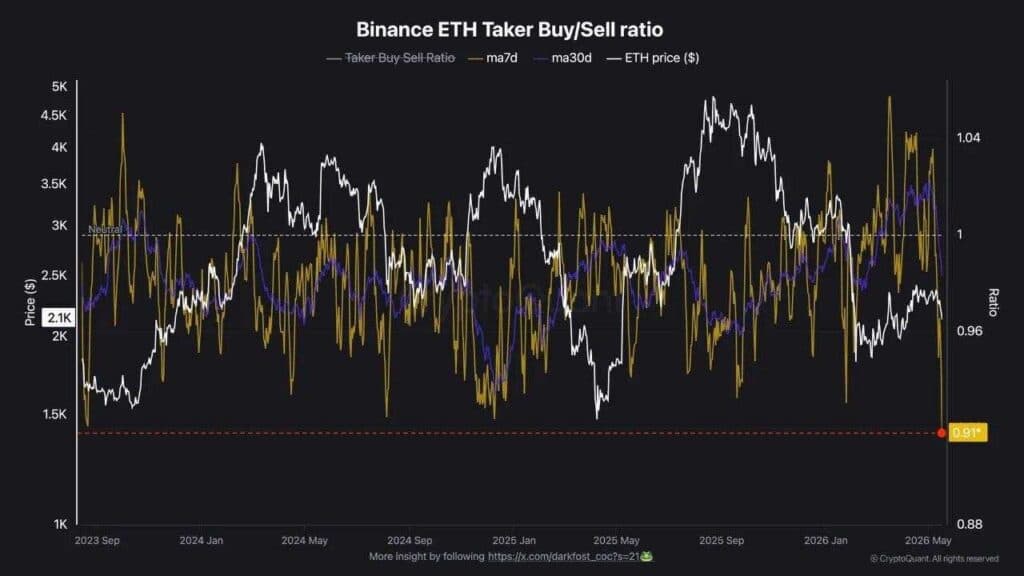
Binance ETH Taker Buy/Sell Ratio — the weekly ratio now sits at 0.91, the lowest reading since September 2023. Source: CryptoQuant.
When the Crowd Bets One Way
What the CryptoQuant analysis points to is a setup worth watching. A taker buy/sell ratio below 1.0 means sell-side aggression is dominating futures order flow. The current weekly reading of 0.91 is the deepest that number has gone into bearish territory since the 2023 bear market lows.
Heavy one-sided positioning like this can flip fast. When shorts pile up and price refuses to break lower, forced liquidations can push price sharply upward against the consensus. The CryptoQuant note flags this directly: the more aggressively traders position short, the greater a potential squeeze becomes.
That said, sentiment data alone does not make a rally. If weekly volume fails to confirm any upside move before Friday’s close, the bearish thesis stays intact.
What Vitalik Actually Said
On the protocol side, things look different from the price chart. Ethereum co-founder Vitalik Buterin posted on X outlining specific short-term steps being taken to shift Ethereum toward native privacy. The list included account abstraction combined with FOCIL, which gives privacy protocol transactions first-class status with strong inclusion guarantees. It also included keyed nonces and early access-layer work like Kohaku and private reads.
These are not vague roadmap items. They are active development tracks already underway. Buterin did not frame this as aspirational. He listed them as things being done.
Crypto commentator llamaonthebrink on X noted that native privacy is the missing piece for ETH:
Ethereum’s missing component at this point is some form of native privacy. ETH’s utility value would literally jump over night. I feel like privacy is the type of feature that can give an asset true ‘moneyness’ qualities. L1 privacy could also drive a surge in mainnet fees.
That last point matters for a retail ETH holder watching the $2,100 level. Higher mainnet fees means more ETH burned per block. More burn tightens supply. Tighter supply, if demand holds, pushes price.
Privacy and the Fee Problem
Ethereum has spent years watching L2s absorb transaction volume from mainnet. Every trade on Arbitrum or Base is a fee that does not flow back to L1 burn. Private transactions executed on L1 directly would reverse some of that. Buterin’s privacy push, in that context, is also an economic argument for mainnet relevance.
The keyed nonces proposal referenced by soispoke on X is part of the same effort. It addresses one of the structural obstacles to private transaction flows at the base layer. Small detail. Big implication if it ships.
None of this has touched the price yet. The taker ratio is still at 0.91. Sellers are still dominant. But the protocol is not standing still.