XRP is consolidating near $1.43 and the silence is getting louder. On-chain activity has cooled, derivatives leverage has been nearly completely flushed out, and the price has barely moved in weeks.
That combination is not neutral. It is a setup.
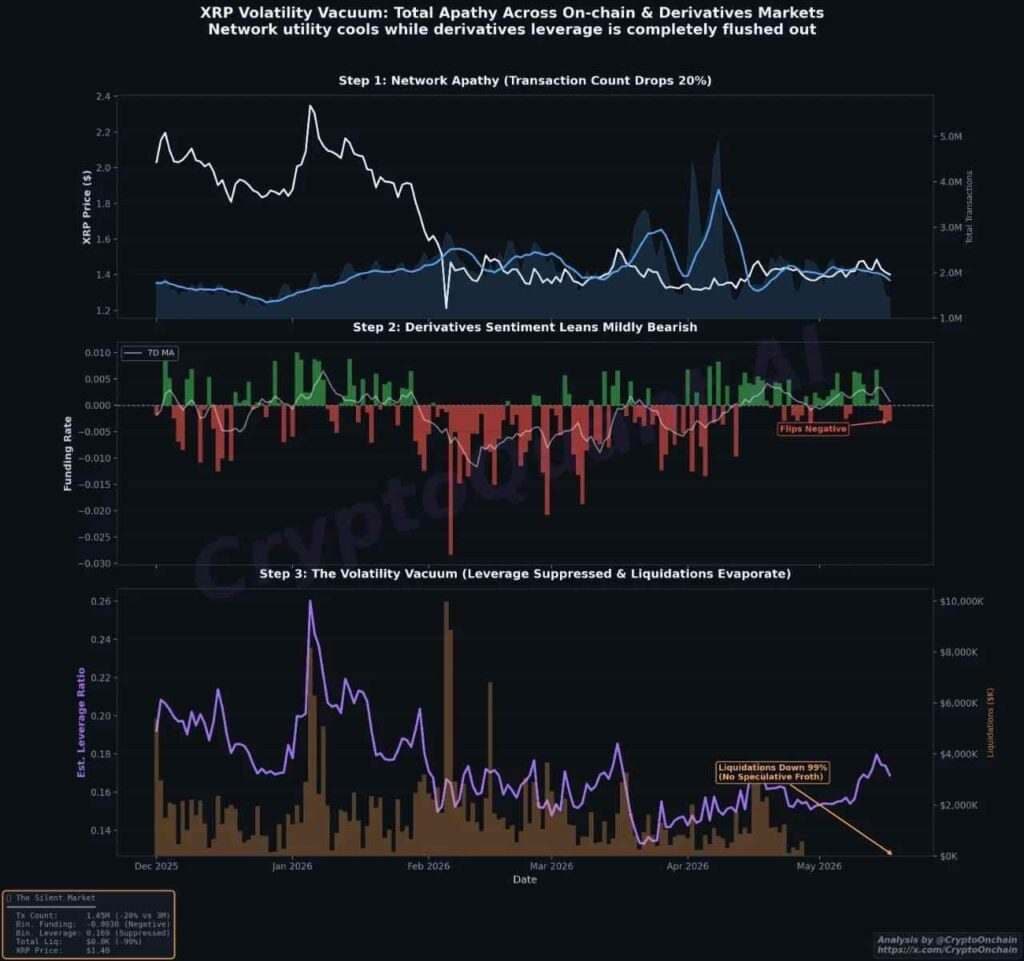
Chart: XRP Volatility Vacuum — Network apathy, mildly bearish derivatives, and suppressed leverage with liquidations evaporated. Source: CryptoQuant / @CryptoOnchain
When the Numbers Go Quiet
CryptoQuant data tracking XRP’s on-chain activity shows total daily transaction count sitting at 1.78 million, a decline of 20% over the past three months. Organic network usage is cooling. That is current ledger data, not a projection.
Binance derivatives markets are telling the same story from a different direction. Funding rates have slipped into negative territory at -0.003, reflecting a mild but measurable lean toward short positioning among perpetual traders. But here is what separates this moment from an ordinary bearish phase: total daily liquidations on Binance have collapsed 99%, falling to just a few thousand dollars per day.
That figure stops most people. A 99% drop in liquidations means there is almost no over-leveraged positioning left on either side. No longs sitting on borrowed fuel waiting to blow up. No aggressive shorts piling in at scale.
No Fuel Left to Squeeze
The Estimated Leverage Ratio on Binance confirms it. The ratio is sitting at 0.173, well below its six-month peak of 0.260. According to CryptoQuant’s analysis, the negative funding rate is not being driven by heavy bearish conviction. It reflects a market that has simply run out of speculative energy.
This is the structural context most coverage misses. XRP is not in a bearish correction. It is in what CryptoQuant describes as a classic Volatility Vacuum — a state of complete structural exhaustion where the leverage that would normally amplify any move has been removed entirely. Retail XRP holders watching for an entry trigger will find no clean signal inside this range.
Historically, these conditions have preceded major directional expansions. The market resets. Leverage clears. Then a catalyst arrives and there is nothing left to absorb it.
The Chart That Has Ali Martinez Watching
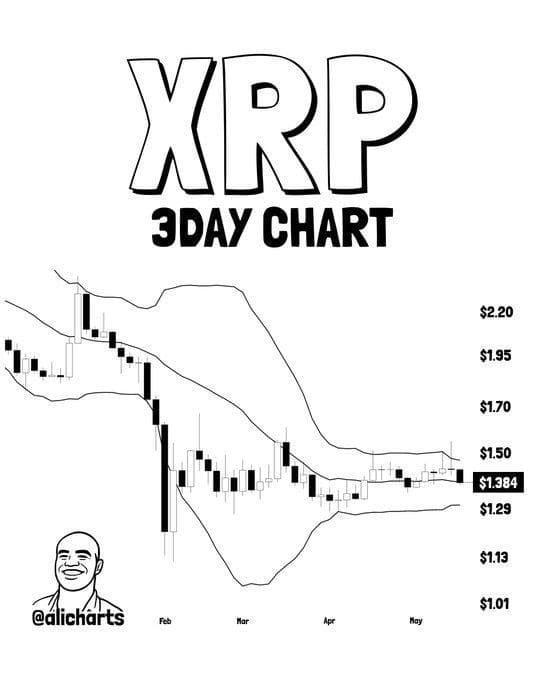
Chart: XRP 3-day Bollinger Band squeeze at its tightest in over a year. Source: @alicharts on X
The technical picture reinforces what the on-chain data is already saying. As Ali Martinez posted on X, the 3-day XRP chart is showing the tightest Bollinger Band squeeze in over a year.
“When volatility compresses this tightly, it’s a signal that a violent price expansion is approaching. This current compression zone is a definitive ‘no-trade zone’: we let the market make its move first, then trade the confirmation.”
Martinez, a widely followed technical analyst on X under the handle @alicharts, outlined two scenarios. A clean 3-day candle close above $1.50 opens the path toward a primary target of $1.80. A close below $1.29, he said, invalidates the immediate bullish structure and brings $1 psychological support back into play.
That is the range. $1.29 on the floor. $1.50 as the ceiling that matters.
Patience Is the Only Position
The combination of CryptoQuant’s on-chain and derivatives data with Martinez’s Bollinger squeeze reading points to one conclusion: the next move is building, but it has not started yet. Both signals say the same thing — wait for confirmation.
No excessive leverage means the eventual move will not be immediately undone by cascading liquidations in the opposite direction. That structural cleanliness is what makes the current setup different from the choppy, high-leverage environment XRP traded in through early 2026.
The catalyst has not appeared yet. Whether it arrives from a macroeconomic shift, a regulatory development, or simply a volume surge that breaks the band, no one knows the timing. What the data confirms is that the environment for that catalyst to produce a sustained directional move is now in place.
As Martinez put it on X: “Patience is the only edge that matters right here. Let the bands break before deploying capital.”