Cardano Budget 2026 voting window closed on June 12 at 12:00 UTC. One hundred and eleven DReps cast votes across 69 proposals. What the final data shows about where the money is going has prompted a public alarm from inside the governance process itself.
Chris O, a DRep operating under the X handle TheOCcryptobro, posted a direct warning to the Cardano community after reviewing a classification matrix published by adatool.net. The tool, built by X user yutazzz, maps every Budget 2026 voter across two axes — how generous they are with yes votes, and whether they tilt toward infrastructure, adoption, or a balanced approach.
When the Numbers Do the Talking
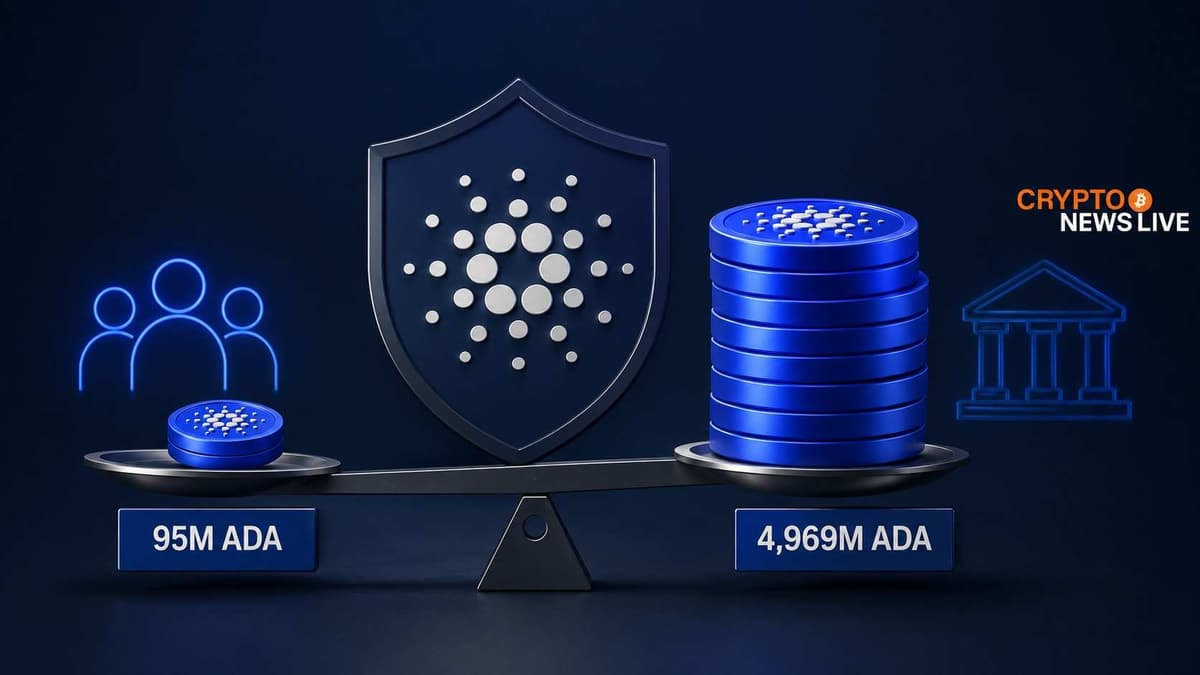
The post-vote data is unambiguous. Of 111 DReps who participated, only four are classified as adoption-leaning, holding a combined 95 million ADA in voting power. Infrastructure-tilted DReps account for 47 voters with 1,870 million ADA behind them. The balanced bloc sits largest at 60 DReps and 3,099 million ADA.
That leaves adoption-focused voting with roughly 1.9% of the total power exercised in the process.
As TheOCcryptobro posted on X:
“I’m literally only 1 of 3 DReps that has ADOPTION as my voting priority. Combined the 3 of us have about 1.5% of voting power. NOTHING. This has to change. Building a technologically incredible blockchain that has ZERO use will serve no one.”
Chris O’s number — 1.5% — reflects his own estimate at the time of posting, before final aggregation. The adatool.net matrix, which captured post-vote data at the close of the window, recorded four adoption-leaning participants at 95 million ADA, or about 1.9% of total aggregated power across 5,064 million ADA.
What the Matrix Actually Shows
The adatool.net classification uses a 20-point spread to determine tilt — if a DRep’s yes rate on maintenance proposals outpaces their yes rate on adoption proposals by more than 20 percentage points, they are tagged infrastructure-leaning. The reverse applies for adoption.
Chris O himself appears in the selective category — DReps voting yes on between 20% and 45% of proposals — alongside some of the largest power blocs in the entire process. YUTA, with 478.4 million ADA under delegation, sits in that selective range with a 25% yes rate. Yoroi Wallet controls 681.7 million ADA and voted yes on 32% of proposals. EMURGO, which shares near-identical voting patterns with Yoroi at a 98.6% agreement rate, brings another 300.7 million ADA.
Neither Yoroi nor EMURGO is classified as adoption-leaning.
The Cardano Foundation, holding 122.7 million ADA in voting power, sits in the generous-balanced category with a 51% yes rate. Its published review framework evaluates proposals across five pillars, one of which is “Adoption and Utility.” But the Foundation’s voting pattern, per adatool.net, places it squarely in the balanced column, not adoption.
The Infrastructure Case Is Not Empty
Replies to Chris O’s post reflect a long-standing tension in the Cardano community. Infrastructure advocates argue that completing core technical work — including the Leios scaling testnet — should come before heavy spending on adoption initiatives. Leios, Cardano’s proposed input endorser protocol, remains in active development with a testnet milestone tracked for later this month.
The counter-position is the one Chris O is making. A chain without users has no demand signal, regardless of how well its consensus mechanism scales.
The Intersect budget process overview places treasury withdrawal governance actions on-chain in mid-to-late June. That means the weight of how DReps just voted in the off-chain Hydra process will carry directly into which proposals receive ADA from the treasury. If adoption-focused proposals did not clear 67% approval from DReps whose voting power skews infrastructure, many may not make the cut.
As yutazzz posted on X, sharing the updated classification view:
“Improved the DRep classification view. Every Budget 2026 voter, now in one matrix: rows = generosity (YES rate) · columns = tilt (infra / balanced / adoption).”
The tool is not an editorial position. It is a data display. But the data it displays tells a story about where Cardano’s treasury priorities sit right now.
Chris O’s ask is direct. He is calling for ADA holders to redelegate to adoption-prioritizing DReps before the next governance cycle, arguing that without a shift in delegated power, the governance structure will keep funding the chain’s engine while the road in front of it stays empty.