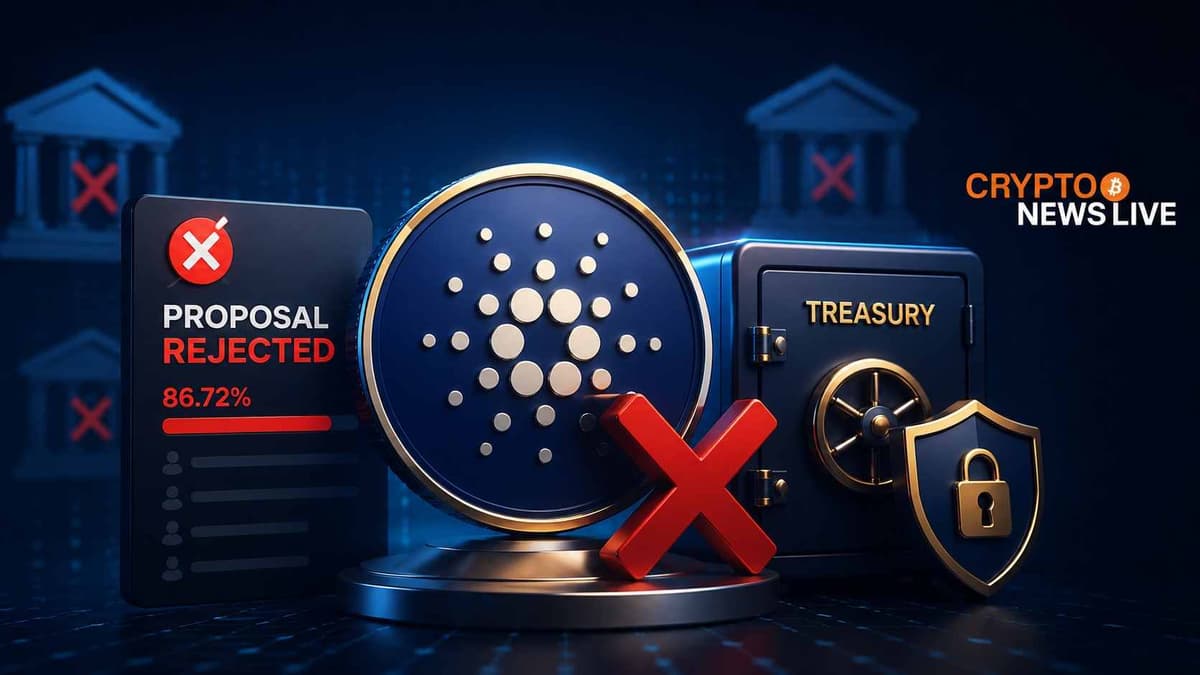
Cardano governance just did something no other major blockchain has managed. It told its own founding development firm no, publicly, on-chain, with 86.72% of active votes against.
The proposal was real. The science behind it was real. The institutional weight pushing for a yes vote was considerable. None of it was enough.
A 32.9 million ADA treasury request from Input Output Global, the firm that built Cardano’s core protocol, is heading toward rejection before the June 8, 2026 voting deadline. The mainstream coverage is calling it a crisis. The structural read is the opposite.
What the Proposal Actually Asked For
The request, formally titled “Cardano Vision 2026: Human Centred, Scalable, Post Quantum Secure – IO Research,” covered Leios scaling technology, Peras protocol development, and post-quantum cryptography research. At prevailing ADA prices, the 32.9 million token ask translates to roughly $8.6 million. The funding was meant to keep IOG’s core research arm running for another year.
As CheekyCrypto posted on X, the vote delivered what he called “ultimate proof of absolute mathematical decentralization in action,” adding that the network is now “officially immune to hostile corporate capture.”
That framing runs directly against the panic circulating in most coverage. But the mechanics support it.
When independent DREPs, led primarily by a highly organised Japanese bloc, opened the proposal, they did not find a clean research grant. They found a bundled package, one large all-or-nothing request with no phased milestones and no granular capital release schedule. In the corporate world, you do not hand a contractor a multi-million dollar check without delivery stages and auditable KPIs. The Japanese DREPs applied exactly that standard to a blockchain treasury, and the proposal did not pass it.
The Treasury Has Been a Target Before
This is not the first time Cardano’s governance layer has said no in 2026. In April, DREPs rejected an Emurgo proposal requesting 14.07 million ADA for Cardano Summit 2026 and Token 2049 participation. Critics pointed to weakening ADA market conditions and rising event costs. That rejection moved through the community with far less drama.
The IOG proposal is different. It carries Hoskinson’s direct backing and the threat of permanent consequences.
As Charles Hoskinson posted on X, his warning to the Japanese community was direct: “We are deeply saddened that some Japanese dReps voted against our research proposal. If this proposal does not pass, we want the entire Japanese community to fully recognize that Cardano will lose its scientists, and our lab will be forced to close.”
IOG also confirmed on X it will not resubmit if the vote fails. That confirmation changed the calculation for several DREPs who had been sitting on abstentions. Japanese DRep YUTA laid out the decision tree publicly: accept the bundled proposal with its wasteful line items to preserve the critical Leios and quantum research, or reject and accept that those programs close with no negotiation window. He moved his vote to Abstain after Hoskinson confirmed there would be no restructured resubmission.
The Japanese Bloc Did Not Vote on Emotion
This is the part most outlets are missing entirely. The Japanese Cardano community did not react to a funding dispute with a protest vote. They applied a structured governance framework to a treasury proposal the same way an audit firm reviews a contractor’s budget submission.
When the Voltaire governance era launched, Japan’s DREPs formed working groups, translated dense technical documents, and built review processes that go well beyond what most token governance systems require. When the IOG request arrived, the objection was structural. The proposal was all-or-nothing. Accepting it meant approving line items the community considered wasteful alongside the research lines it considered non-negotiable. Rejecting it meant demanding the proposal come back in unbundled form with distinct funding modules.
IOG refused to unbundle. That is where the conflict hardened.
As CheekyCrypto argued in his breakdown, the DREPs were not blocking science. They were blocking a funding model that treated the treasury like an open tab. The distinction matters for every ADA holder who owns the token because they believe in what the research phase built.
Corporate Capture Is the Real Issue
CheekyCrypto’s video frames the governance mechanics through the lens of what he calls the tragedy of the commons. When a treasury holds hundreds of millions of dollars in native assets, it becomes a target. In most blockchain networks, concentrated token holdings by venture capital firms and founding entities mean governance votes are a formality. The outcome is set before the vote opens.
Polkadot’s governance history is the clearest example. A few years back, large holders controlling over 50% of voting supply could override community sentiment entirely. The result is a system that protects insiders while diluting retail holders.
Cardano structured the Voltaire era specifically to prevent that. Hundreds of independent DREPs, each answering to their own delegators, now control treasury spending. No single entity, including the one that built the protocol, can guarantee a yes vote through reputational weight alone.
Hoskinson’s own public engagement with the vote involved reviewing over 11,000 DAO proposals and signalling interest in taking a DRep seat himself. That is not the behaviour of someone who controls the outcome. That is someone lobbying inside a system that does not answer to them.
The governance layer ran the way it was designed to run. The largest entity in the ecosystem asked for money, made the case publicly, used institutional credibility to press for approval, and the system still said no. CheekyCrypto calls this crossing the capture immunity threshold, the point where decentralised governance produces outcomes that are not predetermined by insider concentration.
What the Commercial Execution Phase Means
The fear driving most coverage is that rejecting the IOG proposal kills Cardano’s research identity. CheekyCrypto’s argument flips that. The rejection forces every development firm out of what he calls the academic ivory tower and into the commercial market. If IOG’s research is as valuable as the proposal claims, it should be able to attract private capital, generate revenue through commercial applications, and build treasury requests that show measurable returns to the network.
Hoskinson himself has moved in this direction. His Midnight.city project targets commercial adoption with a specific ambition: becoming the most used application in crypto by 2030. That is not an academic research deliverable. That is a commercial roadmap. The governance pressure accelerates the transition whether IOG welcomes it or not.
The NIGHT token and the broader Midnight ecosystem reflect the same shift. Hoskinson is already building the commercial layer while the research funding dispute plays out at the governance level. The two tracks are running in parallel.
The Vote That Closes June 8
With 86.72% opposition and no resubmission offer on the table, the default outcome is a failed proposal. Whether that triggers researcher departures at the scale Hoskinson warns is unknown. What is not unknown is what the vote itself proves.
A blockchain treasury worth hundreds of millions of dollars just resisted a funding request from the most credible institutional voice in its ecosystem. The governance architecture held. The DREPs acted as what CheekyCrypto called a human firewall, stopping a massive capital allocation because the request did not meet the accountability standards the community requires.
Cardano’s research funding crisis is real. The scientific work on Leios and quantum resistance matters. But the process that blocked the funding is exactly the process that makes the network worth building on. A treasury that always says yes to institutional prestige is not a decentralised treasury. It is a corporate account with extra steps.
The era of blank checks is over. What replaces it is messier, slower, and more politically contentious. It is also the only way a genuinely decentralised economic engine can function.