Eight days ago, TAC touched an all-time high of $0.06688. On July 7, it fell as low as roughly $0.0054. The drop did not happen in one straight line.
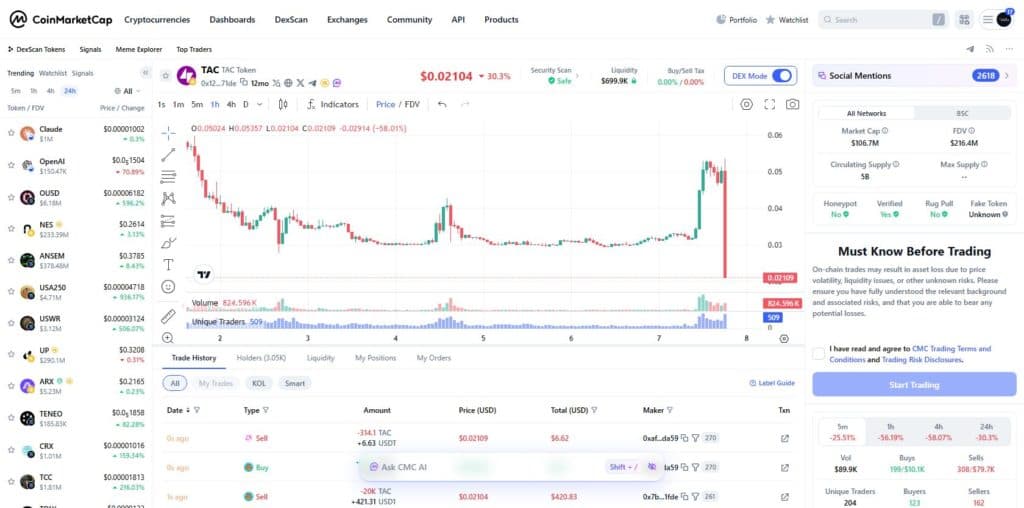
TAC is the token behind a blockchain built to let Ethereum-style Solidity applications reach TON and Telegram users without rewriting their code. Over the course of a single research session today, its price moved enough to make any single number misleading. CoinMarketCap’s front-page feed briefly showed TAC at $0.008047, down 73.46% on the day. Its own DEX Mode tool, which reads live on-chain trades rather than an aggregated price feed, told a related but distinct story: down 30.3% over 24 hours, down 56.19% over one hour, and down 58.07% over four hours.
That last figure matters more than the 24-hour number. A four-hour drop worse than the 24-hour drop means the worst of the move happened recently, not gradually across the full day.
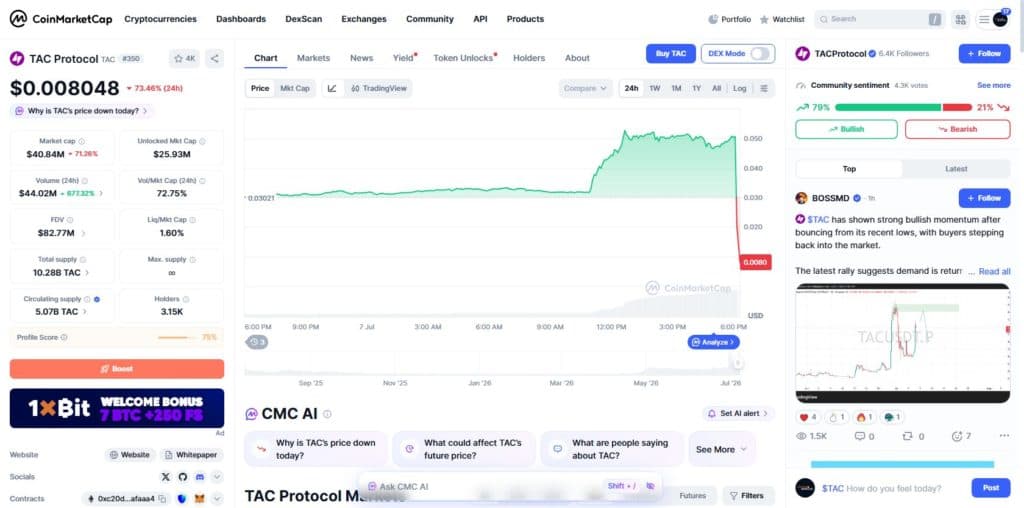
A Bounce, Then A Bigger Fall
One week earlier, on June 30, TAC hit its all-time high of $0.06688, a level 82.81% above where it traded at the first check today. The token bottomed at an all-time low of $0.001286 back on October 11, 2025, nine months prior, meaning today’s worst price still sits far above where TAC has traded before.
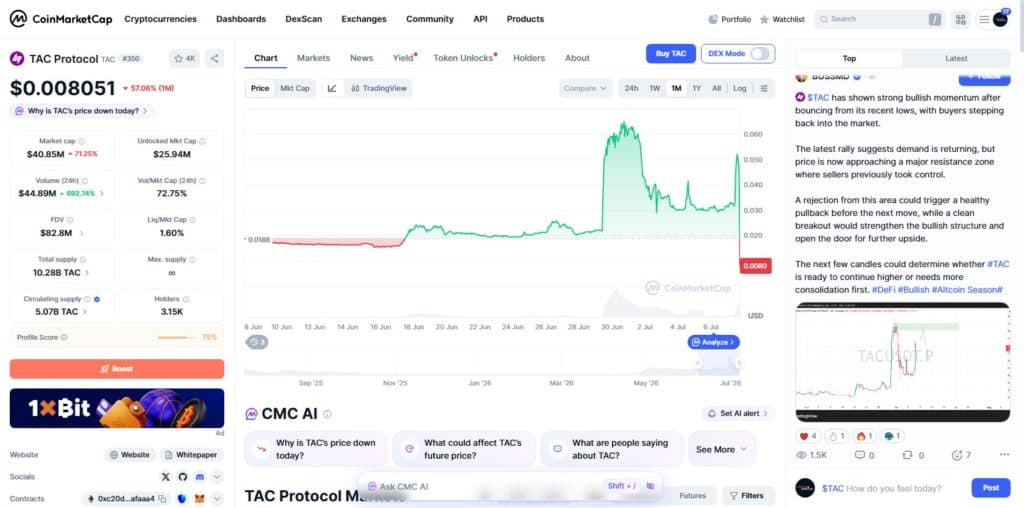
The one-month chart shows the shape clearly. TAC held a tight range near $0.018 to $0.023 through most of June, then broke out to the June 30 peak, drifted down into the low $0.030s over the following days, and then fell hard. Over 30 days, the realized range runs from roughly $0.018 to $0.06688, a spread of about 271%. Over the trailing year, the range runs from the $0.001286 low to the $0.06688 high, better than 5,100%.
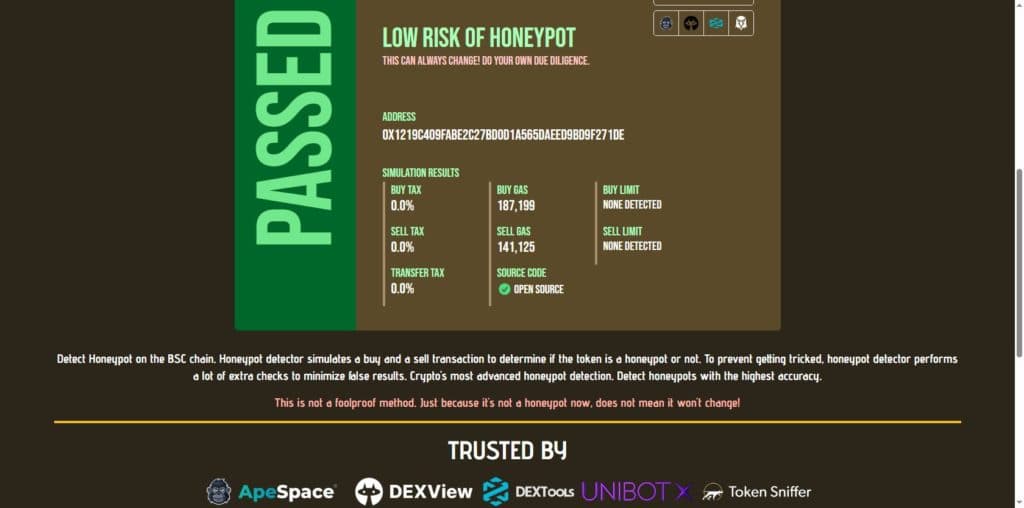
CoinMarketCap’s own DEX Mode view, pulling directly from the largest PancakeSwap pool, showed a security scan alongside the live chart: no honeypot, no rug pull flag, verified contract, and 0.00% buy and sell tax. That scan and the price data sat side by side on the same page, which is worth noting since the two pieces of information answer different questions. One says the code will not trap a seller’s funds. The other says the price cratered anyway.
Six Figures Will Not Fit Through This Pool
The deepest TAC pool on BNB Chain, a PancakeSwap TAC/USD1 pair, held between roughly $475,000 and $723,000 in liquidity at different points during today’s research, itself a sign of how much the pool moved during the session. Testing that depth directly on PancakeSwap’s own swap interface produced a clear, size-dependent pattern.
A $1,000 buy cost less than 0.01% in price impact. A $10,000 buy cost 2.89%. A $100,000 buy cost 21.94%, enough to trigger PancakeSwap’s own “price impact too high” warning. Selling ran worse at every comparable size. A roughly $1,000 sell cost under 0.01%. A near-$10,000 sell, 1,160,000 TAC at the time, cost 16.78%, nearly six times the impact of a same-size buy. A $126,353 sell cost 33.77%.
That gap between buy-side and sell-side impact at the same dollar size is the more interesting finding than either number alone. It points to real, live selling pressure sitting on one side of the pool, not a generic thin-liquidity problem that would hit buys and sells symmetrically.
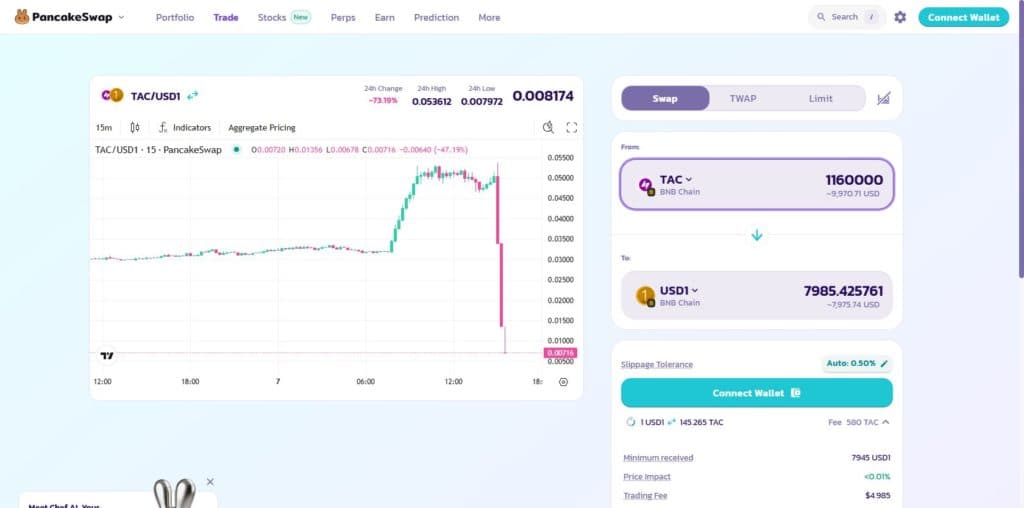
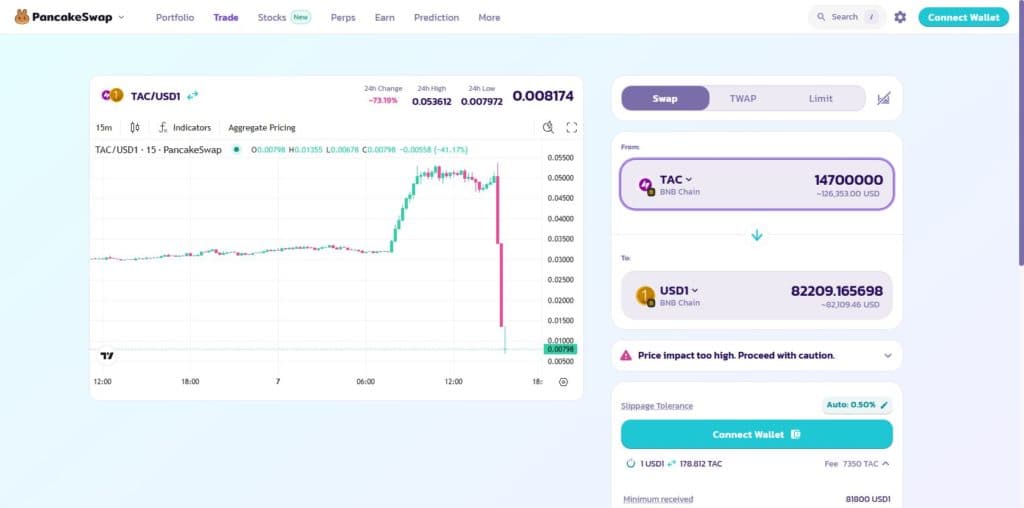
Fig. 5 — PancakeSwap: a $126,353 TAC sell quotes 33.77% price impact | pancakeswap.finance/swap
The Contract Passed Every Check Run On It
None of the price action traces back to the token contract itself. A honeypot.is simulation on the BNB Chain contract came back PASSED, low risk: 0% buy tax, 0% sell tax, 0% transfer tax, no buy limit, no sell limit, open source. 1inch Shield still flagged TAC “Unknown Reputation” when queried separately, a listing-verification warning about the token not appearing on 1inch’s own curated list, not a finding about the code.
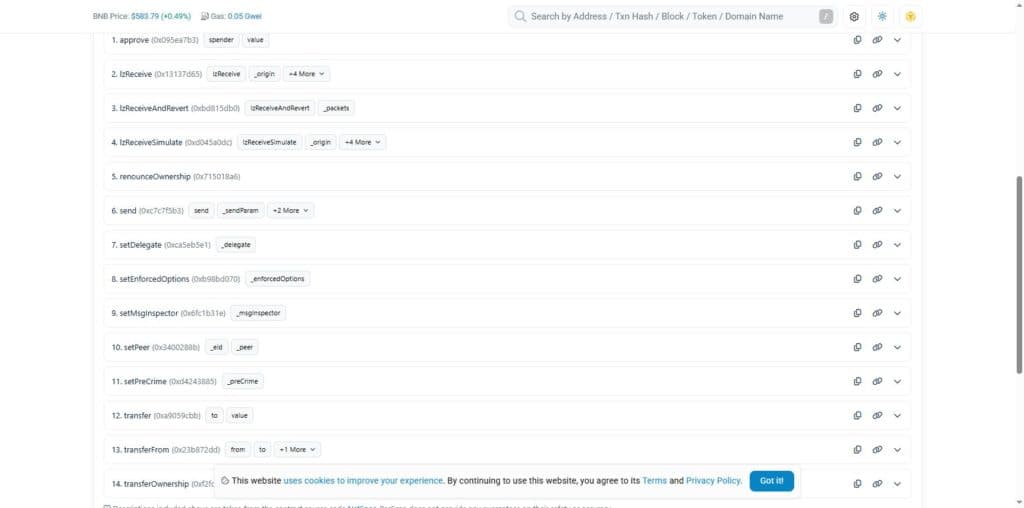
BscScan’s Write Contract tab lists fourteen functions on the BSC token: approve, lzReceive, lzReceiveAndRevert, lzReceiveSimulate, renounceOwnership, send, setDelegate, setEnforcedOptions, setMsgInspector, setPeer, setPreCrime, transfer, transferFrom, and transferOwnership. That list matches a standard LayerZero Omnichain Fungible Token. No mint, no pause, no freeze, no blacklist, no setFee function exists anywhere in it.
Ownership has not been renounced, though. The owner() function returns a live address, 0x592e0D5f382E83406eADC6522a559A457aaa7d2b, still able to call transferOwnership along with a set of LayerZero configuration functions such as setPeer and setDelegate that control how the token routes between chains. That is a narrower risk than a mint key. It gives the owner control over cross-chain messaging setup, not the ability to freeze balances or print new supply.
The Bridge Has Been Frozen Since May
TAC’s own blog carries a detail that does not show up in any price chart. On May 11, 2026, at roughly 02:20 UTC, the bridge connecting TON and TAC suffered what the team’s own post-mortem calls a code-hash verification exploit. An attacker deployed a fake jetton wallet on TON built to look like a genuine USD₮ wallet. TAC’s sequencer software never checked whether the sender’s minter code actually matched USD₮, so it accepted the fake deposit as real and minted the equivalent tokens on TAC, which the attacker then bridged back to TON, draining real, previously locked assets.
Total protocol loss came to approximately $2,854,486.22 across USD₮, BLUM, and tsTON. The stolen funds moved through Ethereum, Bitcoin, BNB Chain, Solana, and Zcash, some of it through privacy tools including Tornado Cash and Umbra. Hypernative’s monitoring flagged the imbalance almost immediately, and the TAC team halted its entire sequencer set within hours, then worked with law enforcement, the security firm Seal911, and TON developers to trace the money.
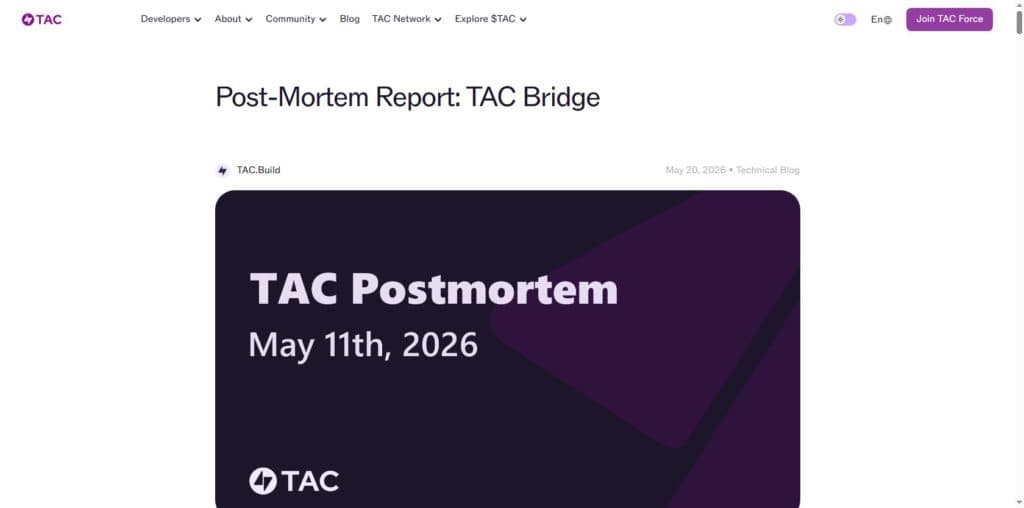
Through negotiation, the team recovered roughly 80.2% of the loss, about $2,290,687.90, and says the remaining shortfall will come out of the TAC Foundation treasury rather than from users or the protocol. As of the post-mortem’s publication date, May 20, 2026, the report states plainly: “TON/TAC Crosschain framework is currently paused; no assets or messages move between TON and TAC blockchains.” The report promised weekly follow-up updates on restoration progress. No newer post has appeared on TAC’s blog since. That is 48 days of silence on a bridge the team itself called still-paused the last time anyone heard from them.
A nearly identical incident played out very differently for another chain just weeks ago. Taiko’s own cross-chain bridge was exploited for roughly $1.7 million on June 22, 2026, after a signing key was accidentally exposed. Taiko patched the bug, made affected users whole, and reopened the bridge within 10 days, on July 2. TAIKO’s token rose as much as 136% on the news. TAC’s bridge has now sat paused nearly five times longer than Taiko’s did, with no comparable restoration announcement, a gap in speed that maps closely onto the gap in each token’s price direction.
A Chain Nobody Is Using
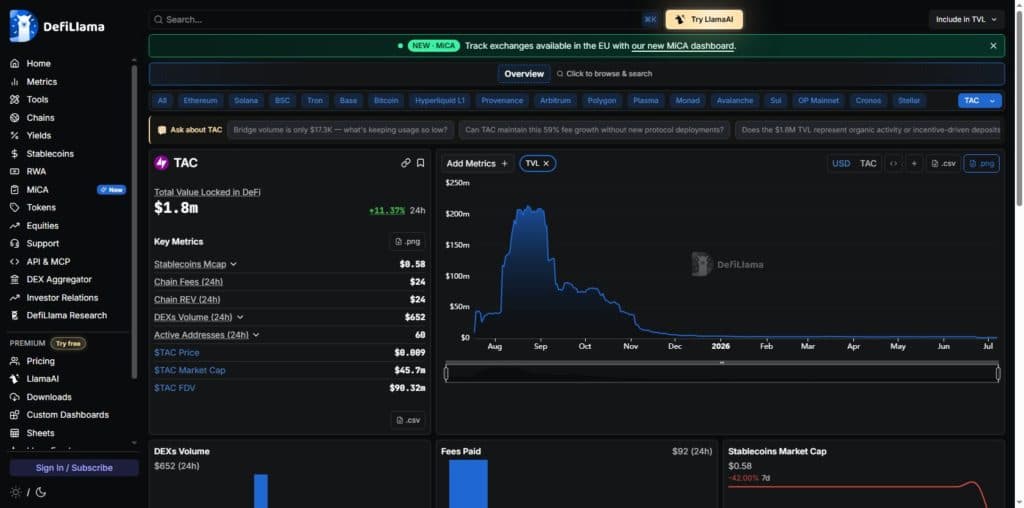
The bridge outage sits inside a larger pattern. DeFiLlama’s data for the TAC chain shows total value locked at $1.8 million today, up 11.37% in the past 24 hours from an even lower base. That figure sat above $200 million at its peak in September 2025, shortly after mainnet launched. The decline from that peak to today’s $1.8 million happened gradually across the better part of a year, well before the May bridge hack, which means the two problems are separate rather than the same story told twice.
Daily numbers make the point sharper. DeFiLlama shows $24 in chain fees over the past 24 hours, $24 in chain revenue, $652 in decentralized exchange volume, and 60 active addresses. Those are not typos. A blockchain that raised institutional money and secured listings on Bybit, Kraken, KuCoin, and Binance Alpha is, by DeFiLlama’s own numbers, currently doing less daily business than a small-town coffee shop.
The Biggest Wallet Is Not A Whale
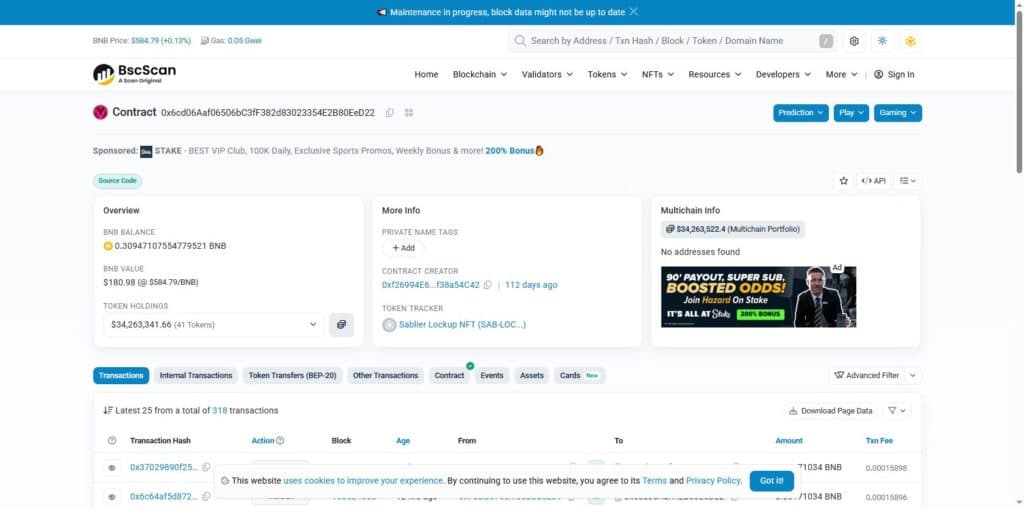
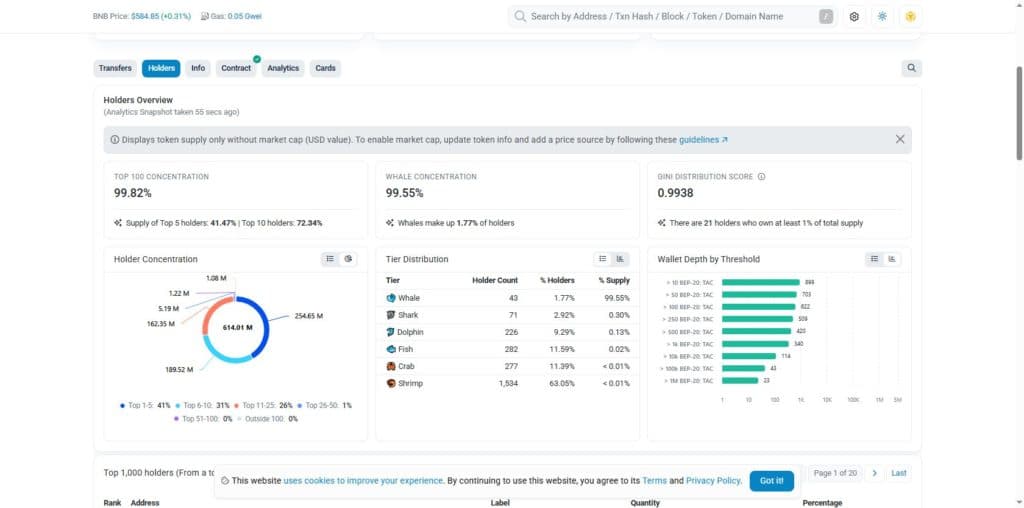
TAC’s BSC contract shows 3,235 holders, with the top 5 wallets controlling 41.47% of that chain’s supply and the top 10 controlling 72.34%, a Gini score of 0.9938. Numbers like that usually invite suspicion of a hidden team wallet ready to dump. Checking the largest wallet directly on BscScan found something different: it is a verified Sablier Lockup contract, a token-streaming vesting tool, holding 88.42 million TAC, about 10.92% of the BSC supply. That is scheduled release infrastructure, not a private key someone can empty on a whim.
The second-largest unlabeled wallet, holding 5.58% of supply, turned out to be an ordinary externally owned wallet funded 60 days ago with a few cents worth of BNB from a Gate-linked address, and it has never sent a single outbound transaction since. Dormant, not distributing.
Two Hundred Million Tokens Unlock In Eight Days
CoinMarketCap’s Token Unlocks tab, reported directly by the TAC project, shows 31.33% of max supply already unlocked and 65.9% still locked. The next scheduled release lands on July 15, 2026, eight days from this writing: 200.28 million TAC, worth about $2.3 million at the price used in that snapshot, spread across seven separate allocation categories rather than a single team wallet. Similar monthly releases, each in the 185 to 195 million TAC range, continue on the 15th of every following month through at least early 2027.
TON Itself Barely Moved
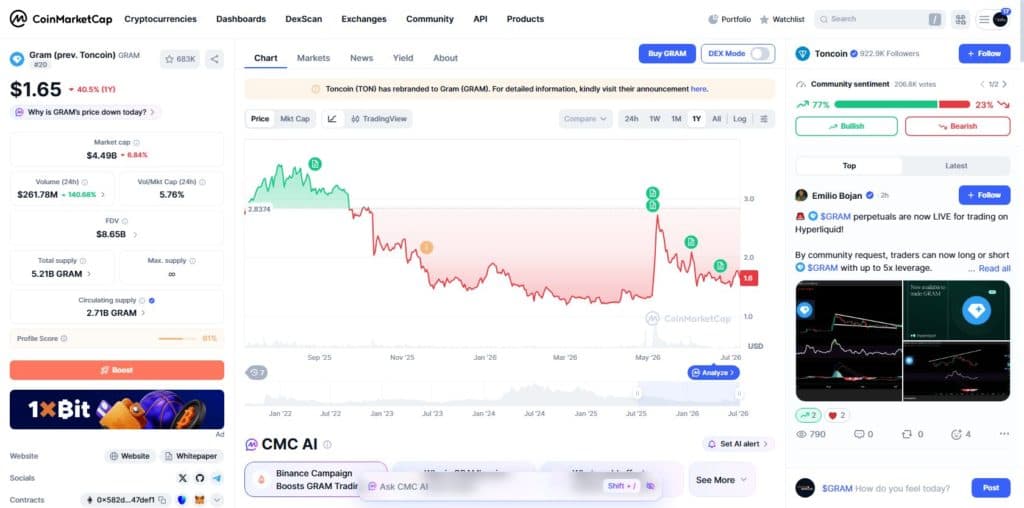
If this were a sector-wide story, the base TON chain token would show it too. Gram, the token formerly known as Toncoin following its rebrand, traded down just 6.84% over the same 24 hours that saw TAC swing across a range measured in tens of percent. That gap points toward a token-specific event sitting on top of an otherwise unremarkable day for the network TAC was built to plug into, not a broad TON-wide selloff dragging TAC down with it.
What To Watch Next
July 15, 2026: the next scheduled token unlock, 200.28 million TAC across seven allocation categories, per CoinMarketCap’s Token Unlocks tracker.
Ongoing, no date attached: any update on TON-to-TAC bridge restoration. The team’s own post-mortem promised weekly progress updates starting May 20, 2026; none had been published as of this writing, 48 days later.
Ongoing: whether DeFiLlama’s TAC chain activity, currently $24 in daily fees and 60 daily active addresses, recovers once the bridge reopens or continues its year-long decline regardless.
Where The Two Cases Diverge
If the patched sequencer clears its independent and TON-ecosystem peer review and the bridge reopens without incident, the chain regains the one feature that made it distinct in the first place: a working path for EVM liquidity to reach TON and Telegram users, at which point today’s TVL and activity numbers become a floor to build from rather than a terminal decline.
If the bridge stays paused much longer, or if the July 15 unlock lands into a market this thin, a pool that already showed 16.78% sell-side impact on a $10,000 trade and 33.77% on $126,353 would need to absorb sellers with far less room to do so than it had a week ago, before the price started falling.
────────────────────────────────────────────────────────────
Disclaimer: This article is for informational purposes only and does not constitute financial advice. Cryptocurrency investments carry significant risk, including the total loss of capital. Always conduct your own research.