Hamster Kombat HMSTR token gained 44.2% in the past day, trading at $0.0003477 after touching an intraday high near $0.00043. The move arrived without a company announcement behind it.
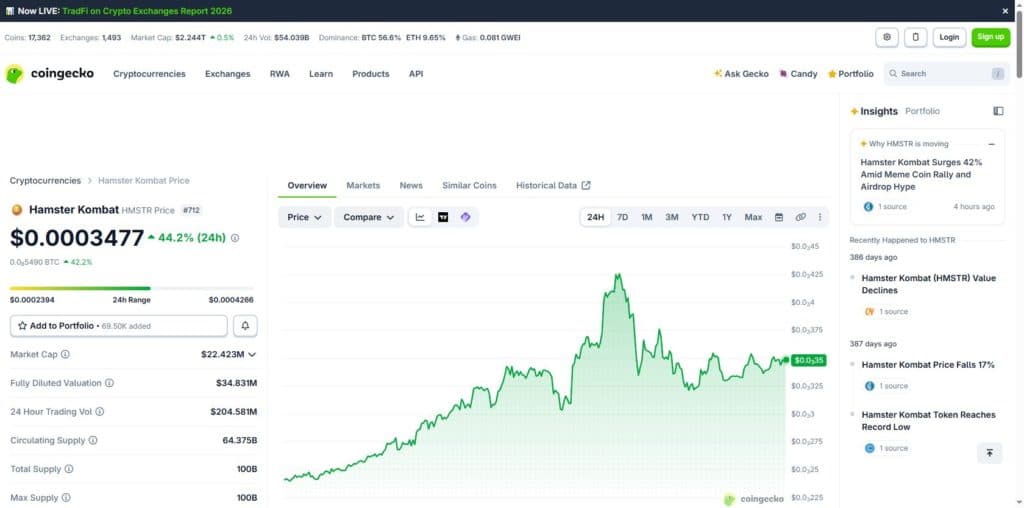
CoinGecko overview, July 4 2026: price $0.0003477, +44.2% 24h, market cap $22.423M, FDV $34.831M, 24h volume $204.581M. Source: CoinGecko – Hamster Kombat
In the same 36-hour window, a wallet controlling 20% of Hamster Kombat’s total HMSTR supply sent 10 billion tokens to Binance Hot Wallet 18 hours ago, then another 5 billion the day before that. Fifteen billion HMSTR, 15% of the entire token supply, moved toward an exchange as the price surged.
The wallet sits behind a TON domain name, selling-domain-dogs.ton, and Tonviewer’s holder list does not label it as an exchange, a foundation reserve, or anything else. It is simply the single largest HMSTR holder on the network.
A fifth of supply moves through one wallet
Tonviewer’s holder list shows selling-domain-dogs.ton at 20% of total supply, unlabeled. Its transaction history shows the 10 billion and 5 billion HMSTR sends to Binance Hot Wallet directly, timestamped 18 hours and roughly 36 hours before this research. Whoever controls it moved a sixth of the entire circulating token supply toward a centralized exchange in a day and a half.
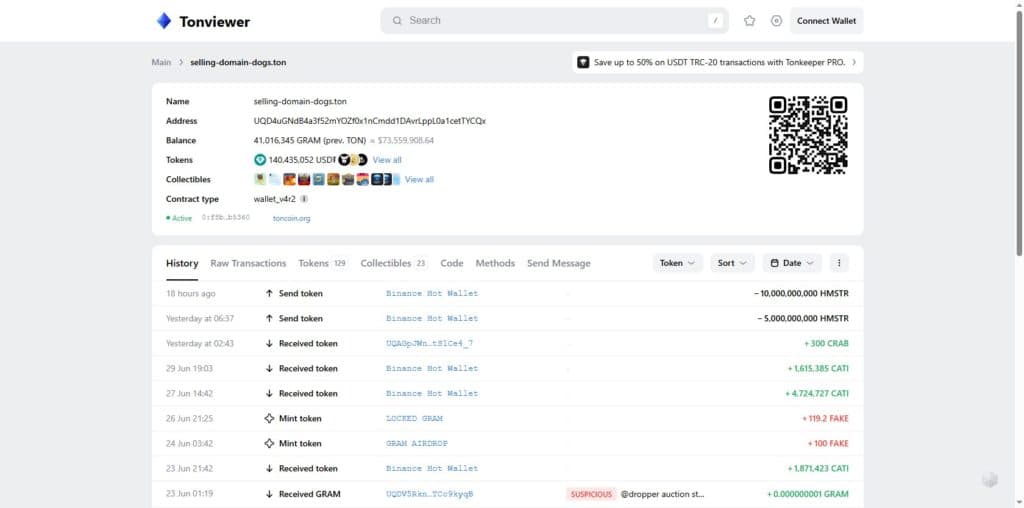
selling-domain-dogs.ton transaction history, July 4 2026: 10B HMSTR sent to Binance Hot Wallet 18 hours prior, 5B HMSTR sent the previous day. Wallet also holds $140.4M USDT and 129 other tokens. Source: Tonviewer – selling-domain-dogs.ton
That sounds worse in isolation than the fuller picture supports. The same wallet holds $140.4 million in USDT, $73.5 million worth of TON, and 129 different tokens. Its transaction history going back to early June shows HMSTR flowing in both directions with Binance: it received 11.2 billion HMSTR from Binance on June 13 and another 1 billion the next day, then sent multiple tranches back over the following weeks, including 2 billion on June 9, 1 billion on June 10, 4 billion on June 22, before this week’s 10 billion and 5 billion. Net outflow to Binance across the past month runs close to 16.5 billion tokens, but the pattern reads like inventory management by a market maker or OTC desk trading across the TON network, not a single insider quietly cashing out. The wallet’s own name, tied to NFT domain trading, points the same direction.
Nobody should read this as confirmed. It should be watched.
Testing what a real trade on-chain costs
A wallet moving billions of tokens raises an obvious question: what happens to everyone else if even a fraction of that hits the open market on TON itself, rather than on Binance? So this trade was run through swap.coffee, a TON aggregator that routes across STON.fi and DeDust, without ever submitting the transaction.
A $1,000 buy lost 34.24% to price impact. A $10,000 buy lost 82.84%. At $100,000, the loss reached 97.95%, leaving roughly $2,046 of value from a $100,000 order. Selling worked the same way in reverse: a $1,000 sale of HMSTR lost 29.99%, a $10,000 sale lost 82.09%, and a $100,000 sale lost 97.88%.
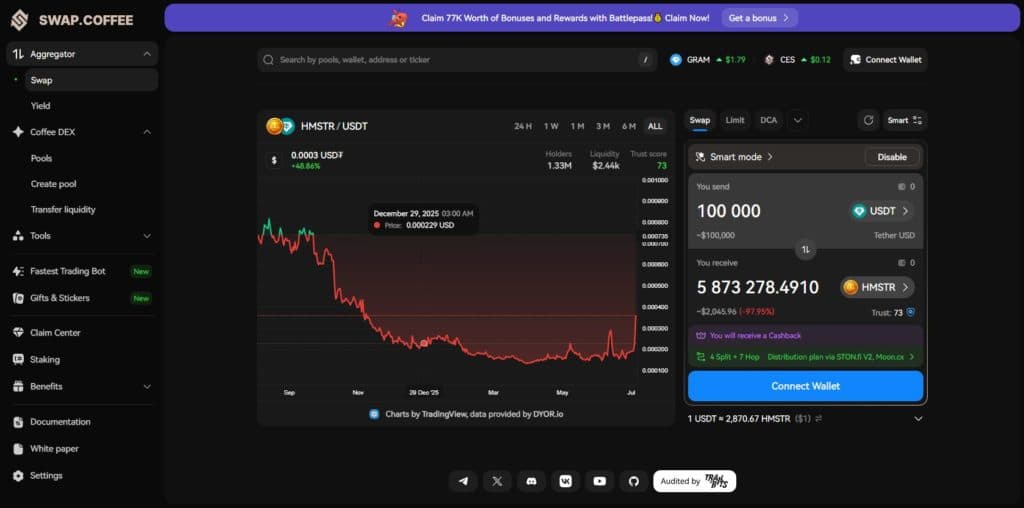
swap.coffee quote, July 4 2026: a $100,000 HMSTR buy on TON loses 97.95% to price impact, receiving only ~$2,046 of value. Source: swap.coffee – $100k buy quote
Combined liquidity across all 20 tracked HMSTR pools on TON totals about $19,800. Compare that to the $204.6 million in 24-hour volume CoinGecko shows for the token overall, and the gap explains itself: that volume is happening on Binance, OKX, Bitget, KuCoin, Bybit and Gate, not on the TON network’s own decentralized exchanges. Binance alone carried $46.3 million of HMSTR/USDT volume in the last 24 hours per CoinGecko’s markets tab. The 15 billion tokens sent this week never touched those thin TON pools at all; they moved through Binance’s own order book, which is exactly why the price could absorb them without the kind of collapse a TON-side sell of that size would cause.
The contract still answers to three keys
Hamster Kombat’s jetton contract is open-source and verified on-chain, built from the standard TON jetton-minter template. Reading the actual FunC code, not just the function list, shows mint() carries no supply cap of any kind. Whoever controls the admin address can issue more HMSTR at will, and the whitepaper’s claim of a fixed 100,000,000,000 token supply is a policy statement, not something enforced by the code itself.
The admin address is not a single private key. It resolves to a 3-of-N multisig wallet with three named signers and one proposer, confirmed by calling get_jetton_data() directly against the contract. The result: mintable is true, admin_address has not been set to none, and drop_admin (the function that would renounce control permanently, copied from Notcoin’s own contract) has never been called. Whoever those three signers are remains unknown. That the power sits behind a multisig rather than one wallet meaningfully changes the risk, even if it does not remove it.
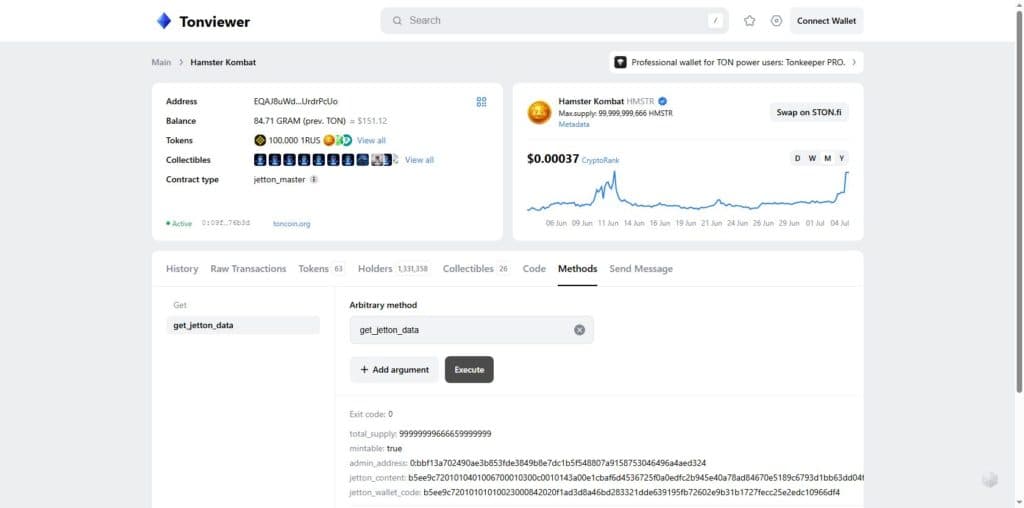
get_jetton_data() executed directly against the contract, July 4 2026: mintable: true, admin_address not set to none. Source: Tonviewer – get_jetton_data result
Why nobody can point to a reason
Meme coins moved together on July 4, 2026. CoinGape reported the combined meme coin market cap rose 2.4% to $28 billion, with Bitcoin above $62,000 lifting risk appetite broadly. One trader summed up the confusion in a post CoinGape embedded directly: “why is hamster kombat $HMSTR up ~84% today?? Is it TON season again.” Nobody, including the project’s own account, answered with a reason.
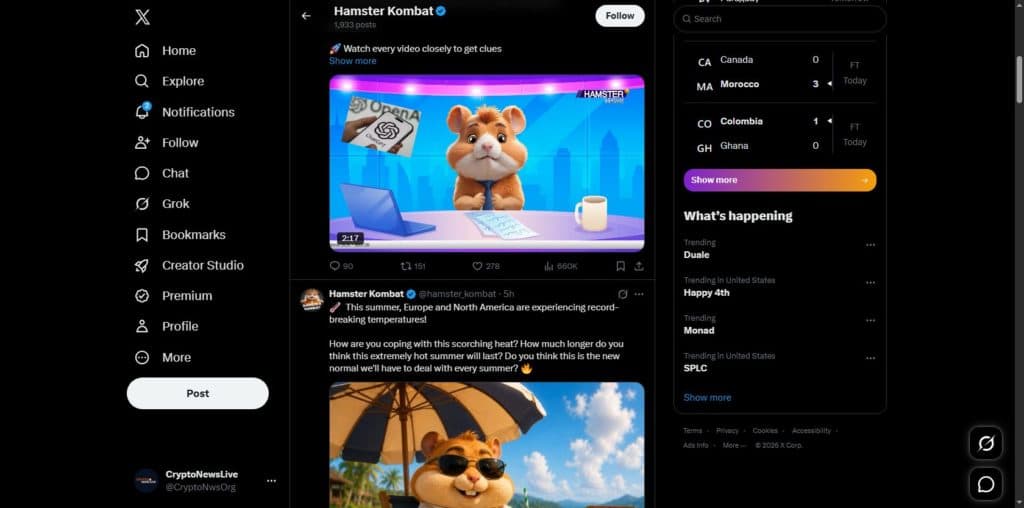
Official X account (@hamster_kombat, verified, 12M followers), July 4 2026: most recent post is generic summer-weather content, not a price or listing announcement. Source: X – @hamster_kombat
Hamster Kombat’s own X account posted about summer heat five hours before this article, not about HMSTR. The team’s whitepaper, last revised September 12, 2024, states plainly there are “neither investment firms nor VCs backing us,” a claim DeFiLlama’s raises database backs up by returning nothing for the project at all. Sixty percent of the total token supply went to players through the airdrop rather than to a fund that eventually sells.
HMSTR’s first trading pool went live September 26, 2024, the same day the token hit its all-time high of $0.007222. Today’s price sits 95% below that first-day peak, and only 30-ish days removed from an all-time low of $0.0001228 touched June 4, 2026. Against sector peers on the TON network, Notcoin gained 7.3% and MemeFi gained 4.9% over the same 24 hours, real moves, but a fraction of HMSTR’s. Whatever pushed HMSTR harder than its neighbors, it wasn’t a listing (HMSTR has traded on Binance since launch), and it wasn’t a team post.
Team identity was never hidden to begin with. No individual names appear anywhere on hamsterkombat.io or in the whitepaper. The project operates under something it calls the Hamster Foundation, a structure the team discloses openly rather than one uncovered through digging, which is a different and more honest situation than a project that hides names and gets caught.
What to Watch Next
No confirmed upcoming catalyst, such as a scheduled unlock, governance vote, or pending listing decision, was identified as of July 4, 2026. Readers tracking this token have two verifiable things worth checking rather than guessing at: whether selling-domain-dogs.ton sends further HMSTR to Binance Hot Wallet in the coming days, and whether the $0.0003 level CoinGape flagged as the current support zone holds once this week’s meme coin rotation cools off. Both are checkable on public explorers without anyone’s permission.
Readers who watched zkPass bounce off its own all-time low found a similar liquidity gap between headline volume and what a real trade would cost, and the same question about whale wallets came up when The Black Bull’s ANSEM token pumped with one address controlling 60% of supply. The MemeCore buyback wallet traced earlier this week showed how a named, on-chain address can say one thing and hold another.