Magma Finance jumped 49% in the past 24 hours. The token trades near $0.567, one of its sharpest single-day moves since the spring.
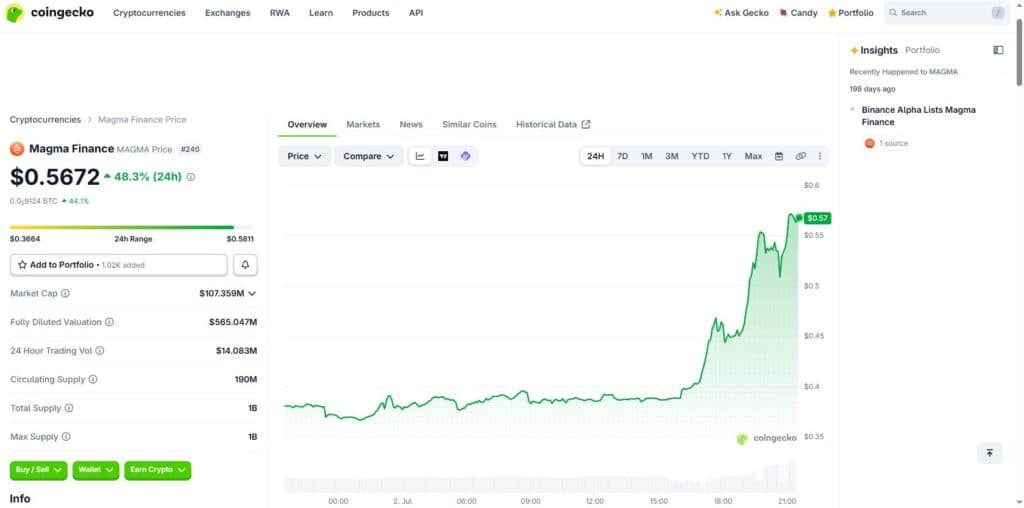
CoinGecko MAGMA overview, July 2, 2026: price $0.5638, up 48.3% in 24 hours, market cap $107.359M, FDV $565.047M, circulating supply 190M against total and max supply of 1B. The same page confirms an all-time high of $0.7289 (Jun 26, 2026) and all-time low of $0.06971 (Apr 2, 2026). Source: CoinGecko
MAGMA is the governance token behind an automated market maker built on the Sui network. It launched on December 14, 2025, and picked up a spot on Binance Alpha two days after that. DexScreener’s own pair-age counter, checked live, shows the primary pool as “6mo 19d ago,” which lines up with that timeline almost exactly.
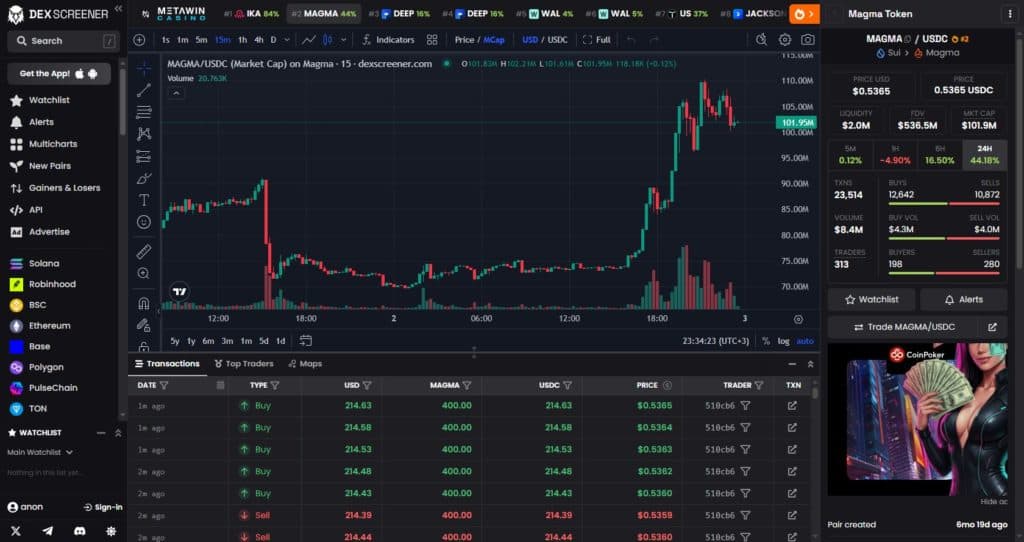
DEX Screener live view of the MAGMA/USDC pair on Magma, July 2, 2026: price $0.5365, 24h +44.18%, liquidity $2.0M, FDV $536.5M, market cap $101.9M, 23,514 total transactions with buys (12,642) outnumbering sells (10,872). Pair age shown as “6mo 19d ago.” Source: DEX Screener
The Real Trigger Wasn’t a Listing
Official posts from @Magma_Finance on X tell a clear story. On June 29, the account teased that “something is starting to build around Magma.”

@Magma_Finance on X, June 29, 2026: “Something is starting to build around Magma. Magma 2.0 is not just another product update, it is a new liquidity engine for Sui DeFi,” paired with a graphic reading “The next wave of Sui DeFi will need stronger liquidity infrastructure. Magma 2.0 is already building for that moment.” Source: X / @Magma_Finance
Two days later, on July 1, a graphic declared “Momentum is Building” for Magma 2.0.
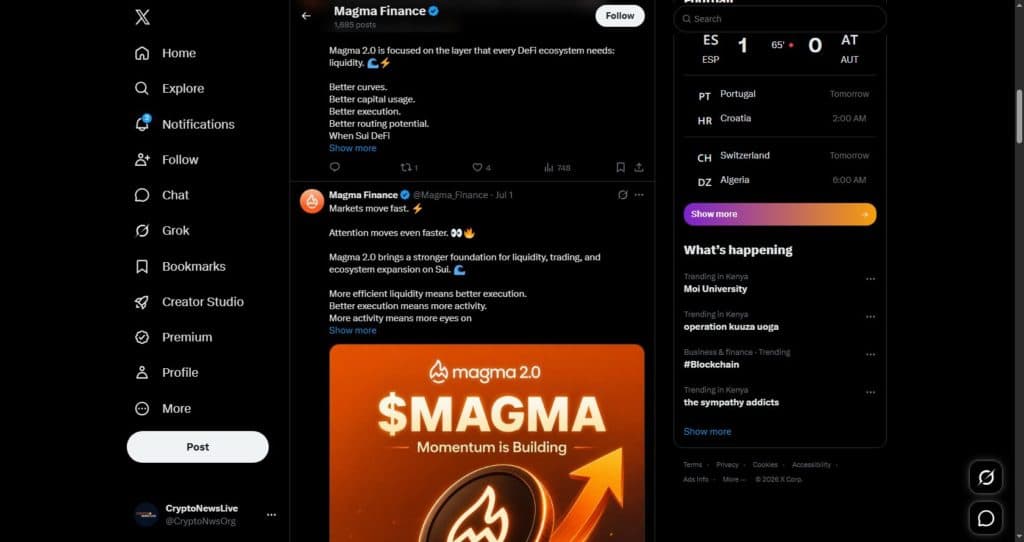
@Magma_Finance on X, July 1, 2026: “Markets move fast. Attention moves even faster. Magma 2.0 brings a stronger foundation for liquidity, trading, and ecosystem expansion on Sui,” with a graphic reading “magma 2.0 $MAGMA Momentum is Building.” Source: X / @Magma_Finance
Hours before this article published, another post repeated the same message: better curves, better execution, more eyes on the token.
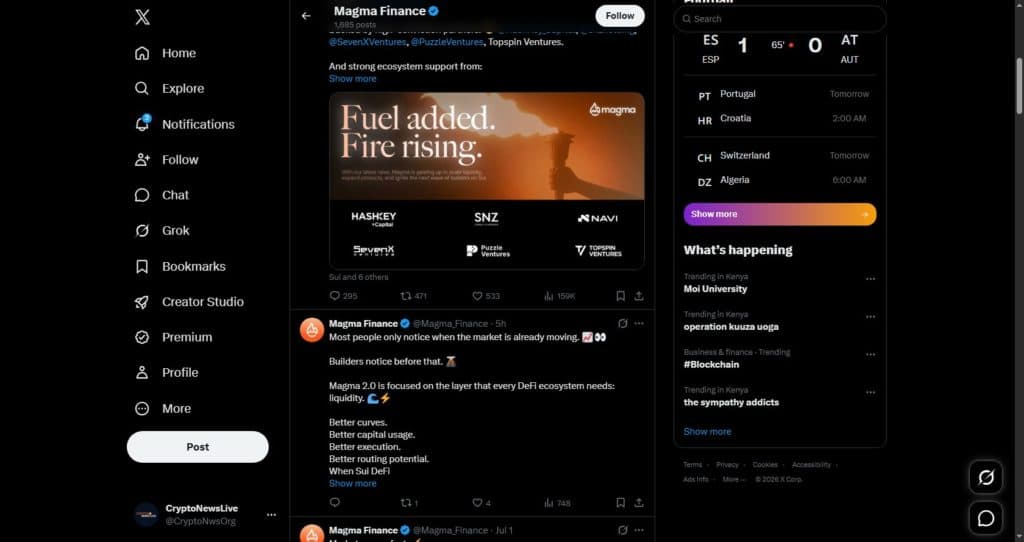
@Magma_Finance on X, posted hours before this research: “Most people only notice when the market is already moving. Builders notice before that. Magma 2.0 is focused on the layer that every DeFi ecosystem needs: liquidity. Better curves. Better capital usage. Better execution. Better routing potential.” Same screenshot also shows the December 8, 2025 funding graphic higher on the timeline. Source: X / @Magma_Finance
That sequence lines up with the price move far better than the Binance Alpha listing does. Binance Alpha added MAGMA on December 16, 2025. That is 198 days old.
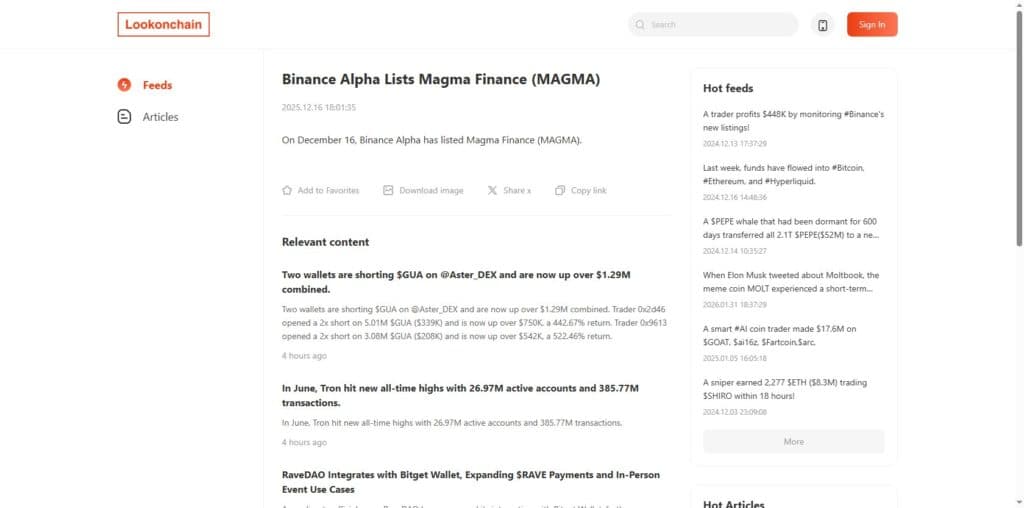
Lookonchain feed post dated December 16, 2025: “On December 16, Binance Alpha has listed Magma Finance (MAGMA).” Linked from CoinGecko’s own Insights sidebar as the token’s most recent tracked event, confirming the listing is 198 days old and unrelated to today’s move. Source: Lookonchain
Priced in months ago. Not today’s driver.
Magma 2.0 introduces what the team calls a propAMM, a pricing engine that blends off-chain quote generation with on-chain settlement. The project’s homepage banner confirms it directly: “2.0 is live.” The roadmap section on the same page lists this exact release under “2026 Q2-Q3, Mainnet Launch.”
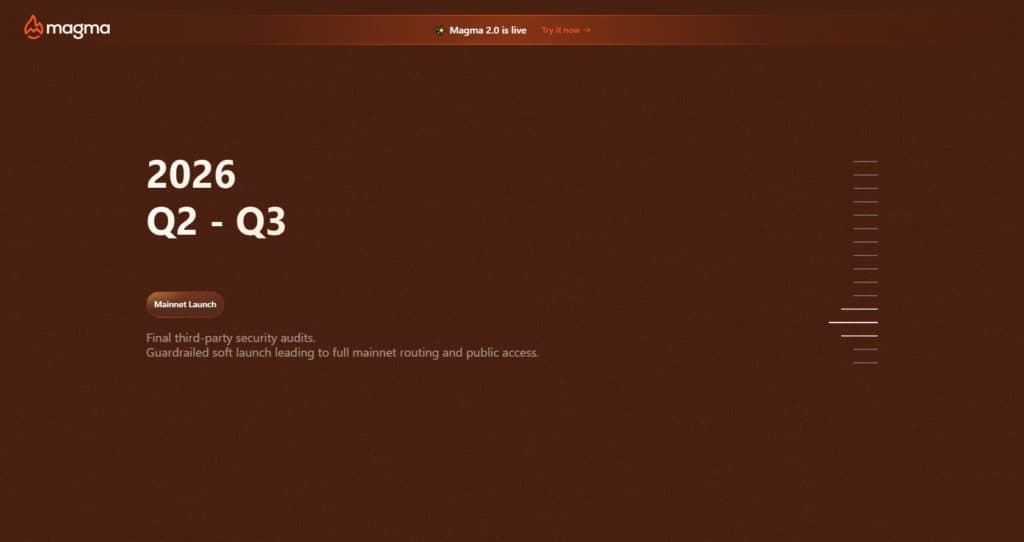
Magma Finance official website roadmap section, July 2, 2026: “2026 Q2-Q3, Mainnet Launch. Final third-party security audits. Guardrailed soft launch leading to full mainnet routing and public access.” The “Magma 2.0 is live” banner is visible at the top of the same page. Source: Magma Finance
Three independent security firms, Zellic, MoveBit and Three Sigma, have reviewed earlier versions of the protocol’s contracts with reports posted publicly. Whether the propAMM code itself has completed a separate final audit is not yet confirmed, since the roadmap above still lists “final third-party security audits” as part of the ongoing rollout, not a finished step.
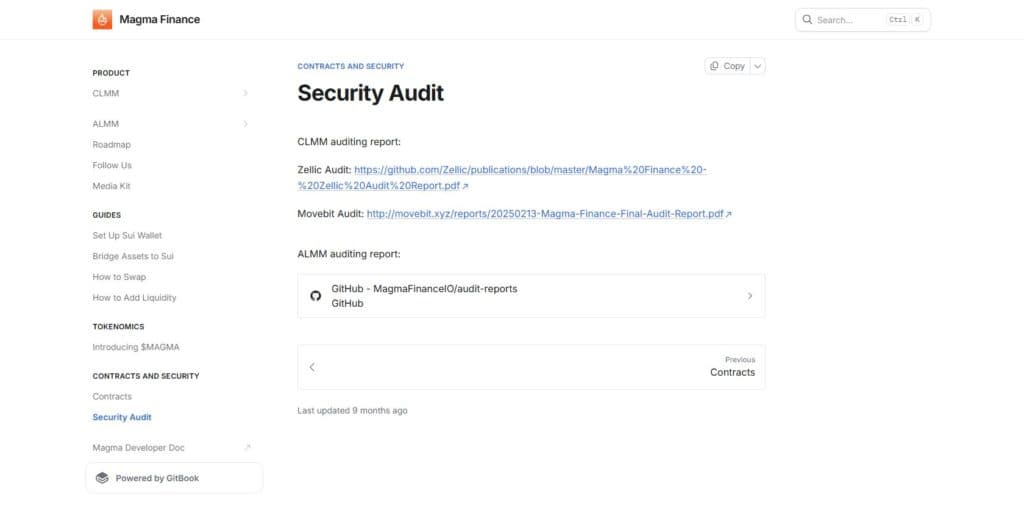
Magma Finance documentation, Security Audit page: CLMM audited by Zellic and MoveBit with public report links; ALMM audit reports linked via GitHub. Page marked “last updated 9 months ago,” predating the Magma 2.0 propAMM release. Source: Magma Finance Docs
Sector Peers Barely Moved
Cetus, the largest Sui-native DEX by trading volume, rose 2.4% over the same 24 hours. Turbos Finance, another Sui AMM, moved 0.3%. Neither peer came close to Magma’s 49%. Whatever is driving this rally belongs to Magma Finance specifically, not Sui DeFi as a sector.
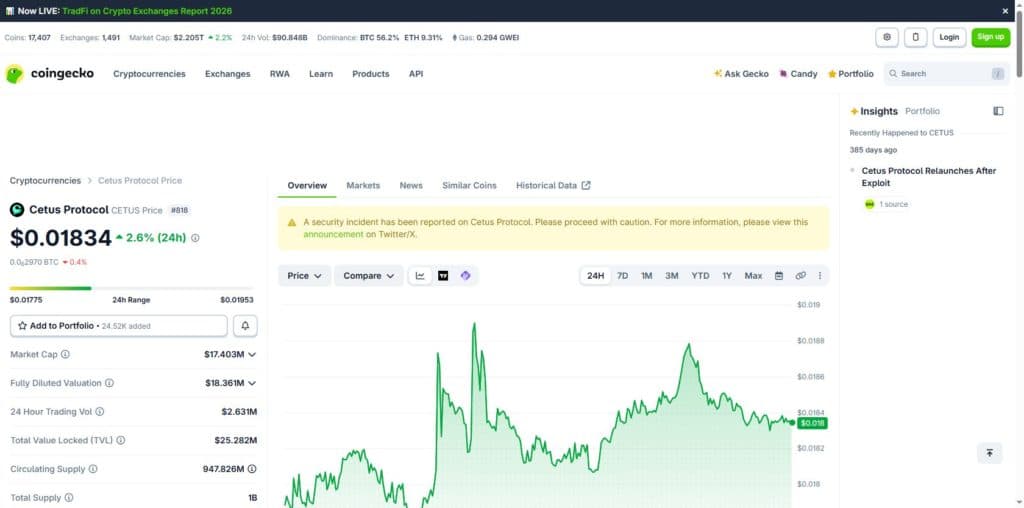
Cetus Protocol on CoinGecko, July 2, 2026: +2.4% (24h), +10.8% (7d). Cetus is the largest Sui-native DEX by trading volume, used here as the primary sector peer comparison. Source: CoinGecko
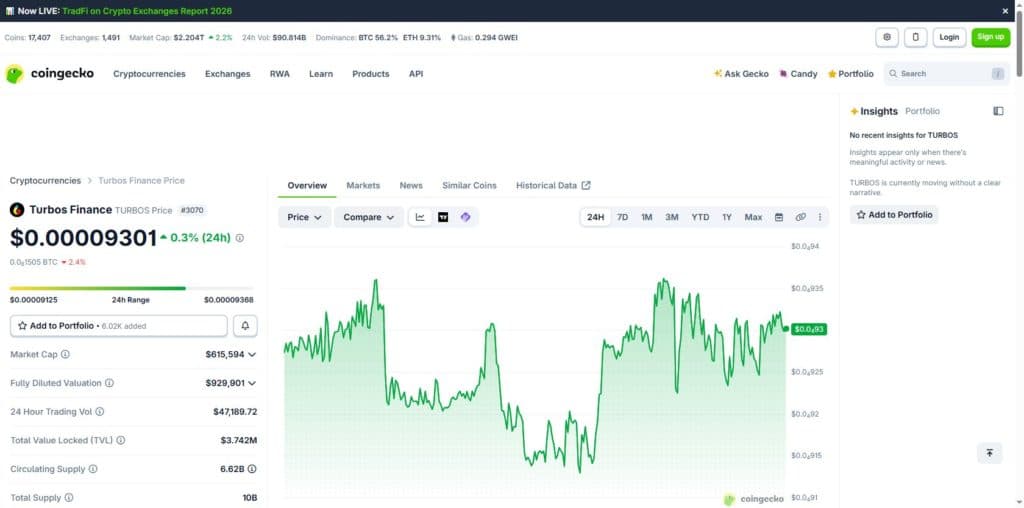
Turbos Finance on CoinGecko, July 2, 2026: +0.3% (24h), essentially flat. CoinGecko’s own Insights panel notes “TURBOS is currently moving without a clear narrative.” Source: CoinGecko
CoinGecko’s own comparison data backs that reading up. MAGMA’s 7-day return of 37% to 39% outpaces both the broader crypto market, up 3.4% over the same window, and the DeFi category, up 1.3%, by a wide margin.
Three Wallets, One Transaction, 94 Days
Here is where the caution belongs. Suiscan’s holder list shows 17,010 addresses holding MAGMA. Just three of them control 810 million tokens, 81% of the fixed 1 billion supply. Wallet one holds 510 million tokens, worth roughly $260 million at today’s price. Wallets two and three hold 150 million each.
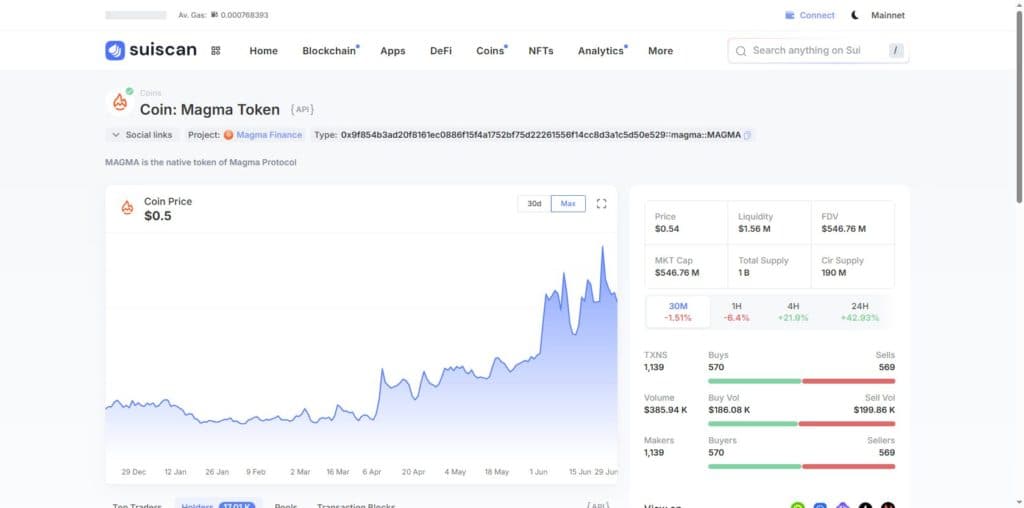
Suiscan holder list for MAGMA, July 2, 2026: 17,010 total holders. Top 3 wallets hold 51%, 15% and 15% of total supply respectively. Wallets ranked 4 through 10 hold between 0.9% and 5.14% each. Source: Suiscan
None of the three are smart contracts. A direct query against Sui’s mainnet RPC (method sui_getObject) returned “notExists” as an object for all three addresses, confirming each is a regular address, the kind controlled by a private key rather than a vesting mechanism that enforces a lockup on its own.
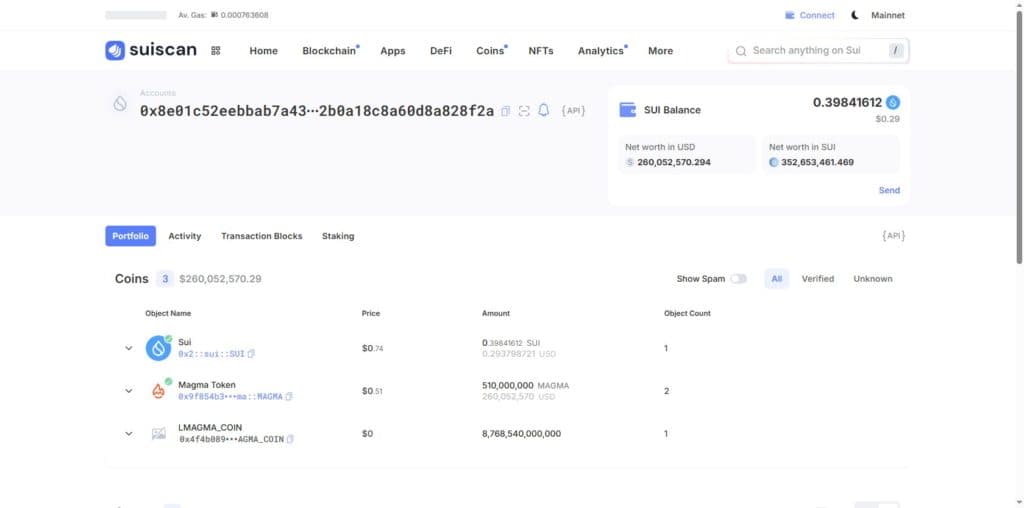
Top holder wallet (51% of supply) portfolio on Suiscan: 510,000,000 MAGMA (~$260,052,570), plus a near-empty 0.398 SUI gas balance ($0.29), consistent with an inactive holding wallet rather than an actively-traded one. Source: Suiscan
That sounds worse than what the chain actually shows. Each of the three wallets has sent exactly one transaction in its entire history. All three are dated 94 days ago. All three carry an identical gas fee of 0.00158388 SUI. None have ever sent tokens toward a known exchange address. They were set up together in a single batch operation in late March and have not moved since.
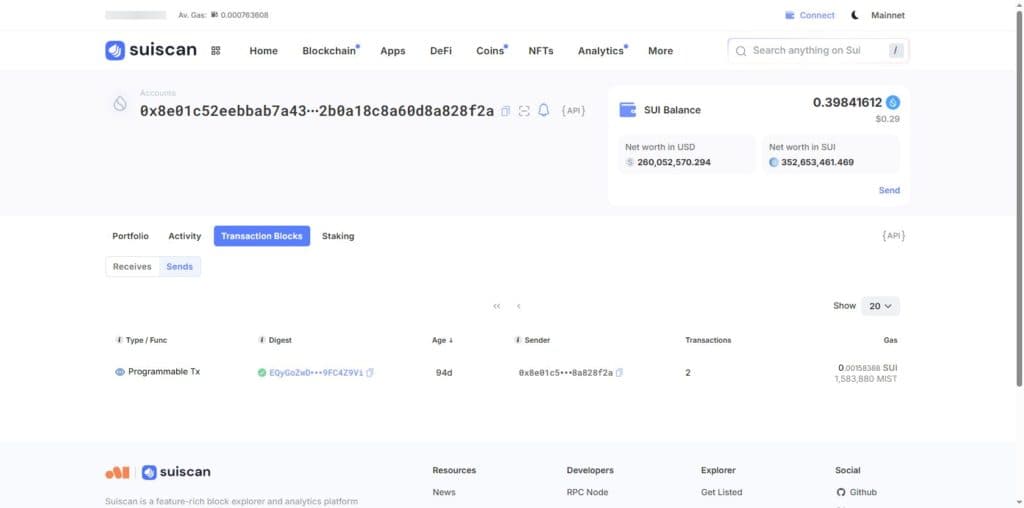
Top holder wallet (51%) send history on Suiscan: exactly one outbound transaction, 94 days old, gas fee 0.00158388 SUI. No exchange transfers found in the full history. Source: Suiscan
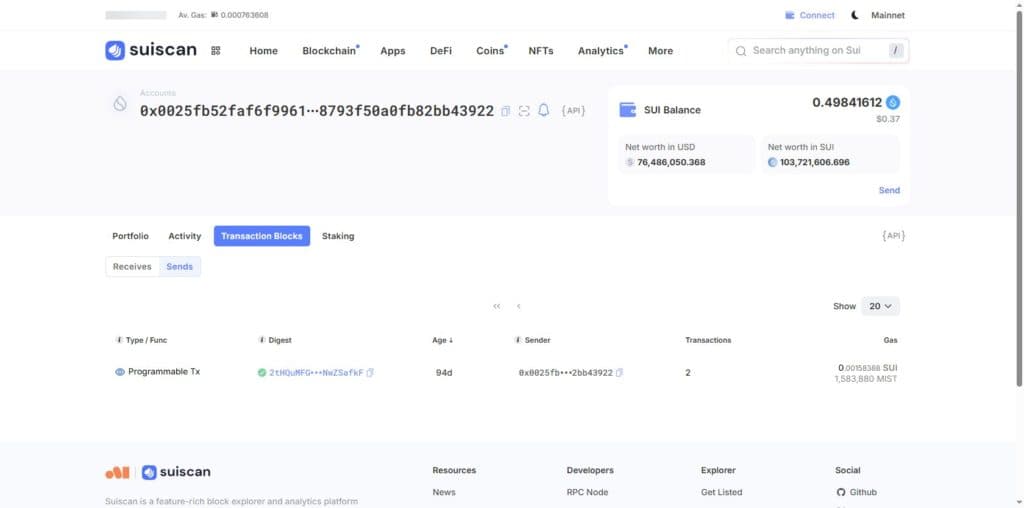
Second-largest holder wallet (15%) send history: exactly one outbound transaction, 94 days old, identical 0.00158388 SUI gas fee to wallet 1, indicating a coordinated batch setup. No exchange transfers found. Source: Suiscan
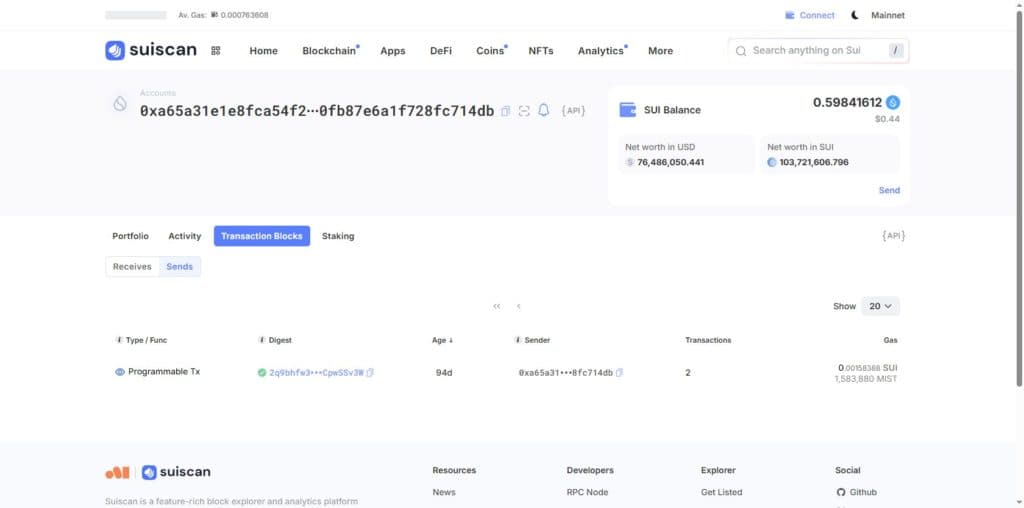
Third-largest holder wallet (15%) send history: exactly one outbound transaction, 94 days old, identical gas fee. No exchange transfers found. All three top wallets show the same dormant pattern. Source: Suiscan
The Math That Checks Out
CoinGecko lists MAGMA’s circulating supply at 190 million against a 1 billion total. Subtract the three dormant wallets’ 810 million from that 1 billion and the answer lands almost exactly on 190 million. The self-reported circulating figure matches on-chain reality within rounding error. That is a rarer finding than it should be.
No published vesting schedule explains what those three wallets represent, though. Magma’s tokenomics documentation lists total supply and token utility categories, but no allocation table, no cliff, no vesting months.
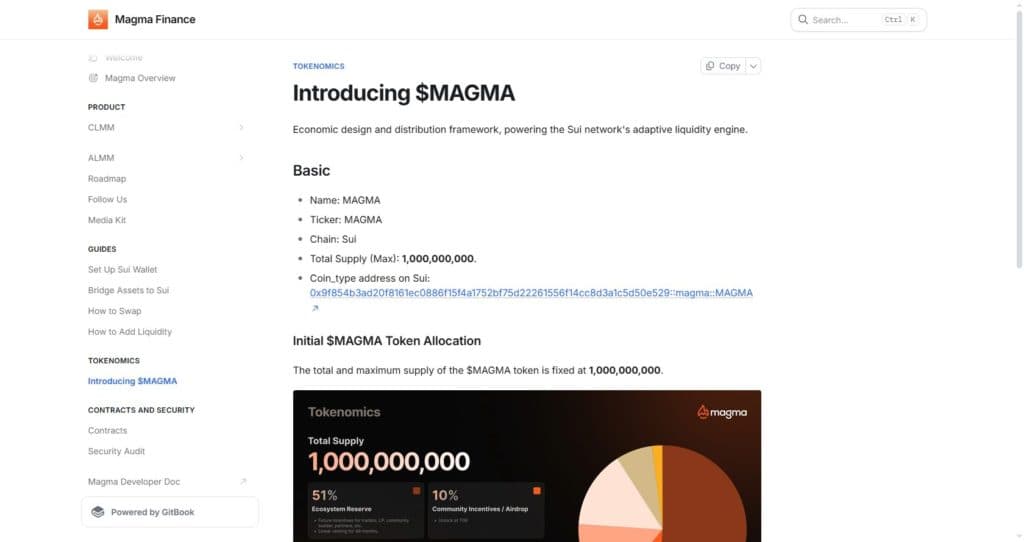
Magma Finance documentation, “Introducing $MAGMA” tokenomics page, July 2, 2026: lists total/max supply (1,000,000,000) and three token utility categories (governance, incentives and compensation, loyalty and access). No allocation percentages, cliff dates, or vesting months are published anywhere on the page. Source: Magma Finance Docs
Tokenomist, formerly Token.unlocks.app, has no listing for MAGMA at all. Readers are left inferring team or treasury holdings from wallet size and the supply math, not confirming it against an official schedule.
Tokenomist.ai search for “magma” returns “No results match your filters,” confirming no independent unlock tracker has data for this token, checked July 2, 2026. Source: Tokenomist
| Circulating supply (CoinGecko) | 190,000,000 MAGMA |
| Total / max supply (Suiscan, on-chain) | 1,000,000,000 MAGMA |
| Top 3 wallets combined | 810,000,000 MAGMA (81%) |
| Total minus top-3 wallets | 190,000,000 MAGMA (matches circulating supply) |
| FV / market cap ratio | ~5.3x |
What $100,000 Actually Costs
A $1,000 buy quoted through the FlowX-routed widget on Birdeye moves the price by less than 0.01%.
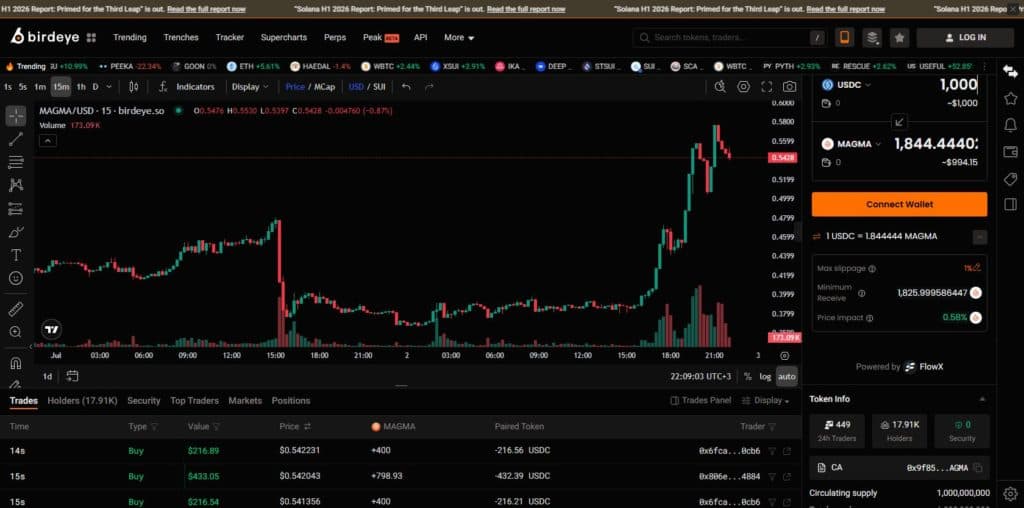
$1,000 USDC to MAGMA buy quote via Birdeye’s FlowX-routed aggregator widget: 1,851.94 MAGMA received, price impact under 0.01%. Quote only, no swap executed. Source: Birdeye
Move up to $10,000 and the impact reaches 0.77%.
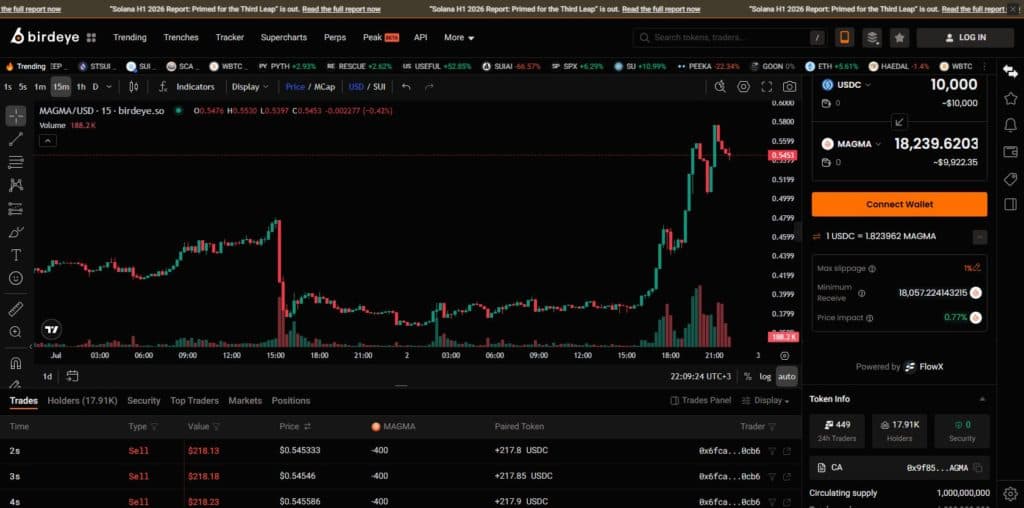
$10,000 USDC to MAGMA buy quote: 18,239.62 MAGMA received, price impact 0.77%. Source: Birdeye
Push to $100,000 and price impact lands at roughly 5%, a level the aggregator’s own interface flags as high. For a token whose primary pool holds about $2.1 million, that is close to the practical ceiling before slippage starts eating meaningfully into a trade.
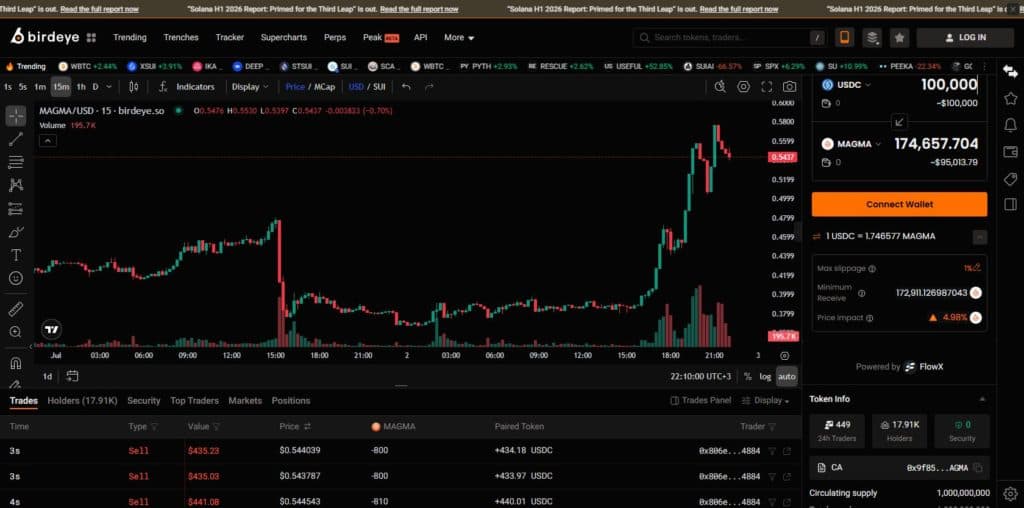
$100,000 USDC to MAGMA buy quote: 174,657.70 MAGMA received, price impact 4.98% to 5.11% across repeated quotes as the live market moved between checks, flagged “high” by Birdeye’s own interface. Sell-side direction was not independently re-verified in this session due to a widget UI limitation. Source: Birdeye
DEX Screener’s transaction data shows buys outnumbering sells across every timeframe checked, from the last hour out to 24 hours, at a consistent ratio rather than a coin-flip split. Live totals at check time: 23,514 transactions, 12,642 buys against 10,872 sells. That is not the equal-ratio pattern typical of wash trading. It reads as organic demand, for now.
Contracts That Cannot Be Changed
Move packages on Sui carry an owner field, and Magma’s carries a notable one. A direct query against Sui’s mainnet RPC (fullnode.mainnet.sui.io, method sui_getObject) returned this result for the MAGMA coin package:
{“objectId”:”0x9f854b3ad20f8161ec0886f15f4a1752bf75d22261556f14cc8d3a1c5d50e529″,”type”:”package”,”owner”:”Immutable”,”version”:”1″}
The core ALMM protocol package (0xc7f4524aad685d7a334b559aea1a1464287a2a62d571243be1877ef53e2a916b) returned the identical owner field: “Immutable.” Neither package can be upgraded, by anyone, ever. Total supply already sits at the 1 billion maximum per both CoinGecko and Suiscan, meaning no further tokens can enter existence under the current code no matter who might want to mint them.
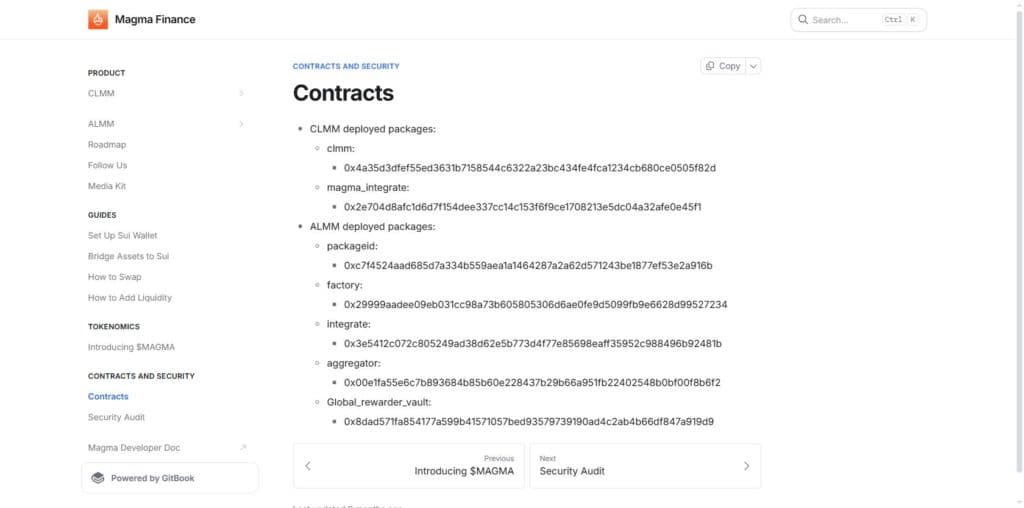
Magma Finance documentation, Contracts page, listing the deployed CLMM and ALMM package IDs on Sui used to run the immutability check above. Source: Magma Finance Docs
For comparison, CryptoNewsLive covered a similar concentration story with The Black Bull, where one wallet controls 60% of supply, and a cliff-driven surge in VELVET, which rallied 242% ahead of a $574 million team unlock. MAGMA’s setup differs from both: its concentrated wallets are dormant rather than approaching a scheduled release.
What Comes Next for MAGMA
Magma’s roadmap lists final third-party security audits for the 2.0 propAMM as part of the ongoing Q2-Q3 2026 rollout window, not yet confirmed complete as of July 2, 2026, per the same roadmap screenshot shown earlier. The three dormant wallets holding 810 million tokens have no scheduled unlock date on record, so any movement from them would be unscheduled by definition and worth tracking on-chain. DeFiLlama shows Magma’s total value locked at $2.02 million, down sharply from a November 2025 peak near $33 million; whether the 2.0 launch pulls fresh liquidity back over the coming weeks is a question the daily fee data will answer first.
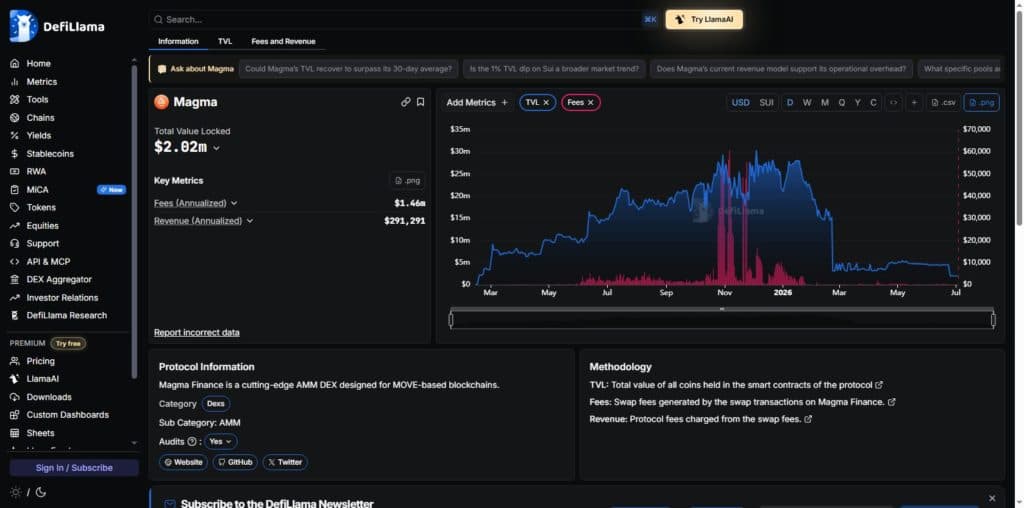
DeFiLlama TVL for Magma (Sui DEX, slug “magma”), July 2, 2026: $2.02M current TVL, down from a peak near $33M in November 2025. Annualized fees $1.46M, annualized revenue $291,291. Note: DeFiLlama also lists an unrelated protocol named “Magma Finance” on IoTeX (slug magma-finance); this chart uses the correct Sui-based entry, confirmed via the DeFiLlama protocols API. Source: DeFiLlama
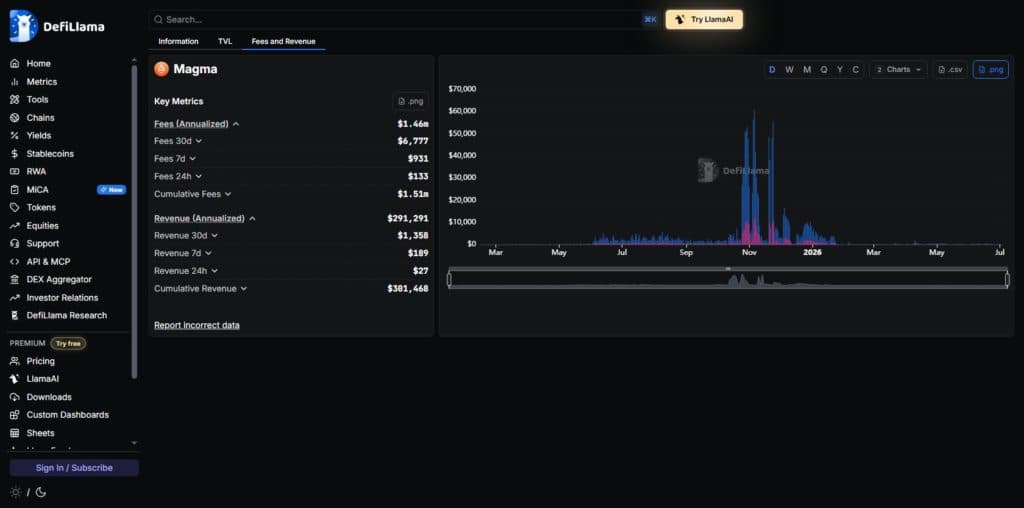
DeFiLlama Fees and Revenue tab for Magma: 24h fees $133, 7d $931, 30d $6,777, cumulative $1.51M. Revenue 24h $27, 7d $189, 30d $1,358. Current daily figures are a small fraction of the Oct/Nov 2025 peak visible on the same chart, which shows single-day fee spikes near $70,000. Source: DeFiLlama
If the Setup Holds, or Doesn’t
If Magma 2.0’s propAMM draws sustained trading volume back toward the levels DeFiLlama recorded in October and November 2025, daily fees would need to climb well past the current $133 to get there, since that period saw single-day fee spikes near $70,000 on the protocol’s own chart. If any of the three dormant wallets move a meaningful share of their 810 million tokens toward an exchange address, sell pressure would follow because that volume is roughly 4.3 times the entire current circulating float of 190 million tokens.
MAGMA trades 21.5% below its all-time high of $0.7289, set six days ago on June 26, and 718% above its all-time low of $0.06971 from April 2. Both records sit inside the same three-month window that also contains today’s move.