Venice, the privacy-focused AI platform behind the VVV token, closed a $65 million Series A on July 1, 2026. Dragonfly led the round, with Coinbase Ventures, F-Prime, and North Island Ventures joining. VVV dropped anyway.
The company’s own blog post puts a billion-dollar price tag on the equity round, the first outside money Venice has ever taken since Erik Voorhees, who previously founded ShapeShift, started the project in 2024. None of that stopped the token from sliding. At $10.44, VVV sits 15.1 percent below where it traded seven days ago and 21.2 percent below its level two weeks back, even as directly comparable AI tokens, Diem, Dolphin, Morpheus AI, all traded red the same day for reasons that look sector-wide rather than Venice-specific.
A Quieter Line Buried in the Announcement
Most coverage of this raise will fixate on the valuation number. Three paragraphs into Venice’s own writeup sits something a token holder should weigh more heavily: VVV’s annual emissions dropped from 4 million tokens to 3 million, effective the same July 1 date as the funding news. A 25% cut to new supply hitting the market every year, confirmed directly from the company, not rumored.
Pair that with the burn side of the ledger and the picture turns genuinely deflationary. Venice’s own token dashboard puts total VVV burned at 33.76 million, 41.9 percent of the project’s self-reported supply, destroyed through a March 2025 unclaimed-airdrop burn and an ongoing monthly buyback funded from real revenue. That revenue is not flat.
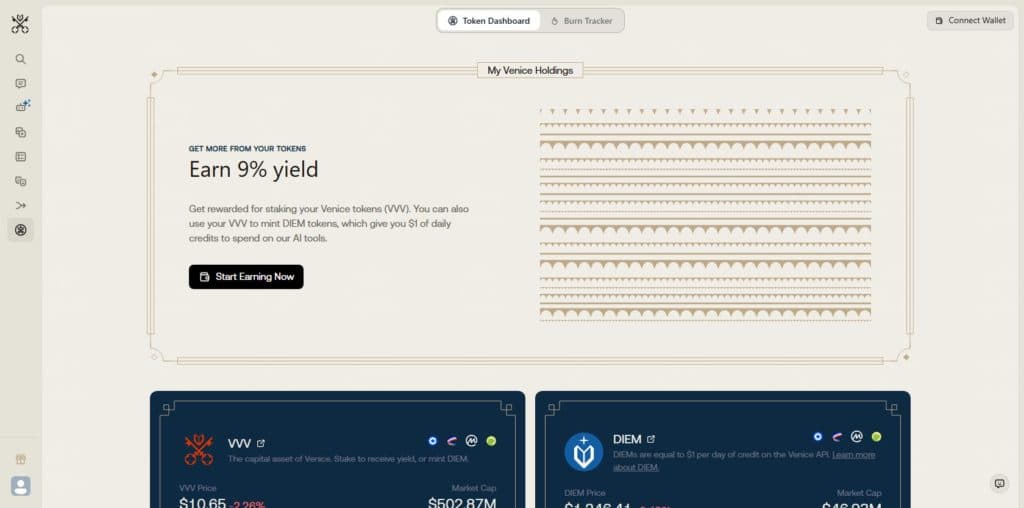
Venice official token dashboard: 33.76M VVV burned, 41.90% of total supply, monthly buy-and-burn chart climbing since December 2025. Source: venice.ai/token
Gross protocol revenue on DeFiLlama went from $64,400 in the fourth quarter of 2025 to $275,080 in the first quarter of 2026 to $623,920 in the second, a fee line that nearly quadrupled and then more than doubled across back-to-back quarters.
Real growth, verified twice.
Whose Supply Number Do You Believe
Here is where things get messier. CoinGecko states VVV’s total supply at 80.553 million tokens. Venice’s own dashboard agrees, down to the decimal. BaseScan, reading straight off the contract’s own totalSupply() function, returns a different number entirely: 114,308,530.
Not a typo, and not a stale cache. Matcha’s GoPlus-powered token panel and DeFiLlama’s own “Outstanding FDV” metric both land on that same higher figure independently.
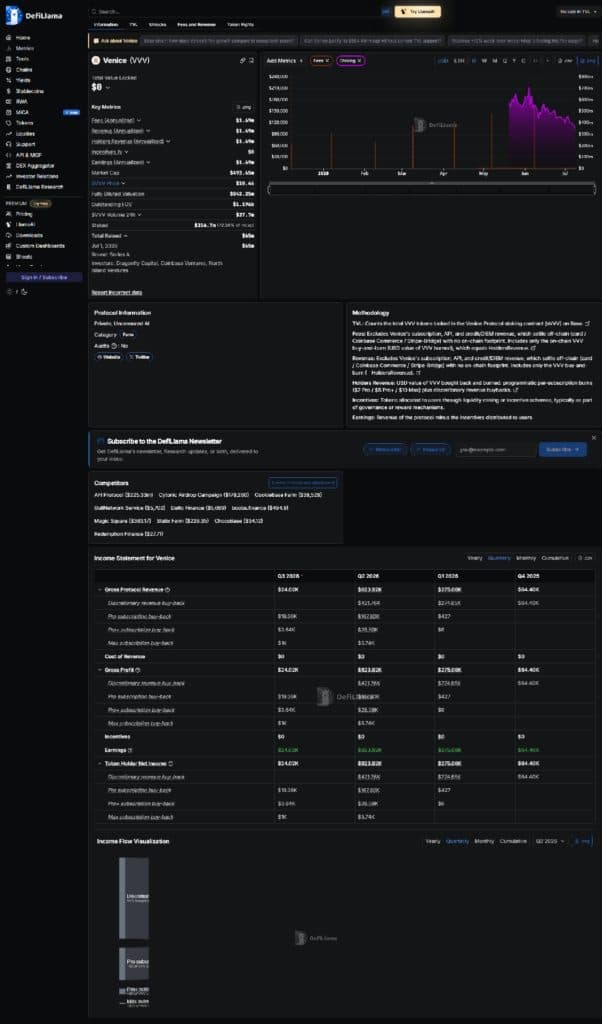
DeFiLlama Venice protocol page: Fully Diluted Valuation $842.25M vs Outstanding FDV $1.196B, Staked $356.7M (72.26% of mcap), Total Raised $65M Series A. Source: DeFiLlama
The gap traces to how the burn mechanism actually works. Venice sends destroyed VVV to the null address rather than calling a function that decrements the contract’s internal counter, so BaseScan‘s totalSupply() still counts 33.76 million already-burned tokens as if they exist. CoinGecko and Venice’s own dashboard net that figure out. BaseScan, and everyone reading straight off it, does not.
Depending which number gets used, VVV’s fully diluted value is either $842 million or $1.2 billion. Tokenomist adds a third figure, $1.53 billion, by projecting the current emission schedule out to the year 2035, since Venice’s supply has no hard cap and technically runs forever. None of the three is wrong. Each answers a slightly different question about what supply even means for a token engineered to keep minting indefinitely.
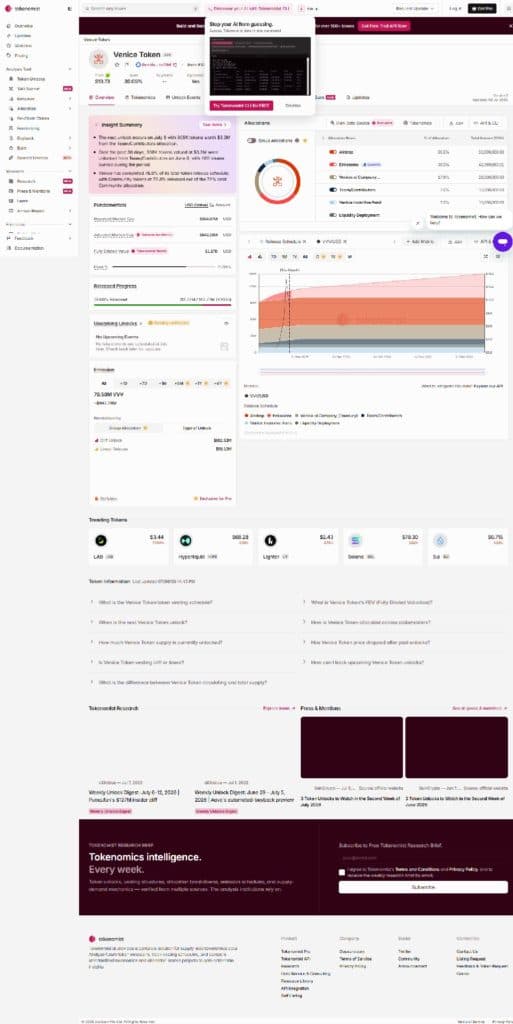
Tokenomist unlock tracker for Venice Token: allocation breakdown, 30.05% burned, no confirmed hard cap, Team/Contributors unlock detail. Source: tokenomist.ai
The Mint Function Nobody’s Personal Key Controls
That supply ambiguity traces to something concrete in the contract itself. Reading Venice’s verified source on Basescan confirms a mint() function with no cap check anywhere in the bytecode, gated only by a standard owner permission from the solmate library. Calling owner() directly against Base’s RPC turns up the more interesting fact: the current owner is not a person’s wallet, not Venice’s deployer address, and not even a company multisig.
It is the sVVV staking contract itself, at 0x321b7ff7, the same address that already holds 29.18 percent of everything in circulation and doubles as the token’s second-largest holder.
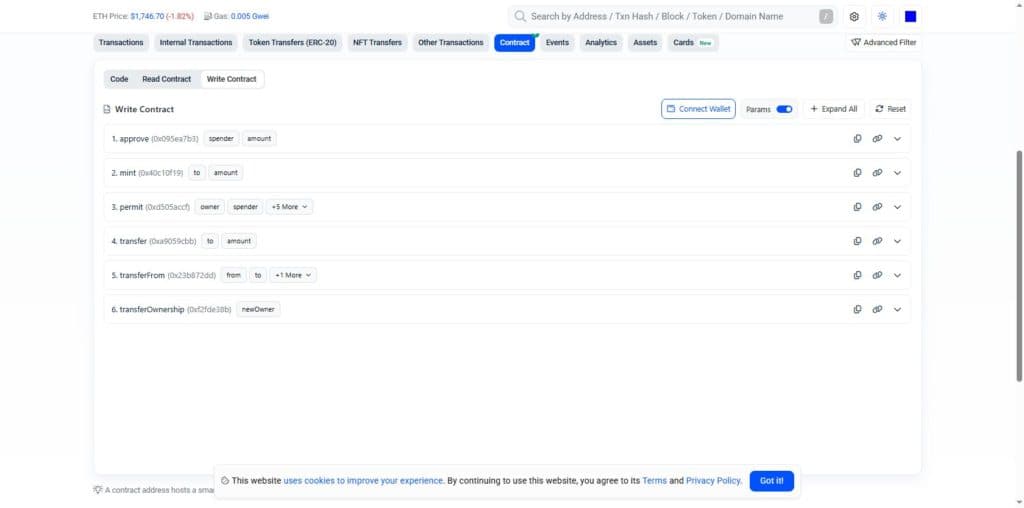
Venice Token Write Contract tab on BaseScan: approve, mint, permit, transfer, transferFrom, transferOwnership. No pause, blacklist, or fee functions exist. Source: BaseScan
New VVV gets minted through the staking contract’s own internal logic, in other words, rather than through a discretionary call from whoever holds a private key. This research did not extend to auditing that staking contract’s own code, so whether its minting trigger is strictly schedule-bound or carries some separate override remains a fair question for someone else to chase down.
The Whale That Was Actually the Treasury
Holder concentration on VVV looks alarming until the top ten get broken down individually. BaseScan puts the top 100 wallets at 98.07 percent of supply and a Gini score of 0.9997, about as concentrated as a distribution can get on paper.
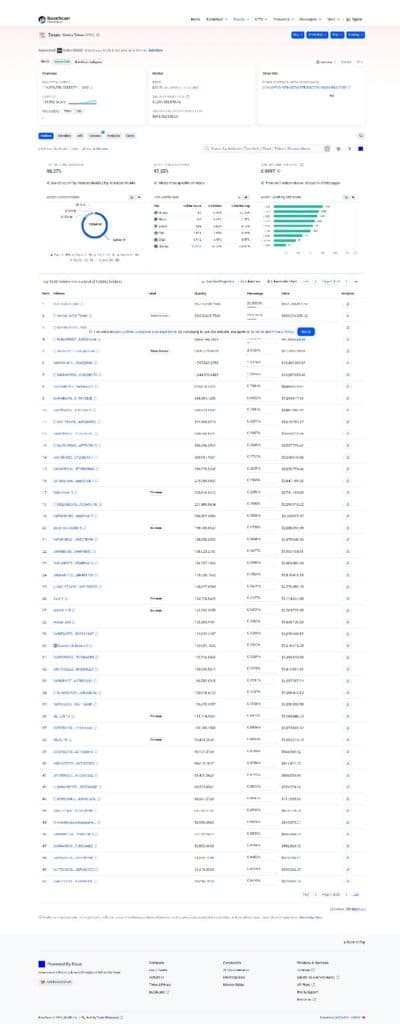
BaseScan top VVV holders: rank 1 null/burn address 29.53%, rank 2 sVVV staking contract 29.18%, rank 3 unlabeled treasury multisig 18.19%. Source: BaseScan
Rank one is the null address, holding the 33.76 million already-burned tokens at 29.53 percent. Rank two is the sVVV staking contract, the same address that controls mint(), at 29.18 percent. Rank three, 18.19 percent and roughly $218 million, looked at first glance like an unlabeled whale wallet.
Then the contract’s own constructor arguments, verified on the same page, name that exact address as “treasury.” Rank four, another 7.32 percent worth roughly $88 million, is also a Gnosis Safe multisig rather than a private-key wallet, though BaseScan carries no name tag for it. Rank five belongs to Sablier’s LockupLinear contract, the streaming-payments protocol behind Venice’s 24-month team vesting.
Add up what is genuinely still an unlabeled, ordinary wallet inside the top ten and the total comes to under five percent combined. The 91.34% top-ten concentration figure is real. Most of it is burn infrastructure, a staking contract, a named treasury, and a vesting stream, not a handful of people who could dump on the open market tomorrow morning.
What Lands in Wallets Today
One exception earns its own callout. Per Tokenomist’s unlock tracker, roughly 308,000 VVV, worth about $3.3 million at current prices, unlocks today, July 8, from the Team and Contributors allocation. The same amount released a month earlier, on June 8, which fits a straight monthly vesting line rather than a single cliff event.
$3.3 million against a token trading $5.6 million a day across its DEX pools alone, before counting Coinbase volume, is not nothing. It is also nowhere near large enough by itself to swamp the order book.
A Peak That Was Not Really a Peak
CoinGecko’s own banner states VVV’s all-time high at $22.58, set January 27, 2025, the exact day the token’s first liquidity pool went live on Aerodrome. Pulling the raw daily price series straight from that same chart, though, the highest close anywhere in eighteen months of trading is $20.82, hit June 3, 2026, barely five weeks before this article went to print.
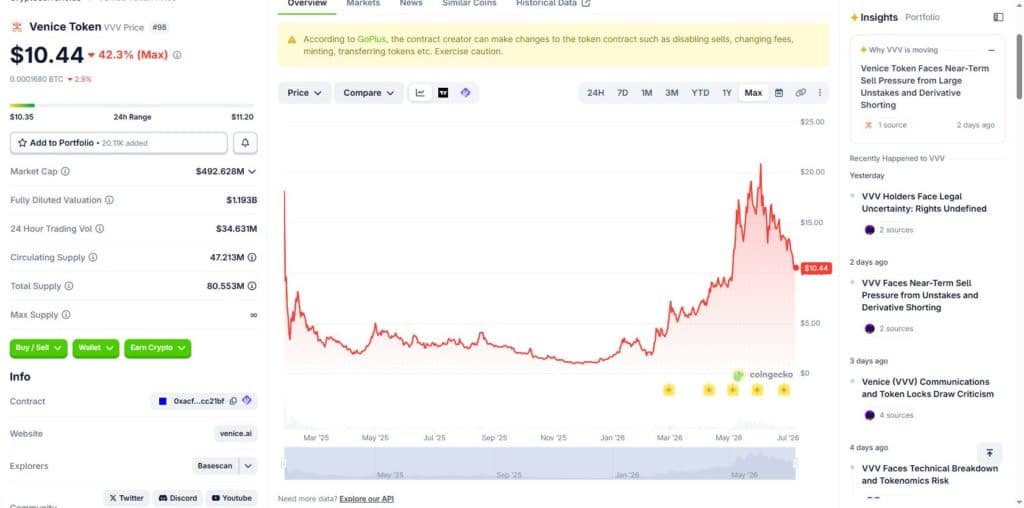
VVV full price history on CoinGecko: launch-day spike near ATH followed by a crash to the December 2025 low, then a rally to $20.82 in June 2026. Source: CoinGecko
A launch-day print, made before any real market had formed around the token, is doing the work of an “all-time high” label. A more honest read: VVV traded within about 8 percent of its actual multi-year high just over a month ago, not 53.8 percent below some untouchable early peak.
Sizing a Trade Nobody Should Have to Guess At
For anyone deciding whether to actually buy or sell VVV, execution turned out to be the pleasant surprise in all of this. Quoting trades through Matcha’s aggregator, a $100,000 buy moves price by only 0.35 percent, split automatically across as many as eight liquidity venues at once. Selling the same size costs 0.21 percent. Even a $1,000 test came back near-identical in both directions.
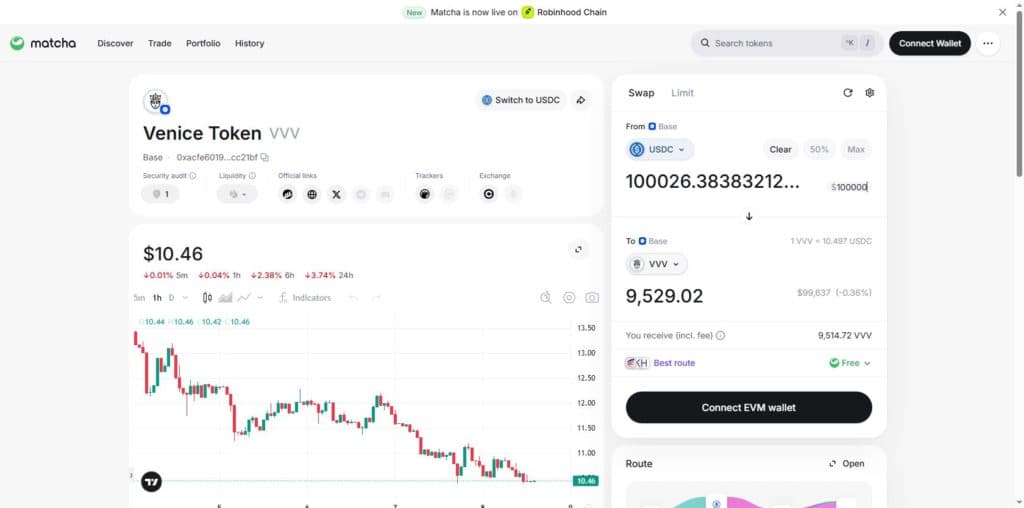
Matcha quote for a $100,000 VVV buy: 0.35% price impact, route split across 8 venues including Aerodrome, PancakeSwap V3, and 0x RFQ. Source: Matcha
That is despite just $12.27 million in total on-chain liquidity spread thin across thirty separate pools, none of which alone could absorb a six-figure order cleanly. The aggregator does what any single pool cannot.
Two independent honeypot simulators both came back clean. Honeypot.is and the GoPlus check built into Matcha each show zero percent tax on buys, sells, and transfers, no wallet limits, and every one of 451 recently active holders honeypot.is tested was able to sell without issue. No third-party security audit has ever been submitted for the contract, a fact confirmed on both BaseScan and DeFiLlama, worth knowing even though nothing in the code itself looks unusually dangerous.
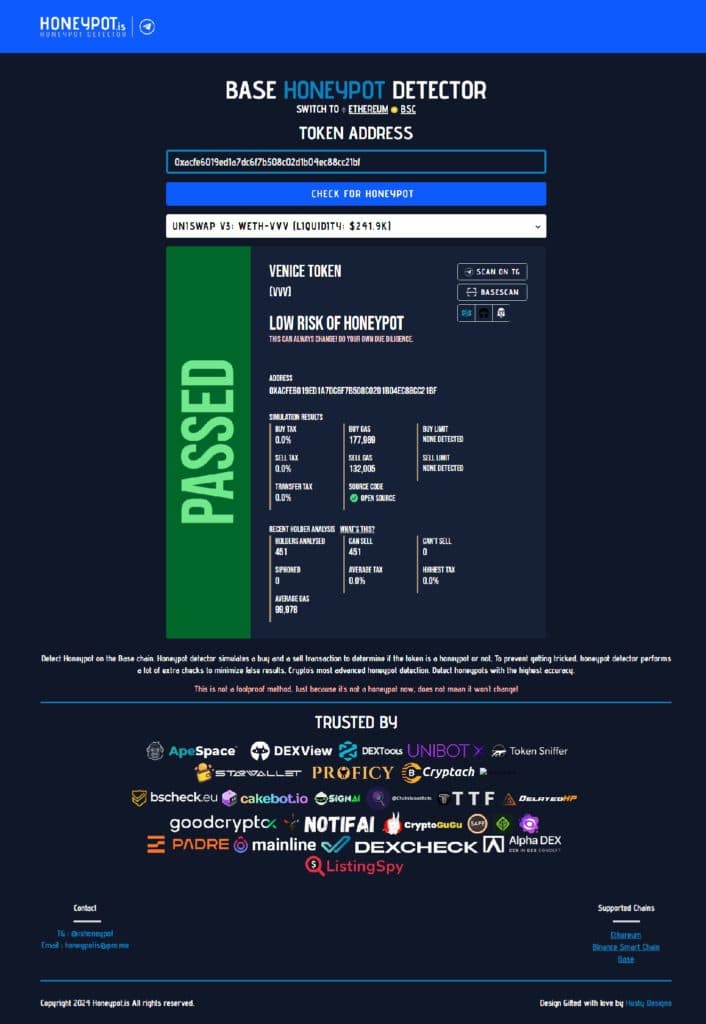
Honeypot.is simulation for VVV: PASSED, low risk, 0% buy/sell/transfer tax, 451/451 recently analyzed holders able to sell. Source: honeypot.is
What to Watch Next
Four dated items carry forward from here. Today, July 8, roughly 308,000 VVV unlocks from the Team allocation, matching the amount released a month prior; the next such release should land around August 8 if the linear schedule holds pace. Venice’s emissions rate, cut from 4 million to 3 million VVV a year on July 1, is now in effect and should show up as slower net new supply from this point forward. The buy-and-burn program, funded by a revenue line that more than doubled between the first and second quarters of 2026, has no confirmed next disclosure date, but its trend updates every quarter on DeFiLlama and is worth checking again after Q3 closes.
Where the Setup Cuts Both Ways
On the numbers gathered here, the case for VVV rests on emissions slowing, burns continuing at their current pace, and the roughly 72 percent of market-cap value currently staked staying locked rather than unwinding. The case against it rests on the recurring monthly team unlock eventually outweighing burn-and-stake demand, and on the fact that no external audit has ever reviewed a contract now controlling close to half a billion dollars in circulating value, whatever its stated supply turns out to be.