Sentient SENT token gained roughly 26 percent in the 24 hours before this was written. Price moved from about $0.0138 to $0.01748, and volume on CoinGecko jumped 530 percent against the prior day.
The cause is not a mystery. Robinhood’s official account posted at 5:01 PM on July 9: new asset, now tradable on Robinhood Crypto. The post is dated, verified, and sits inside the price window itself. What is less obvious, and took longer to check, is a completely different claim that has followed this token around since April.
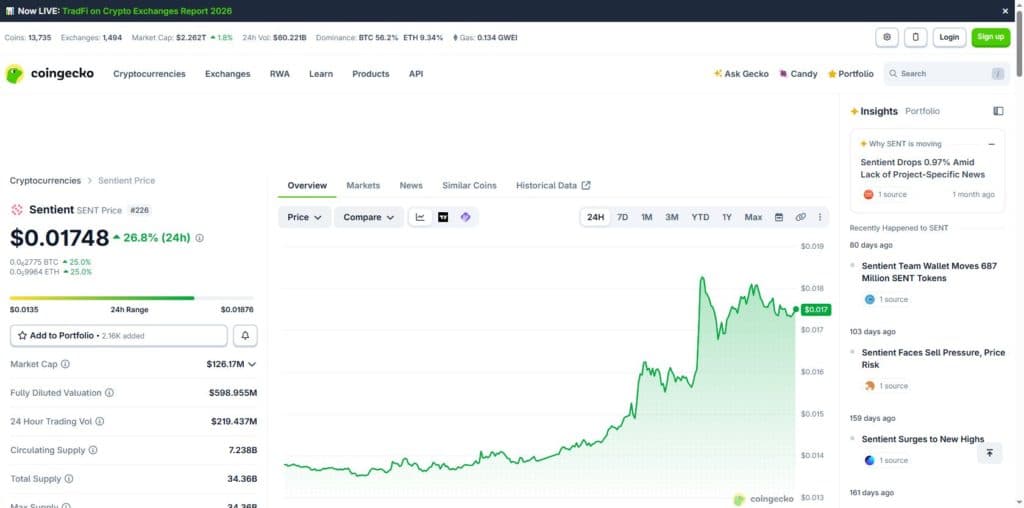
Sentient (SENT) on CoinGecko, July 10 2026: price $0.01748, up 26.8% in 24 hours, market cap $126.17M. Source: CoinGecko
An Announcement That Actually Explains the Move
Robinhood’s own post reads: “New asset now available to trade on Robinhood Crypto,” followed by the $SENT cashtag. Lookonchain picked it up within hours. Nothing about the timing is ambiguous. A dated, official, top-tier brokerage listing landed inside the same window as a 26 percent move. That is about as clean a cause-and-effect as on-chain research gets.
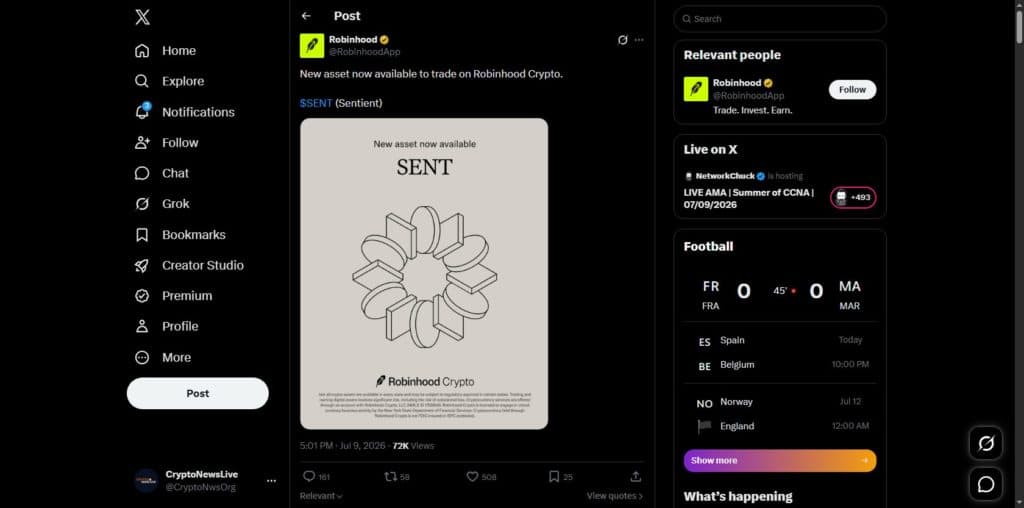
Robinhood’s official X post, 5:01 PM July 9 2026: “New asset now available to trade on Robinhood Crypto. $SENT (Sentient).” Source: x.com/RobinhoodApp
It is not the first time a listing has done this. Two exchange announcements roughly 161 and 163 days ago, OKX and a dual Upbit-Bithumb listing, preceded a reported jump to a $225 million market cap. A month ago, with no news to point to, CoinGecko’s own tracker flagged the opposite: SENT drifted down about 1 percent “amid lack of project-specific news.” This is a token that moves on headlines, not on drift.
A Wallet That Isn’t What Headlines Called It
Eighty days ago, a story spread that a “Sentient team wallet” had moved 687 million SENT tokens. It has been repeated since as shorthand for insider risk. Checking it against the token’s own published rules turns up a problem.
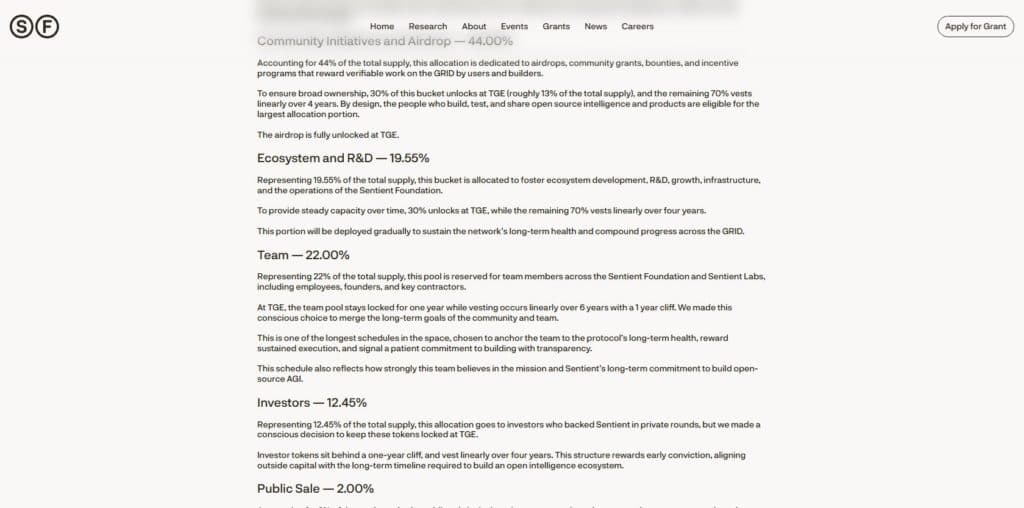
Sentient Foundation tokenomics, published Jan 29 2026: Team allocation (22.00%) locked for a full year at TGE, then vesting linearly over 6 years. Source: sentient.foundation/news/sent-tokenomics
Sentient’s tokenomics document states plainly that the Team pool, 22 percent of the 34,359,738,368-token supply, “stays locked for one year” from token generation, then vests over six more. Token generation happened January 22, 2026. That cliff does not lift until roughly January 2027. Team tokens, by the project’s own contractual design, cannot move today. They could not have moved eighty days ago either.
So what did move? On Etherscan’s current holder list, one unlabeled wallet holds exactly 687,194,767.0000 SENT this morning. That is 2.0000 percent of total supply, to four decimal places, matching the old headline’s figure almost to the token. Sentient’s Public Sale allocation is, separately, fixed at exactly 2.00 percent of supply. The far more likely explanation is that the reported “team wallet” was always the Public Sale bucket, not a founder or employee position.
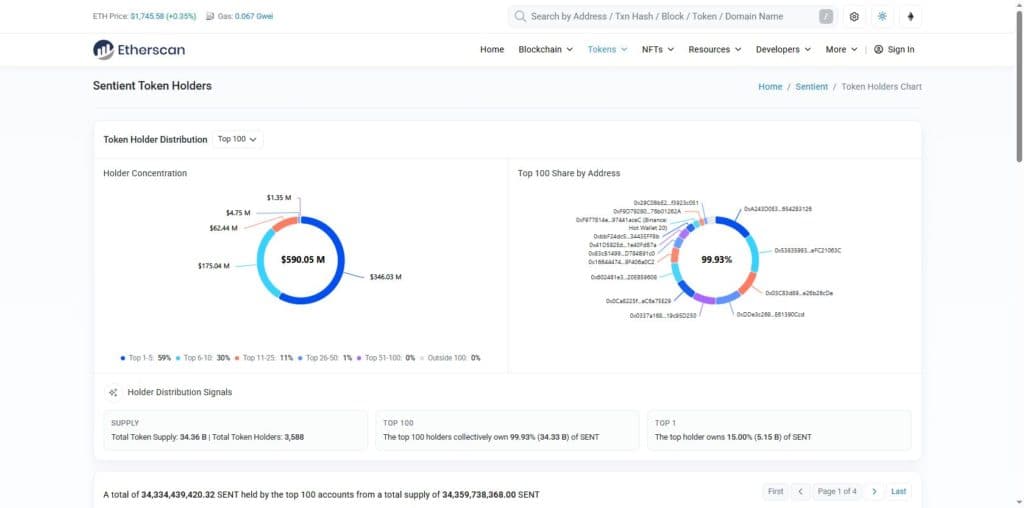
Etherscan holder distribution for SENT: top 100 addresses hold 99.93% of supply, mostly Safe multisig wallets at round percentages matching tokenomics buckets. Source: Etherscan
The rest of the top holder table backs this up. Almost every large address is labeled a Safe multisig, and their balances land on suspiciously exact numbers: 15 percent, 10 percent twice, 8.97, 7.92, 6, 4.26, 4, 3, 2, 0.1. Those are not the balances of organic whales. They read like the project’s own disclosed allocation buckets, split across several treasury wallets for operational reasons.
What $224 Million in Volume Is Hiding
CoinGecko shows $224.15 million in 24-hour volume. Almost none of it happens where anyone can inspect the order book on-chain. A DEX Screener pull of all three Ethereum Uniswap pools for this contract returns combined liquidity of about $33,347 and combined 24-hour DEX volume of roughly $40,768. Divide that into the reported total and less than two hundredths of one percent of SENT’s trading happens on a public, checkable venue. The rest sits on Binance, Robinhood, Coinbase and similar order books that free tools cannot see into.
That thin sliver still tells a story. Buy and sell counts across the three pools ran 169 to 109 over 24 hours, a 61 percent buy skew, not the near-even split that flags bot wash trading. Nothing here looks automated. It is simply too small a piece of the real market to draw conclusions about SENT’s overall order flow.
Buy and Sell Metrics, By Timeframe
Pulled directly from the DEX Screener API and summed across all three pools; CEX order flow, the majority of real volume, is not covered here.
| Timeframe | Buys | Sells | Buy Vol (est.) | Sell Vol (est.) | Buy % | Read |
| 5m | 0 | 0 | $0 | $0 | – | no activity |
| 1h | 2 | 0 | $40 | $0 | 100% | skewed toward buys (tiny sample) |
| 6h | 121 | 108 | $20,521 | $18,345 | 52.8% | roughly even, low volume |
| 24h | 169 | 109 | $24,787 | $15,981 | 60.8% | skewed toward buys |
Trying to Actually Trade It
What that thin liquidity means in practice is worth testing directly rather than assuming. A live quote on Matcha, the DEX aggregator, shows a $1,000 buy costing 5.54 percent in price impact. A $10,000 buy costs 24.36 percent. A $100,000 buy costs 88.19 percent, close to losing the whole trade to slippage. Selling runs slightly worse: 5.92, 31.56, and 90.37 percent at the same three sizes.
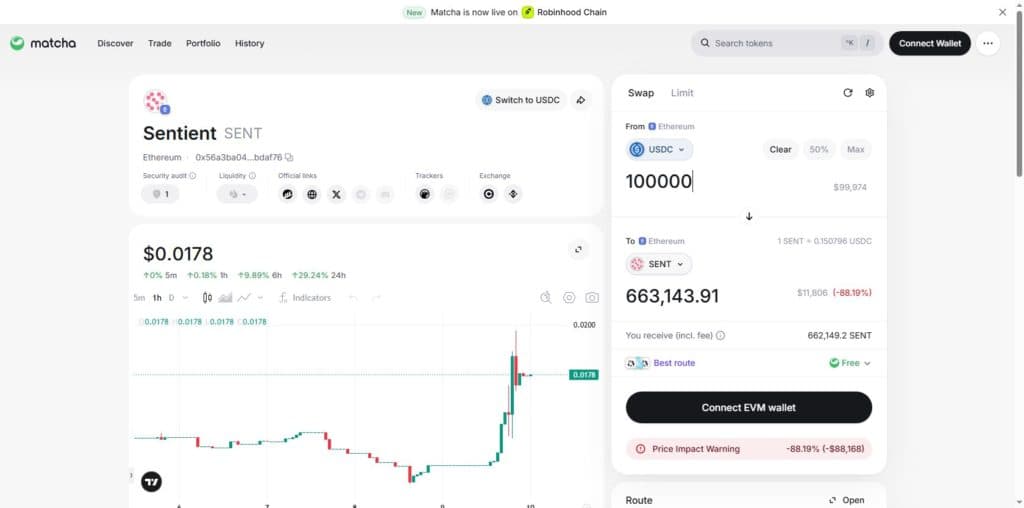
Matcha live quote, July 10 2026: a $100,000 SENT buy routed through Uniswap V4/V3 shows -88.19% price impact ($88,168 lost to slippage). Source: matcha.xyz
A trader who wants real size in SENT is not going to get it from Uniswap. That is not automatically a red flag on the project, since the token clearly trades in genuine depth on Binance and now Robinhood. It is, however, a hard fact anyone routing through a DEX aggregator instead of a centralized exchange needs to know before clicking confirm.
Checking Whether Sells Even Go Through
A slippage percentage assumes the trade executes at all. honeypot.is returned “UNKNOWN,” unable to determine, with a warning that “a very high amount of users can not sell their tokens.” Read the fine print and the tool tested a Uniswap V3 pool holding $0.000015 in liquidity, a dead, nearly empty pool, which is why its one test buy reverted.
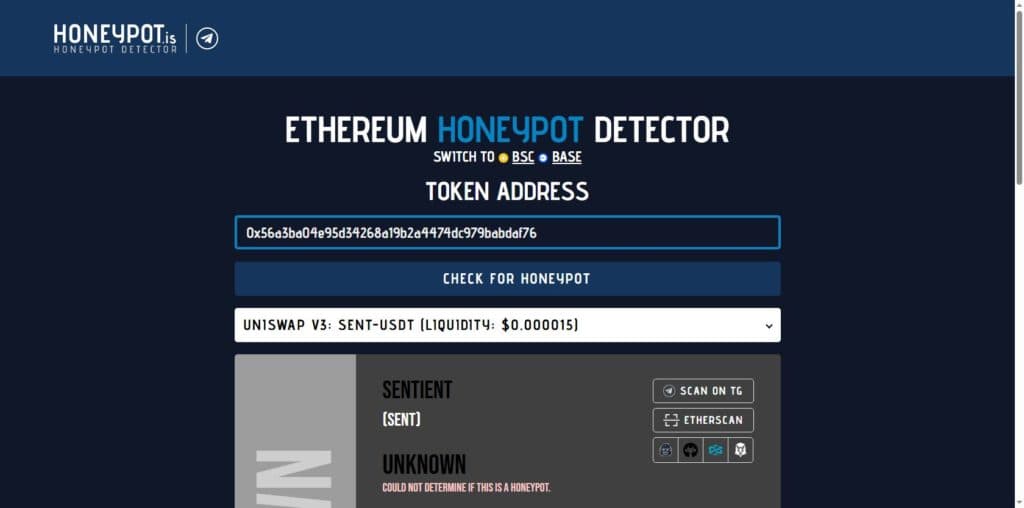
honeypot.is result for SENT: UNKNOWN, tested against a near-dead Uniswap V3 pool with $0.000015 liquidity, causing a BUY_FAILED simulation. Source: honeypot.is
The live quotes pulled minutes earlier tell a different story: $1,000, $10,000, and $100,000 sells all routed through the pools that actually carry volume and completed, with steep but real pricing, no reverts. The automated tool’s warning is an artifact of which pool it happened to pick, not evidence that the pools people actually use will trap a seller.
A Contract That Can Still Be Changed
SENT’s contract is a proxy, the upgradeable kind. Etherscan’s write functions list pause() and unpause(), which can halt every transfer on the network, and upgradeToAndCall(), which can swap out the entire implementation logic behind the token. A pair of functions, claimInflation() and setMintInflationPerSecond(), form a controlled minting mechanism, one that lines up with the 2 percent annual community emissions the tokenomics document already discloses rather than a hidden supply expansion.
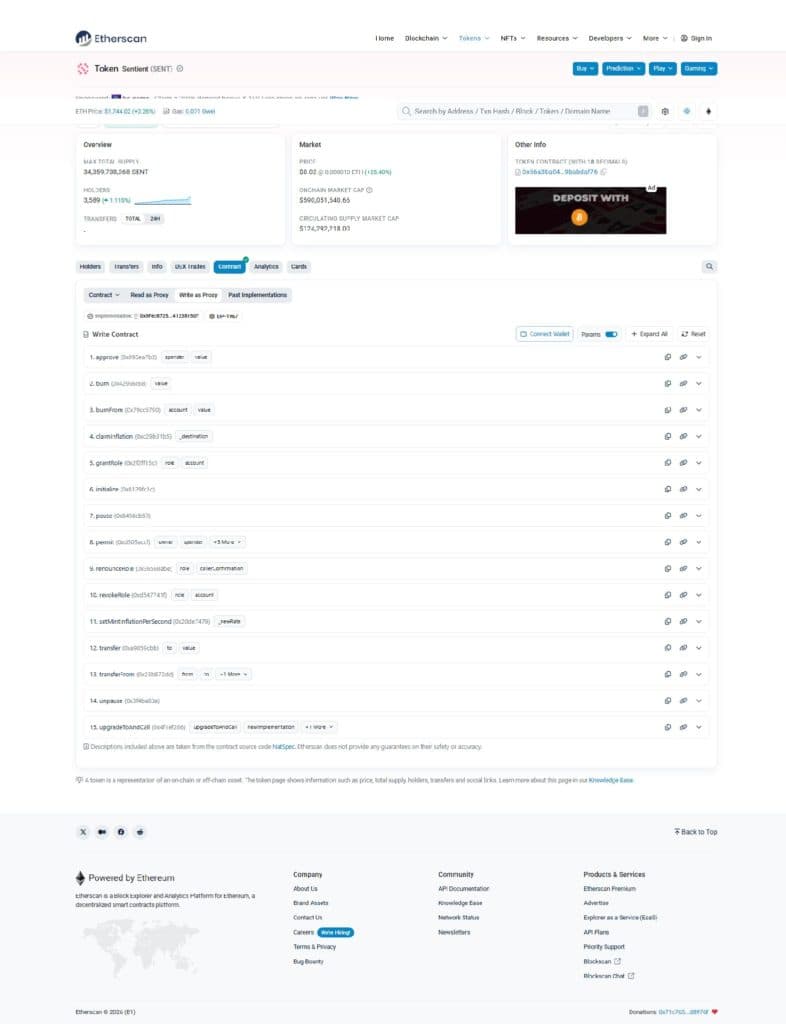
Etherscan Write as Proxy tab for SENT: pause(), unpause(), upgradeToAndCall(), claimInflation() and setMintInflationPerSecond() confirmed on-chain. Source: Etherscan
These functions sit behind role-based access control, not a single owner key, and the roles trace back toward the same Safe multisig wallets visible in the holder table. Exactly which signers control those roles was not traced address-by-address in this pass, and a formal audit was not independently confirmed either way. Both are open questions worth someone’s follow-up, not settled facts.
Where the Money and the Names Came From
Sentient is not a blank-slate token with an anonymous team behind it. Its founders are named and checkable: Sandeep Nailwal, a co-founder of Polygon, Pramod Viswanath, a Princeton professor, Himanshu Tyagi, a professor at the Indian Institute of Science, and Kenzi Wang, co-founder of Symbolic Capital. DeFiLlama’s raises database shows an $85 million seed round from July 2024, co-led by Peter Thiel’s Founders Fund and Pantera Capital, joined by Framework Ventures, Delphi Ventures, and several others.
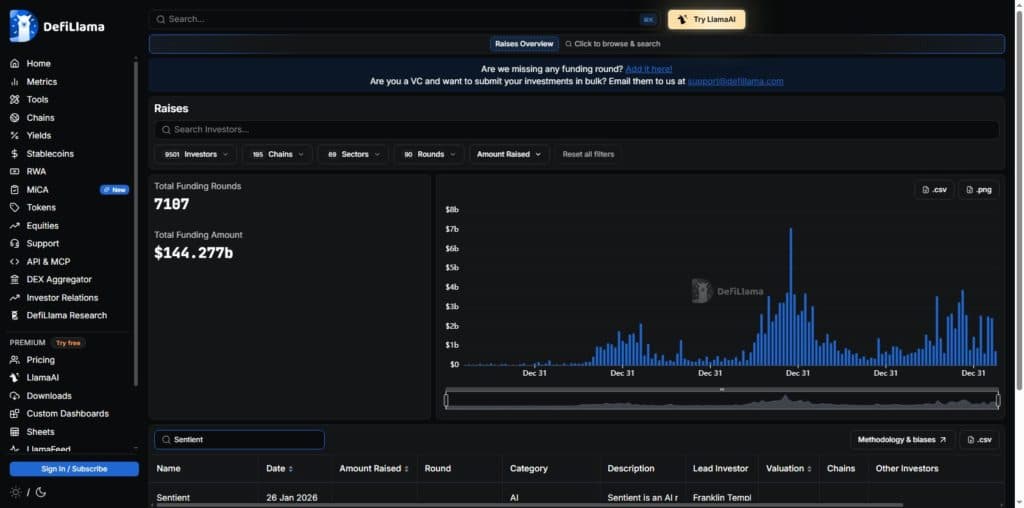
DeFiLlama raises: Sentient’s $85M seed round (Jul 2024, Founders Fund and Pantera Capital), a Jan 2026 round naming Franklin Templeton, and a $7.6M public sale. Source: DeFiLlama
A later round in January 2026 names Franklin Templeton as an investor, though the amount was not disclosed. A separate Forbes piece from July 1 covers a $42 million commitment from the Sentient Foundation toward open-source AGI grants, a real, published figure rather than marketing language. None of this guarantees the token performs. It does mean “who is behind this” is a fully answerable question, and the answer involves recognizable names rather than a wallet with no history.
Real Code, Not Just a Roadmap
The sentient-agi GitHub org carries 17 public repositories with real engagement: ROMA at 5,100 stars, OpenDeepSearch at 3,800, OML-1.0-Fingerprinting at 3,500. A commit merged July 6 fixes a specific bug where the project’s agent harness kept re-fetching chat messages and crashing on structured-output queries, plus a stdout-versus-stderr bug in the install script that broke piped installs. That is the kind of unglamorous fix that only gets written by people actually running the software.
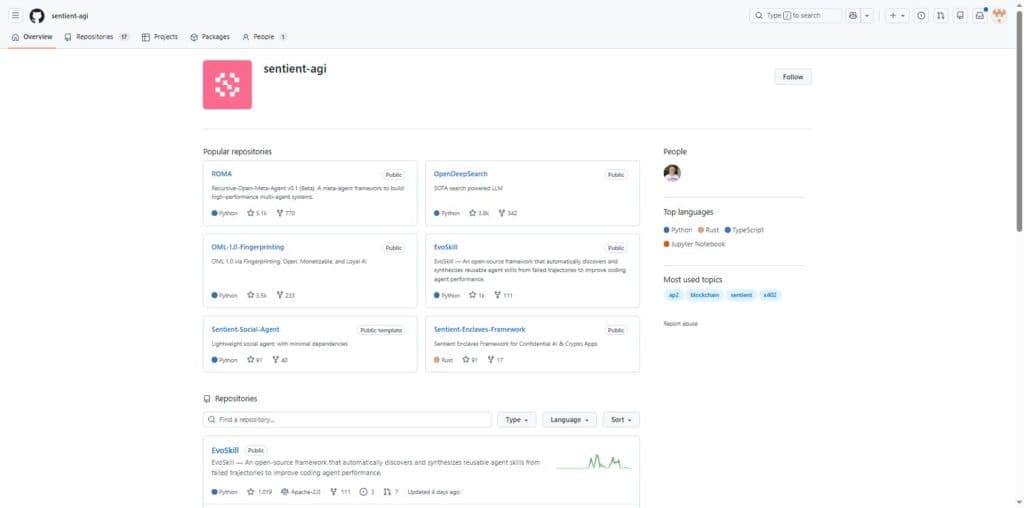
sentient-agi GitHub organization: 17 public repositories including ROMA (5.1k stars), OpenDeepSearch (3.8k stars), and EvoSkill, last updated 4 days ago. Source: GitHub
A Supply Number That Does Not Quite Add Up
CoinGecko lists circulating supply at 7.238 billion SENT, 21.06 percent of the fixed 34,359,738,368 total. That figure matches the token generation event’s day-one unlock almost exactly: 13.2 percent from Community, 5.865 from Ecosystem, 2 from Public Sale. Running the same tokenomics document forward across the roughly 5.55 months since TGE, accounting for the linear vesting those two buckets are supposed to release monthly, produces a calculated circulating figure closer to 9.01 billion, about 26.21 percent of supply.
The gap is about 1.77 billion tokens, worth roughly $31 million at today’s price. On-chain total supply matches the disclosed hard cap exactly, so nothing suggests unscheduled minting. The likelier explanation is a lag between tokens becoming contractually vested inside a treasury contract and those same tokens actually being claimed and released into circulating supply, something CoinGecko’s tracker would only reflect once claims happen. It is a real discrepancy worth watching, not proof of anything hidden.
What to Watch Next
Four dated items, pulled directly from the verified sources above.
Around January 22, 2027, the one-year cliff lifts on both Team (22 percent of supply) and Investor (12.45 percent) allocations, together 34.45 percent of everything that will ever exist, and both begin multi-year linear vesting into a market that will need to absorb it.
Community and Ecosystem allocations continue releasing on a four-year linear schedule from January 22, 2026, adding a combined 0.93 percent of total supply to the vested pool every month regardless of price.
CoinGecko’s circulating-supply figure has sat close to the TGE-day unlock number for over five months without visibly reflecting the linear vesting tokenomics describes; a correction, whenever it lands, would change the displayed market cap with no change in the underlying price.
No confirmed listing beyond Robinhood turned up in this research; any further exchange announcement would be the next test of whether today’s pattern of listing-driven moves continues.
Where the Setup Cuts Both Ways
If the Robinhood listing draws sustained new order flow the way the OKX and Upbit listings did roughly 161 to 163 days ago, and the roughly 1.77 billion token supply gap resolves as claimed-but-uncirculated treasury holdings rather than fresh sell pressure, the case for this being a genuine re-rating rather than a one-day pop gets stronger, because the team and investor cliffs stay locked another six-plus months regardless.
If the January 2027 Team and Investor cliff arrives and any of the Safe multisig wallets begin moving tokens toward exchange deposit addresses, which is visible on Etherscan the moment it happens, or if a role-holder for the contract’s pause or upgrade functions turns out to sit outside the disclosed foundation structure, the risk case gets harder to dismiss. Neither outcome is guessable from today’s data. Both are specific, dated, checkable things rather than a guess.