Power Protocol’s POWER token gained close to thirty percent in twenty-four hours on July 9, 2026, according to CoinMarketCap. Price moved from roughly $0.076 to $0.098. Trading volume jumped more than 530% against the prior day.
Eleven hours before that move started showing up on charts, the official Power Protocol account published something unusual. Not a listing announcement. Not a partnership post. A long, self-critical account of what actually happened in March, when this token hit an all-time high of $2.94 and then lost 97% of its value within weeks.
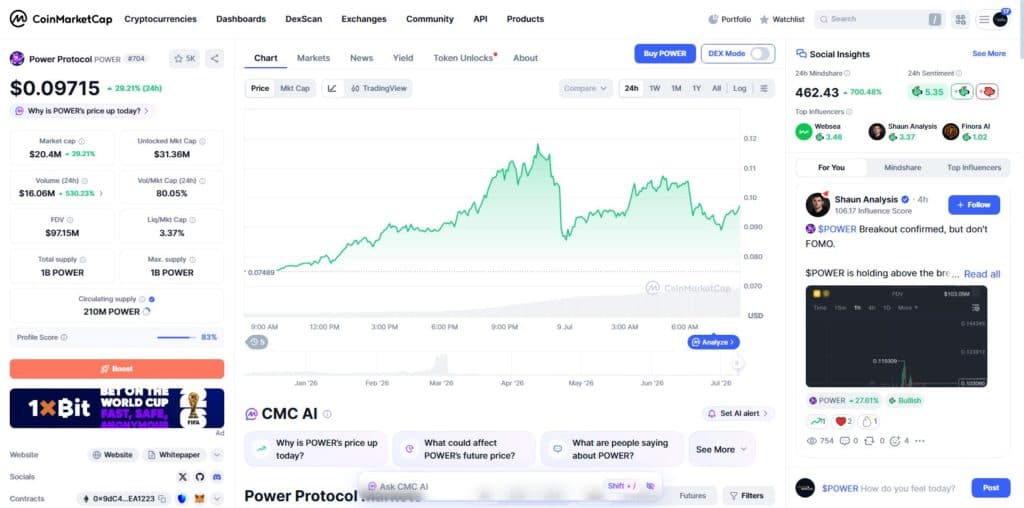
Power Protocol (POWER) on CoinMarketCap, July 9 2026: price near $0.098, up roughly 29-30% in 24 hours, market cap approximately $20.5M. Source: CoinMarketCap
The Admission Nobody Asked For
The post, titled “Power Ecosystem: What Comes Next” and published on X at 9:35 PM on July 8, contains a paragraph most projects never write. “In early March, the token reached a value we didn’t envision so early on in the ecosystem’s life while tokens entered the market in a way we did not anticipate or want,” the team wrote. “The result was immediate. The token spiked to an all-time high, then corrected abruptly.”
No specifics on which tokens or whose wallet. But the timing lines up exactly with CoinMarketCap’s recorded all-time high of $2.94 on March 2, a level the token has not come close to since. From there it fell to an all-time low of $0.056 just five weeks ago, a decline of nearly 97 percent.
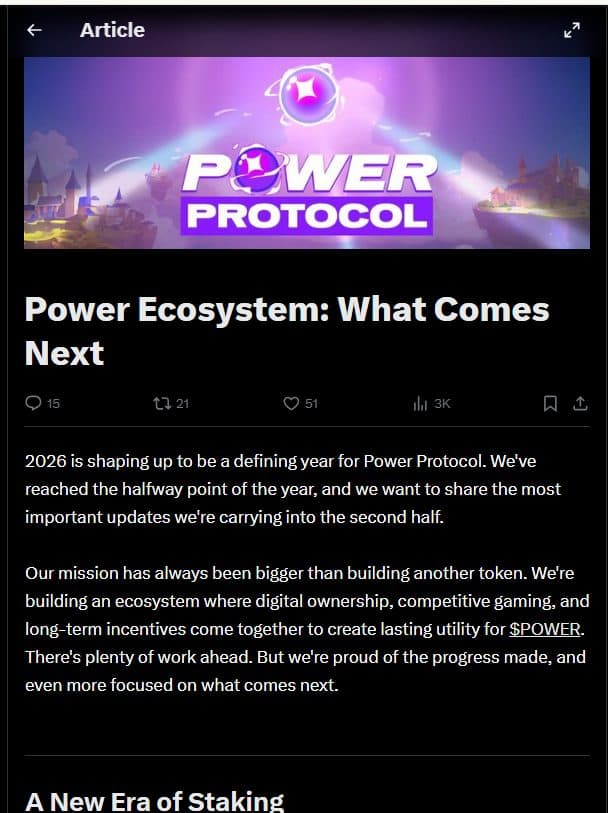
Power Protocol’s official X article, “Power Ecosystem: What Comes Next,” published 9:35 PM July 8 2026, admitting unplanned token market entry caused the March all-time high and crash, and confirming investor unlocks are delayed to Q1 2027. Source: x.com/PowerPrtcl
The team went further than most would. “We were not blameless in the aftermath,” they wrote. “We should have communicated faster, and more… silence was still a choice, and it was the wrong one.” That is a specific, dated, self-directed criticism, not the kind of language a marketing account uses to spin a chart.
A Delay With a Specific Date
Buried in the same post is a line with actual near-term consequences for anyone holding the token today. “We’ve agreed with our investors to move the beginning of investor token unlocks to Q1 2027.” That is a direct, dated commitment. Investor allocations, 16.15 percent of the entire one billion token supply according to the breakdown on CMC’s own unlock tracker, will not begin releasing before next year.
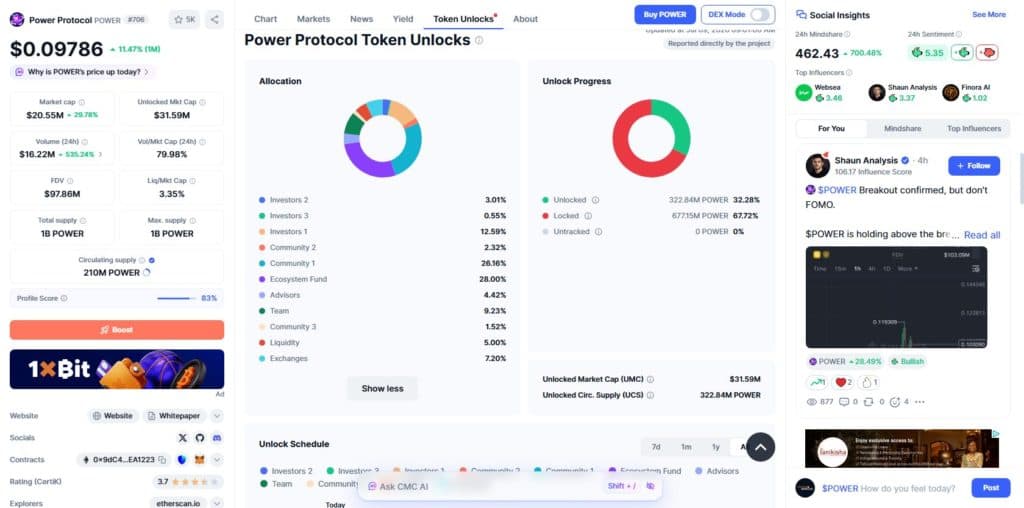
CoinMarketCap’s Power Protocol Token Unlocks tab, reported directly by the project: full allocation table showing Ecosystem Fund 28%, Community 1 26.16%, Investors 1 12.59%, Team 9.23%, and 322.84M of 1B POWER (32.28%) unlocked to date. Source: CoinMarketCap
The same tracker shows what is actually scheduled to unlock regardless: 21.59 million POWER on August 5, roughly $2.07 million at current price, the next event on the calendar. Monthly releases near that size continue through October, then the number of unlocking categories doubles from four to eight starting in December, which is when tranches beyond the currently-active ones begin. None of the near-term releases through the rest of 2026 are the investor tranche the team just delayed.
One Wallet, Half the Supply, and a Very Boring Explanation
A single address controls 51.79% of everything held on BSC, per BSCScan’s holder chart. On a smaller or newer token that number alone would be the story. Here it isn’t, because the address carries a label: Binance Alpha 2.0 Router Proxy.
BSCScan top POWER holders on BSC: rank 1 is labeled “Binance: Alpha 2.0 Router Proxy” at 51.79%, rank 5 is “Pancakeswap: Infinity Vault” at 3.90%. Source: BSCScan
That is Binance’s own custody address for users who acquired POWER through its Alpha pre-listing marketplace and have not withdrawn to self-custody, not a founder or venture wallet sitting on an unvested position. The second-largest holder, 8.58 percent, checked out as a regular externally-owned wallet funded from a Binance hot wallet roughly seven months ago, active for about four weeks after that funding and quiet since. Unlabeled, but not tied to any team or investor allocation this research could confirm.
What a Real Trade Actually Costs
Market cap and headline liquidity numbers do not tell a trader what happens when they actually click buy. So this research ran live quotes through PancakeSwap’s router, which aggregates across every pool carrying POWER liquidity, at three sizes in both directions.
PancakeSwap live swap quote: a $100,000 USDT-to-POWER buy shows 24.23% price impact, flagged “Price impact too high.” Source: PancakeSwap
A $1,000 buy costs 0.43% in price impact. A $10,000 buy costs 1.51%. A $100,000 buy costs 24.23%, enough that PancakeSwap’s own interface flags it as too high to proceed without acknowledging the warning. The sell side is nearly a mirror image: 0.35% at $1,000, 3.80% at $10,000, and 26.61% at $100,000.
Two things follow from that. First, sells go through. Nothing in these tests blocked or reverted a large sell, which matters given what came up next. Second, this is a real liquidity ceiling: a ~$20 million market cap token that cannot currently move six-figure size without material cost, in either direction.
A Scanner Said Honeypot. The Source Code Says No.
Running the contract through honeypot.is returned an unsettling result at first glance: a failed buy simulation and a warning that “a very high amount of users can not sell their tokens.” Ten of sixteen sampled holders in its own data showed as unable to sell.
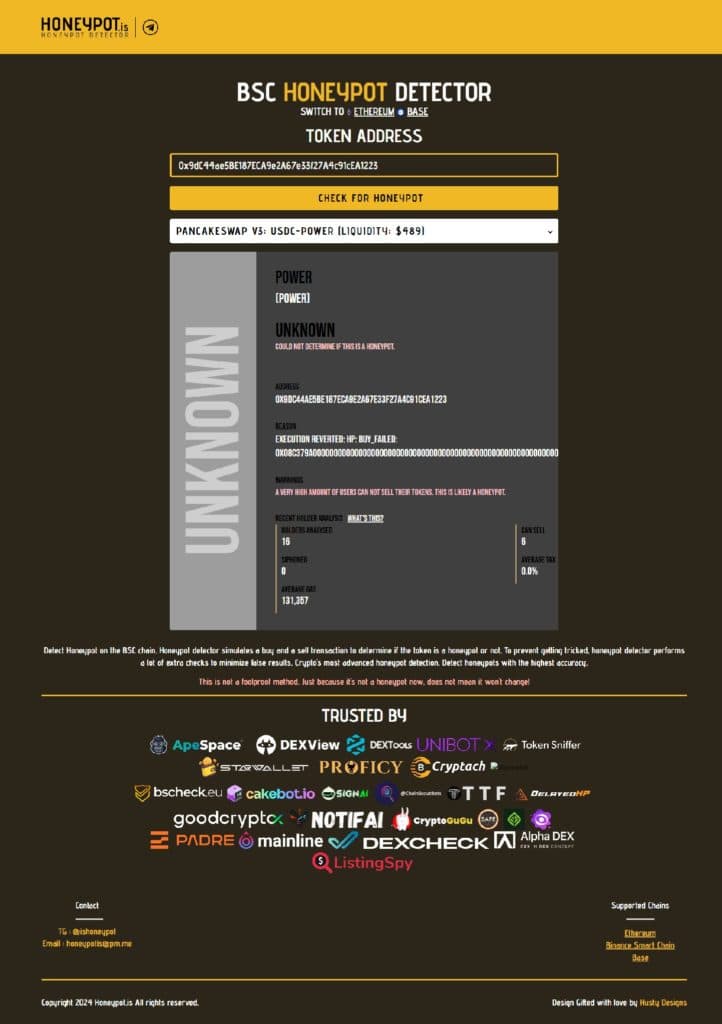
Honeypot.is result for POWER: simulated buy failed on a PancakeSwap V3 USDC-POWER pool holding only $489 in liquidity; warning flags a high proportion of holders unable to sell. Source: honeypot.is
The detail that changes the read: the pool honeypot.is tested against held $489. Four hundred eighty-nine dollars. A test buy of any meaningful size cannot fill in a pool that thin, which produces exactly the kind of failure this scanner returned, independent of anything the contract code does.
The verified source code settles it more directly. PowerWrappedToken.sol contains almost no custom logic of its own. It inherits, unmodified, from Chainlink’s BurnMintERC677, the standard used for cross-chain tokens under Chainlink’s CCIP bridge. No blacklist function exists anywhere in the contract. No pause function. No sell tax, no transfer tax, no owner-toggleable trading switch of any kind.
BSCScan Read Contract results for POWER: maxSupply() returns exactly 1,000,000,000 tokens, getMinters() returns a single verified contract address. Source: BSCScan
The same read confirms the token’s mint function is capped, not open-ended. maxSupply() returns exactly one billion, matching the constant written into the constructor. getMinters() returns a single address, and that address is not a private wallet. It is a verified contract deployed by the project’s own deployer address, with exactly two transactions in its history: a chain-configuration call and an ownership transfer, the standard setup sequence for a Chainlink CCIP token pool, not a discretionary mint switch.
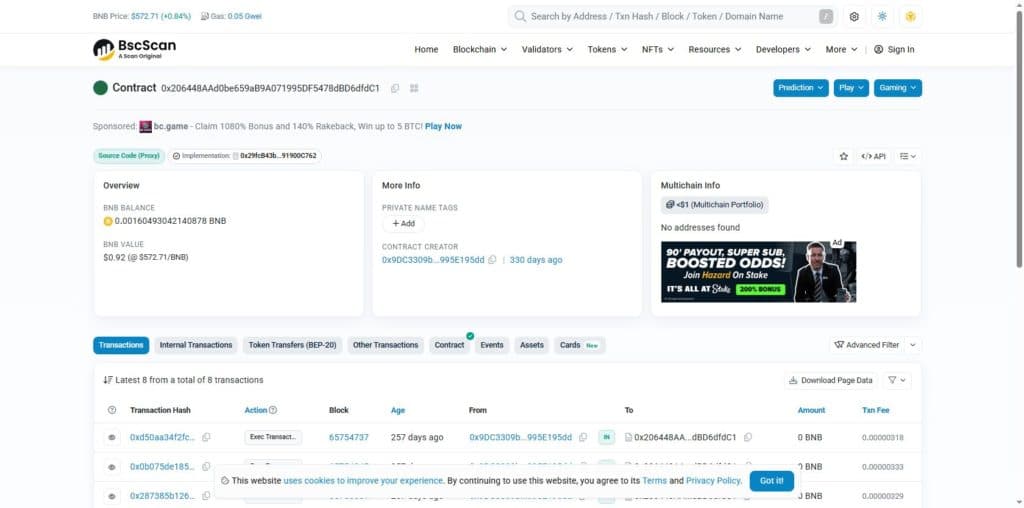
BSCScan address page for the POWER contract owner: a Gnosis Safe proxy contract with an “Exec Transaction” pattern in its history, not a single-signer wallet. Source: BSCScan
The contract’s owner, separately, turned out to be a Gnosis Safe multisig rather than a single wallet, based on the “Exec Transaction” pattern running through its history. No third-party security firm has published a standalone audit of this specific wrapper contract, which is worth stating plainly. But its logic is inherited entirely from a library Chainlink itself has put through independent review, and nothing in the honeypot.is failure survives a look at the actual code.
Who’s Actually Behind This
Power Protocol is not an anonymous team. Pixion Games, the studio behind flagship game Fableborne, is led by Kam Punia, a fifteen-year gaming industry veteran from Konami who built competitive esports infrastructure for Yu-Gi-Oh! and sits on the gaming advisory board of ECOMI, the company behind VeVe Digital Collectibles.
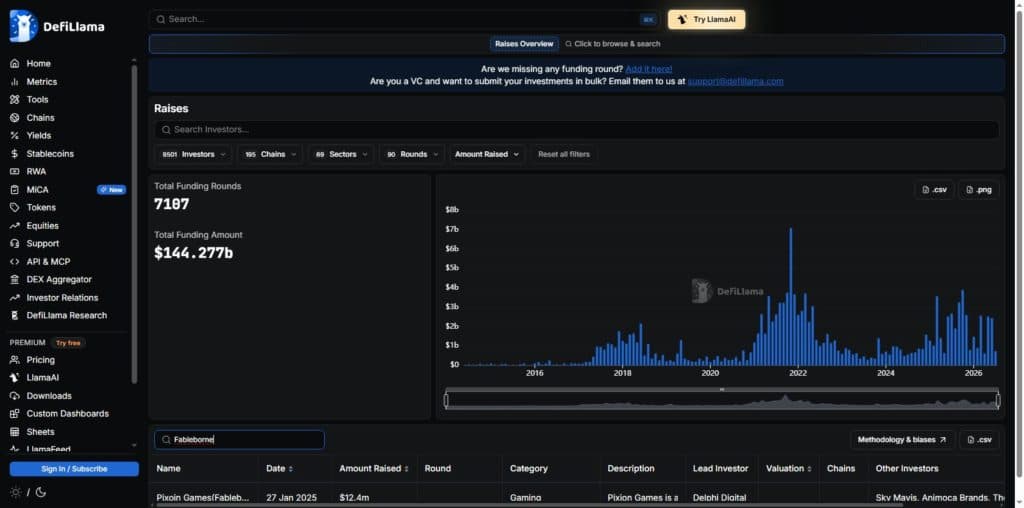
The studio raised $12.4 million in January 2025 led by Delphi Digital, with Sky Mavis, Animoca Brands, Yield Guild Games, and The Spartan Group among the backers, according to DeFiLlama’s raises database. That roster explains why POWER also trades on Ronin, the chain Sky Mavis built for Axie Infinity. A search of DeFiLlama’s hacks database for Fableborne, Pixion Games, or Power Protocol returns nothing.
DeFiLlama raises database entry: Pixion Games (Fableborne) raised $12.4M on January 27, 2025, led by Delphi Digital with Sky Mavis, Animoca Brands, and Yield Guild Games among other investors. Source: DeFiLlama
One gap is worth flagging plainly rather than skipping. Fableborne’s own litepaper states outright that it does not cover POWER tokenomics and points readers elsewhere; no standalone allocation table exists on the main Power Protocol website either. The same allocation numbers used throughout this piece do exist, credited as “reported directly by the project,” on CoinMarketCap’s unlock tracker. That is a real source. It is just not the project’s own documentation, and a reader who only checked the litepaper would come away with nothing.
What to Watch Next
Four dated items, pulled directly from the sources above.
August 5, 2026: the next scheduled unlock, 21.59 million POWER, about 2.16 percent of max supply, spread across the four categories currently vesting. Not the investor tranche.
Q1 2027: the newly agreed start date for investor token unlocks, per the team’s own July 8 statement, covering 16.15 percent of total supply.
December 5, 2026: the first date the unlock schedule expands from four allocation categories to eight, the point where additional tranches beyond the current set begin releasing.
No fixed date yet, but described as “weeks away”: Fableborne Season 5, and separately, the game’s soft launch into the mainstream mobile market, which the team frames as exposing both the game and the token to an audience well outside today’s Web3 base.
Where This Actually Sits
The bull case here is unusually well-documented for a token that just crashed 97 percent five months ago: a named, credentialed founder, tier-one gaming VC backing, a clean audited-standard contract with no sell-blocking mechanism in source, a contractually confirmed delay to investor unlocks, and a real staking base with meaningful two-year lockups. The bear case is just as concrete: this token still cannot absorb six-figure trade size without heavy slippage, a large share of its “unlocked” supply is not actually circulating yet, and the team’s own words confirm the March collapse came from a distribution mistake they have not fully explained even now.
Both of those are true at the same time. Neither cancels the other out.