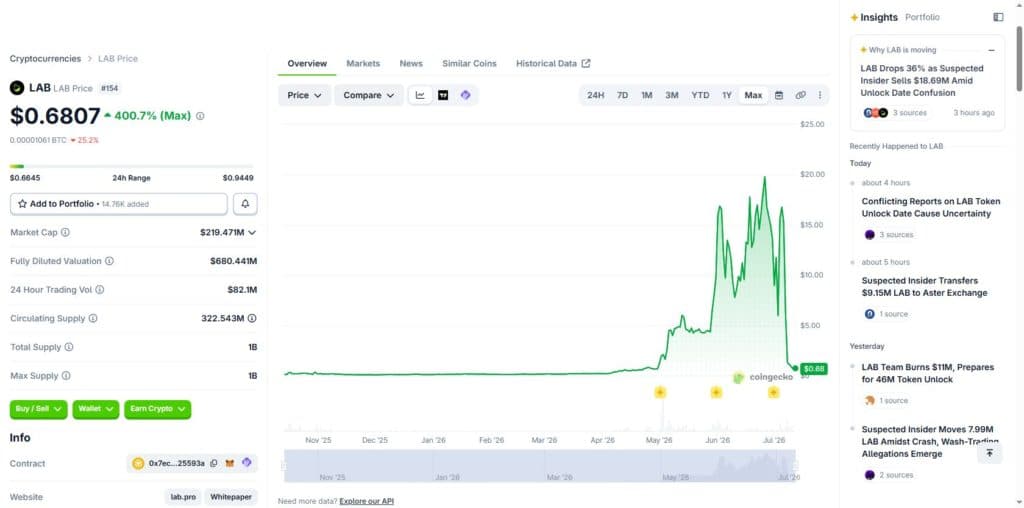
LAB traded at $0.6807 in the early hours of July 11, 2026. Ten weeks ago it touched $27.48. Do the arithmetic and the token has given up 97.5% of its value since June 2, most of that in the last seven days alone.
LAB Terminal bills itself as a multi-chain trading terminal, a Telegram bot and iOS app for spot, limit, and perp orders. Its token launched on BNB Chain on October 13, 2025 and spent most of its first six months trading under a dollar before spiking to its all-time high in early June. The chart since then is a near-vertical drop, and this week added a fresh leg down: -25.0% in the last 24 hours alone, on top of a seven-day collapse of 95.6%.
Six Wallets, One Recurring Name
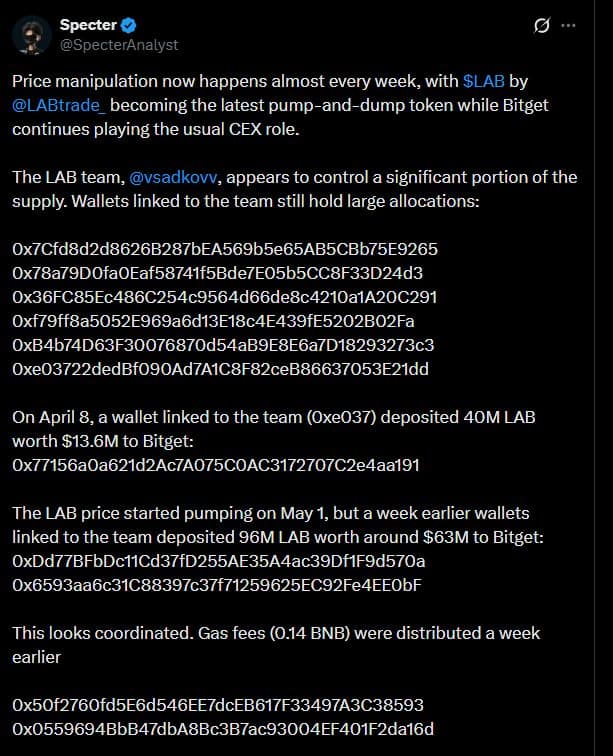
Back in May, an on-chain investigator who goes by Specter published a thread naming six wallet addresses “linked to the team” that still held large LAB allocations. The claim: a wallet deposited 40 million LAB worth $13.6 million to Bitget on April 8, and a cluster of wallets moved roughly 96 million LAB worth about $63 million to Bitget a week before LAB’s May 1 pump. ZachXBT, a well-known on-chain investigator, followed up with a public $10,000 bounty for the passport or legal identity behind the LAB founder account, @vsadkovv.
That thread is two months old. What is not old is where those wallets sit today.
Pulling LAB’s live holder chart from BscScan and matching it against Specter’s six addresses line by line: four of them are still there, still in the top six ranked holders, having neither sold down nor been renamed to any exchange label in the two months since. Between just those four wallets sits 53.28% of LAB’s entire 990 million token supply. Add the two other unlabeled wallets rounding out the top six, and six addresses control 81.86% of everything that exists.
| Rank | Address | Holding | % Supply | On Specter’s May list? | Type |
| 1 | 0xB4b74D63…293273c3 | 200.0M LAB ($136.2M) | 20.20% | Yes | Gnosis Safe multisig |
| 2 | 0xB471837F…9CCdfAbb8 | 150.0M LAB ($102.2M) | 15.15% | No | Unlabeled |
| 3 | 0x7Cfd8d2d…Bb75E9265 | 138.0M LAB ($94.0M) | 13.94% | Yes | Unlabeled |
| 4 | 0x955a963B…5DC301888 | 133.0M LAB ($90.6M) | 13.43% | No | Unlabeled |
| 5 | 0x78a79D0f…8F33D24d3 | 108.0M LAB ($73.6M) | 10.91% | Yes | Unlabeled |
| 6 | 0xf79ff8a5…5202B02Fa | 81.5M LAB ($55.5M) | 8.23% | Yes | Unlabeled |
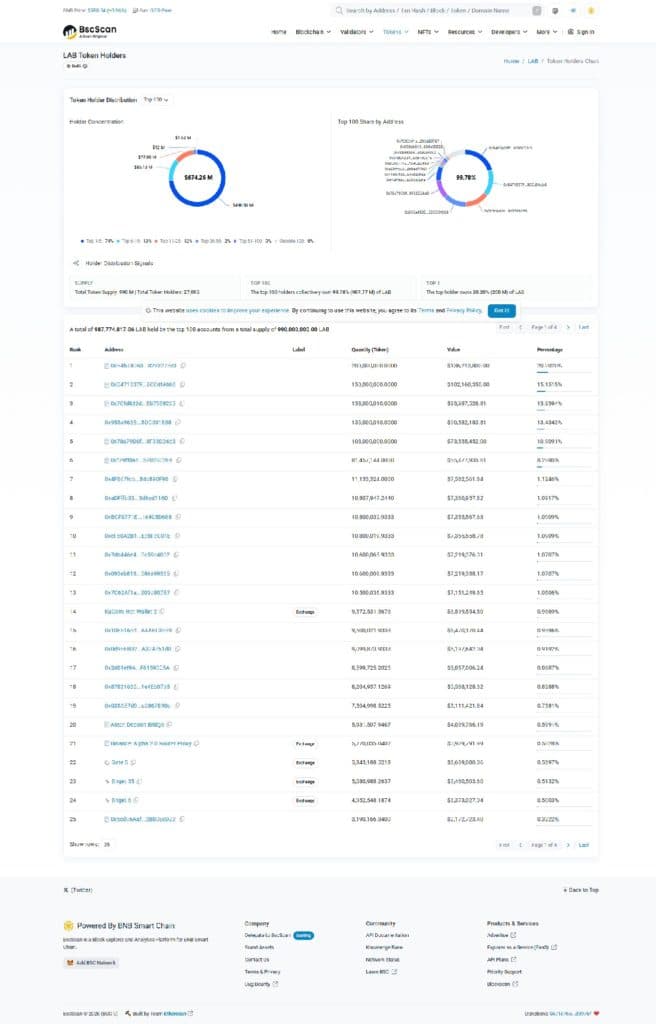
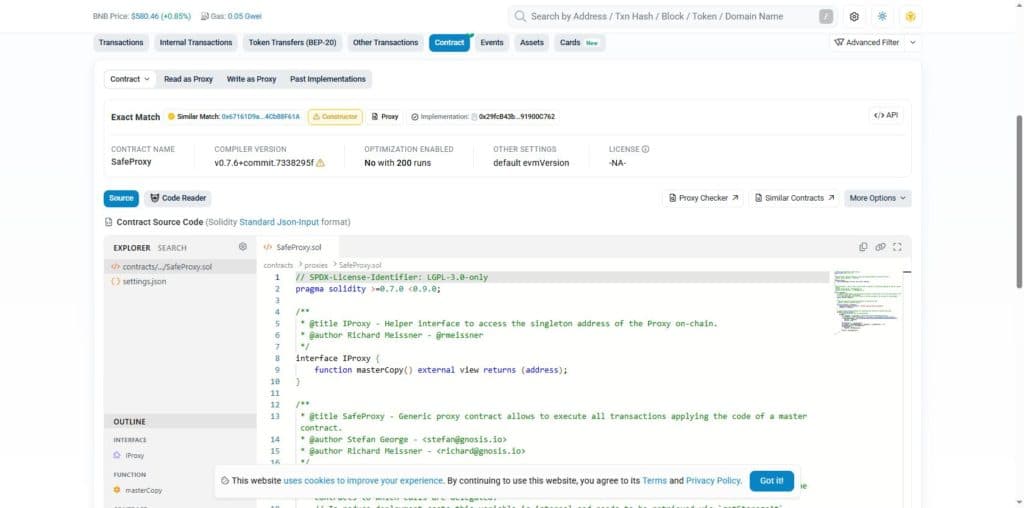
One nuance worth stating plainly: the single largest wallet, at 20.2% of supply, is not a private key sitting in someone’s browser extension. It is a Gnosis Safe multisig proxy contract, created 266 days ago, with only four transactions in its entire history. That is a real mitigating detail. A multisig needs multiple signers to move funds, and this one has moved almost nothing since inception. It is not, however, a vesting contract with an enforced release schedule. Whoever controls its keys can act whenever they agree to.
This Week’s Deposits Rhyme With May’s
CoinGecko’s own news feed for LAB, as of this writing, runs a short list of headlines that read like a sequel: “Suspected Insider Transfers $9.15M LAB Tokens to Aster,” posted twice within hours of each other, and a third flagging “$7.99M LAB Amidst Crash, Wash-Trading Allegations Emerge.” All three landed inside the same 24-to-48-hour window as this week’s worst price action. Aster itself, the exchange receiving those tokens, posted its own insight acknowledging the exposure: “Aster’s LAB Market Suffers 26% Price Crash and Liquidity Exposure.”
That $9.15 million figure traces back to a single post by on-chain analyst Ai Yi (@ai_9684xtpa) on Lookonchain’s feed, citing wallet addresses rather than a name. A headline repeating a claim is not verification. So this piece pulled the wallet addresses Ai Yi posted and checked them directly on BscScan.
The first address, 0xAaD30cAB…5bf3a467a, shows exactly four transactions total. It received 2,871,271.5 LAB two days ago, forwarded the full amount to an address BscScan itself labels “Aster: Deposit Bridge” 45 hours ago, received 3,500,049.93 LAB 25 hours ago, and forwarded that batch to the same Aster deposit address 23 hours ago. Its current balance: 0.00325 LAB, dust. Nothing sits in this wallet long enough to be mistaken for a holding position.
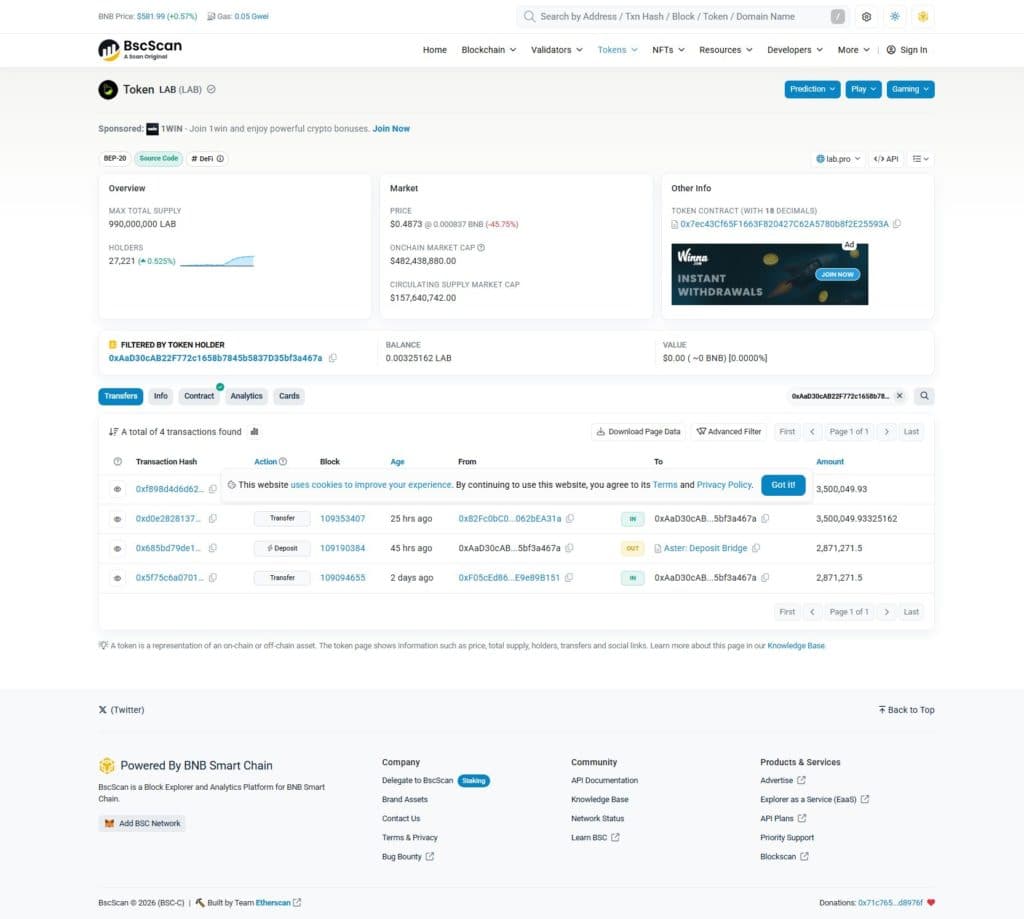
A second address from the same post, 0x628dd74F…93f76047A, shows the identical pattern: 2,507,913 LAB in, forwarded to “Aster: Deposit Bridge” 45 hours ago, then 3,500,000 LAB in, forwarded to the same Aster address 24 hours ago. Its balance today is zero. Both wallets were funded by the same two upstream addresses, 0xF05cEd86…E9e89B151 and 0x82Fc0bC0…062bEA31a, which is the detail that turns two coincidentally similar wallets into what looks like one coordinated operation. Between just these two confirmed wallets, 12.38 million LAB moved to Aster’s deposit bridge in under 48 hours.
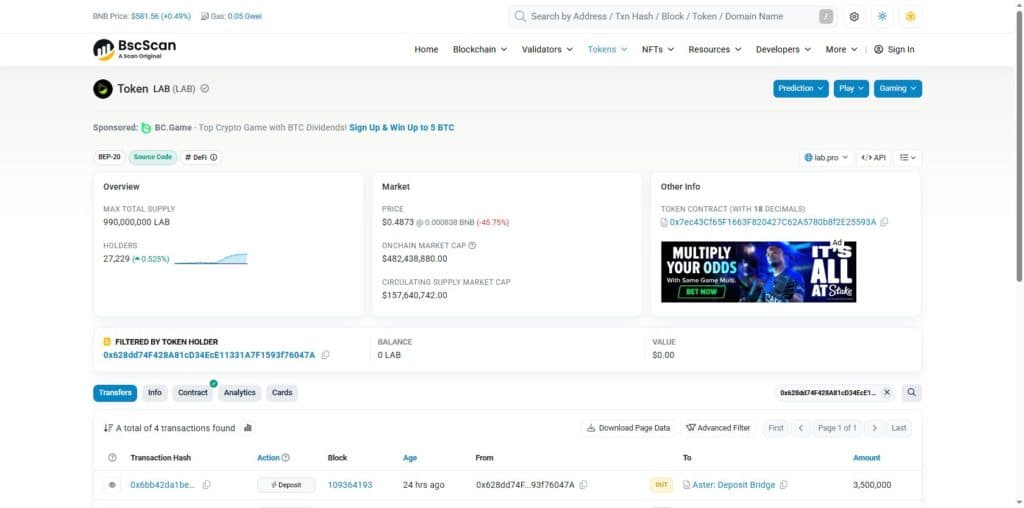
This does not prove who controls either wallet, and it does not prove intent. What it does show, independent of Ai Yi’s post or any aggregator’s headline, is that real LAB tokens moved from fresh receiving wallets straight into Aster’s own deposit infrastructure, twice, within the exact window this week’s crash happened. That is the same mechanic Specter described in May: tokens landing at a wallet and leaving for an exchange shortly after, not sitting still. It has simply moved from Bitget to Aster.
The Contract Itself Checks Out
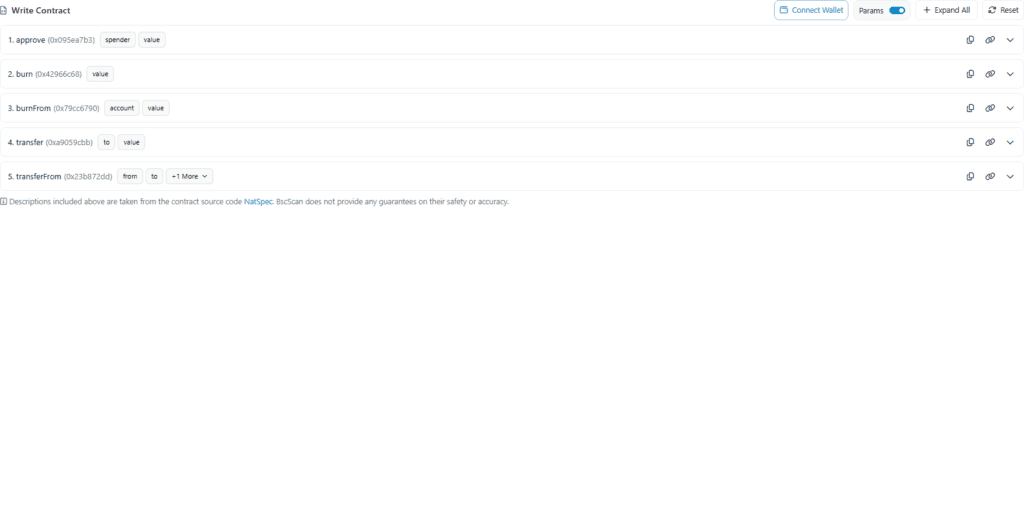
It would be easy to read all of this and assume the token is rigged at the code level. It is not, at least not by anything visible in the verified source. A honeypot.is simulation on the BNB Chain contract came back PASSED, low risk: 0% buy tax, 0% sell tax, 0% transfer tax, no buy or sell limit, and all 1,567 sampled holder wallets able to complete a sell. BscScan’s Write Contract tab lists exactly five functions: approve, burn, burnFrom, transfer, transferFrom. No mint. No pause. No blacklist. No fee-setter an owner could flip on later. A third-party firm, EtherAuthority, submitted a security audit dated May 25, 2026.
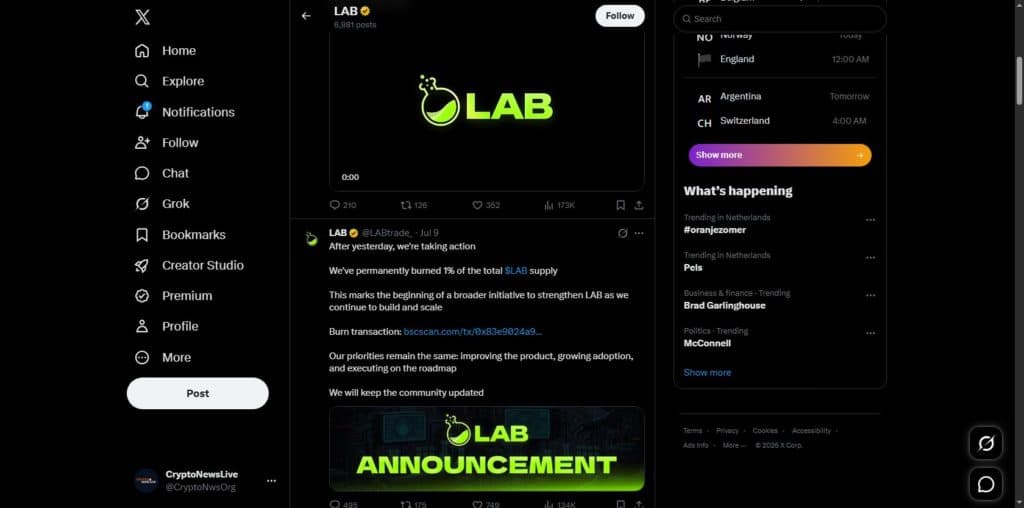
The team used that burn function on July 9. “After yesterday, we’re taking action,” the official LAB account posted, announcing a permanent burn of 1% of total supply, cutting it from 1 billion to 990 million. The post links a real, verifiable transaction on BscScan. It does not name what “yesterday” refers to, and it does not address the unlock-date dispute or Specter’s allegations directly.
Try Selling $100,000 and See What Happens
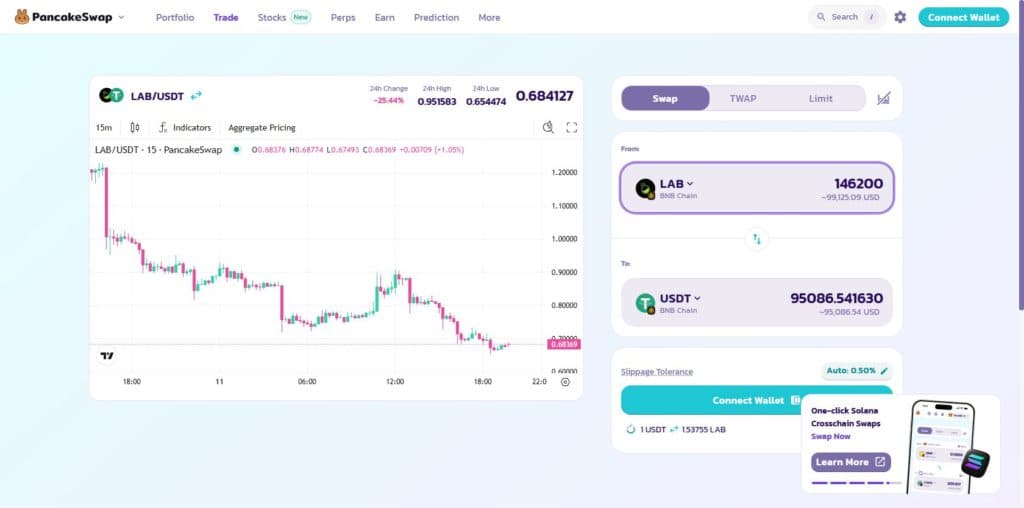
Whatever LAB’s $219 million market cap suggests about size, its on-chain liquidity says something smaller. The deepest pool actually used for price discovery, a PancakeSwap USDT pair on BNB Chain, held about $123,500 at the time of testing. Quoting real trade sizes against it on PancakeSwap’s own swap interface produced a clean, size-dependent curve in both directions.
| Size | Buy Impact | Sell Impact |
| $1,000 | 0.16% | 0.33% |
| $10,000 | 1.10% | 0.80% |
| $100,000 | 5.12% (flagged) | 5.03% (flagged) |
Table 2 — Live price impact quotes, PancakeSwap LAB/USDT pool, July 11, 2026
A $1,000 order barely moves the price either way. A $100,000 order, in either direction, blows past 5% and trips PancakeSwap’s own “price impact too high” warning. For a token still ranked inside CoinGecko’s top 200, that is a thin pool to be resting a $219 million valuation on top of.
On-chain transaction data backs up the same story from a different angle. Across every timeframe checked, from five minutes to a full day, sell orders on the main pool outnumbered buy orders. That is not the near-identical buy/sell ratio that usually signals bot-driven wash volume; it is a sustained, real skew toward selling, consistent with actual distribution pressure rather than an artificial pump in transaction count.
| Timeframe | Buys | Sells | Buy Vol | Sell Vol | Buy % | Read |
| 5m | 3 | 5 | — | — | 37.5% | skewed toward sells |
| 1h | 59 | 110 | — | — | 34.9% | skewed toward sells |
| 6h | 1,036 | 1,599 | — | — | 39.3% | skewed toward sells |
| 24h | 4,614 | 6,822 | $494K | $514K | 40.3% (by count) | skewed toward sells |
Table 3 — Buy/sell transaction split, main LAB/USDT pool (Uniswap, BSC), July 11, 2026
Nobody Can Say For Certain When The Next Unlock Lands
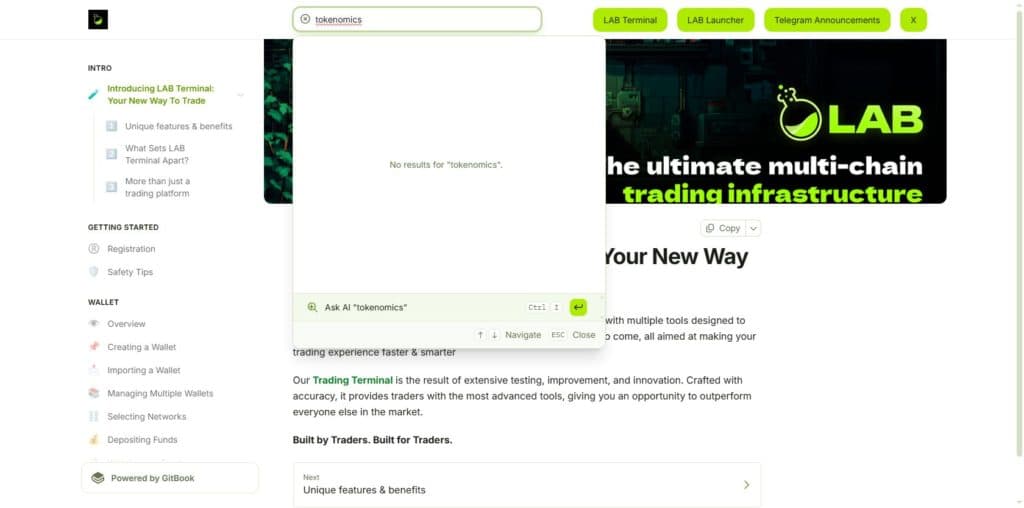
LAB’s own documentation site, hosted on GitBook, returns zero results for a search of the word “tokenomics.” It returns zero results for “team,” too. There is no allocation table, no vesting schedule, and no named team page anywhere on the official docs, only user guides for the trading terminal itself.
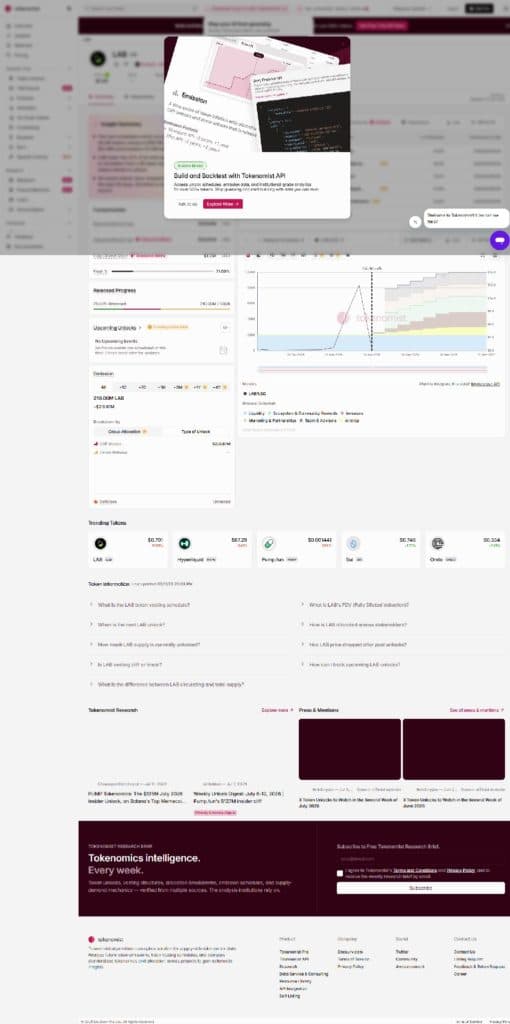
Into that vacuum, social media has produced two competing dates for the same event. One account with 232,000 followers wrote that a cliff from LAB’s original Legion ICO “ends in july 14th.” A separate account, sourcing an unnamed “early investor,” wrote that the first 10% of tokens “won’t be claimable until August 14,” directly contradicting the team’s own alleged announcement of a July 14 date. A third-party tracker, Tokenomist, muddies things further: it lists LAB as fully unlocked already, with no pending event in its system at all. None of the three sources agree, and there is no official document to referee between them.
What Actually Went Right This Year
Buried under the wallet story, LAB did ship something real. On June 24, the official account announced the trading terminal had gone live on Apple’s App Store, a genuine expansion beyond its original Telegram-bot form. DeFiLlama tracks $11.87 million in annualized trading fees flowing through the platform, with $6.5 million raised across two rounds from a list of named investors that includes OKX Ventures, KuCoin Ventures, Gate Ventures, Animoca Brands, GSR, and Amber Group, a roster serious enough that it argues against dismissing the whole project as a shell.
None of that changes what is sitting in those six wallets, or who is moving tokens onto Aster this week. It does mean the balance sheet has two real sides: a working product with institutional backers on one, and a supply structure that repeats a pattern a bounty hunter is actively paying to unravel on the other.
What To Watch Next
July 14 and August 14, 2026: the two competing dates circulating for LAB’s first claimed unlock. Neither has been confirmed by an official team document as of this writing.
Ongoing: whether any of the four Specter-flagged wallets, or the unlabeled #2 and #4 holders, show new outbound transfers to an exchange. All six are public addresses, linked in Table 1.
Ongoing: whether ZachXBT’s $10,000 bounty produces a confirmed identity behind the @vsadkovv account, and whether Bitget or Aster issue any findings from their own internal reviews.
If the wallets Specter and CoinGecko both flagged turn out to be treasury or market-making infrastructure moving through normal operations, and the July or August unlock lands without a matching dump, LAB’s clean contract, real audit, and functioning iOS app give it a floor to rebuild from, still trading on eleven-plus exchanges with $11.87 million in annualized platform fees behind it.
If those wallets keep feeding exchanges the way they did in April, May, and again this week, a $123,500 pool cannot absorb much more selling without the kind of price impact already visible at the $100,000 mark, and a market that cannot agree on its own next unlock date is not a market pricing that risk correctly yet.
────────────────────────────────────────────────────────────
Disclaimer: This article is for informational purposes only and does not constitute financial advice. Cryptocurrency investments carry significant risk, including the total loss of capital. Always conduct your own research.