Audiera BEAT jumped 27% today, and underneath that move sits a stranger number: its primary pool processed 34,207 buys against 35,043 sells in the past 24 hours, a 49.4% buy share. On its own, that means little. What makes it worth stopping on is that the same near-50/50 split shows up independently at the 1-hour mark, 50.4%, and the 6-hour mark, 49.3%. Three separate windows, three near-identical splits, on a token whose entire pitch is that AI agents, not just humans, are supposed to be the ones trading it.
That consistency is the exact pattern this research treats as an automated-volume flag, the kind usually tied to wash-trading bots inflating a thin pool. Audiera’s own documentation offers a different, equally plausible explanation. The project describes itself as an “agent-native participation economy,” where autonomous AI software transacts on-chain through defined “Operator Agent” and “Player Agent” roles. Bot-driven wash trading and legitimate autonomous-agent throughput produce the identical visible signature from outside the contract. Public data cannot separate them, and Audiera is one of the few tokens where that ambiguity cuts both ways: this volume could be the product working exactly as designed, or it could be nothing of the kind.
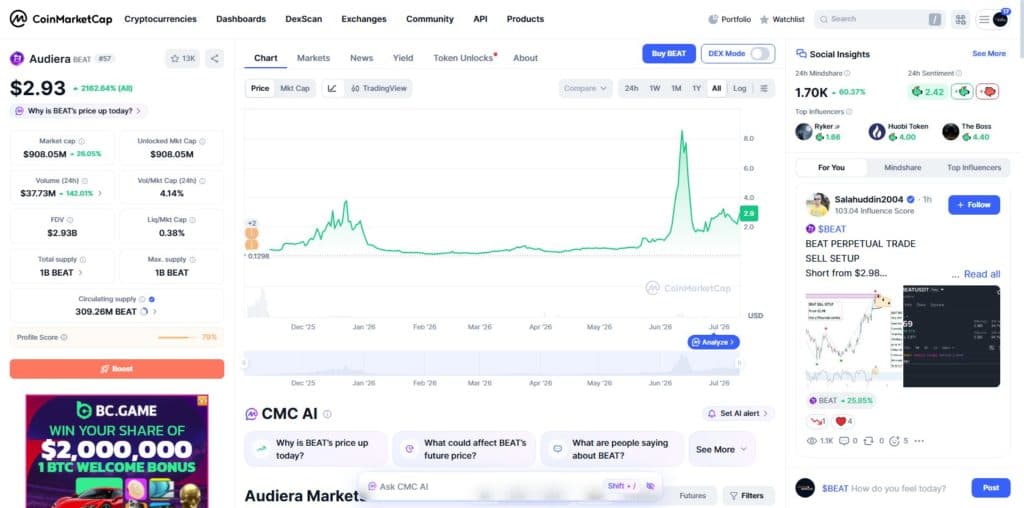
Audiera (BEAT) on CoinMarketCap, July 11 2026: price near $2.93-2.99, market cap around $908-927M, Liq/Mkt Cap 0.37-0.38%. Source: CoinMarketCap.
69,250 Trades, Split Almost Exactly 50/50
Pulled directly from GeckoTerminal’s pool data for BEAT’s primary PancakeSwap Infinity pool:
| Timeframe | Buys | Sells | Vol (USD) | Buy % | Read |
| 5m | 165 | 137 | $59,633 | 54.6% | slightly buy-skewed |
| 1h | 1,727 | 1,700 | $849,251 | 50.4% | near-parity |
| 6h | 11,483 | 11,809 | $5,744,920 | 49.3% | near-parity (wash-trading pattern) |
| 24h | 34,207 | 35,043 | $16,543,031 | 49.4% | near-parity (wash-trading pattern) |
The 5-minute window runs slightly hotter toward buys, 54.6%, which is normal for a small sample size. What is not normal is how quickly that gap closes: by the 1-hour mark it has settled to 50.4%, and it stays within a point of even through 6 hours and 24 hours. Wider still, BscScan’s own transfer counter puts BEAT’s lifetime total above 24.15 million transfers, an extraordinary count for a token roughly nine months past its token-generation event. Vol/Mkt Cap sits at a moderate 4.1% on the 24h number CoinMarketCap reports across all venues, not itself an extreme figure, which means the flag here is not “too much volume.” It is that the buy and sell sides of that volume mirror each other too precisely, too consistently, for this to read as ordinary retail activity.
One limitation matters here: BEAT trades on nine centralized exchanges whose order flow is invisible to free on-chain APIs. This table, and the reasoning built on it, covers only the DEX side of Audiera’s total volume. If the bulk of directional, human-driven buying happens on Binance Alpha or Gate rather than on-chain, this pattern would look exactly the way it does regardless of what is happening off-chain. That gap is worth naming rather than papering over.
What $100,000 Actually Costs to Move
BEAT is up 26.68% in the past 24 hours and down 65.91% over the past 30 days, a token still working off its June 12 all-time high of $11.10. None of that volatility shows up in a live trade quote the way its liquidity depth does. Checked directly against 1inch, a real-time DEX aggregator, rather than estimated from the pool balance:
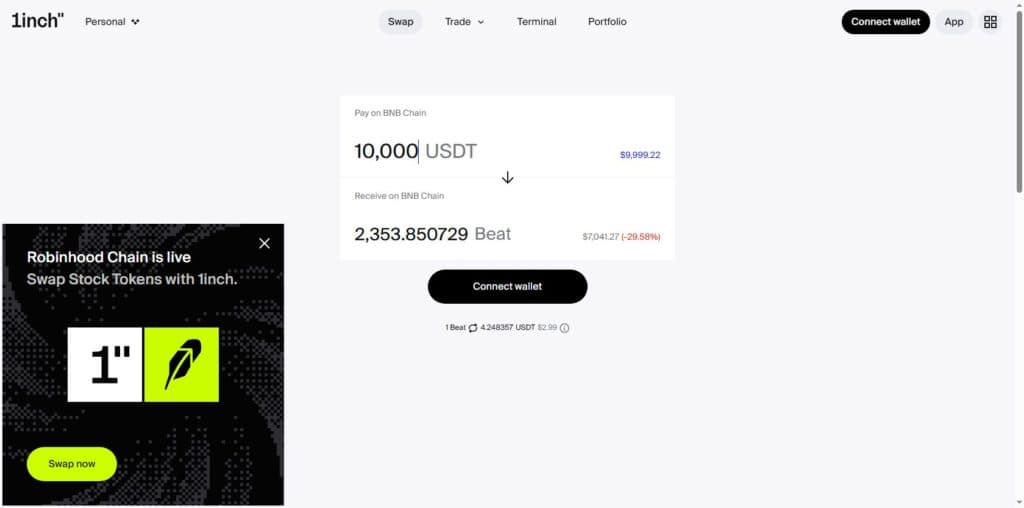
$10,000 buy quote on 1inch: -29.58% price impact. Source: 1inch (BNB Chain).
A $1,000 buy costs 3.61%. Reasonable. A $10,000 buy costs 29.58%. A $100,000 buy costs 92.49%, meaning the effective price paid works out to roughly $39.85 per BEAT against a $2.99 spot price. Selling shows the same shape in reverse: -3.00% at $1,000, -18.08% at $10,000, -86.02% at $100,000.
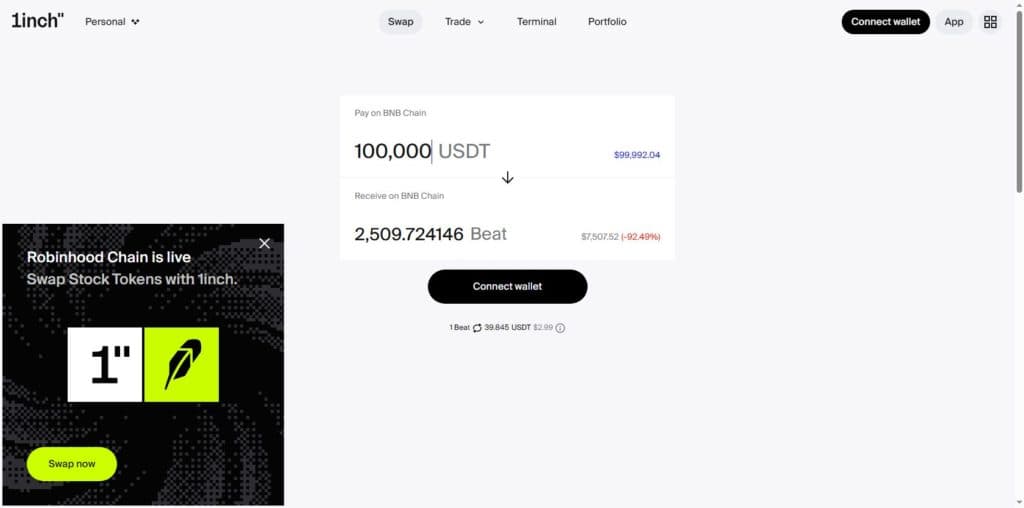
$100,000 buy quote on 1inch: -92.49% price impact, effective rate roughly $39.85 per BEAT versus a $2.99 spot price. Source: 1inch.
Behind those numbers sits a single fact: Audiera’s primary pool, a PancakeSwap Infinity concentrated-liquidity market on BNB Chain, holds $3.04 million. Total liquidity across every pool tied to the contract adds up to roughly $3.1-3.2 million. Against a market cap north of $900 million, that puts Liq/Mkt Cap at 0.37-0.38%, well under the 1% level this research treats as a minimum floor. A trader moving below $10,000 trades cleanly. Above that, size becomes expensive fast. That is a fact about depth today, not a prediction about tomorrow.
The Scanner That Contradicted Itself
That thin liquidity is also what produced the false honeypot flag. honeypot.is ran its buy-then-sell simulation against “PANCAKESWAP V3: USDT-BEAT (LIQUIDITY: $336),” a fee-tier pool from BEAT’s earliest days that has since been drained down to almost nothing. Simulating a trade into $336 of liquidity fails for the same reason emptying a shot glass with a fire hose fails: there is nowhere for the volume to go.
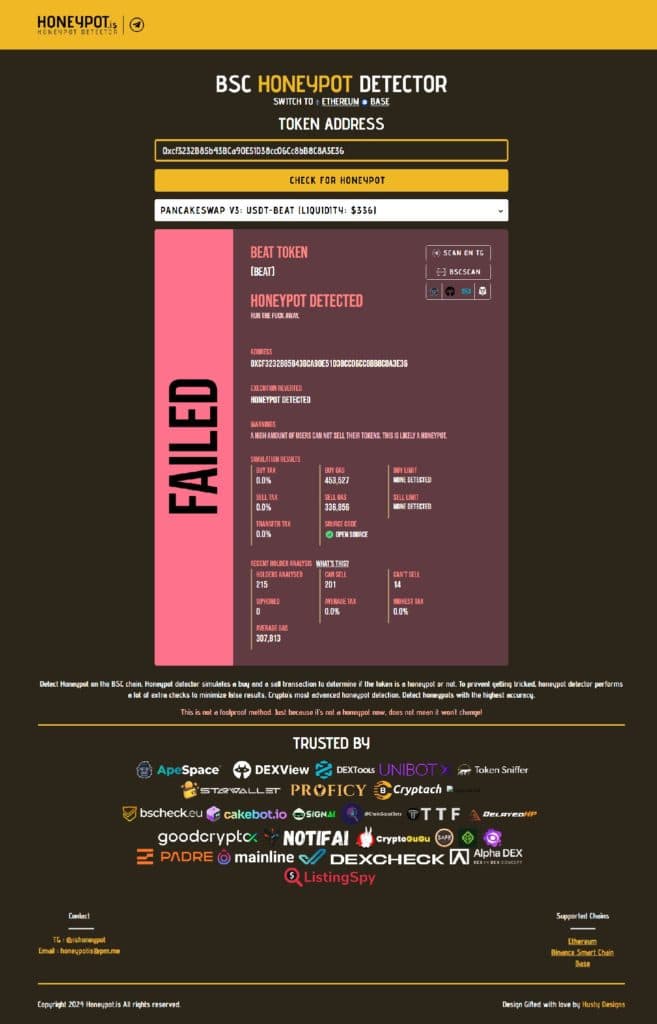
honeypot.is result for BEAT: headline “HONEYPOT DETECTED,” tested against a $336 legacy pool, while the report’s own Simulation Results show 0% buy/sell tax and Recent Holder Analysis shows 201 of 215 sampled holders (93.5%) successfully sold. Source: honeypot.is.
Reading the verified contract settles it properly rather than trusting either badge. Beat.sol is seventeen lines of custom code sitting on a standard, unmodified ERC20 base: a constructor, and a mint() function. That is the entire custom logic. No pause. No blacklist. No sell tax. No trading-toggle an owner could flip. Nothing in the deployed bytecode can distinguish a buy from a sell, let alone block one.
A Supply Cap That Has Already Been Reached
The mint() function that does exist is capped in code, not just described as capped in marketing copy: “if (amount_ + totalSupply_ > MAX_SUPPLY) { amount_ = MAX_SUPPLY – totalSupply_; }” A direct eth_call to totalSupply() returns exactly 1,000,000,000.00 BEAT, precisely matching MAX_SUPPLY. Mint is exhausted. Zero additional BEAT can be created by anyone, ever.
A second eth_call, this time to owner(), returns 0x0000000000000000000000000000000000000000. Ownership has been renounced. There is no address left that could call mint() even if headroom remained, and no address that could call any of the contract’s other owner-gated functions. Combined with the absence of a pause or blacklist function, Audiera’s contract has essentially no remaining lever a bad actor could pull. Audiera’s own documentation also points to a security review by Beosin, an established blockchain-security firm, though the audit date is not stated on the page.
82% of Supply Sits in Contracts, Not Wallets
That clean contract picture collides with a concentration number that looks alarming on its face. The top 100 holders control 98.63% of supply, and the top five alone hold 68%, according to BscScan’s holder chart. The single largest wallet holds 333,333,336 BEAT, exactly one-third of everything that will ever exist.
That wallet is not a person. It is a verified TransparentUpgradeableProxy smart contract, tagged “BEP-20: Community” on BscScan’s own token tracker, deployed 287 days before this research, well before Audiera’s late-October token launch. Its recent transaction history is a steady stream of small “Claim To” entries, consistent with a rewards or vesting-claim system that individual users draw from over time, not a single wallet a team could empty in one signed transaction.
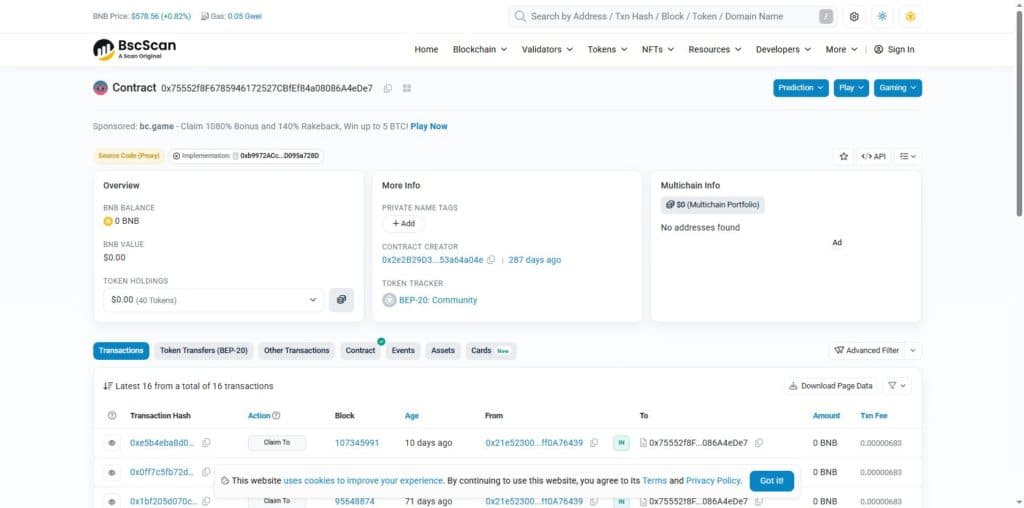
BscScan address page for BEAT’s largest holder (33.33% of supply): verified TransparentUpgradeableProxy contract, tagged “BEP-20: Community,” created 287 days before this research, showing recurring “Claim To” transactions. Source: BscScan.
It is not alone. Checking the code deployed at nine of BEAT’s ten largest non-exchange, non-burn wallets, ranks one through eight plus rank ten, covering roughly 82.7% of total supply combined, finds every single one is a smart contract. Some share an identical proxy pattern and deployer to the Community wallet. One, rank three at 8% of supply, is a different lock-contract design entirely, deployed by a separate address, and has recorded zero transactions of any kind since it was created 222 days ago.
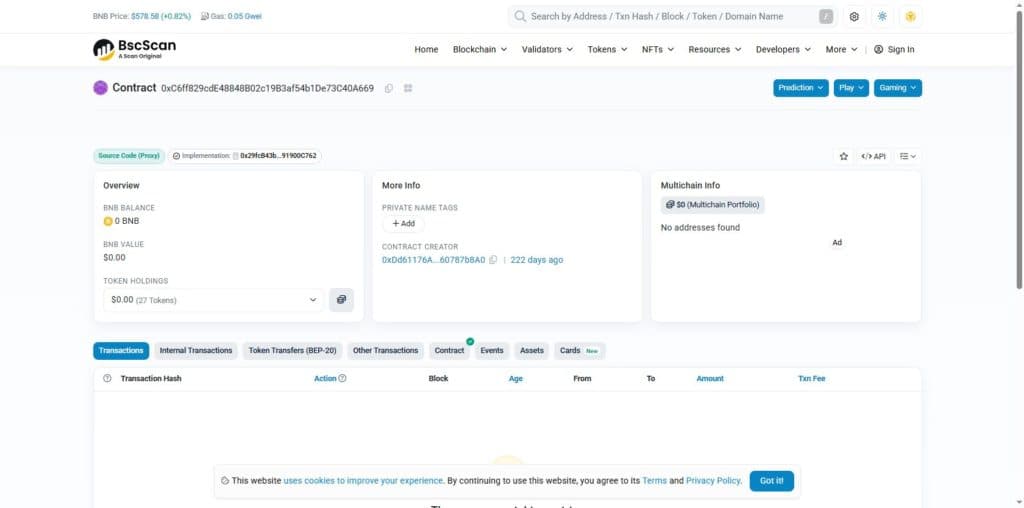
BscScan address page for BEAT’s third-largest holder (8% of supply): a separate lock-contract, deployed by a different creator address, with zero transactions recorded since inception. Source: BscScan.
None of this can be matched against a named allocation table, because Audiera’s own documentation does not publish one. No team page and no percentage-by-category tokenomics breakdown exist anywhere in the docs, confirmed against the site’s own indexed sitemap. Independent unlock trackers turn up nothing either: Tokenomist has no record for BEAT, and DeFiLlama has no protocol page at all. The mechanism looks safe. The bookkeeping behind it is not public.
Automated Volume, By Design or By Bot
The primary pool processed 34,207 buys against 35,043 sells in the past 24 hours, a 49.4% buy share, and the same near-50/50 split shows up at the 1-hour and 6-hour windows too. That pattern, buys and sells landing within a percent or two of each other across multiple timeframes, is the exact signature this research treats as a wash-trading flag. Pulled directly from GeckoTerminal’s pool data:
| Timeframe | Buys | Sells | Vol (USD) | Buy % | Read |
| 5m | 165 | 137 | $59,633 | 54.6% | slightly buy-skewed |
| 1h | 1,727 | 1,700 | $849,251 | 50.4% | near-parity |
| 6h | 11,483 | 11,809 | $5,744,920 | 49.3% | near-parity (wash-trading pattern) |
| 24h | 34,207 | 35,043 | $16,543,031 | 49.4% | near-parity (wash-trading pattern) |
There is a plausible non-manipulative explanation specific to this token. Audiera’s own documentation describes the project as an “agent-native participation economy,” where autonomous AI software, not just humans, is designed to transact on-chain using BEAT through defined “Operator Agent” and “Player Agent” roles. A near-50/50 split with an unusually high absolute transaction count is also what automated, product-native agent activity would look like. Both explanations, bot-driven wash trading and legitimate autonomous-agent throughput, produce the same visible pattern from outside the contract, and this research cannot fully separate them from public data alone. Either way, the practical takeaway for a trader is the same: this volume is not a reliable signal of organic human buy pressure.
Two Fake Tokens Share Its Name
A search for “Audiera” on DexScreener surfaces at least two impersonator tokens using the identical BEAT ticker on Ethereum and Base, one labeled “Audiera AI,” neither connected to the verified BNB Chain contract used throughout this research. Anyone searching by name rather than pasting the exact contract address, 0xcf3232B85b43BCa90E51D38cc06Cc8bB8C8A3E36, risks landing on one of these unrelated tokens instead.
No Named Team, No Public Code
Audiera’s official site, audiera.fi, returned “Please access on your mobile device” to this research’s browser tooling, on both a standard desktop request and an emulated mobile device, a pattern more consistent with anti-bot gating than a genuine mobile-only product. The documentation subdomain loaded normally and names zero human team members anywhere. The project’s public faces are Kira and Ray, two AI character personas built into its marketing and its “Meet Kira & Ray” docs page.
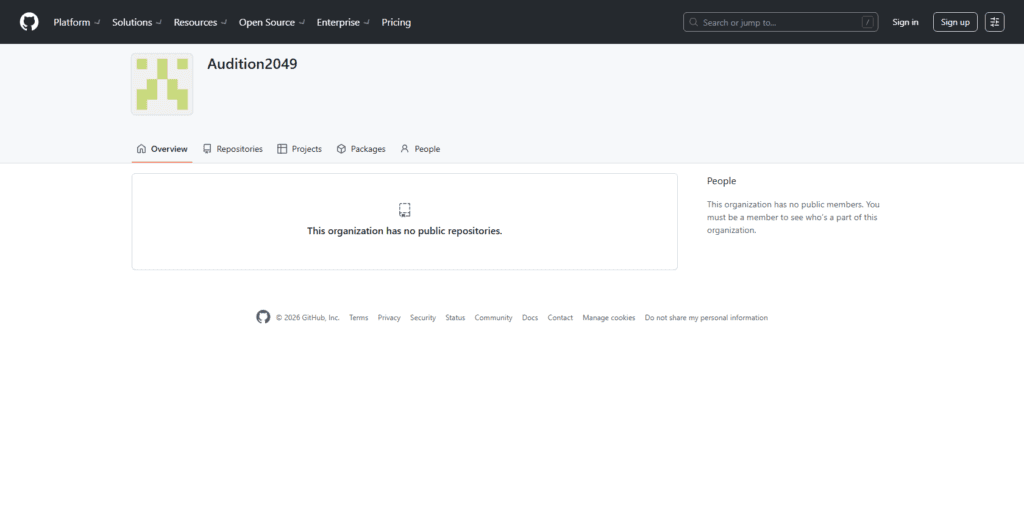
GitHub organization page for Audition2049, linked from Audiera’s CoinMarketCap listing: zero public repositories, zero public members. Source: GitHub.
The GitHub organization linked from Audiera’s own CoinMarketCap page lists zero public repositories and zero public members. For a project whose entire premise rests on verifiable AI-agent behavior, there is no public code to verify it against.
So What Actually Moved the Price Today
No official, dated announcement appears on Audiera’s verified X account (68.4K followers, active continuously since August 2023) inside the 72 hours before this price move. Its most recent post, from July 7, is a general momentum update about rising DEX volume, not a specific new catalyst. The only claimed trigger traces to a third-party, contributor-submitted CoinMarketCap Community article, 38 views, carrying an explicit “read what our contributors have to say, DYOR” disclaimer, which points to an unspecified “ecosystem announcement” about a virtual world tour for Audiera’s AI characters, and otherwise reads the move as a third successful bounce off an ascending technical trendline dating back to the June crash.

CoinMarketCap Community article attributing today’s BEAT rally to an unverified “ecosystem announcement” and a technical trendline bounce. Contributor-submitted, 38 views, explicit DYOR disclaimer. Source: CoinMarketCap Community.
Social mindshare genuinely spiked, up 60.37% in 24 hours per CoinMarketCap’s own tracking, and sentiment leans bullish. But a mindshare spike that coincides with an unverified claim is a symptom as easily as a cause. Checked in order, official announcement, scheduled unlock, whale movement, buy/sell imbalance, and social spike, none of them lines up as a clean, confirmed trigger. Most likely cause: a technical bounce combined with chatter around an unconfirmed announcement. Confidence: possible, not confirmed.
What to Watch Next (as of July 11, 2026)
Four things worth tracking: whether Audiera’s own channels confirm or deny the “virtual world tour” claim currently circulating only through an unverified third party; whether the Community claims contract’s distribution pace changes now that price has moved; whether the roadmap’s Phase 4 “Agent Economy,” targeting 2026-2027 with agent wallet systems and a skill marketplace, produces a dated announcement; and whether liquidity deepens meaningfully beyond its current $3 million, since that single number governs how expensive it is to trade this token at any real size.
Historical Catalyst Playbook
The closest comparable precedent sits in Audiera’s own history. On November 4, 2025, days after its late-October token launch and its November 2 all-time low, the project’s official account announced BEAT had hit “#1 Gainer” status across Binance Alpha, OKX Boost, KuCoin, and Gate simultaneously, alongside a two-day CoinMarketCap trending streak and $740 million in 24-hour volume. That episode was multi-exchange and self-reported rather than independently confirmed at the time, a useful pattern to keep in mind: this project’s biggest documented rallies have coincided with broad exchange-side attention as much as with any single dated announcement.
Bull Case, Bear Case
Bull case, strictly from what was verified: a mint function that is capped in code and already fully exhausted, ownership renounced on-chain, no pause or blacklist function anywhere in the contract, a Beosin security review referenced in official docs, nine live exchange listings including Binance Alpha, and roughly 82.7% of supply sitting in contract-gated claims and lock infrastructure rather than freely-movable private wallets. Bear case, equally strict: a $3 million liquidity pool against a $900 million-plus market cap that turns anything above $10,000 into a costly trade, zero named team members anywhere in official materials, zero public code on the linked GitHub, an official website that blocks this research’s access entirely, no formal tokenomics allocation table to check the holder contracts against, and a 27% single-day rally with no confirmed cause from the project’s own channels.