DODO is up 40.3% in 24 hours and 73% across seven days, trading at $0.0274 as of July 15, 2026, according to CoinGecko. Here’s the part that should give a buyer pause: DeFiLlama’s income statement for the DODO protocol shows gross revenue fell from $16.53 million in Q3 2025 to just $178,350 this quarter, a decline of roughly 99% in a year. The token is celebrating while the business underneath it is dying. That gap, not the price chart, is the actual story.
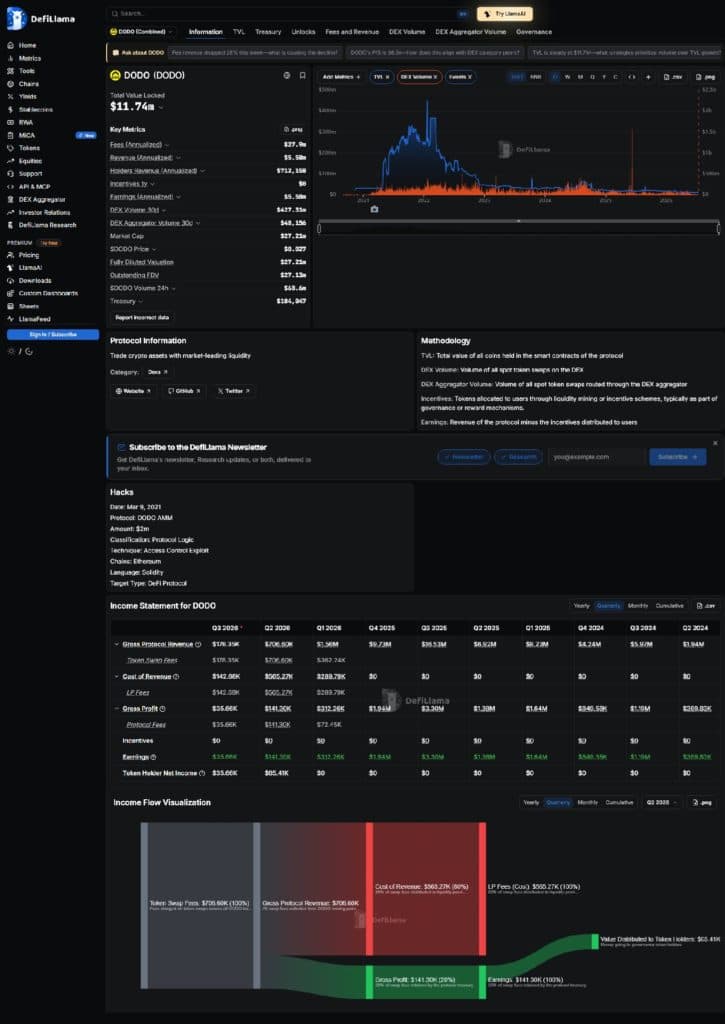
DeFiLlama — DODO Key Metrics panel and quarterly Income Statement showing revenue falling from $16.53M (Q3 2025) to $178.35K (Q3 2026), screenshotted July 15, 2026.
Two DODOs, One Ticker
Working out why requires separating two different things that share a ticker. DODO the protocol is a proactive market maker DEX that earns swap fees from anyone trading through its pools. DODO the token is what people are buying right now. The protocol’s fee income has collapsed every single quarter since Q3 2025: $16.53 million, then $9.73 million, then $1.56 million, then $706,600, then $178,350 so far this quarter, per DeFiLlama. Treasury sits at $104,047. None of that improved this week. What moved was demand for the coin itself, on venues that have nothing to do with how much the protocol earns.
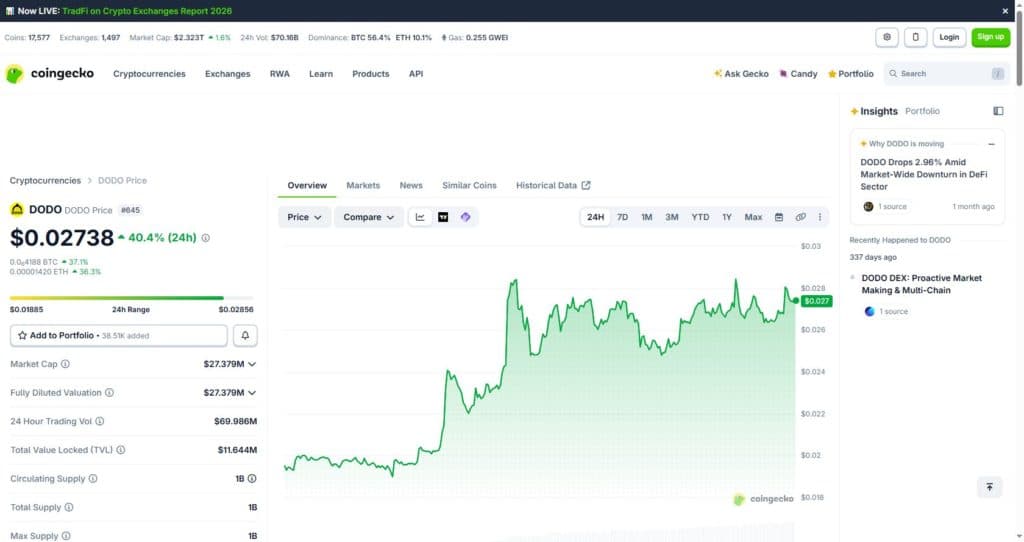
CoinGecko — DODO overview tab showing price $0.0274, 24h +40.4%, market cap $27.4M, screenshotted July 15, 2026.
Where the Money Actually Trades
That distinction matters because of where DODO’s trading volume lives. CoinGecko puts 24-hour volume at roughly $70 million. Add up every on-chain DODO pool across Ethereum, BNB Chain, Polygon, and Arbitrum through DexScreener’s API and the total is about $216,000 in actual swap volume, call it three-tenths of one percent of the reported figure. The other 99.7% clears through centralized order books, mostly Binance, where DODO/TRY and DODO/USDT together account for 42% of listed volume on CoinGecko’s own Markets tab.
CoinGecko — DODO Markets tab showing Binance DODO/TRY and DODO/USDT as top pairs by volume, screenshotted July 15, 2026.
That split changes what’s worth investigating. A DEX-liquidity story, thin pools getting pushed around by a whale, wash trading dressing up a chart, barely applies here, because the DEX side is a rounding error. The real question is what centralized order books and their attached futures markets were doing, and Binance has carried both DODO pairs for years, so there’s no new listing hiding in that 42%.
Two Legs, Not One
The move itself came in two pieces. On July 12 at 21:00 UTC, DODO jumped 53.6% in a single hour, from about $0.0165 to $0.0254, per CoinGecko’s hourly market chart data. It then sat between $0.020 and $0.024 for roughly 36 hours before a second leg, running from 22:00 UTC on July 14 through 01:00 UTC on July 15, added another 35% and pushed the token to a fresh high near $0.0282.
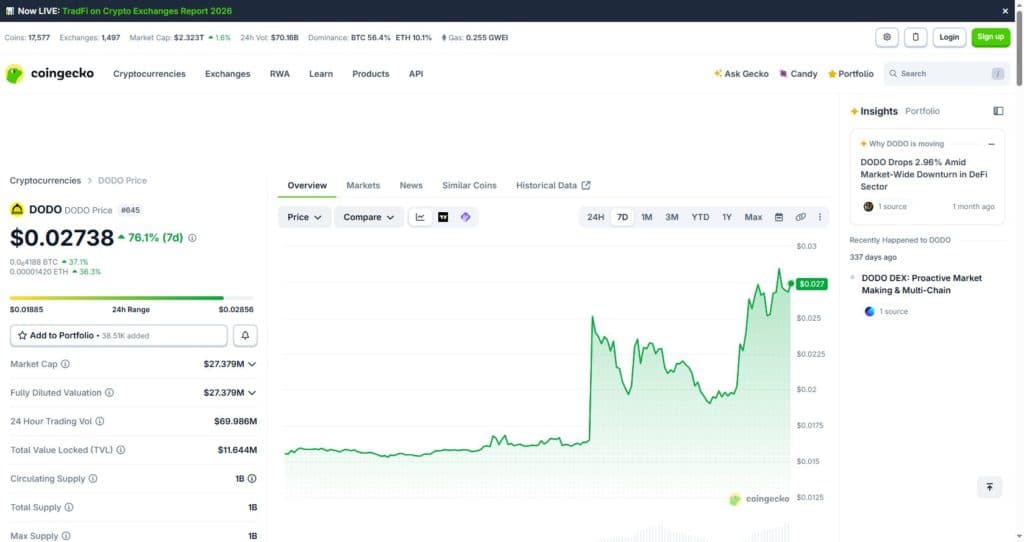
CoinGecko — DODO 7D chart tab showing the two-stage step pattern, screenshotted July 15, 2026.
Nothing dated from the project explains either leg. DODO’s verified X account, 260,300 followers, last posted July 9, a ChainPilot CLI update that drew 4,984 views, modest by its own history, three days before the first spike even started. Between July 12 and July 15 it posted nothing.
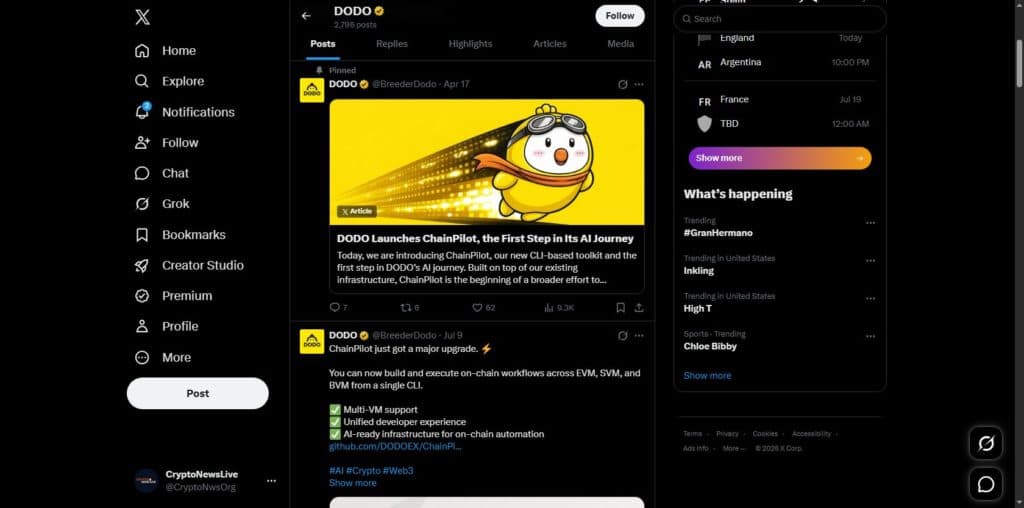
X (@BreederDodo) — official DODO account showing its last post dated July 9 with no activity July 12-15, screenshotted July 15, 2026.
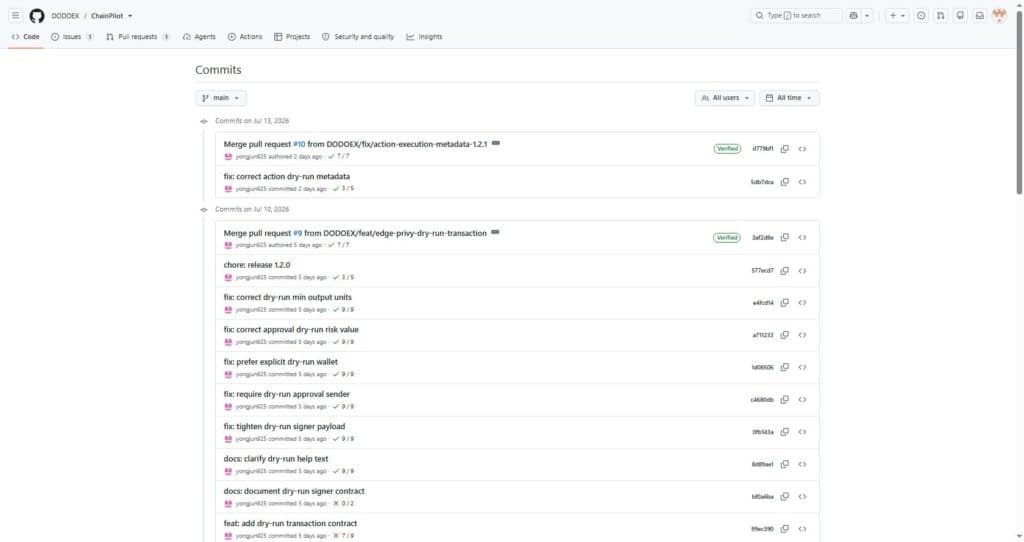
GitHub — DODOEX/ChainPilot commit history showing a July 13, 2026 dry-run metadata fix, screenshotted July 15, 2026.
A commit titled “fix: correct action dry-run metadata” merged into DODOEX/ChainPilot on GitHub on July 13, but it’s a backend correction to dry-run transaction metadata, not the kind of change that moves a market cap 73%. It isn’t sector-wide either: Sushi gained 5.4% over the same week, 1inch 7.4%, Balancer 8.2%, PancakeSwap 5.5%, Kyber 3.9%, all per CoinGecko, while Bitcoin was up 2.4% on the day. Whatever hit DODO stayed contained to DODO.
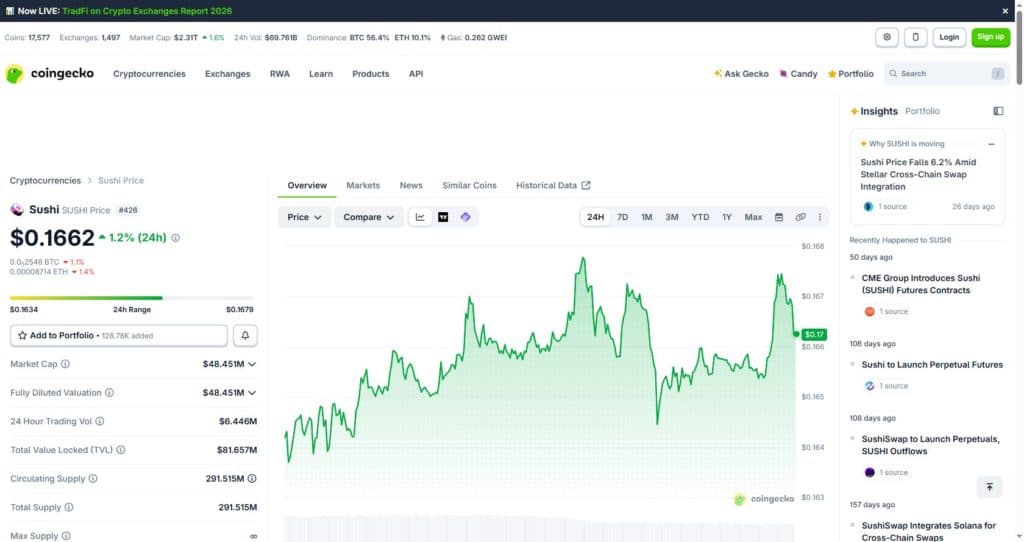
CoinGecko — Sushi price page showing only +1.2% 24h against DODO’s +40%, screenshotted July 15, 2026.
The Leverage Arrived After the Price Did
If the real trading happens on centralized exchanges, their futures markets are where a mechanical explanation would show up, and it does. Coinglass data shows DODO futures open interest jumped 42.1% in a single day, to $4.2 million, with KuCoin’s OI up 195.82% and MEXC’s up 219.49% on the same day. Futures volume, $21.12 million over 24 hours, outpaced spot volume of $14.12 million.
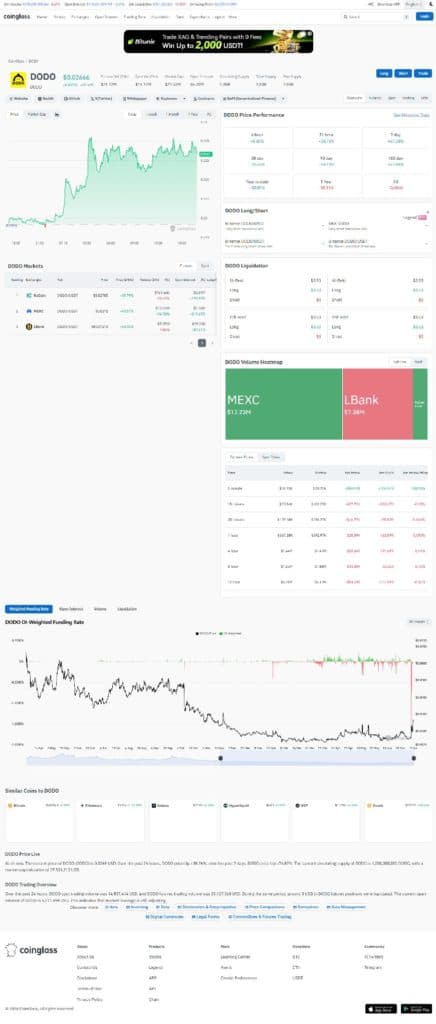
Coinglass — DODO futures dashboard showing open interest, per-exchange OI change, and the liquidation panel, screenshotted July 15, 2026.
That pattern usually reads as a short squeeze, positions forced closed, adding fuel to the climb. It isn’t one here: Coinglass’s liquidation panel shows $3.53 total liquidated across the 1-hour, 4-hour, 12-hour, and 24-hour windows, and what little there was sat on the long side.
There was no cascade.
The sequence instead looks like traders piling fresh margin onto a breakout that had already started, on a market thin enough that the buying itself did most of the work. DODO had room to make that work: the three-month chart shows it boxed between $0.015 and $0.02 for most of that stretch, sitting on a five-month-old floor of $0.0129848 set February 6, 2026, itself 99.67% below the token’s February 2021 peak of $8.38.
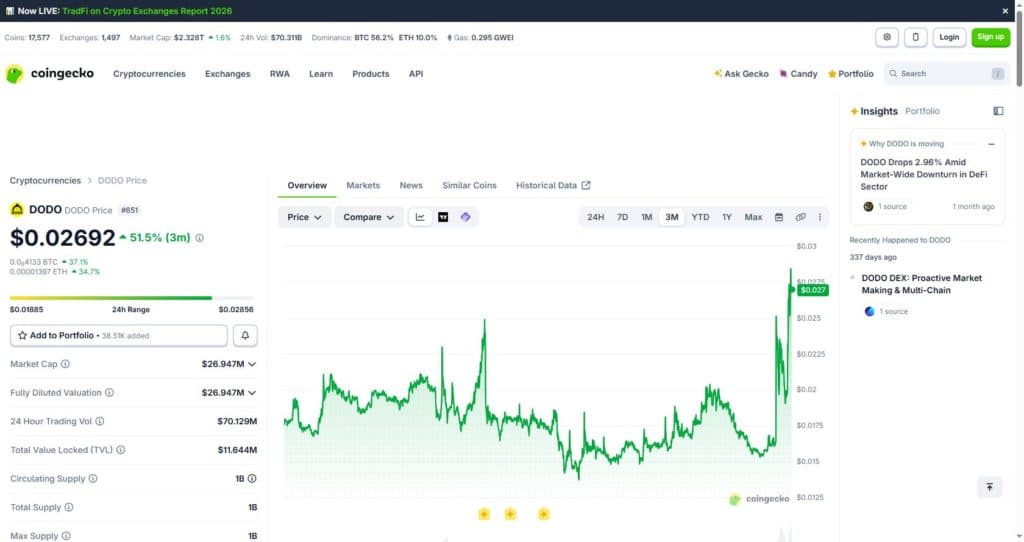
CoinGecko — DODO 3M chart tab showing the consolidation range before breakout, screenshotted July 15, 2026.
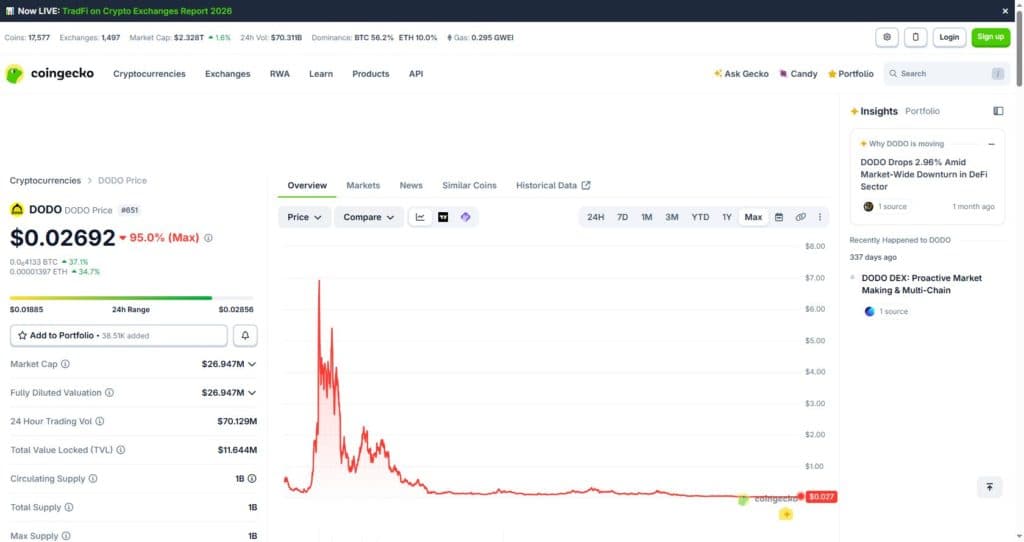
CoinGecko — DODO Max chart tab showing the 2021 all-time high and the multi-year decline, screenshotted July 15, 2026.
Retail showed up once the chart had already turned. An account called Crypto Narrative Research, 1,075 followers, bio advertising a paid signal channel, claimed today to have “called” the move from a July 1 post. Other accounts in the same search were pushing 50x and 75x margin entries on DODO after the fact. Neither moved a $27 million market cap; they showed up once the move was visible, the same way the futures money did.
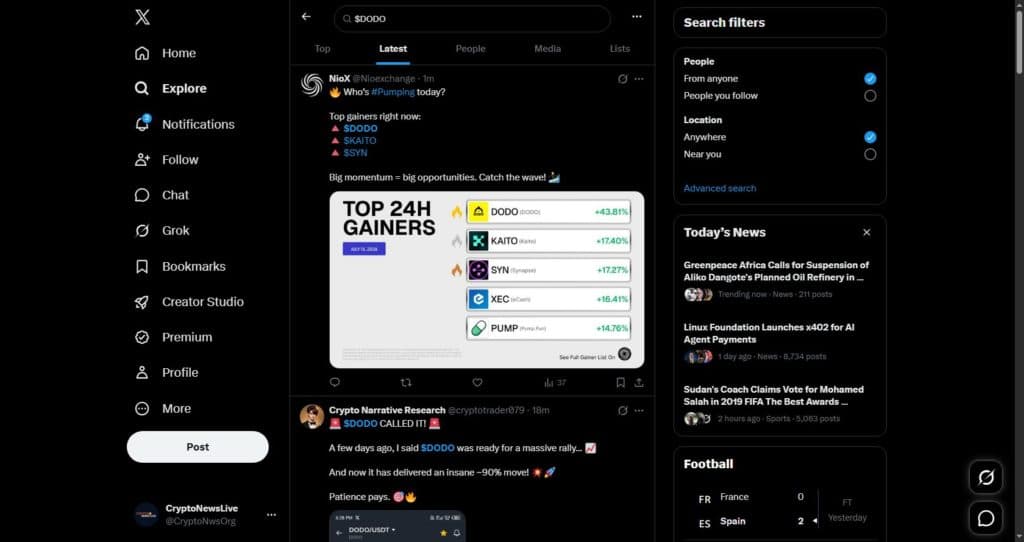
X — live search for “$DODO” showing signal-seller and bot accounts reacting to the move, screenshotted July 15, 2026.
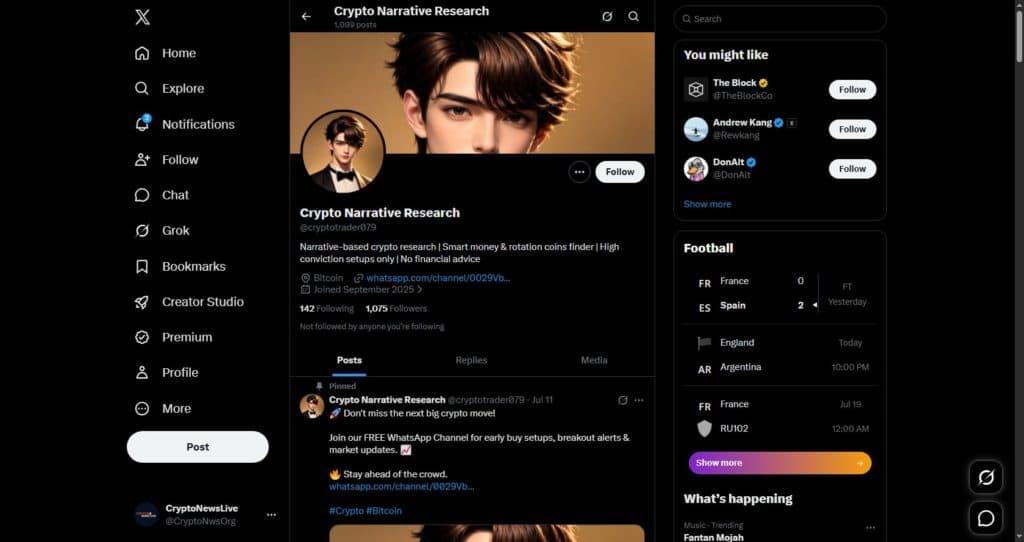
X — @cryptotrader079 profile showing 1,075 followers and a paid WhatsApp signal channel bio, screenshotted July 15, 2026.
What the Contract Doesn’t Change
The token itself isn’t the risk here. Honeypot.is returned a “PASSED, LOW RISK” result on the BSC contract: 0% tax on buys, sells, and transfers, open source, all 1,531 sampled holder wallets able to sell. DexScreener’s Top Traders tab on the main BSC pool showed the most profitable wallet over 30 days made $17,700 across 169 transactions, arbitrage-bot behavior, not a windfall from advance knowledge. Circulating, total, and max supply are all 1 billion DODO, identical, so there’s no unlock overhang waiting to hit the market. DeFiLlama’s only recorded hack is from March 9, 2021, a $2 million access-control exploit, ancient history with no bearing on this week.
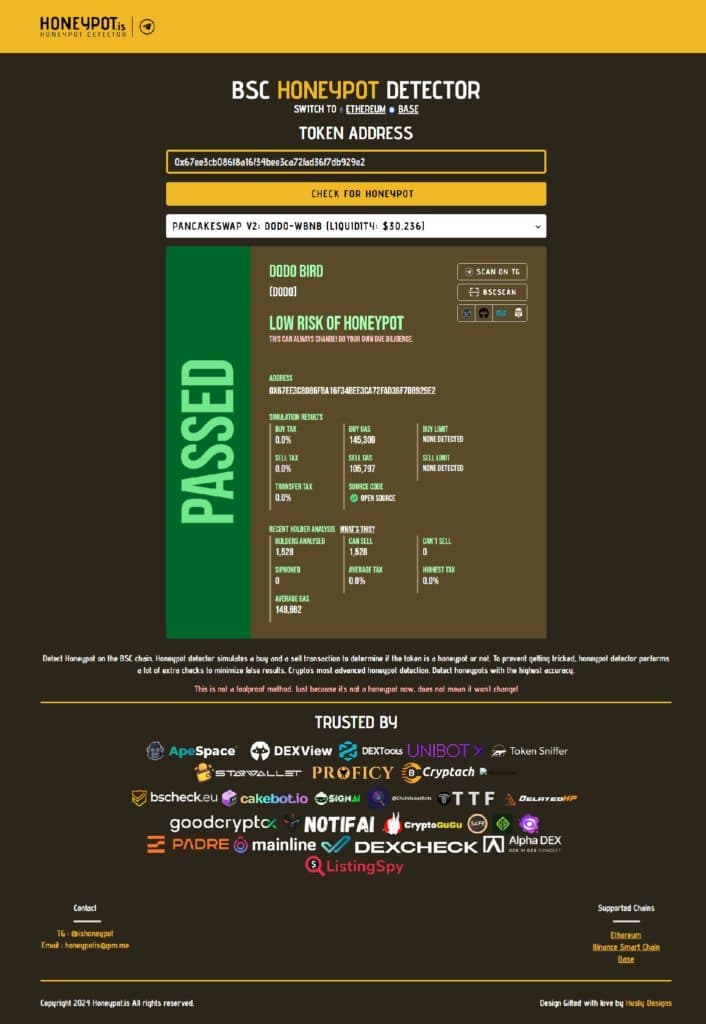
Honeypot.is — BSC contract scan result, PASSED with 0% tax across buy, sell, and transfer, screenshotted July 15, 2026.
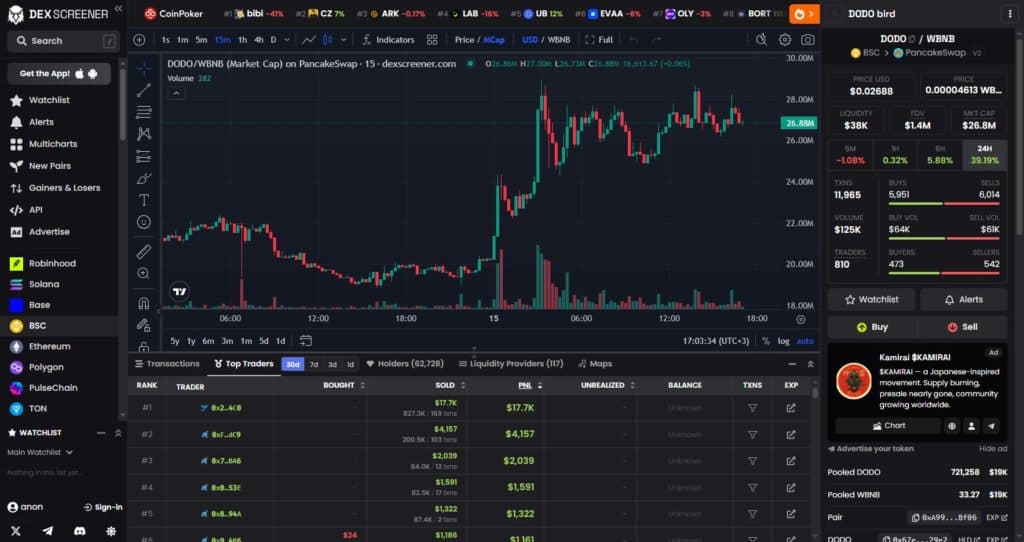
DexScreener — Top Traders tab for the DODO/WBNB PancakeSwap pool, showing modest 30-day PnL figures, screenshotted July 15, 2026.
Put together, that’s a token whose price broke out on centralized order books and leveraged futures, while the protocol generating those fees has been losing revenue every quarter for a year. If the futures buildup keeps growing without matching growth in the protocol’s actual fee income, the more likely mechanical outcome is a give-back once the leverage stops finding new buyers to trade against, since nothing underneath the price is currently confirming it. There’s no scheduled unlock, listing vote, or governance proposal to mark on a calendar. The one number worth watching is whether Monday’s revenue print breaks the losing streak, or extends it.