- Mastercard launched Agent Pay for Machines on June 10 with 30+ partners, including Ripple, Coinbase, and Stripe.
- Binance XRP reserves dropped to approximately 2.69 billion XRP, the lowest point in four months, per CryptoQuant data.
- XRP is trading near $1.11 despite the institutional news, with community sentiment divided on whether the Ripple partnership lifts token value.
Mastercard officially launched Agent Pay for Machines on June 10, a new payments service built for AI agents that transact autonomously at high speed. More than 30 companies backed the rollout from day one, including Adyen, Coinbase, Stripe, OKX, and Ripple. The launch signals a direct bid to build financial infrastructure for software that buys, pays, and settles without any human initiating the transaction.
Jorn Lambert, Mastercard’s chief product officer, described the service as opening conditions for a wide burst of AI business models. Machine payments, he said, can run at fundamentally different scales compared to today: very high volumes, very small values, and extremely low latency. The system handles everything from card rails to stablecoin settlement across multiple providers simultaneously.
XRPL and RLUSD as the Blockchain Settlement Layer
Ripple’s role in the system centers on the XRP Ledger and RLUSD, its USD-backed stablecoin. Markus Infanger, senior vice president of RippleX, said the infrastructure keeps agents within defined transaction rules enforced by the chain itself, with settlement completing in seconds and a full audit trail attached to every transaction.
“XRPL and RLUSD are built so enterprises can let agents transact at machine speed within rules the chain itself enforces, with settlement in seconds, predictable costs, programmable compliance, and a full audit trail, so agents can only ever do what they are authorized to do. Mastercard’s move toward regulated stablecoin settlement on-chain is an important signal that this is evolving from an emerging capability into an enterprise standard.” – Markus Infanger, SVP RippleX, on X
Ripple posted directly on X that AI agents now need more than speed when moving value on behalf of businesses. Trust, controls, and clear rules about how value moves are the requirements the company says its infrastructure is designed to meet, with XRPL and RLUSD laying what it described as the foundation for the future of commerce.
The Agent Pay for Machines platform handles credentialing, permissioning, and guaranteed settlement across cards, accounts, and stablecoins. Mastercard’s Verifiable Intent technology checks and authorizes participating agents before they transact. Ripple sits inside that settlement stack at the blockchain layer, where RLUSD brings price stability for invoice settlement and XRPL manages the actual transaction execution.
Binance XRP Reserves Drop to Four-Month Low
While the partnership news landed, on-chain data from CryptoQuant showed Binance XRP reserves dropping to roughly 2.69 billion XRP over the past two days. That is the lowest level in four months. The exchange previously held above 2.8 billion XRP before a gradual decline started in recent weeks.
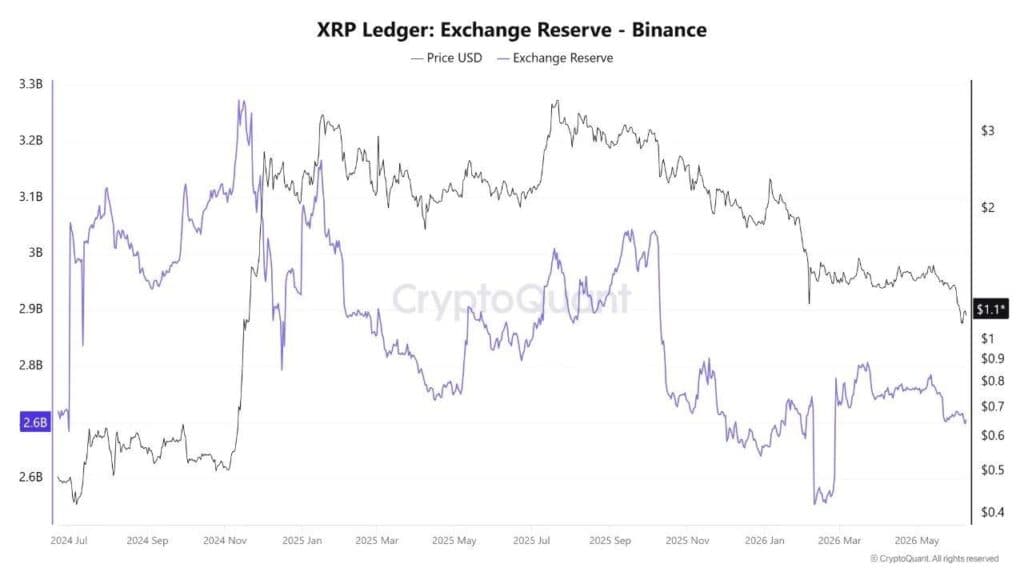
Source: CryptoQuant – XRP Ledger Exchange Reserve on Binance, showing reserves at 2.69B XRP as of June 10, 2026
XRP is holding near $1.11 and was trading around $1.17 at the time the reserve figures were recorded. The coin has fallen roughly 2.76% in the past day. CryptoQuant noted the declining reserves may reduce short-term selling pressure since fewer coins are sitting on the exchange ready to be sold. Still, price direction depends on broader factors including trading volumes, whale activity, and overall market conditions.
XRP Holders React as Price Stays Flat on Partnership News
The community response on X was divided. Goldsfeir, posting under the handle @Goldsfeir1, made a pointed claim about Ripple’s direction.
“You destroyed XRP and slowly replaced it with $RLUSD. You only used the incredible XRP army to finance your operations, acquisitions and nothing else. You have left in the dust all the XRP holders that were counting on you to bring real value and adoption to $XRP.” – @Goldsfeir1 on X
The frustration reflects a specific tension that other media coverage has largely skipped: Ripple’s expanding institutional presence through RLUSD and Mastercard partnerships has not translated into XRP price recovery. Several replies under Ripple’s post on X echoed skepticism. One user posting as @MillarPhillippe wrote: “Again good news, price down. Very good.” Another account, @XRPCuracao, asked where Ripple was even mentioned in the Mastercard article, suggesting confusion about how prominently Ripple’s role was being signaled in official communications.
RLUSD has grown steadily in the background. The stablecoin passed $1.5 billion in market cap by mid-2026, according to MoneyCheck, and now connects to more than 40 blockchain networks via Wormhole’s Native Token Transfers protocol. That expansion runs parallel to XRP’s price sitting significantly below its 2024 highs above $3.
What the 30-Partner Machine Payments Network Actually Does
The Agent Pay for Machines system builds on Mastercard’s earlier Agent Pay program from 2025. The original program defined how trusted AI agents participate in payments. The new service targets automated microtransactions that run continuously in the background of digital commerce, too small or too fast for human involvement.
Stani Kulechov, founder and CEO of Aave Labs, described payments and treasury management as inseparable in this new setup. He said Aave delivers credit and liquidity to work with machine-speed payment execution. Chris Harmse, co-founder and chief business officer at BVNK, said stablecoins bring programmability and efficiency to how value moves between agents, placing his company at the intersection of currencies, rails, and formats.
Cloudflare’s chief strategy officer Stephanie Cohen said the internet was built for human interactions but the infrastructure of the future must handle autonomous ones. Coinbase’s Nina Coughlin highlighted open standards like x402 as part of the framework, combining trusted payment networks with programmable digital dollars.
Practical examples in the Mastercard announcement included an AI agent building a flower shop’s web presence by buying a domain, hosting, images, and checkout pages within a set budget, turning a single human instruction into a chain of automatic purchases. A logistics agent could also pay for freight, reserve loading-bay access, buy cold-chain monitoring data, and settle warehouse fees automatically as a shipment moves.