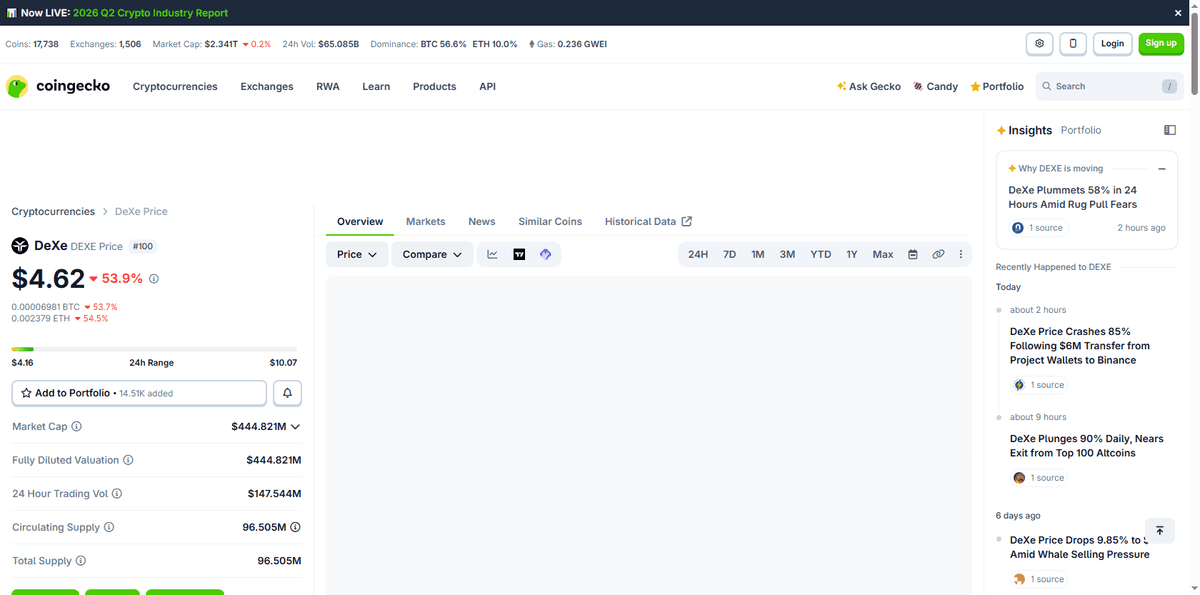
DeXe traded at $48.85 nine days ago. It traded at $4.40 this morning. Somewhere between those two numbers, more than two billion dollars in market value simply stopped existing, and the crypto press split into two camps that can’t both be right.
One camp calls it a hack. Coinspectator asked outright whether DEXE was a rug pull. Cryptoticker described “an apparent exploit in its smart contracts.” A widely read MEXC news post claimed an attacker had minted unlimited tokens and drained liquidity pools on exchanges.
The other camp, including CoinMarketCap’s own newsroom, found nothing. No confirmed hack. Concentrated selling into thin, overextended liquidity, was the read there instead.
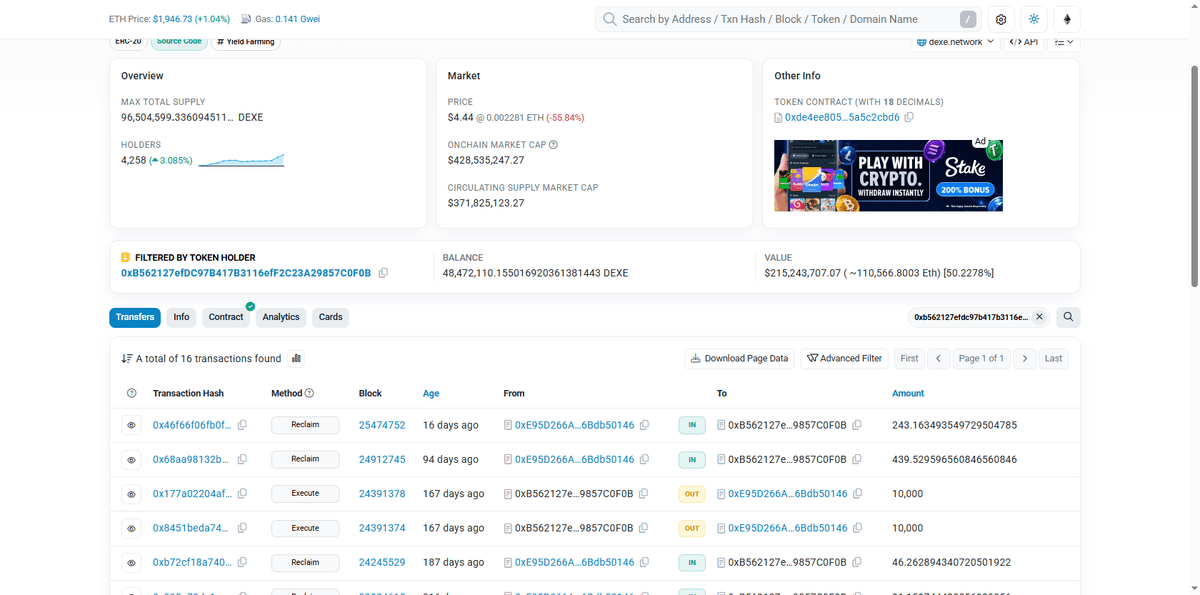
CryptoNewsLive has skin in this one already. On June 23rd this site published on DeXe’s supply structure. One wallet held just over half the token’s entire supply back then. Its balance today: 48,472,110 DEXE, worth $215 million at current prices, actually a fraction more than what was recorded a month ago, not less. The wallet CryptoNewsLive itself flagged as the single largest concentration risk in the token did not sell into this crash. Neither did the Wormhole Token Bridge wallet holding another 23.95 percent, nor did DeXe Network’s own contract, sitting on 13.23 percent. Three wallets, 87.4 percent of supply between them, verified unchanged this afternoon on Etherscan.
Nine Days From Listing to All-Time High
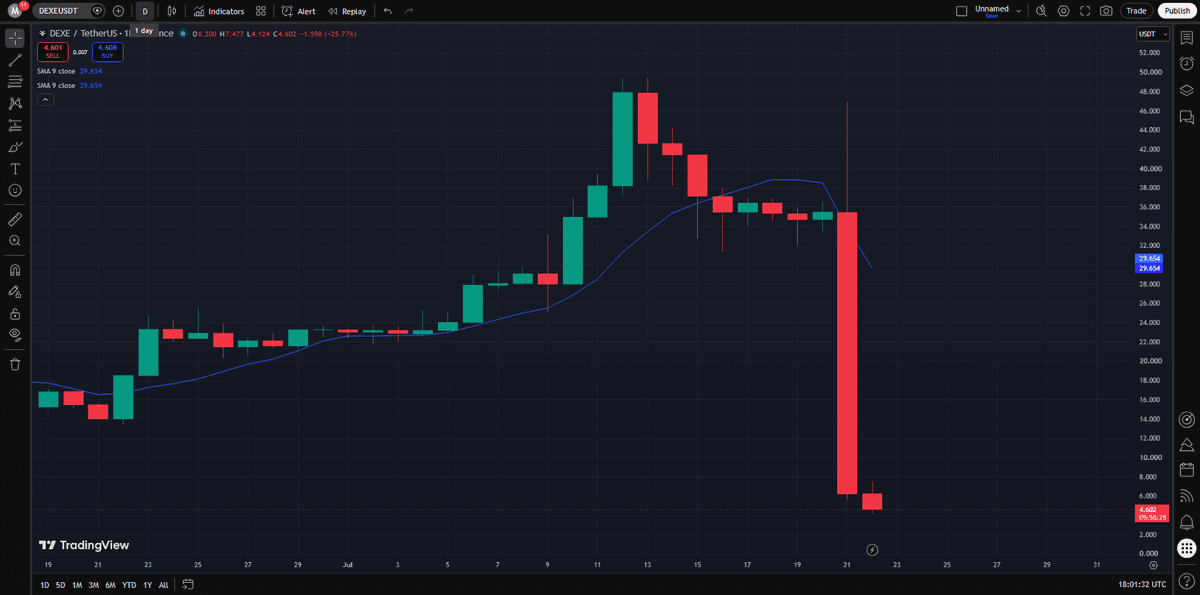
The run itself has a clean, unremarkable start. DeXe listed on ChangeNOW on July 9th. Within a day, price broke out of a pennant pattern that had been building for weeks, and that breakout ran straight into a wall of short positions. Forced buying from traders closing those shorts added fuel neither the listing nor the chart pattern accounts for on its own. By July 13th, DEXE printed $48.89, an eighteen-fold gain from February’s $1.80.
Then a week of bleeding.
$48 down to roughly $34, spread across seven quiet days that looked like profit-taking rather than panic.
Then July 21st happened. One hour DEXE traded at $28.49. Four hours later it traded at $13.36. That’s not a selloff, not by the normal definition. That’s a floor giving out.
The Mint Claim Doesn’t Survive Its Own Math
Start with the unlimited-minting accusation, because it’s the easiest one to check and the one that gets repeated the most. If someone had minted new DEXE out of thin air during the crash, the token’s own market cap divided by its own price, tracked hour by hour via the CoinGecko API, would show a jump in implied supply right at the moment of the crash. It doesn’t. From July 19th through this morning, that number sits at 46.7 to 46.9 million tokens the entire way through, before the crash, during it, and after. No discontinuity, anywhere. Whoever wrote that unlimited-mint headline didn’t check.
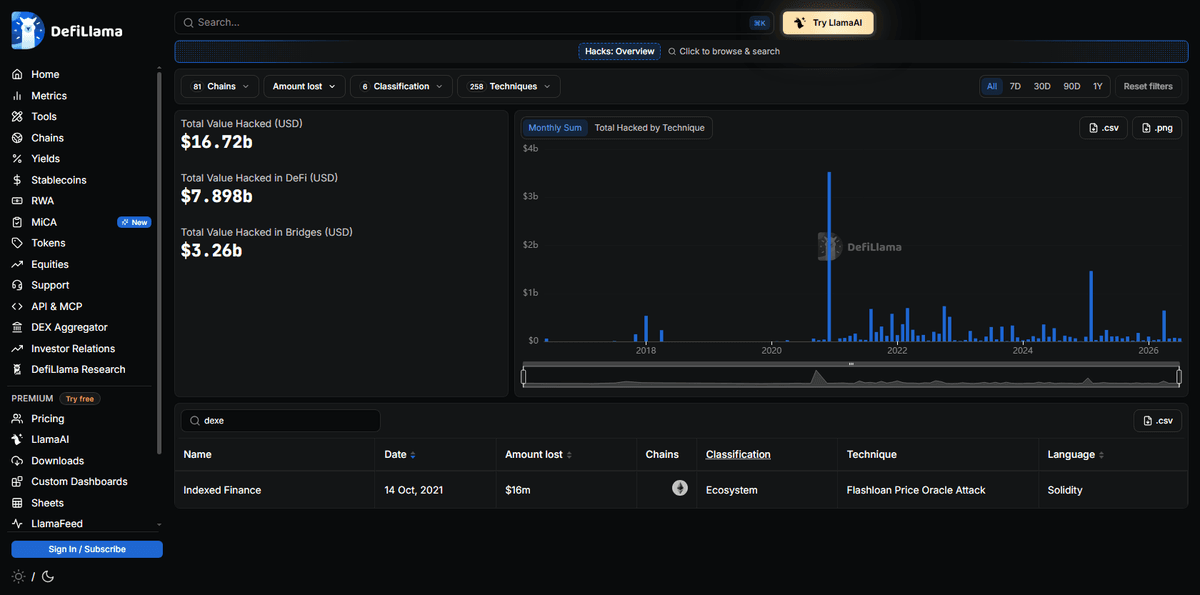
DeFiLlama’s hacks database backs this up from a different angle. Search “dexe” there and nothing comes back. Not a clean “investigated and cleared” entry. Nothing at all, which is its own kind of answer.
Half a Million Tokens, Six Days Early
So if the three biggest wallets sat still and nobody minted anything, who actually sold?
A separate report, syndicated onto CoinGecko’s own news feed a few hours ago, named two Gnosis Safe multisig wallets, the kind of structure project teams use rather than individual holders, and put a combined $6.2 million in DEXE moving to Binance in the hours before the crash. CryptoNewsLive checked both addresses directly rather than taking that at face value. On Ethereum, where the article’s own links pointed, both wallets showed a zero balance and, more tellingly, zero DEXE transaction history of any kind. Wrong chain, it turned out. DEXE trades on Ethereum and BNB Chain both, and the addresses in question live on the second one.
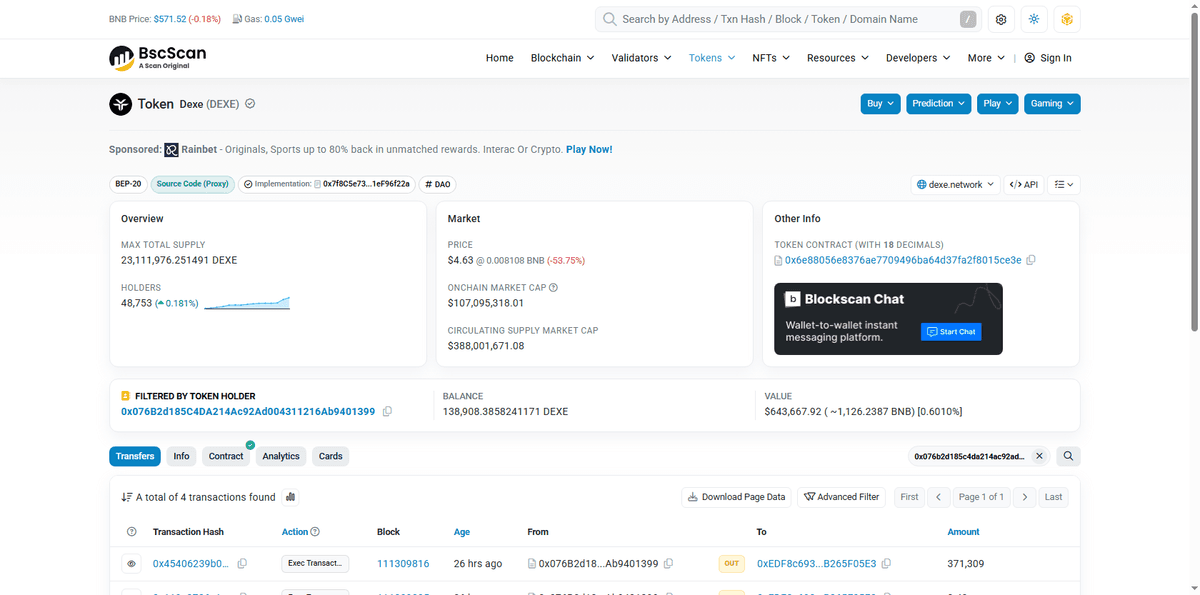
BscScan tells a real story. One of the two wallets, 0x076B2d18…9401399, received 510,216 DEXE on July 16th, six days before the crash and three days after the all-time high, back when price was still bleeding quietly through the $30s. Twenty-six hours before this check, that same wallet sent out 371,309 DEXE, the exact figure the original report claimed, to an intermediate address that forwards to Binance. The timing lines up with the worst of the collapse almost to the hour. The second wallet named in that report wasn’t re-traced here; call that one reported, not independently confirmed.
Why a Few Million Dollars Broke a Quarter-Billion-Dollar Token
Here’s the part that actually explains the size of the damage. DeXe’s real on-chain liquidity, the PancakeSwap pool everyone can trade against without a middleman, holds about $317,000. Over 99 percent of the token’s real volume clears through exchange order books instead, spread across Pionex, Binance, Bithumb, Gate, and a dozen smaller venues, all of them pricing within cents of each other with no single outlier. That rules out a glitch on one exchange.
What it doesn’t rule out is a market propped up on borrowed money. Coinglass shows $886 million in futures volume against just $78.5 million in spot over the last day, nearly eleven times over. Total liquidations across every exchange came to $2.93 million, small on its own, not nearly enough to erase two billion dollars by itself. But stack a modest, well-timed sale on top of thin real liquidity and a market where most of the trading runs on borrowed positions rather than owned tokens, and a few million dollars moving at the wrong moment turns into exactly this.
Bitcoin moved less than half a percent the same day. Ethereum gained about one percent.
Whatever happened to DeXe happened to DeXe alone.
What the Chart Confirms, in Plain Terms
Pull up the daily chart and the pattern needs no interpretation. Price traded well above its 9-day moving average through the entire run to $48, held a loose channel through the July consolidation around $34 to $38, then broke straight through that average and kept falling, closing today roughly seventy percent below a line that’s supposed to represent recent fair value. There’s no meaningful support printed between the July lows near $32 and this week’s $4.40, because price never traded there before. The declining moving average, sitting near $4.63 as of this morning, is the first real resistance on the way back up. Below current price, there’s nothing but the two candles that made this move.
The Open Question Nobody’s Answered Yet
Whether more of that $6.2 million is still sitting on Binance, waiting to hit the market, or whether Wednesday’s selling already cleared it out, isn’t something CryptoNewsLive or anyone else covering this story has confirmed. The DeXe team hasn’t issued a public statement addressing either the wallet movements or the crash itself as of this writing. For a token that this newsroom flagged a month ago for concentration risk in exactly three wallets, the actual seller turning up in a fourth one, on a chain half the coverage didn’t think to check, is the detail that got missed everywhere else.
This article is for informational purposes only and does not constitute financial advice. Cryptocurrency markets are highly volatile; conduct your own research before making investment decisions.