Raydium just gave back a chunk of the best two weeks it has had all year. $RAY fell roughly 10% across every major venue on Sunday, a drop nearly three times sharper than Solana itself. The token had spent the prior fortnight climbing from around $0.80 to an 11-month high near $1.90.
Something specific to Raydium is unwinding here. Not the whole chain.
A Rally Built On Three Real Things
Solana’s own price is down about 3.5% over the same 24 hours. Orca, Raydium’s closest onchain peer, is off roughly 4%. Raydium’s drop is more than double either one.
That gap matters. When a token falls harder than its own sector, the honest read is that the token ran up harder first, and today is the market taking some of that back.
The run itself was not mysterious. Three things happened inside the investigation window, each confirmed straight from Raydium’s own account, not from a headline repeating it.
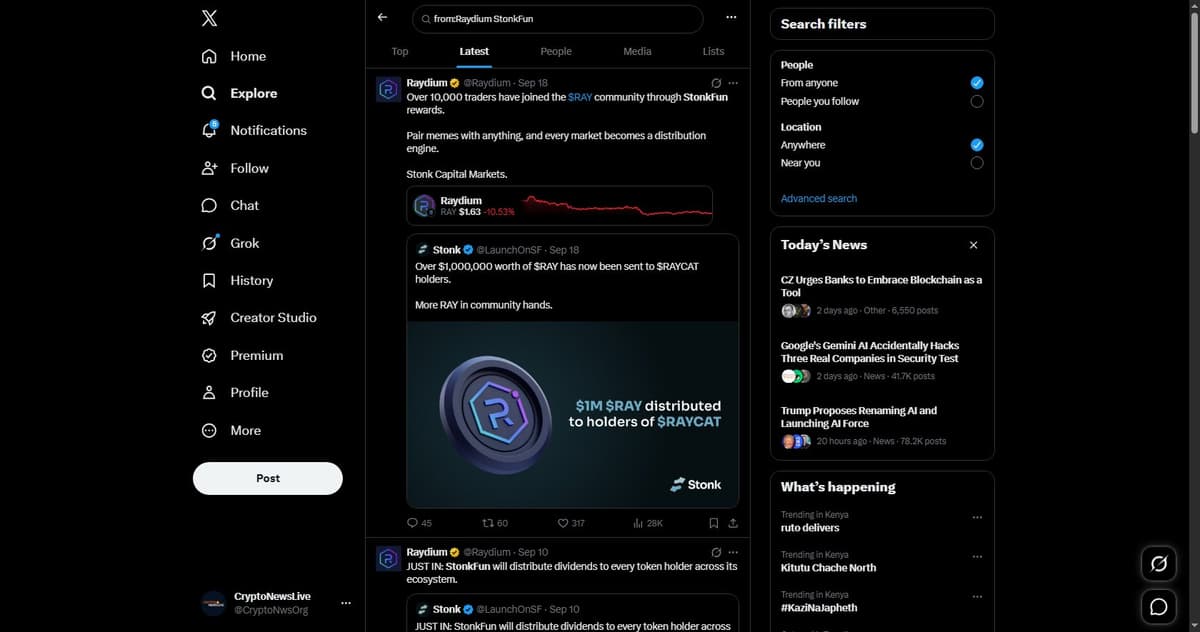
StonkFun, a meme and tokenized-equity launch platform, began routing new listings through Raydium’s LaunchLab in early September. Raydium’s own account posted on September 9 that “OVER $25M IN REWARDS DISTRIBUTED TO STONKFUN ECO HOLDERS,” and followed on September 18 with “Over 10,000 traders have joined the $RAY community through StonkFun rewards.”
Then came the tokenized stock push. On September 16, Raydium posted that AMD, the chip maker, was “live on Raydium,” trading around the clock on Solana through Sunrise and Backpack Securities. AMD joined a growing list that already included BlackBerry, whose stock went live on the platform roughly three days later.
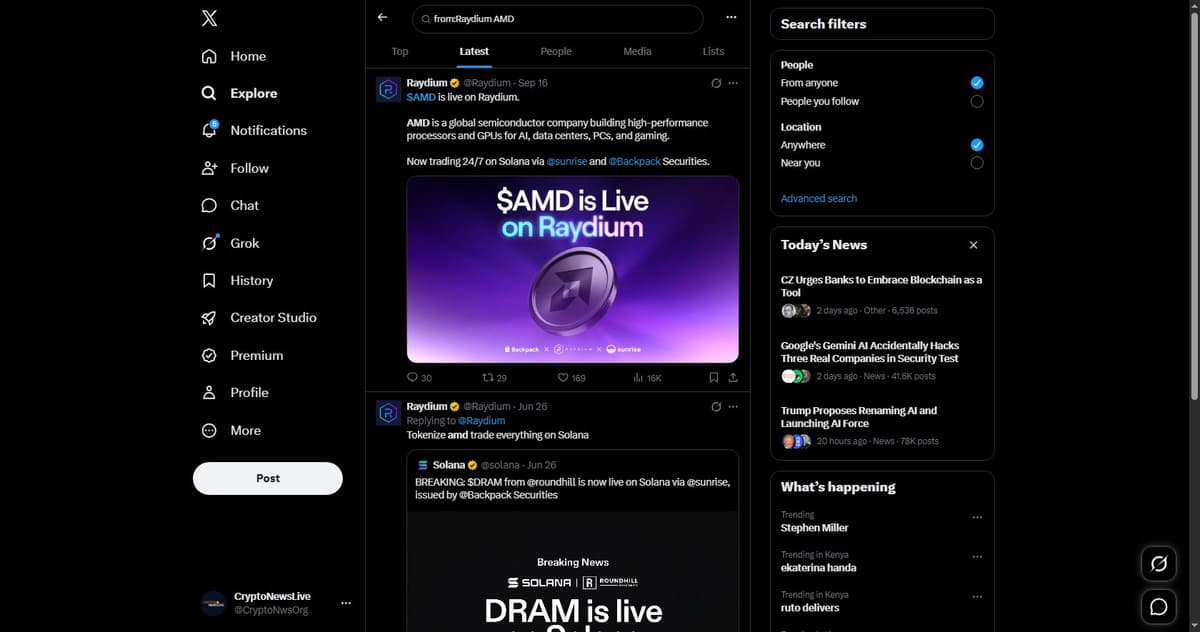
Two days after the AMD listing, Raydium’s pinned post announced the protocol had crossed $5 billion in cumulative tokenized stock volume, calling itself the leading onchain AMM for that specific trade. Solana Compass separately reported Raydium was routing more than 90% of all tokenized stock and memestock volume on the entire chain.
Put those three together, a rewards program pulling in new holders, a fresh blue-chip stock listing, and a genuine volume record, and a 90%-plus run over two weeks stops looking like noise.
The Chart Shows Two Separate Legs, Not One Straight Line
A 30-minute TradingView chart of RAY/USDT tells the story in two acts. The first leg ran from around $0.80 on August 24 to roughly $1.45 by September 7, right as the StonkFun integration took hold. Price then cooled into a $1.20 to $1.30 range for about a week.
The second leg started September 16, the same day AMD went live, and carried RAY to its $1.90 peak by September 19, one day after the $5 billion milestone post.
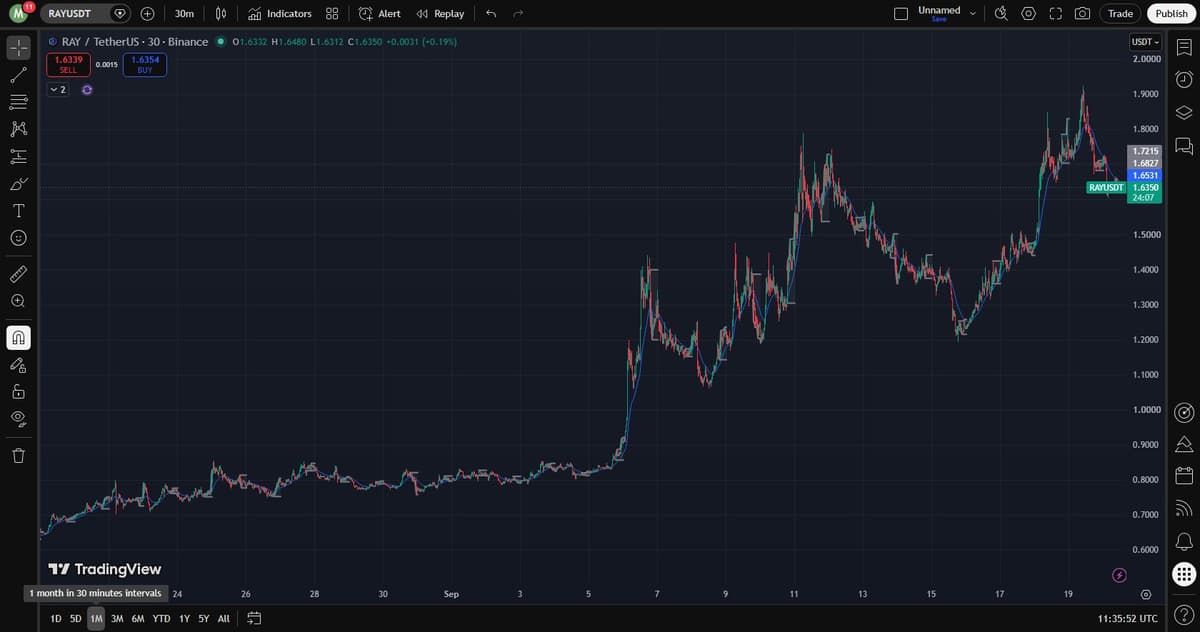
Sunday’s candle broke that second leg. RAY is now trading near $1.63, sitting roughly 14% below the peak and back inside territory it last visited around September 11.
The $1.90 area behaves like resistance the token has now failed to hold twice within the same week. The $1.20 to $1.30 band from early September stands as the nearest real support beneath current price, the last place buyers stepped in with size before the second rally leg began.
Derivatives Data Rules Out A Squeeze
CoinGlass shows the decline landed almost identically across every venue with real Raydium futures volume: OKX down 10.16%, KuCoin 10.14%, Gate 10.18%, Bitget 10.11%, BingX 10.05%, MEXC 9.93%. That kind of uniformity across independent order books is the signature of broad spot-led selling, not a glitch or a manipulation on one exchange.
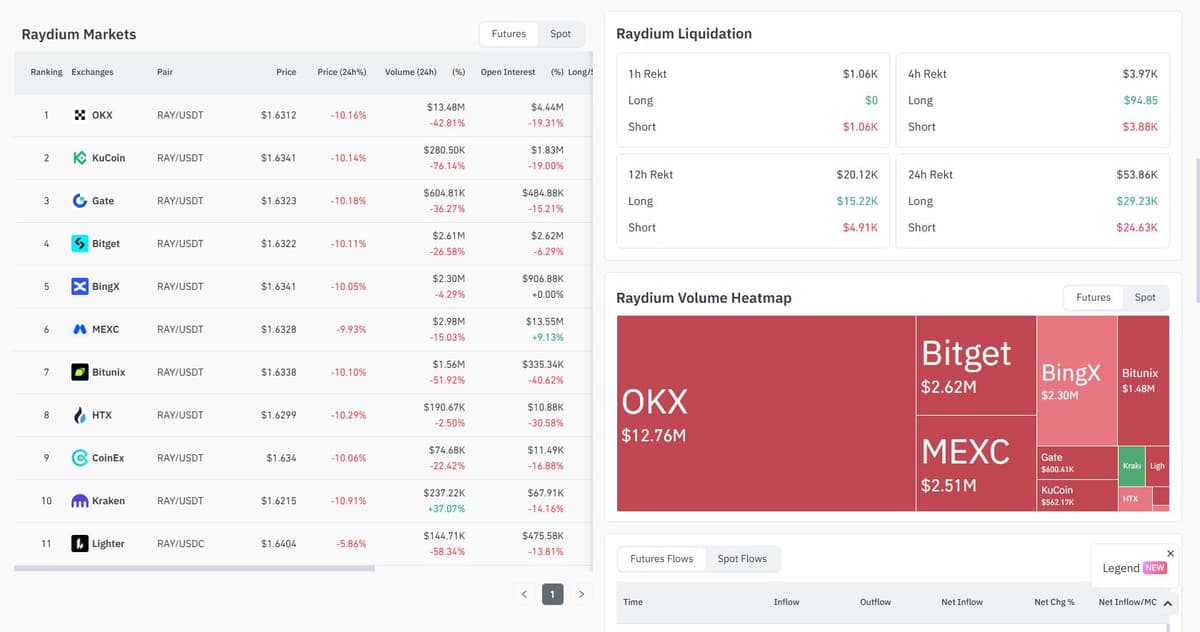
Long and short liquidations stayed small. OKX, the venue with the deepest RAY futures book, recorded just $19,550 in long liquidations and $22,610 in shorts over 24 hours, against $24.74 million in total open interest. A genuine cascade, longs getting forcibly closed as price falls, chews through open interest fast and leaves liquidation totals in the hundreds of thousands or more on a move this size.
That did not happen here. The 24-hour long-short ratio sat close to even, 48.72% long against 51.28% short. Traders holding leveraged positions were not caught particularly offside in either direction before the drop.
The mechanism reads as profit-taking after outsized gains, not forced selling. People who bought RAY in the $0.80s or $1.20s took some money off the table once the token doubled and then some.
What Actually Broke, And What Didn’t
Nothing about the underlying growth story reversed. The StonkFun rewards program is still running. AMD and BlackBerry are still trading on Raydium. The $5 billion cumulative volume figure does not un-happen because the token pulled back a week later.
What changed is simpler: a token that ran 90% in two weeks corrected 10% in one day, and every venue with meaningful volume moved together on the way down. Raydium’s total value locked sits near $1.23 billion and its market cap around $440 million, both figures reflecting a protocol still processing real trading activity rather than one facing a fundamentals problem.
Whether Sunday’s drop is the whole correction or the first piece of a larger one depends on whether $1.20 to $1.30 holds if price keeps sliding, or whether buyers step back in closer to today’s $1.63 level. Neither scenario has enough evidence behind it yet to call.