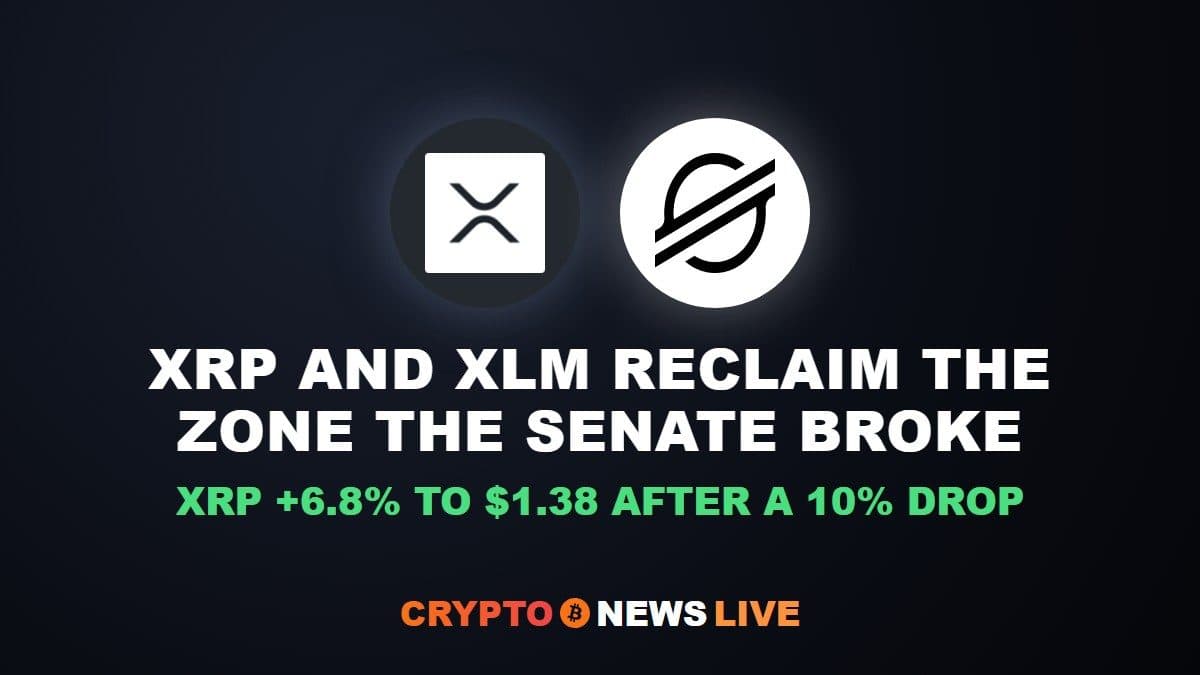
XRP and XLM spent the week trapped under levels that used to be support. On Friday both climbed back above them, and the trigger looks more like Bitcoin’s short squeeze than any change in Washington.
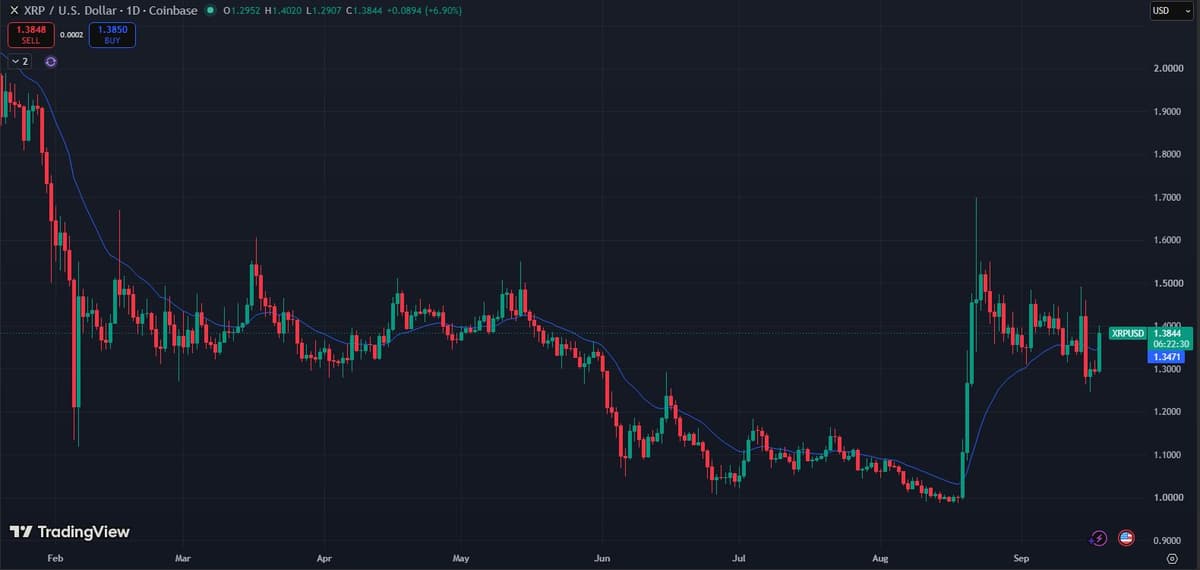
XRP closed up about 6.9% near $1.38. XLM gained about 5.1% to $0.1925. The Senate bill that sank them on Tuesday has not moved.
The Vote That Reset Both Charts
On September 14 both coins ran into a Senate vote. XRP rose about 6% to $1.4228 and XLM gained about 8.2% to $0.1916, with XRP touching $1.4914 intraday.
The next day the Senate rejected cloture on the motion to proceed to H.R. 3633, the digital commodities market-structure bill, by 49 to 50. The tally was short of the 60 needed to move forward.
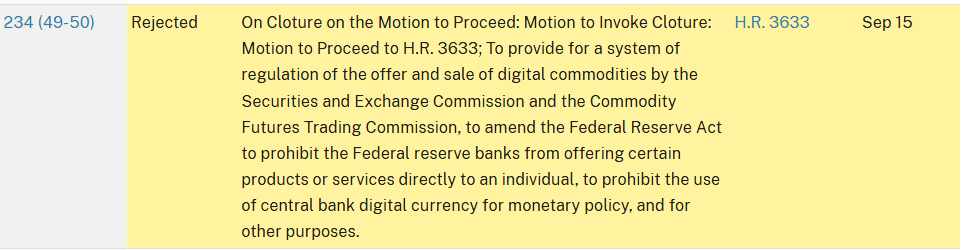
XRP fell from $1.4228 to $1.2823 that day, a drop of about 9.9%, with a low of $1.2634. XLM dropped about 8.1% to $0.1760, and its low was $0.1738.
The rejection was procedural. It was a vote on whether to begin debate, not on the bill’s text. The roll call list shows no repeat vote yet.
Sitting Under the Old Support
The damage on the chart was that both coins closed below zones they had held through most of September. For XRP that was the $1.31 to $1.34 band, which had been support since late August.
XRP closed at $1.2986 on Wednesday and $1.2950 on Thursday. Both closes sat beneath the band, which turned it into resistance to be retested from below.
XLM had the same shape. Its shelf near $0.176 to $0.183 held, but the roughly $0.186 to $0.189 zone above it kept turning rallies back. On Wednesday and Thursday it closed at $0.1838 and $0.1832, under that line.
Friday Cleared Both
XRP opened Friday at $1.2952, ran to $1.4020 and held $1.38 into the afternoon. That is a close back above the old band and above the roughly $1.347 moving average on the daily chart.
XLM opened at $0.1832, reached $0.1942 and printed $0.1925. That clears the $0.186 to $0.189 zone for the first time since its September 7 and 14 highs at $0.1964 and $0.1969.
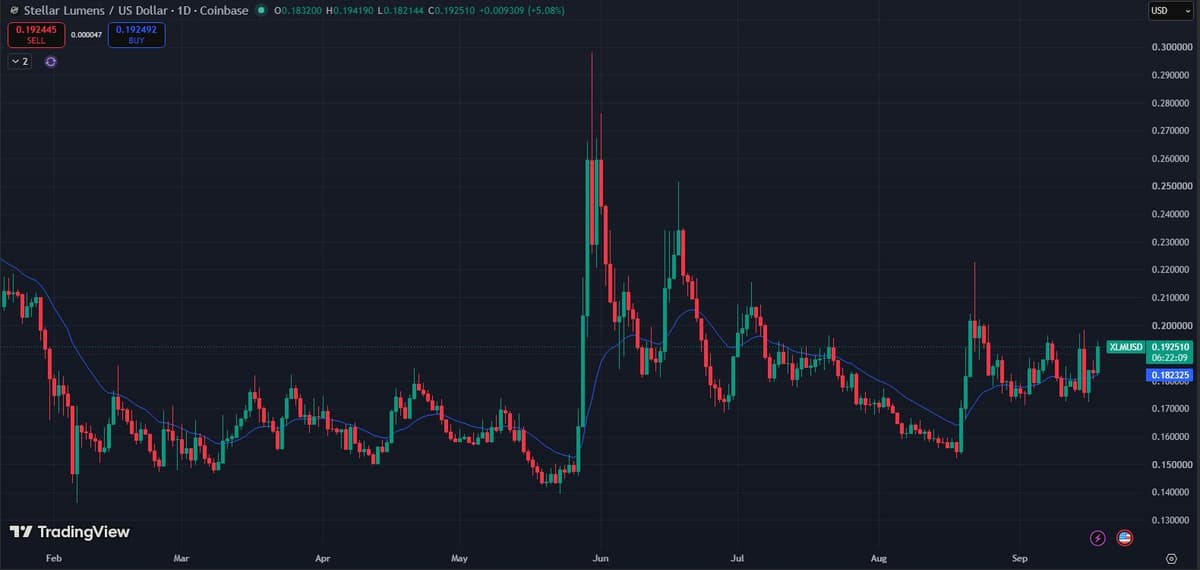
The next tests are close. For XLM it is that $0.196 to $0.197 shelf. For XRP it is $1.45 to $1.49, where the September 3 and September 14 highs ($1.4841 and $1.4914) both failed.
How Much Of This Is Just Bitcoin
A lot of it. Using Coinbase daily returns, XRP’s 30-day correlation to BTC is 0.91 and XLM’s is 0.81. Over the last seven days the figures are 0.91 and 0.80.
Bitcoin gained about 5.9% on the same day as it squeezed shorts. XRP’s 6.9% and XLM’s 5.1% are the same trade with slightly different beta. Nothing in Friday’s tape says the Senate overhang cleared.
The derivatives data agrees. On Binance, the last three XRPUSDT funding prints went from negative 0.0074% to positive 0.0094% and then 0.0100%. Shorts were paying longs after the crash, and that had flipped to the baseline rate by Friday.
XRPUSDT open interest slid from about $443 million to about $370 million across the selloff, then rebuilt to about $399 million. XLM’s went the opposite way, falling from about $44.7 million to $39.2 million even as price rose, which points to short covering rather than fresh leverage.
What Decides the Next Move
The broken levels are now the reference points. If XRP holds above $1.34 on a pullback, the reclaim is real. A close back under it would put the Senate low near $1.26 back in play.
For XLM the line is $0.186 to $0.189. Holding it turns the old ceiling into a floor, and losing it sends the coin back to its $0.176 shelf.
The bigger swing factor is still the bill. Until the Senate lines up another vote, both coins are trading on Bitcoin’s momentum with a legislative discount that has not gone away.