DeXe is having a very good Tuesday. The DAO infrastructure token is up 35% in the last 24 hours and sits at a new yearly high of $22.88. Volume exploded to $260 million, a 218% jump from the day before.
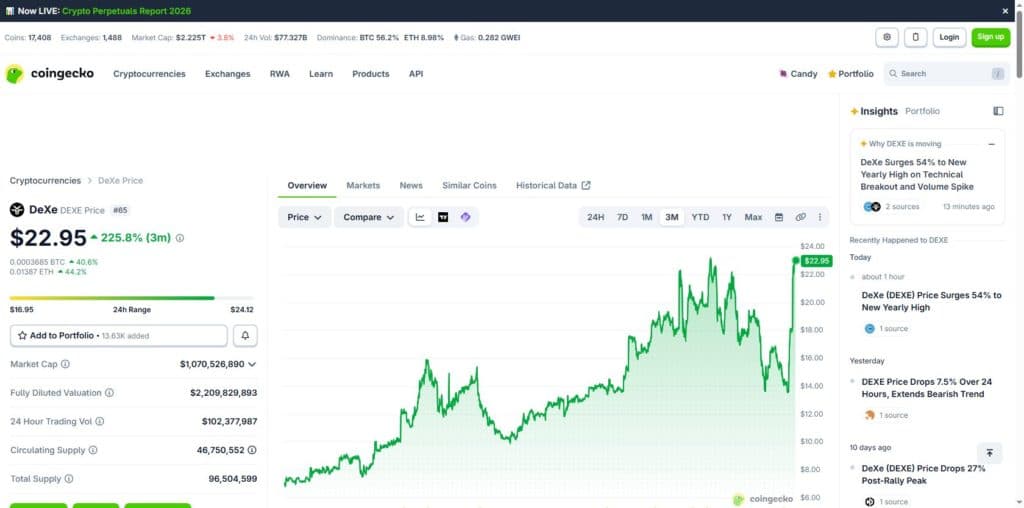
Source: CoinGecko — DEXE price and 24H stats, June 23, 2026
Nobody knows who is driving this.
The $1.1 Billion Wallet With No Name
The data coming out of Etherscan is striking. One wallet — address 0xb562127e…9857c0f0b — holds 48,471,866 DEXE tokens. That is 50.2% of the entire token supply. At current prices that stake is worth $1.1 billion. The address carries no label on Etherscan. No name, no exchange flag, no protocol tag. Just a wallet with more than a billion dollars in DEXE and no public identity.
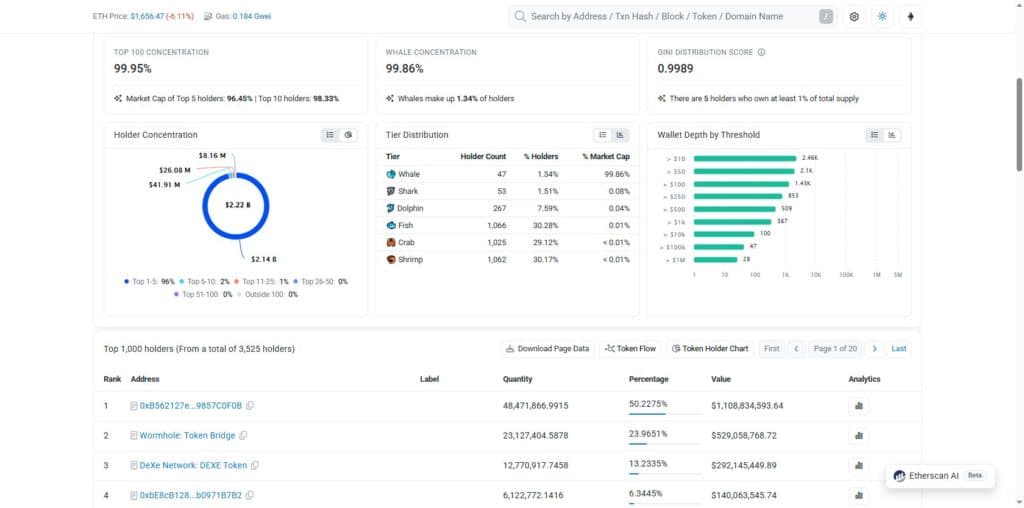
Source: Etherscan — DEXE top holders. Gini 0.9989. Top 5 wallets = 96.45% of total market cap.
For context on how unusual this is: the Gini distribution score for DEXE is 0.9989 on a scale where 1.0 represents perfect inequality. The top 5 holders collectively own 96.45% of the market cap. The top 10 own 98.33%. There are 3,525 total holders across the entire network. For a project with a $1.07 billion market cap and a fully diluted valuation above $2.2 billion, that holder count is extraordinarily thin.
One Token. Two Circulating Supplies.
There is a secondary mystery in the supply numbers. CoinGecko reports 46.75 million DEXE tokens in circulation. Pull the on-chain data from Etherscan and the picture changes. The second-largest holder is the Wormhole Token Bridge, which holds 23.1 million DEXE — 23.97% of total supply. That bridge routes tokens to BNB Chain or Solana. CoinGecko lists DEXE on Ethereum plus one additional network. The “one more” is likely wherever those 23 million bridged tokens ended up.
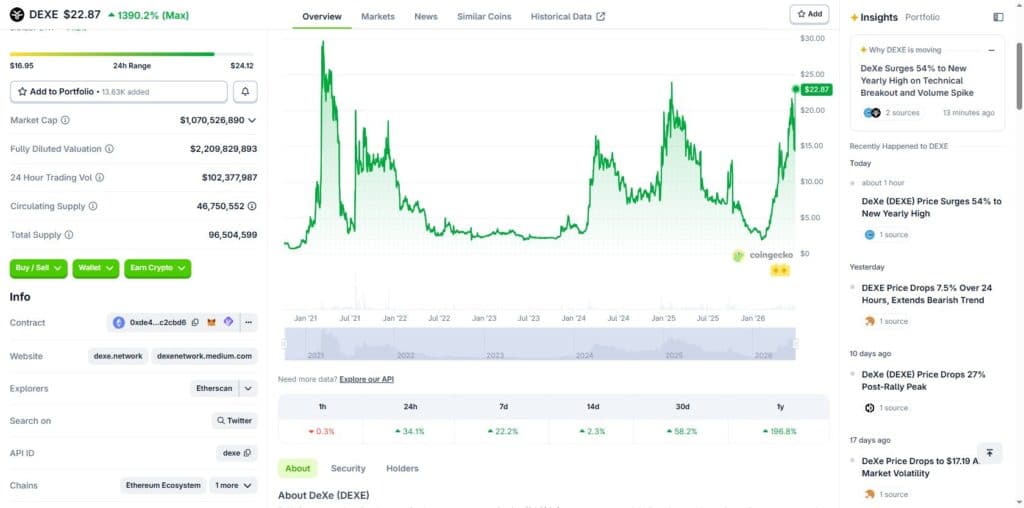
Source: Etherscan — DEXE token overview, on-chain supply data
Back-calculating from Etherscan‘s circulating market cap of $1.915 billion at the same price point, the implied circulating supply is approximately 83.7 million tokens — nearly double what CoinGecko shows. The difference between these two numbers is 37 million DEXE. That gap is 79%, far past the threshold that typically warrants investigation.
The third-largest holder is the DeXe Network token contract itself, sitting on 12.77 million DEXE — 13.23% of supply, valued at $292 million.
Add it up: the #1 unlabeled wallet (50.2%), the Wormhole bridge (23.97%), and the protocol’s own contract (13.23%) account for 87.4% of all DEXE tokens. The effective public float is approximately 12.6% of supply. That means the $1.07 billion market cap is being priced against roughly 12 million freely circulating tokens.
Source: CoinGecko — DEXE market metrics and performance stats
That math creates conditions for extreme price volatility. When 50% of supply sits in a single unidentified wallet and the free float is only 12% of total tokens, a relatively small capital input produces outsized percentage moves. This is not proof of anything. But it is the mechanical setup that would make price manipulation possible.
DeXe describes itself as a DAO infrastructure protocol — tools for building on-chain governance systems. It launched in 2020 and gave early holders a return of 1,390% at maximum, according to the price history on CoinGecko going back to inception.
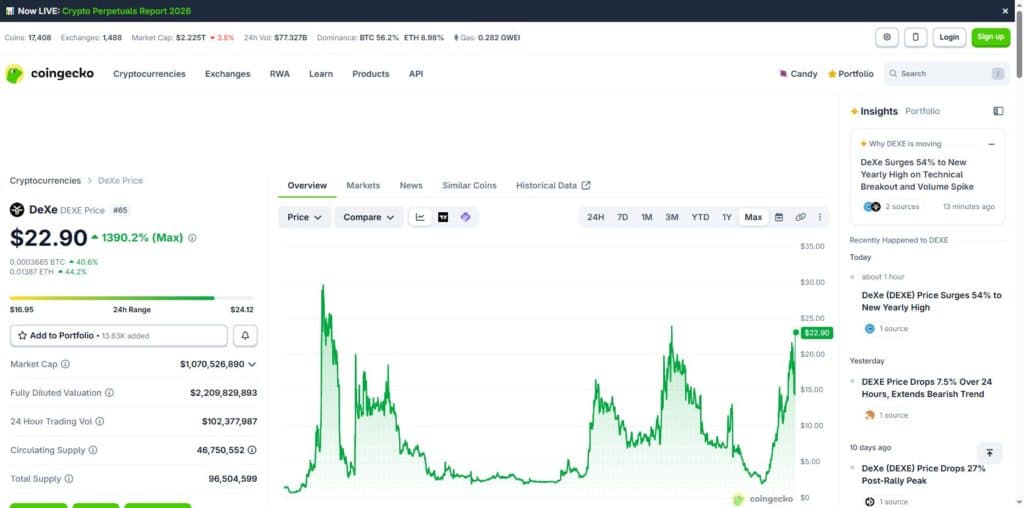
Source: CoinGecko — DEXE max price chart: +1,390.2% from inception
No TVL. No Revenue. No Commits.
What DeXe does not have, according to every DeFi analytics platform reviewed for this report, is any tracked activity.
DeFiLlama, which monitors total value locked across virtually every DeFi protocol that has ever had meaningful usage, returns zero results for DeXe. No TVL. No protocol fees. No yield. Token Terminal, which tracks revenue and earnings for crypto protocols, shows no financial data for DEXE. No fees generated. No revenue recorded. A $1.07 billion “infrastructure” project with no measurable infrastructure output.
The GitHub situation adds another layer. The DeXe Protocol organization on GitHub has a main repository. The last commit to that repository was two years ago. The core codebase for a billion-dollar protocol has not been touched in 24 months.
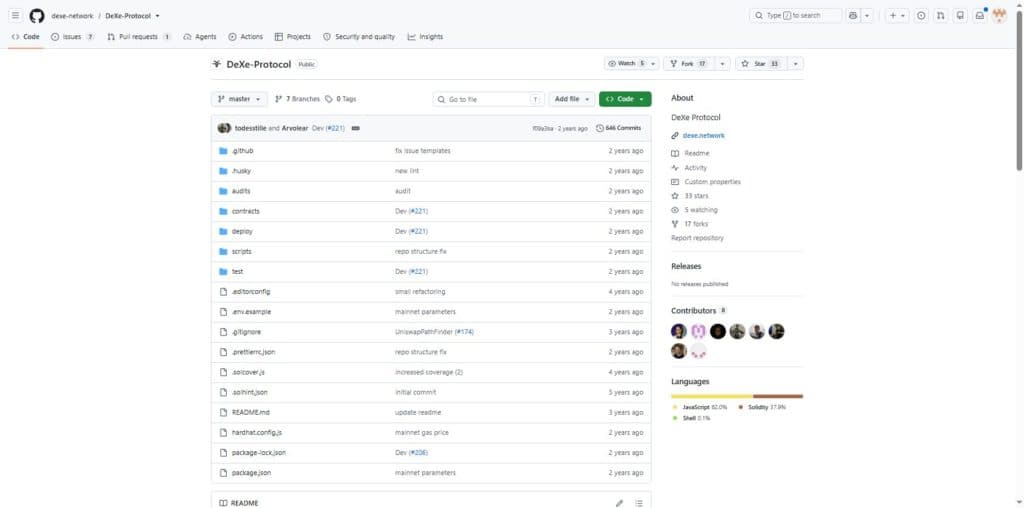
Source: DeXe Protocol on GitHub — main repository: last commit 2 years ago
64% Bearish at a Yearly High
The community appears to sense something is wrong. CoinGecko shows 64% bearish community sentiment for DEXE at the exact moment the token is hitting its yearly high. That divergence rarely shows up in token data. Markets go up. Community confidence goes down. The price goes up anyway.
DEX Screener data confirms the trading is real. The DEXE/WETH pair shows genuine liquidity and genuine volume during the 24-hour surge. The price movement is not a data anomaly.
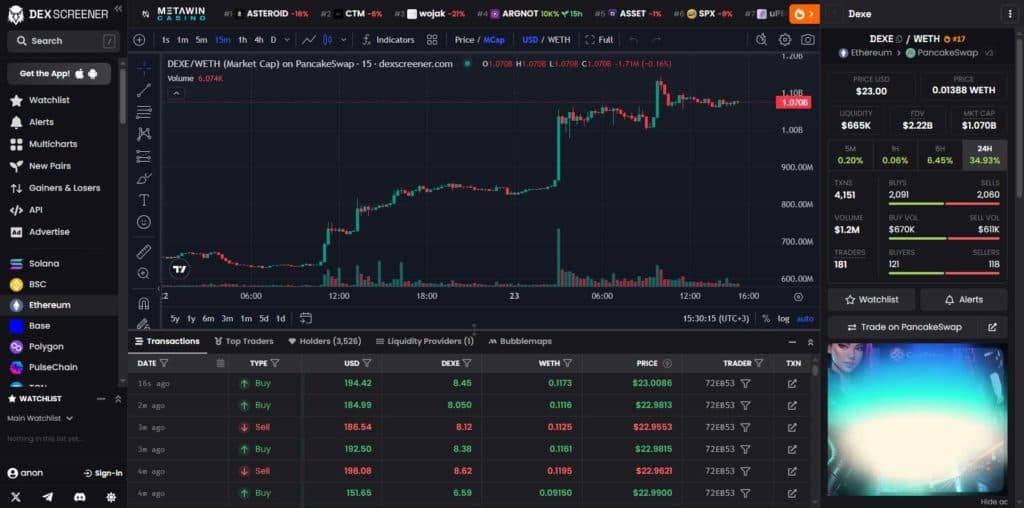
Source: DEX Screener — DEXE/WETH pair showing real liquidity and volume activity
The 3-month chart on CoinGecko shows DEXE is up 225.8% over the past 90 days. The run started well before today’s volume surge.
Source: CoinGecko — DEXE 3-month chart: +225.8%
What Is Driving This?
What causes a token with no tracked TVL on DeFiLlama, no revenue on Token Terminal, a dormant GitHub, and 64% bearish community sentiment to run 225% in three months and set a new yearly high today? The holder data on Etherscan offers one structural explanation. A thin float of 12% against a concentrated ownership structure does not require large capital to generate large percentage moves.
Exchange presence confirms real secondary market activity. Binance 28, Ceffu 2, and Binance Hot Wallet 20 appear among the top seven DEXE holders. Actual buy and sell pressure is coming from major trading venues.
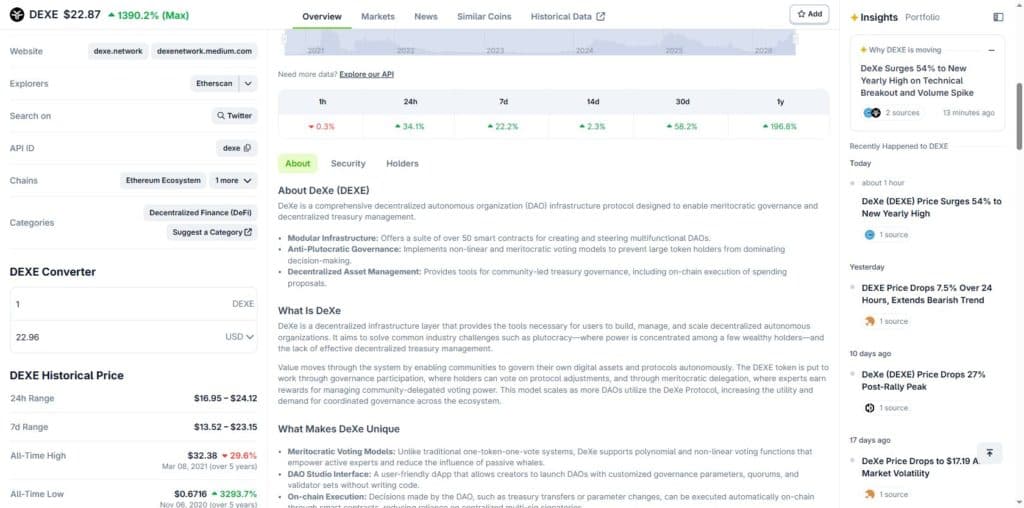
Source: CoinGecko — DEXE ATH and historical performance stats
What is not clear is why the price is moving. The on-chain data raises the question. The fundamental data does not answer it.