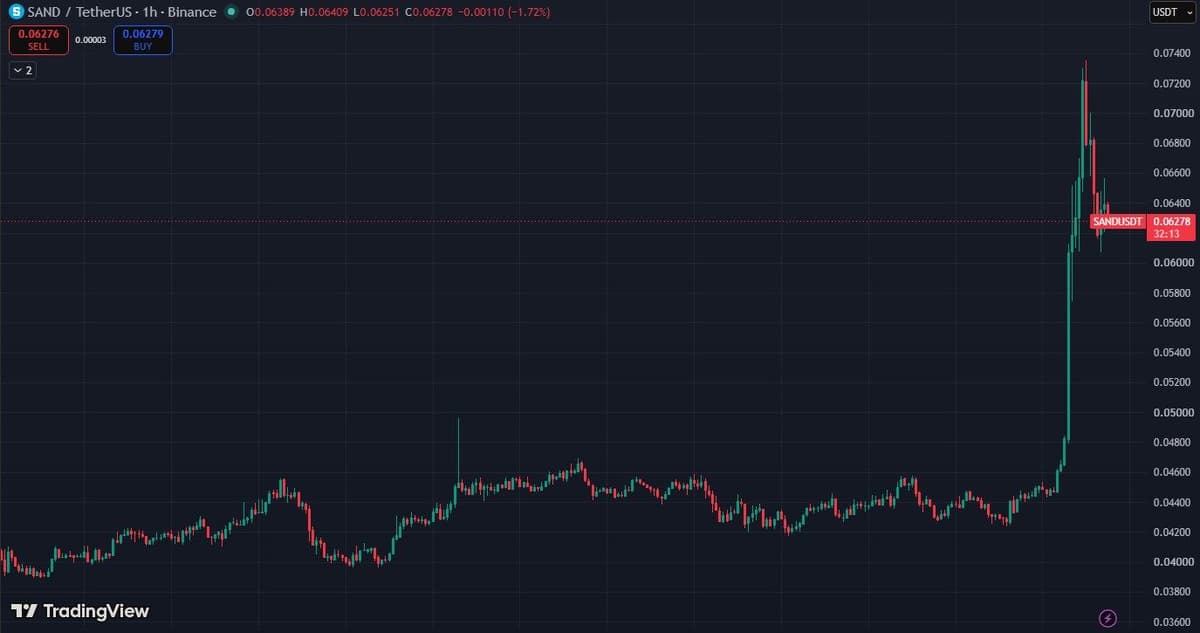
The SAND price went from $0.0482 to a high of $0.0613 inside one hourly candle on October 2. That candle opened at 07:00 UTC, which is 16:00 in Seoul, the time Bithumb and Coinone set for SAND deposits and withdrawals to reopen and the minute Upbit posted its notice.
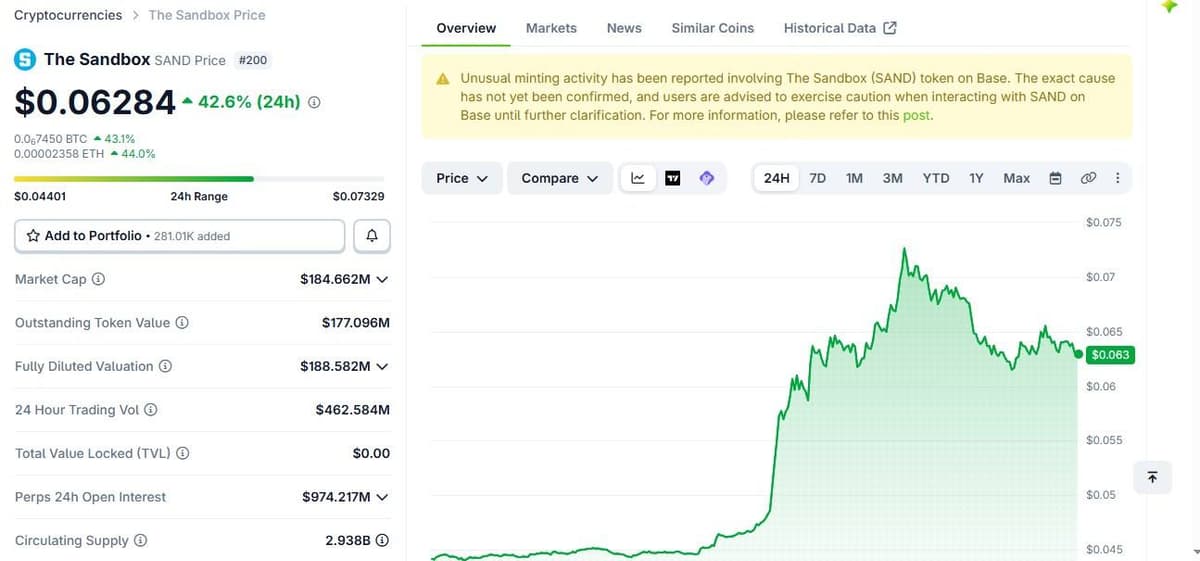
By the day’s high of $0.0735 on Binance, The Sandbox’s token was up about 63% from where the day started. At the last check it was at $0.0628, up 42.6% in 24 hours on CoinGecko.
Korean Exchanges Reopened SAND At 16:00 Seoul Time
Three Korean exchanges had frozen SAND since the August 22 exploit. On October 2 they lifted their trading-caution designations on the same afternoon.
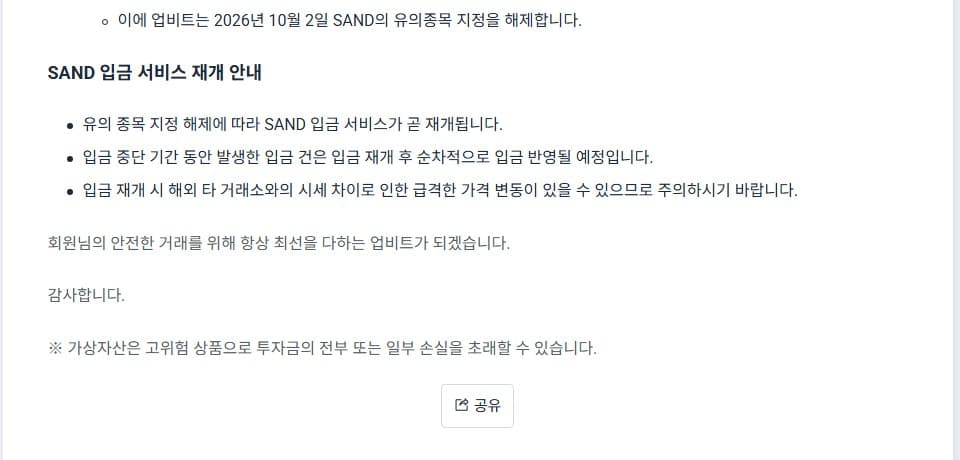
Upbit’s notice says SAND deposits “will resume shortly.” It adds a warning that reopening deposits can cause sharp price swings because of price gaps with overseas exchanges.
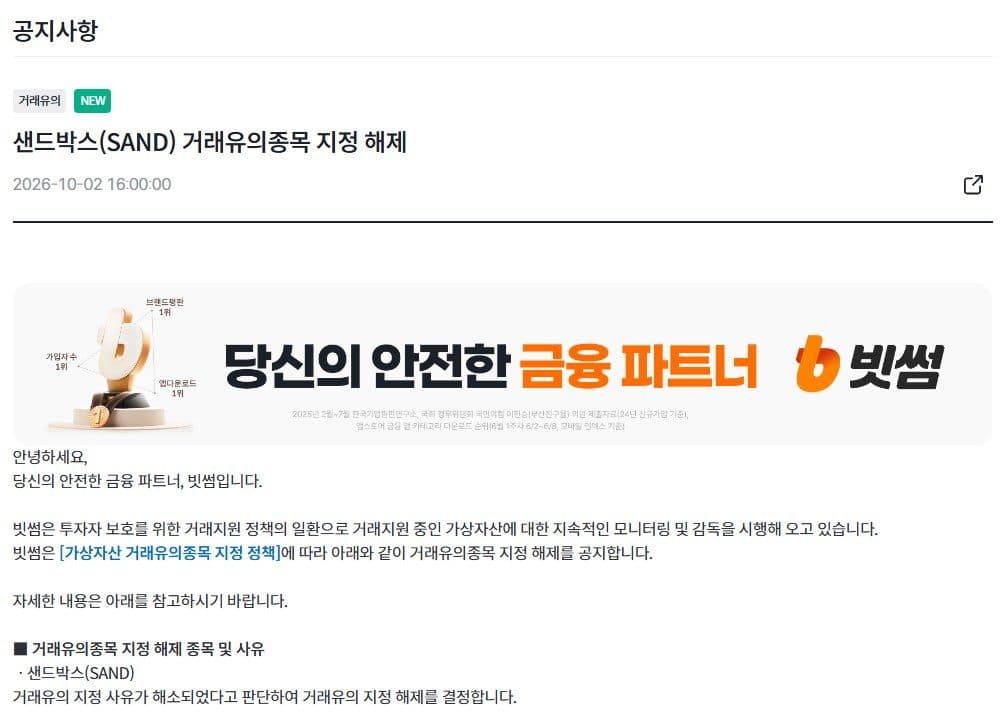
Bithumb posted its own removal at 16:00 KST and said deposits and withdrawals were scheduled to reopen at 16:00 that day, subject to change.
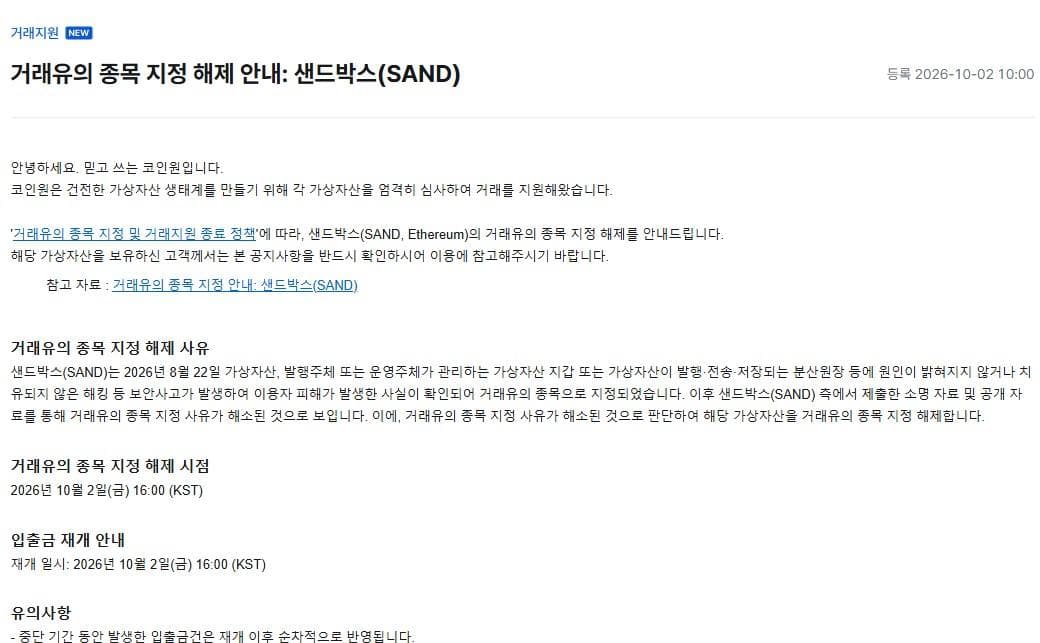
Coinone’s notice went up at 10:00 KST but set the lift and the deposit restart for 16:00 KST. It said the project’s submitted materials and public information had resolved the grounds for the designation.
The market did not react to the 10:00 KST notice. Binance SAND/USDT moved less than 1% in the hour after it (the 01:00 UTC candle went from $0.04484 to $0.04457) and was still at $0.0482 at 06:59 UTC. The jump came when the deposit window opened.
How The SAND Price Behaved After The Reopening
Upbit’s SAND/KRW volume was 0.9 billion won in the 06:00 UTC hour. In the 07:00 UTC hour it was 41.7 billion won, about 46 times higher.
Binance spot told the same story. SAND traded $53.6 million on Binance for the day, against an average of $1.56 million a day over the previous 30 days.
The SAND price in Seoul did not detach. Converted at Upbit’s USDT rate, SAND/KRW closed the 07:00 UTC hour 1.1% above Binance and stayed within about half a percent for most of the day. Korean buyers were not paying a big premium. They were simply back in the market.
Over 24 hours Upbit traded about 201 billion won, roughly $148 million at 1,357 won per USDT.
What Froze SAND In The First Place
The Sandbox’s own post-mortem says an attacker exploited a vulnerability in the bridge contracts on Base and BNB Smart Chain at 23:41 UTC on August 21. The attacker minted unbacked SAND there and withdrew 14,742,341.84 SAND, worth about $697,000, from collateral held on Ethereum.
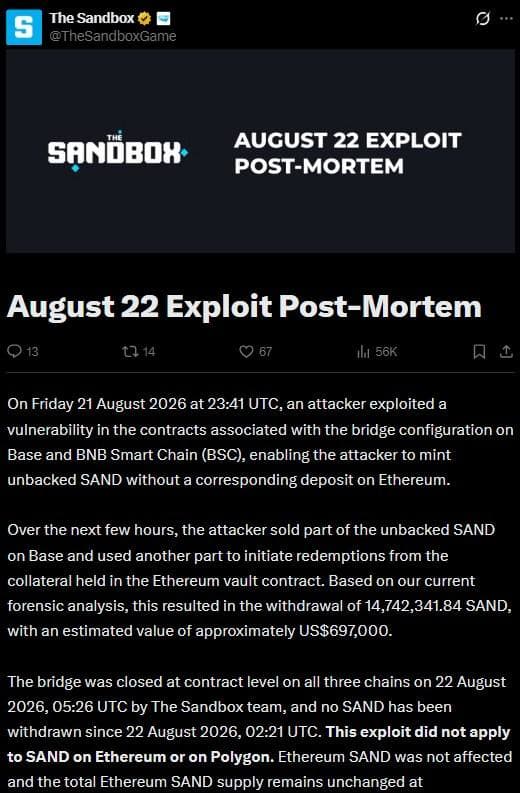
The team closed the bridge at contract level at 05:26 UTC on August 22. It says Ethereum SAND was not affected and total supply there remains 3,000,000,000.
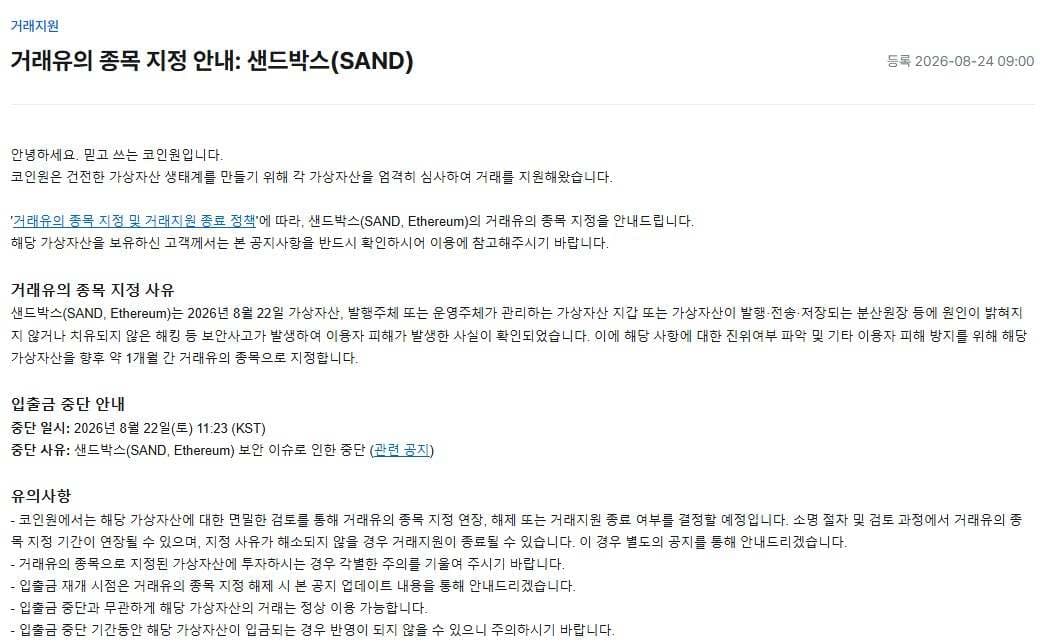
Coinone halted SAND deposits and withdrawals at 11:23 KST that morning and put the token under a trading-caution designation on August 24 for about a month. Upbit designated it the same day.
The price hit was modest. SAND closed August 21 at $0.04903 and August 22 at $0.04510, down 8.0%. It kept sliding, to $0.03758 on August 30, 23.4% under the pre-exploit close.
The October 2 SAND price now sits 28% above that August 21 close.
The Sandbox’s Compensation Plan
Upbit says it reviewed incident and follow-up materials submitted by The Sandbox before deciding. The exchanges did not publish those materials. The public record of the project’s response includes a compensation plan.
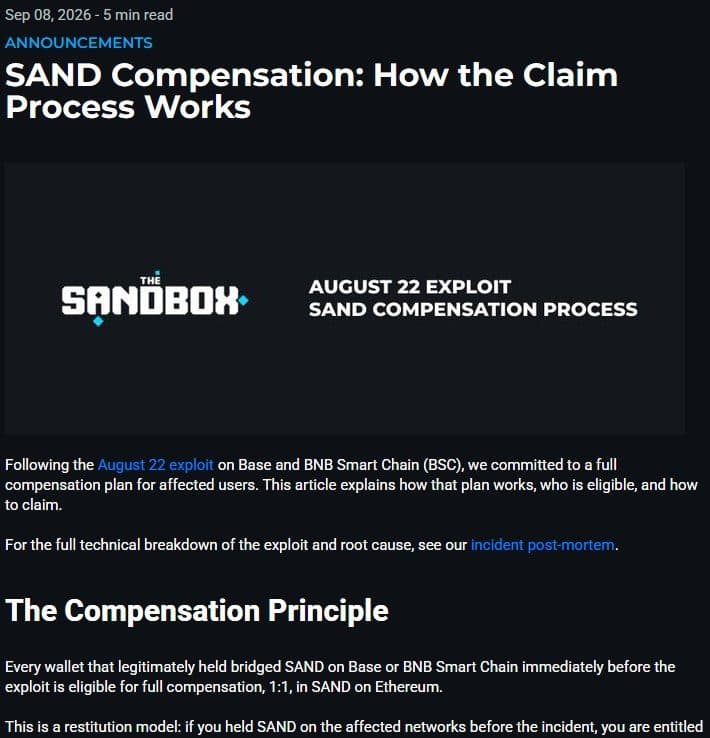
Every wallet that legitimately held bridged SAND on Base or BNB Smart Chain before the exploit is entitled to 1:1 compensation in Ethereum SAND. The claim page ran from September 8 to September 22, and late claims are being handled case by case through the end of October.
What The Derivatives Data Shows
CoinGlass shows $1.35 billion of SAND futures volume in 24 hours against $221 million on spot. Open interest rose 153.6% to $94.2 million.
Funding is negative. Binance’s SAND perpetual showed -0.4404%, KuCoin -0.4297% and Bitget -0.6943%. Negative funding means shorts are paying longs, so traders are paying to bet against the move.
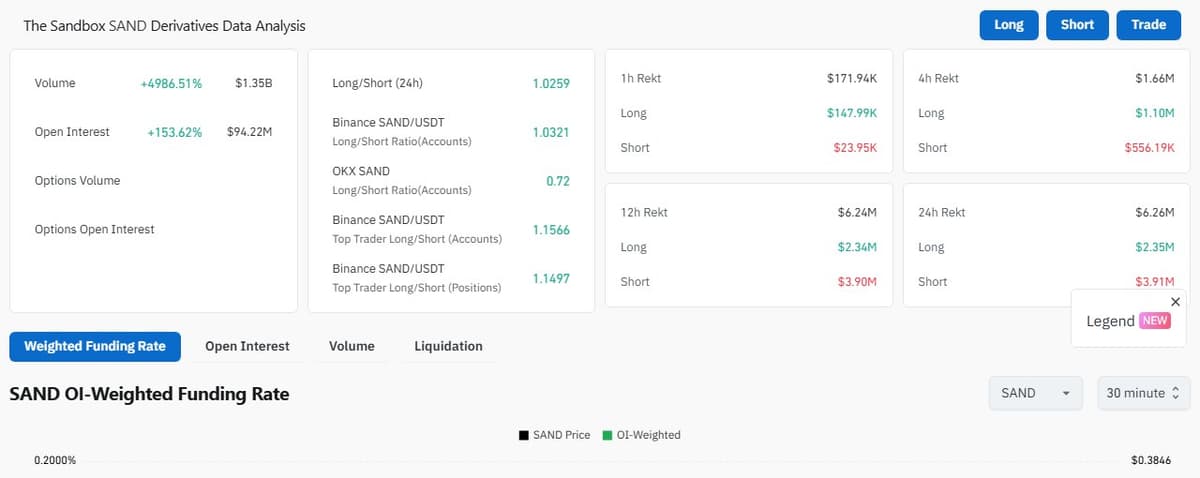
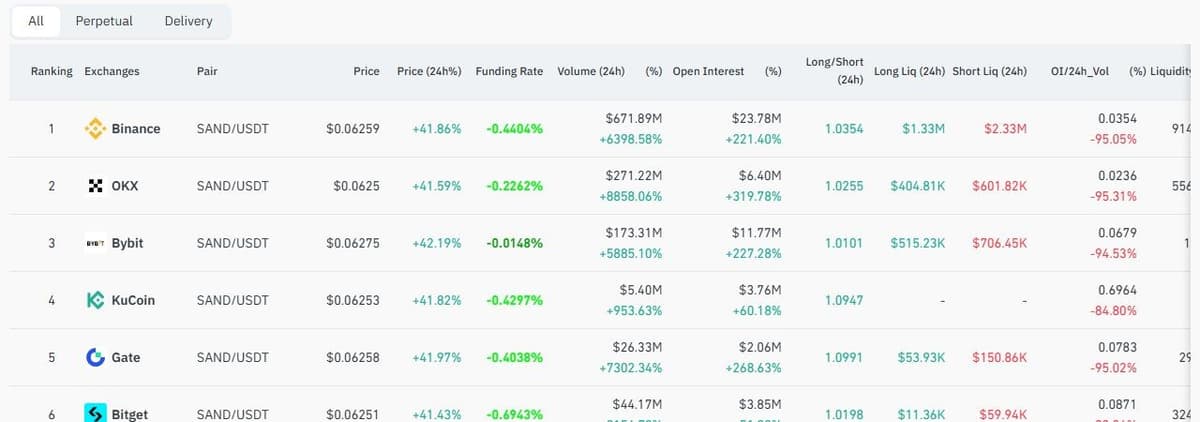
Liquidations were small at $6.26 million, so a liquidation squeeze does not explain the move. The spot volume does, and the futures market piled in around it.
Where The Chart Stands
The breakout candle opened at $0.0482. The prior two weeks traded between roughly $0.0325 and $0.047, with a spike to $0.0496 on September 25. The hourly RSI peaked near 96 on Binance data, and the daily RSI is about 81.
Price is now close to the 38% to 50% retracement zone of the move from $0.0482 to $0.0735, which sits at $0.0638 and $0.0609. A hold above $0.0609 keeps the breakout intact on this read. A loss of $0.0579, the 61.8% level, would put the whole base back in play.
Below $0.0482 the entire move is erased. The 50-day average from Binance daily closes is about $0.0408, so price is roughly 54% above it.
SAND’s 30-day correlation with Bitcoin was 0.48 before today. On October 2 Bitcoin slipped about 0.4% while SAND rose 42%, so this SAND price move was its own story.
What Is And Is Not Proven
The timing links the SAND price jump to the Korean reopening. It is not proof of cause.
CoinGecko still carried its warning about unusual minting on Base at the time of the screenshot. SAND remains about 99% below its November 2021 high of $8.40.
Upbit’s own warning applies. The Sandbox price reflects a market reconnecting after six weeks, and reconnections can reverse as fast as they start.