Curve DAO added 20% to its price in a single session on Monday, jumping from roughly $0.33 to $0.40 while the rest of the market barely moved. On paper it looks like a protocol catching a bid on real news. Pull the derivatives data and the DeFiLlama numbers, and the actual story is almost the opposite: the leverage arrived well before any reason did.
The Move Was Built in the Futures Market, Not the Spot Market
CRV’s spot volume on Binance is a fraction of what actually moved Monday. Open interest on Binance’s CRV/USDT perpetual jumped 32% in 24 hours to $32.29 million, and futures volume there exploded 300% to $145.8 million. The pattern repeats almost everywhere: OKX futures volume up 346%, Bybit up 191%, MEXC up 416%, Bitget up 250%. Across every major venue tracked by CoinGlass, CRV’s total open interest sits at $167.5 million against a market cap of just $630 million, a leverage ratio that looks a lot more like a derivatives-led squeeze than organic accumulation.
What it isn’t, though, is a one-sided short squeeze. The aggregate long/short split across exchanges reads 49.37% long to 50.63% short, close enough to even that neither side can claim the move as a forced liquidation cascade in its favor. Traders piled into both directions at once. That’s consistent with fresh speculative interest chasing a breakout, not with a crowded short position getting run over.
A Chart That’s Retesting a Level It Already Failed At
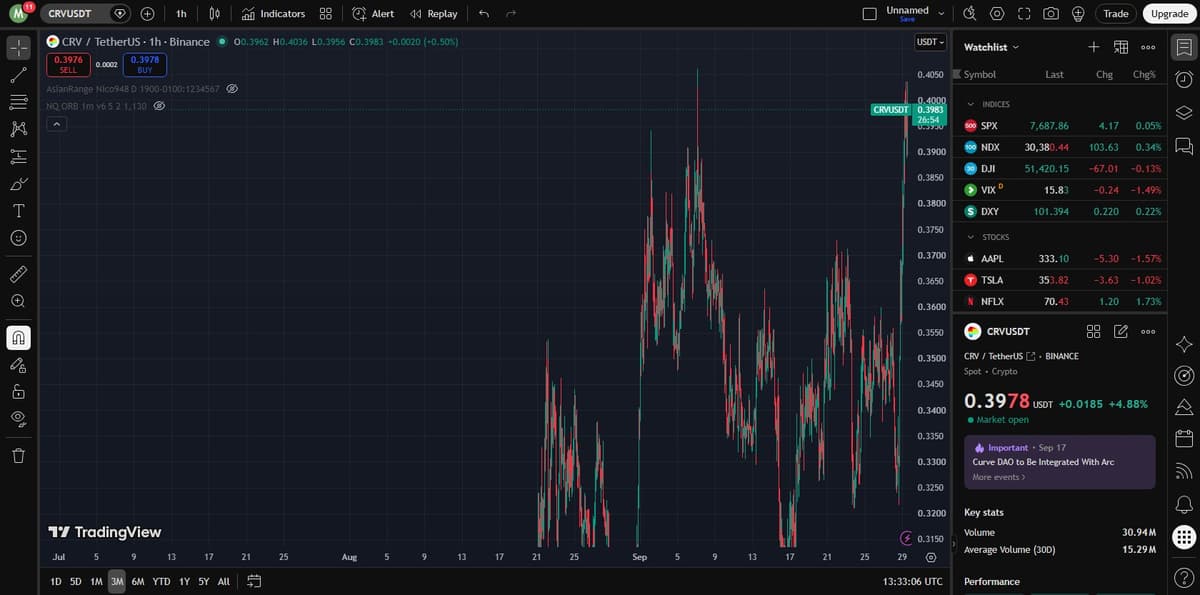
CRV/USDT on the 1-hour chart tells a cleaner story than the headline percentage does. Price built a base near $0.32 through late August, ran to a first peak just above $0.405 around September 10 to 13, then gave almost the entire move back to $0.33 by September 17 to 21. Monday’s rally brings CRV right back to that same $0.40 ceiling, not into new territory. It is the second attempt at the same level in three weeks, and the first attempt failed.
Zoomed out, the token’s multi-timeframe performance shows how uneven the recovery has been: up 31% over the past month, up 116% over three months, but still down 43% over the past year. Monday’s rally is real, but it’s a bounce inside a chart still trying to climb out of a much deeper hole.
The Fundamentals Didn’t Move
Curve’s actual protocol metrics on DeFiLlama show nothing that would explain a 20% day. Total value locked sits at $1.31 billion, roughly double the token’s own market cap, a ratio that’s been stable rather than a fresh divergence. Fees over the past 30 days come to $3.14 million, revenue to the protocol $1.03 million, and DEX volume over the same period $3.17 billion, all numbers that read as steady, unremarkable DeFi usage rather than a sudden spike in real activity. Active addresses over 24 hours were just over 5,000, in line with recent norms.
The one dated item on Curve’s own calendar in recent weeks is its integration with Arc, Circle’s stablecoin-focused layer 1, announced September 17. TradingView’s own economic calendar flags it as a market-moving event for CRV. But September 17 was twelve days before Monday’s rally, and it landed right in the middle of the token’s failed first run at $0.40, not at the start of this second one. If Arc was the catalyst, the market took nearly two weeks to notice it, and even then reacted to it with the exact same leverage-heavy pattern now showing up again.
What Happens at $0.40 Next
The open interest build gives this move a specific vulnerability the first September rally didn’t advertise as clearly: a lot of fresh leveraged length now sits stacked just below a resistance level the token has already failed to clear once. A clean break and hold above $0.405 would be the first genuine higher high since the September peak, and would leave the failed short side exposed. A rejection at the same ceiling, on the other hand, hands both the bulls who just piled in near the top and the DeFi thesis built on Arc’s still-unproven traffic a second consecutive false start, with $167 million in open contracts now needing to unwind either way.