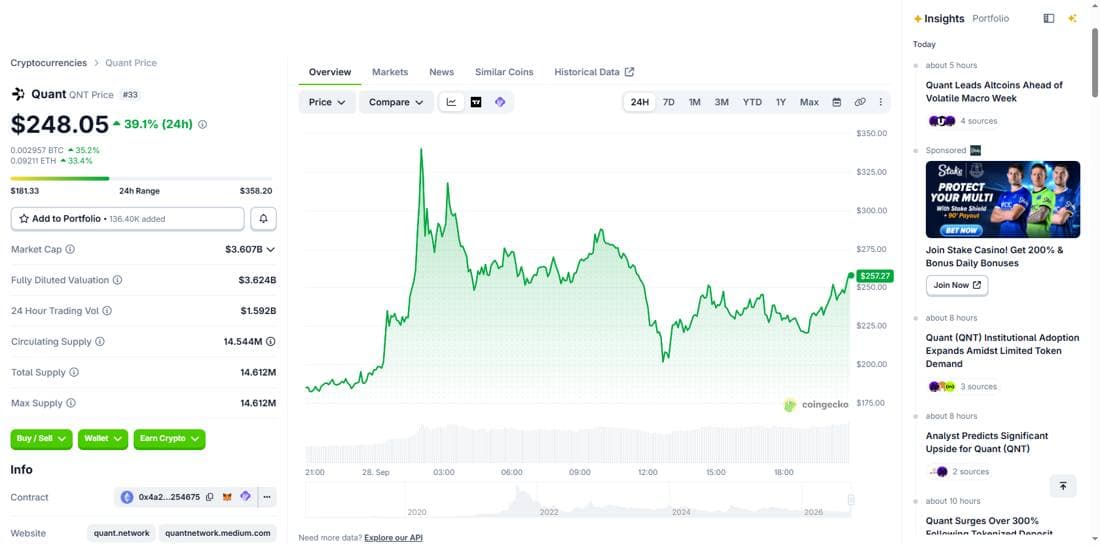
Quant traded at $70.62 on September 24. By Saturday night it touched $356.90, an intraday peak just short of its all-time high of $427.42. By Monday morning it had given back roughly a third of that spike and was changing hands near $248. Two separate banking-sector deals, one in New York and one in London, drove the run. Neither press release names the QNT token even once.
Two Deals, One Day Apart
The first came from The Clearing House, the payments operator that says it clears more than $2 trillion daily through wire, ACH and real-time rails. On September 24 it named Quant Network as the provider powering its On-Chain Money Initiative, a project that lets banks clear and settle tokenized deposits and connects to the existing RTP and CHIPS networks.
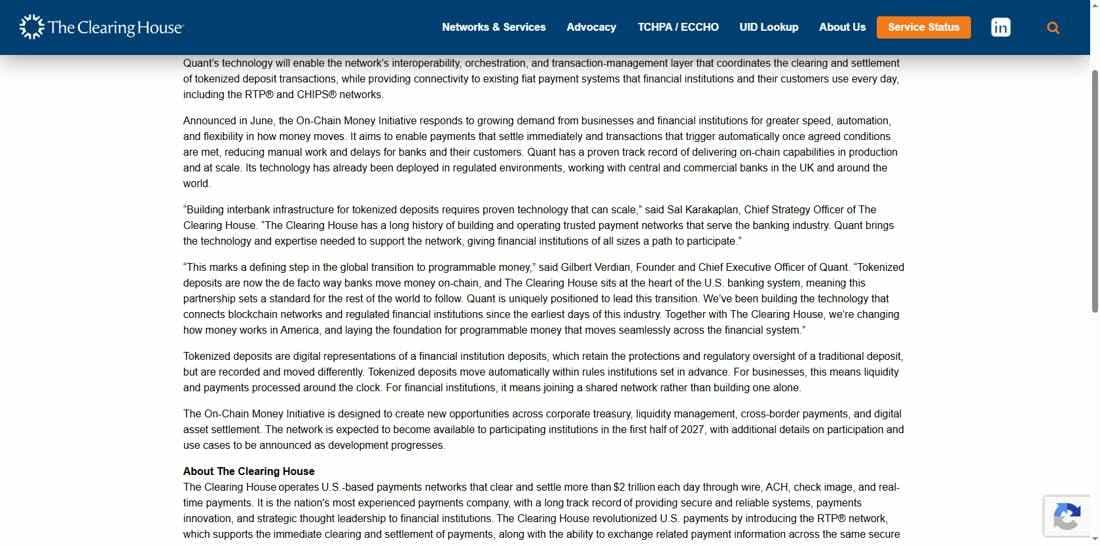
“Tokenized deposits are now the de facto way banks move money on-chain, and The Clearing House sits at the heart of the U.S. banking system,” said Gilbert Verdian, Quant’s founder and CEO, in the release. Sal Karakaplan, The Clearing House’s Chief Strategy Officer, framed the choice around scale: “Quant brings the technology and expertise needed to support the network, giving financial institutions of all sizes a path to participate.”
The same week, seven UK banks including Barclays, HSBC UK, Lloyds, Monzo, Nationwide, NatWest and Santander went further than an announcement. Coordinated through UK Finance’s Great British Tokenized Deposits program, they completed live customer transactions on a platform built by Quant: two remortgage completions with funds released automatically at closing, and a person-to-person marketplace payment that held a buyer’s money until goods were confirmed delivered.
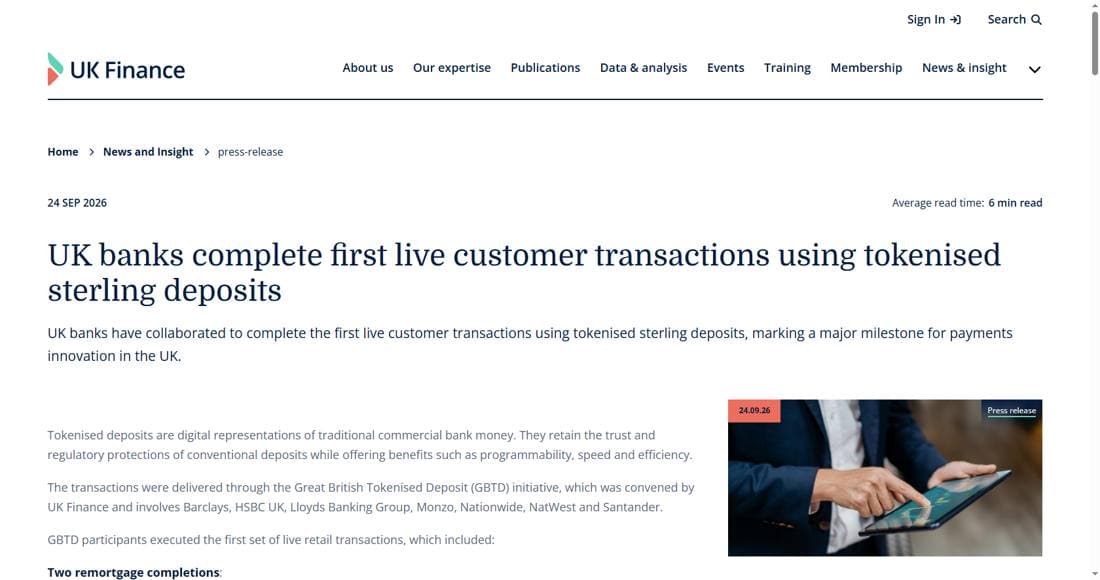
“These transactions are real money moving on UK infrastructure, not an experiment,” Verdian said of the UK pilots. Jana Mackintosh, UK Finance’s Managing Director of Payments and Innovation, called it proof that tokenized deposits “can strengthen the UK’s payments infrastructure, support innovation across the economy and drive the UK’s competitiveness internationally.”
What Neither Release Actually Promises
Both deals are technology contracts with Quant Network the company. Neither document requires a bank to hold, transact in or reference the QNT coin itself. Quant’s software supplies the interoperability layer that lets tokenized deposits move between institutions. The token’s connection to that plumbing is a market bet on adoption, not a term written into either agreement.
The Clearing House’s network is not expected to reach participating institutions until the first half of 2027. The UK program’s next milestone, a set of digital bonds settled with tokenized deposits, is scheduled for the first quarter of 2027. The revenue these deals could eventually generate is more than a year away from actually landing.
The Chart Ran Well Past the News
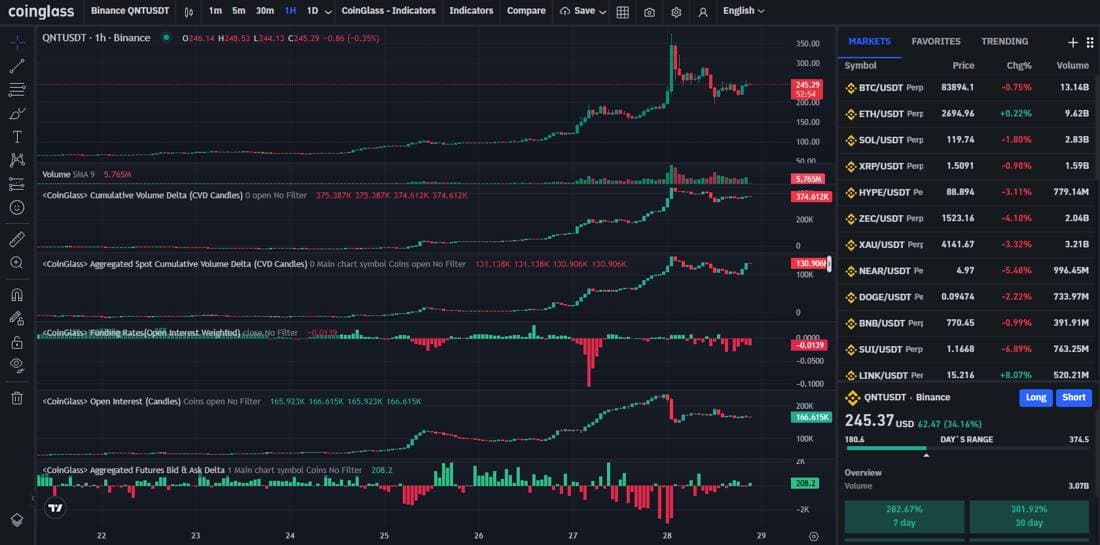
Quant spent August and most of September pinned in a tight band between roughly $55 and $70, with almost no volume behind it. The breakout candle on September 24 lifted the price out of that base entirely. By the weekend it was vertical, adding another leg after a brief pause near $180 to $200 that had already looked stretched on its own.
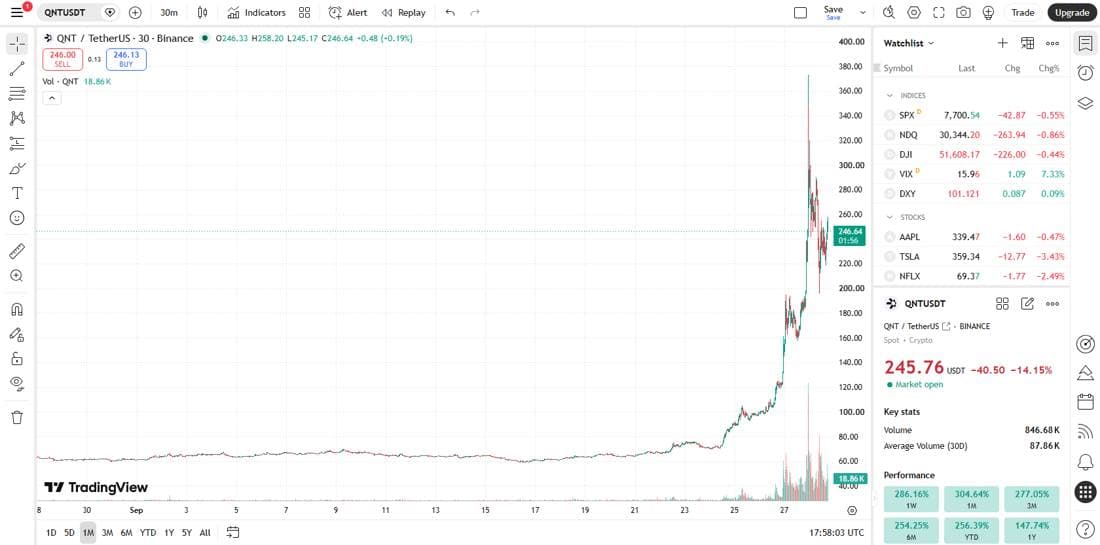
The pullback from $356 to the current $248 level erased about a third of the spike within roughly a day, a fast retracement that is typical of a parabolic move losing its final buyers rather than a controlled uptrend. The $180 to $200 zone, where the market pushed through on the way up, is the nearest shelf if the retracement continues. Below that sits the $124 area, the level the token’s prior run stalled at before this second catalyst hit.
Binance’s own order book shows the pullback met real buying, not a vacuum. Trading volume over the past 24 hours ran $1.59 billion, several multiples of Quant’s typical turnover before September 24.
Futures Traders Are Not Chasing It
Open interest on Binance’s QNT perpetual roughly doubled through the run, then cut sharply as price rolled over from its Saturday peak, a sign margined longs got closed out rather than added to on the way down. Funding turned negative during the same window, dipping to roughly -0.05% on an hourly basis at the worst of Saturday’s swing, before settling near -0.014%. Negative funding after a 300%-plus move is unusual. It means short positioning, not more long exposure, has been building into the pullback.
A Supply Detail Worth Stating Plainly
CoinGecko and CoinMarketCap both track Quant’s circulating supply at 14.544 million tokens against a capped max supply of 14.612 million, a figure that leaves almost no dilution overhang. Etherscan’s own token page, however, shows 45.467 million QNT minted on-chain against those same exchanges’ circulating figures. The gap reflects a large allocation Quant has never put into free float, tied to its enterprise licensing model rather than a scheduled release date. It is not a hidden cliff event. It is a reminder that the tracked “circulating” number understates how much QNT actually exists on-chain.
What to Watch Next
The Clearing House’s On-Chain Money network is due to reach participating institutions in the first half of 2027. UK Finance’s consortium is scheduled to issue its first tokenized digital bonds in the first quarter of 2027, the first real test of whether these platforms generate activity beyond a pilot. Further UK pilots linking tokenized deposits to digital-asset settlement are expected within the next few months, according to UK Finance’s own notes. And the $180 to $200 zone from this week’s breakout is the level that decides whether the current pullback stays a normal cooldown or turns into a deeper retracement toward the token’s pre-news range.