CoinGecko’s own insights panel had nothing to say about Phala Network this week. No recent activity, it read. No clear narrative.
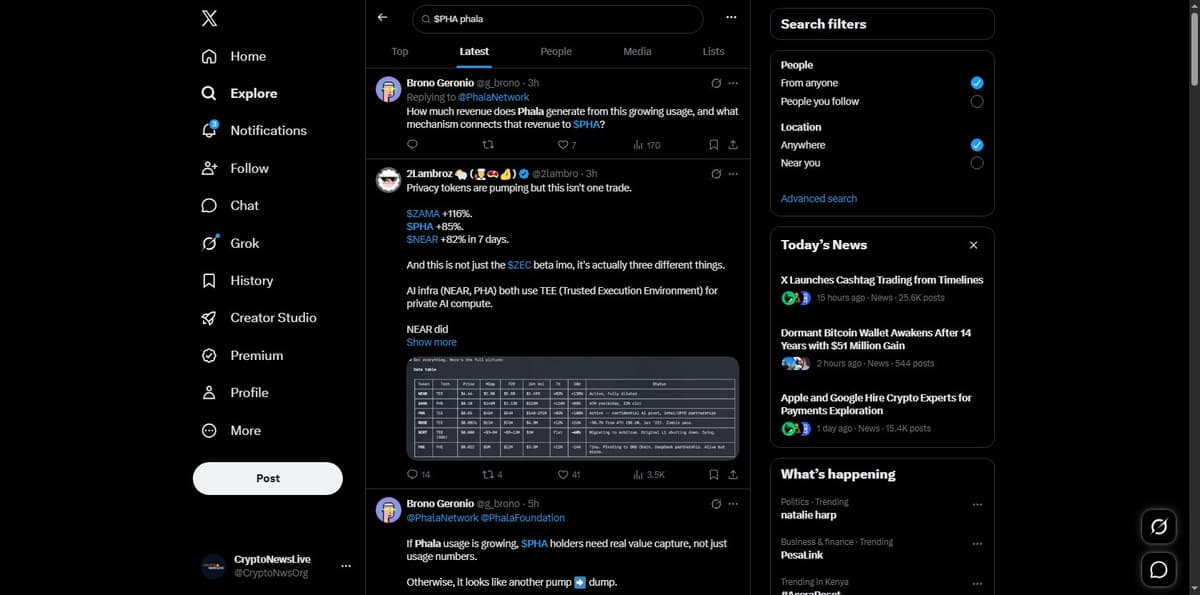
That reading was already out of date. Hours earlier, a trader posting as 2lambro had laid the narrative out in one screenshot: a data table comparing four tokens built around confidential computing, $ZAMA up 116 percent over seven days, $PHA up 85 percent, $NEAR up 82 percent, plus $SCRT further down the list. The thread’s framing was blunt. Privacy tokens are pumping, it said, and this is not one trade, it is three or four things moving together under a single idea: Trusted Execution Environment infrastructure for private AI compute.
By the time the piece got written, $PHA had round-tripped a large chunk of that move. The token sits near $0.045, down roughly 24 percent in 24 hours, after a seven-day candle that still reads +58 percent even after the drop. Pull the window back further and the real shape appears: PHA spent late August grinding along near $0.023, then tripled to an intraday high just above $0.065 before the reversal started. Three months of base building, one parabolic week, one violent unwind. That is the actual story, not the 24-hour number alone.
A Blow-Off Top, Textbook Shape
The hourly chart on Binance shows the anatomy cleanly. A single green candle carries price from the low $0.040s straight through $0.060 with barely a pause, tags $0.0655, then immediately prints a red candle nearly as large. What follows is not a clean drop but a fight: a bounce back toward $0.058, a stall, a slow bleed down to the $0.050 shelf, then a second sharp leg that breaks the rising short-term moving average and does not find support again until $0.045.
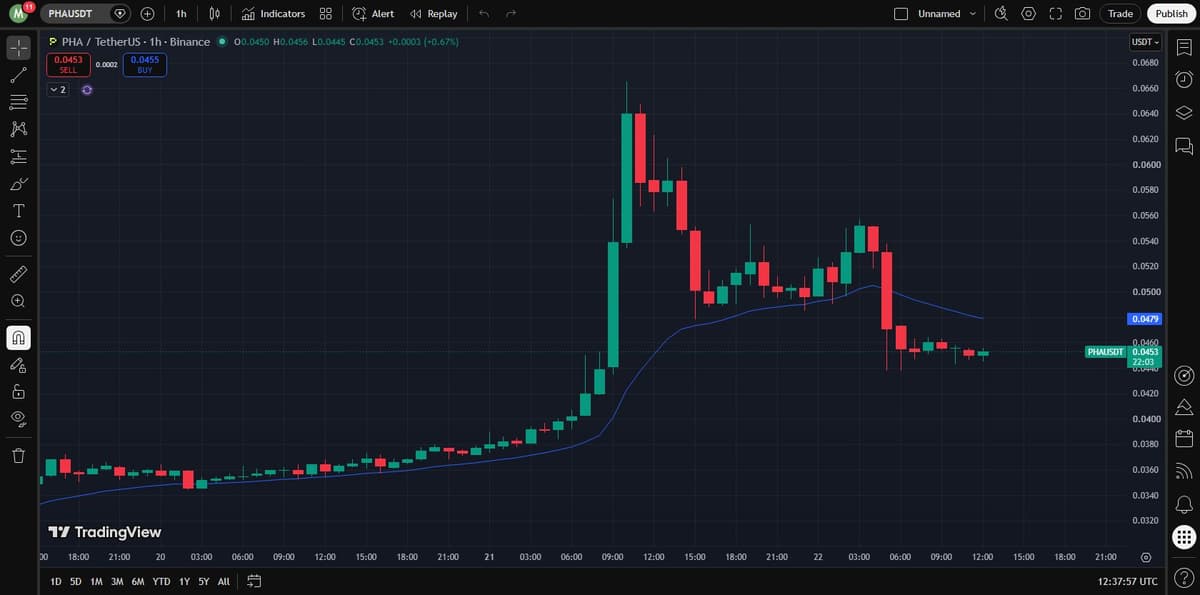
That two-stage structure, spike, failed retest, second leg down, is the classic shape of a blow-off top rather than a single liquidation cascade. Buyers who chased the first candle got a chance to exit near the highs on the bounce. Whoever didn’t take it sold into the second leg instead, at a worse price.
Open Interest Built the Move, Then Fed the Drop
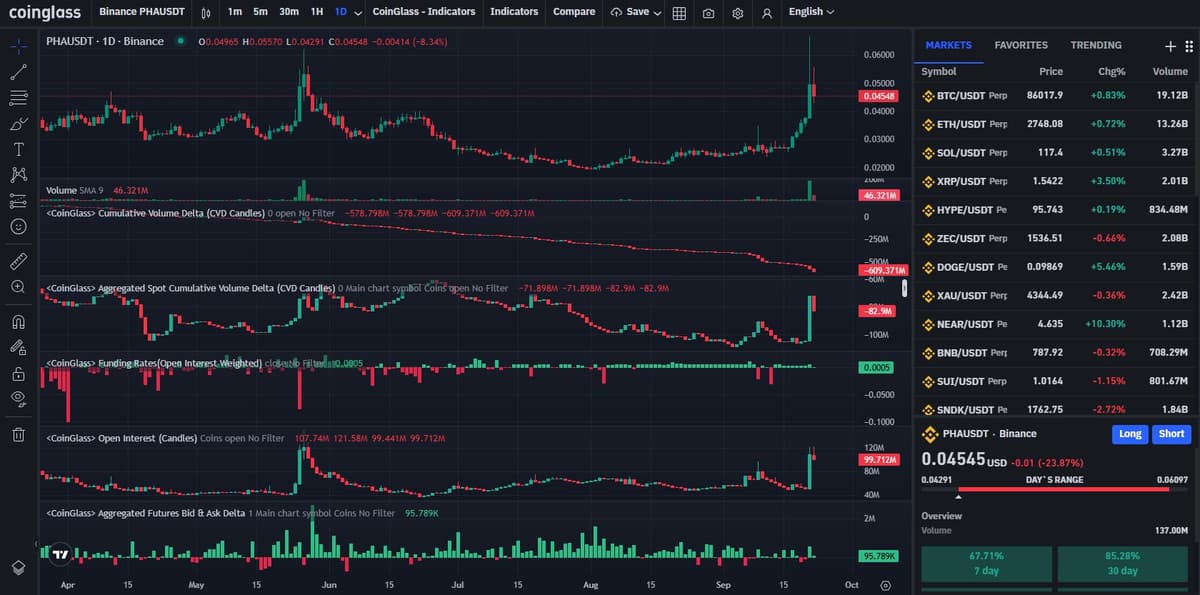
Binance’s futures data on PHA shows open interest climbing from roughly $99.7 million to about $121.6 million right as the spike hit, a jump of close to 22 percent in contracts outstanding in a token with a $38 million spot market cap. That ratio alone is a flag: more was riding on futures than the entire circulating supply was worth on spot markets. Open interest has since eased back toward the $99 million to $100 million range as price fell, which is what a round of forced closes on stretched positions looks like rather than a broad, orderly exit. Funding on the pair currently sits close to flat, near 0.0005, suggesting most of the excess has already cleared out.
None of this happened on thin, DEX-only liquidity, the kind that makes a move easy to dismiss. CoinGecko’s own market data puts total 24-hour PHA volume above $107 million, with roughly 99.6 percent of it clearing on centralized order books, split across BloFin near $19.9 million, Binance’s combined USDT and TRY pairs above $26 million, BTCC, CoinW, HTX, WhiteBIT, OKX, Bitvavo, Gate and KuCoin all carrying seven figures apiece. On-chain trading across PancakeSwap-style pairs and NEAR-native pools added up to roughly $418,000, a rounding error against the centralized total. Whatever drove this was a futures and spot order-book event on major venues, not a wash-traded token thin enough for one wallet to move.
The Rest of the Sector Didn’t Crash With It
PHA’s 30-day correlation to Bitcoin sits at just 0.24, a token that mostly moves to its own rhythm. Over the last seven days that reading rose to 0.56, a period that overlapped with Bitcoin’s own break above a six-month price ceiling this week. Some of the lift had a favorable macro backdrop behind it. But $ZAMA and $NEAR, the two tokens sharing the same privacy-computing narrative, were still up double digits at the time of writing, without PHA’s overnight reversal. The dump looks specific to PHA’s own crowded futures book rather than a sector-wide flush.
Whether that TEE-and-confidential-AI narrative has staying power or fades by next week is an open question the data can’t answer yet. What the numbers do show is a token that tripled off a real multi-month base on a real, verifiable sector story, then got hit by its own borrowed money on the way back down. If the narrative holds and fresh spot demand shows up without piling contracts on top of it again, PHA has room to retest the highs. If the next leg is funded the same way this one was, the same unwind plays out again.