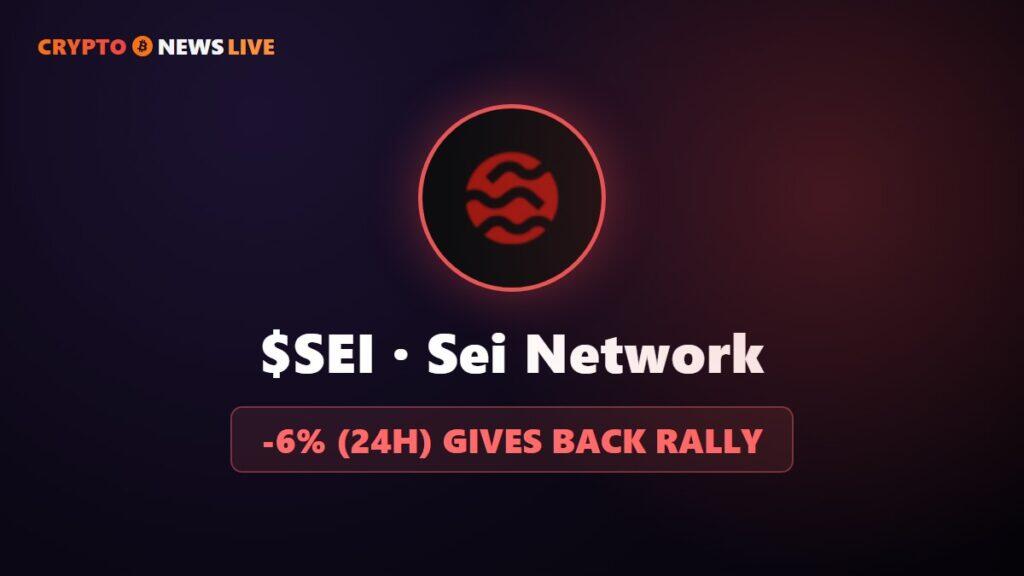
Sei Network gained 52% over the past week and then handed back a real chunk of it, sliding 6% in the past 24 hours. Two dated catalysts explain the run. Neither explains today’s pullback, and the derivatives data suggests it doesn’t need to.
The Rally Had Two Real, Traceable Triggers
SEI bottomed near $0.045 on September 17-19, then spiked to $0.086 by September 25-26, more than doubling in a week. The move lines up with two separate, verifiable events. On September 21, Canary Capital filed Amendment No. 2 to its S-1 registration for a staked SEI ETF with the SEC, raising the proposed staking allocation to roughly 90% of the fund’s holdings and naming BitGo as sole custodian for a planned Cboe BZX listing. Two days later, on September 23, Sei Labs published lab benchmarks for Hermes, the consensus protocol built for its planned Giga upgrade, showing a median finality of 68 milliseconds and sustained throughput of 100,000 transactions per second across 51 validators, even with some validators deliberately stalled during testing.

Neither event is a guarantee of anything landing soon. The ETF filing is still a proposed registration statement, not an approval, and Hermes remains a lab benchmark, not a live mainnet upgrade. But both are genuine, dated, and independently verifiable, which is more than most 50%-plus weekly moves in this market can point to.
Today’s Drop Looks Like Profit-Taking, Not Panic
The derivatives data across every major venue tells a consistent story: this is de-risking, not a fresh sell-off. Binance’s SEI perpetual saw its 24-hour futures volume fall 51% alongside the price drop, and open interest there fell 14%. OKX and Bybit show the identical shape, futures activity and open interest both falling as price falls, and MEXC’s open interest is off by more than a quarter over the same 24 hours. Spot volume over the past 24 hours, at $98.55 million, actually sits below SEI’s own 30-day average of $133 million. If this were a leveraged unwind or a fresh short attack, volume and open interest would be climbing into the drop, not falling with it.
The long/short split across exchanges also stayed close to balanced at 49.14% long to 50.86% short, barely tilted either way. Existing longs from the rally appear to be taking profit and closing positions, rather than a wave of new shorts driving the price down.
Zoomed Out, This Bounce Is Still Small
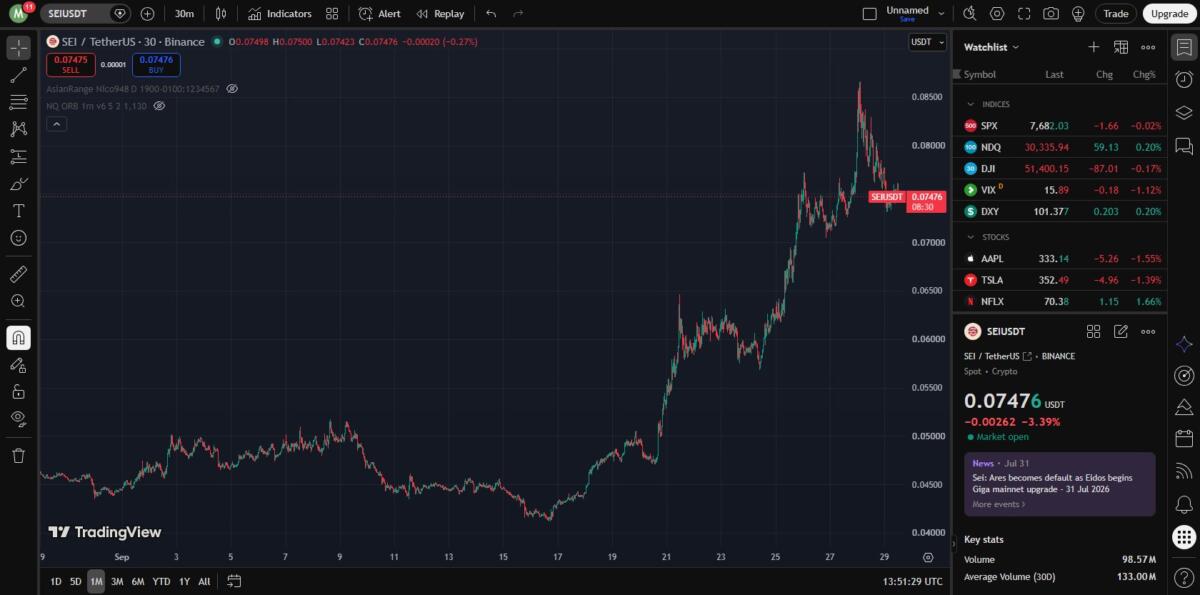
SEI’s chart puts the scale of both moves in perspective. The token is still down 32.7% year-to-date and 73.6% over the past year, a much deeper hole than one strong week can fill. The rally from $0.045 to $0.086 was real and sharp, but it played out entirely within a base that had been grinding sideways in the high-$0.04s to low-$0.05s for most of September before the ETF filing and the Hermes benchmark landed in the same week.
What The Two Catalysts Would Actually Need To Do Next
For this move to extend rather than fully round-trip, the two threads need real follow-through rather than another headline. The Canary filing needs to clear SEC review and actually list, a process that has taken other spot and staked crypto ETFs months rather than days. Hermes needs to move from a 51-validator lab benchmark into a live testnet or mainnet deployment under real network conditions, not just a controlled demo. Until either of those things happens, Monday’s pullback is exactly what a rally built on two pieces of forward-looking news, with no immediate follow-up, should look like.