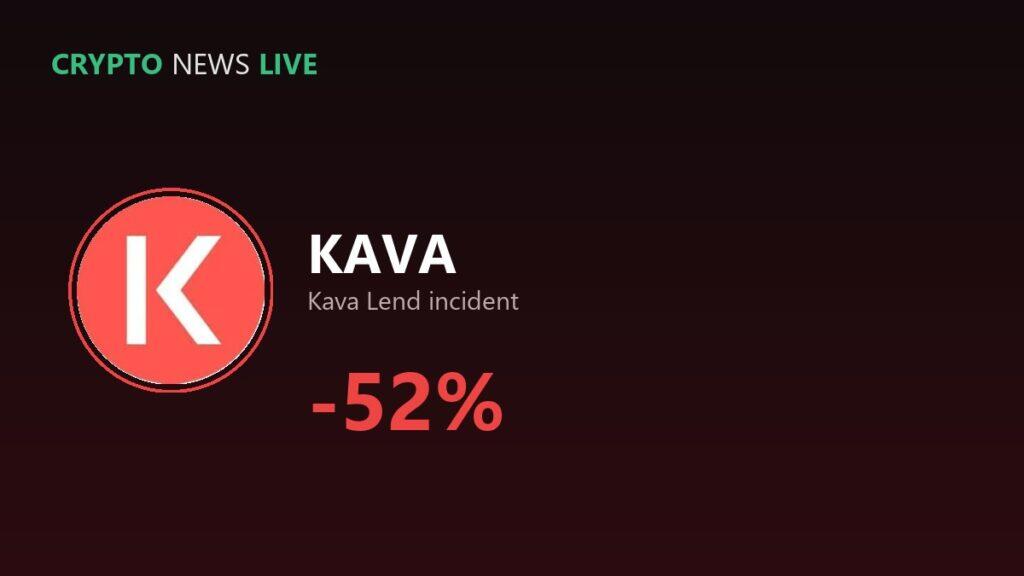
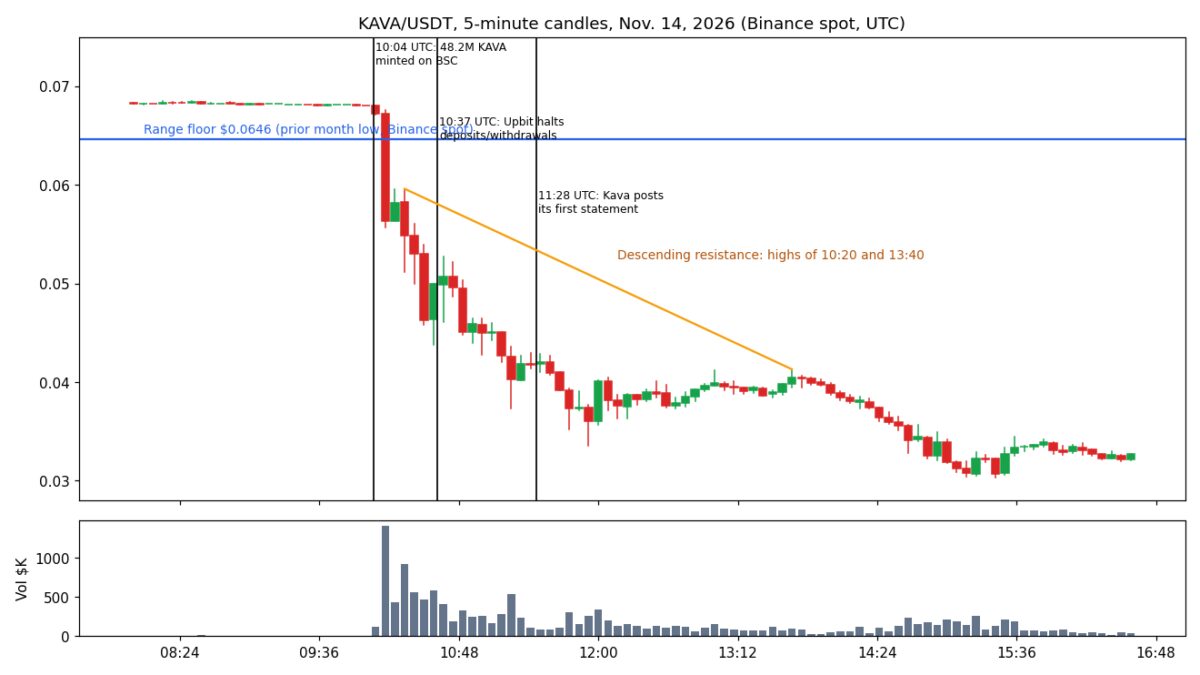
KAVA fell 52% on Nov. 14, 2026, and the beginning of the fall happened 84 minutes before any public announcement by Kava. BscScan shows 48.21 million KAVA tokens minted on BNB Smart Chain at 10:04 UTC, and Kava has attributed it to Kava Lend, their lending protocol.
The Kava Lend chronology, minute by minute
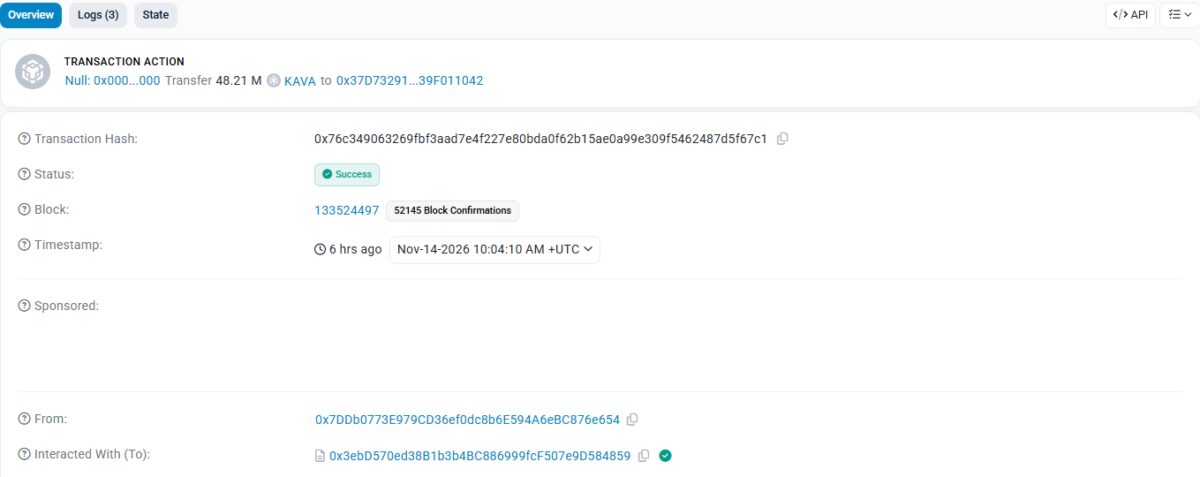
BscScan records the Kava Lend minting at 10:04:10 UTC: 48,209,600 KAVA out of thin air and deposited into one address. There was also a smaller minting of 149,000 KAVA tokens into the same receiving address at 10:01:06 UTC, while a third minting took place at 12:07:20 UTC: 849,000 KAVA. Thus, 49.2 million KAVA tokens were involved here, and the receiving address has no public label.
Then the tokens have gone further. The first onward transfer came within three minutes of the minting, and by 10:41 UTC, 48.2 million tokens had been transferred to five different contracts, and 41.6 million tokens were transferred to just one of them. Kava described the activity as “bridging and sale of KAVA tokens on BSC.”
Binance spot shows the same minutes. KAVA/USDT was trading at $0.0680 until 10:05 UTC, after which the 10:10 candle fell down to $0.0557 with a volume of $1.41 million. This is quite unusual for this pair as it usually trades only several thousand dollars in five-minute candles. By 11:00 UTC, the price fell to $0.0458, a 33% drop from 10:05.
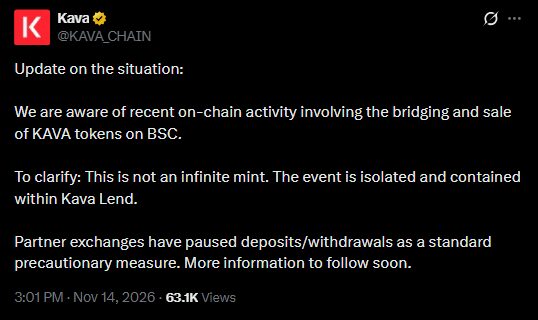
Upbit was an early exchange to act. It issued a notice that it has suspended KAVA deposits and withdrawals because of signs of a security incident at 19:36 Korea time (10:36 UTC), followed by a caution notice at 11:00 UTC. The first public statement from Kava was released at 11:28 UTC, saying it was tracking unexpected behavior originating from a dApp in its ecosystem.

In its next update at 12:01 UTC, Kava wrote that “the event is isolated and contained within Kava Lend” and that “this is not an infinite mint.” They also announced the pause in the Axelar bridge at 14:05 UTC. As of 16:40 UTC, no detailed report on the incident has yet been published.
What Binance and DefiLlama show about KAVA and Kava Lend
Kava Lend mint accounts for about 4.5% of the 1.083 billion KAVA supply according to CoinGecko, and is worth about $3.3 million at the pre-drop price. At $0.033 as of 16:40 UTC, the market cap for KAVA is about $36 million. Bitcoin has declined by 4.2% on the day, and the correlation between KAVA and bitcoin for the 30 days before Nov. 14 is just 0.18, so the move is KAVA-specific.
DefiLlama shows that Kava Lend has $5.33 million of value locked down 27% on the day. The other two Kava products, namely Kava Earn and Kava Liquid have dropped by 49% and 54%, respectively.
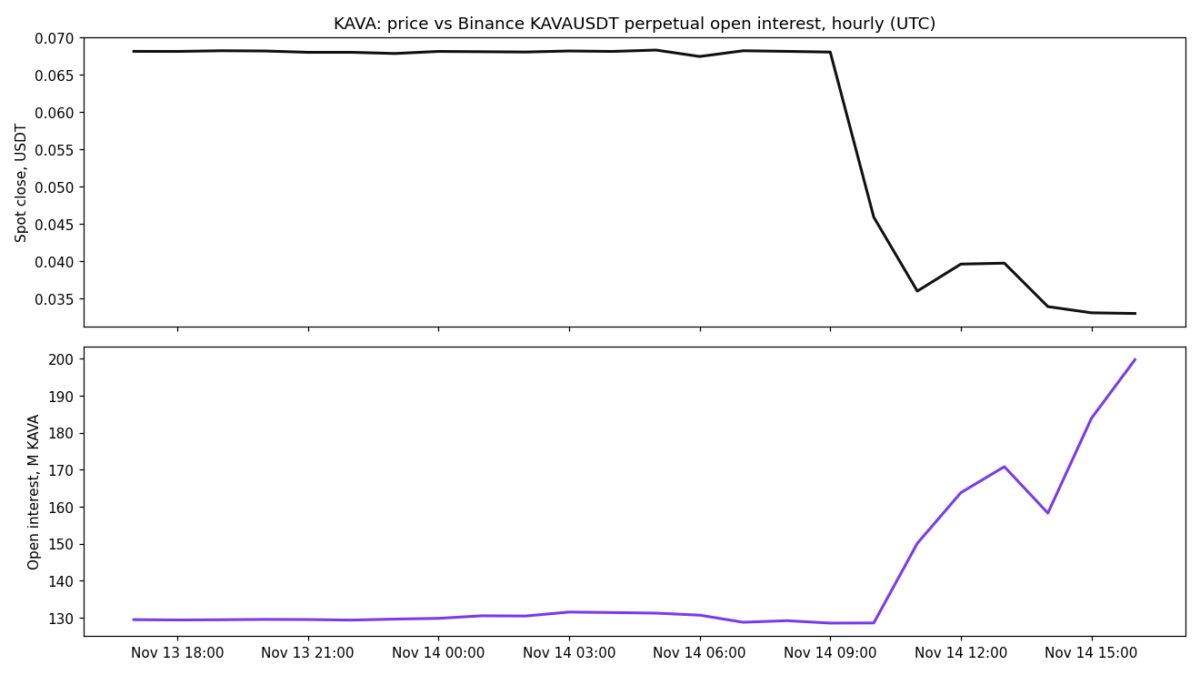
Futures traders took the other side. Open interest on Binance’s KAVAUSDT perpetual futures increased from 128.6 million KAVA at 10:00 UTC to 150.1 million KAVA at 11:00 and 199.7 million at 16:00, up 55%. In dollar terms, it increased from $8.75 million to $6.61 million. The funding rate at 12:00 UTC was -0.0617%, compared to the usual 0.005%, but was back to 0.005% by 16:00.
Kava is the second Binance-listed token with an incident within days. On Nov. 12, CryptoNewsLive reported that the Initia exploit rally was wiped out when INIT dropped 66% off its highs.
Two cases for KAVA with $0.0303 as the low
Pre-Kava Lend event, the 30-day median daily trading range of KAVA was 2.1%. KAVA had traded above $0.0646, the prior-month low, until the 10:10 UTC candle broke it. Bitcoin, near $65,400, is below its 100-day average of $77,764, and KAVA is below its 10-day low. Cryptocurrencies are highly volatile, and there is a possibility of loss of capital; this is a level analysis.
Down case. A one-hour close below $0.0303, which is the day’s low in Binance perpetual, would put price in a zone without any previous level to analyze from. This case is cancelled by a one-hour close back above $0.0304. The above trend analysis favors this case.
Up case. A one-hour close above $0.0413, the swing high at 13:40 UTC that marked the end of the latest bounce, would open $0.0450, and then $0.0596, the 10:20 UTC high. The up case would fail on a one-hour close below $0.0364, the lows of 12:10/12:15 UTC.