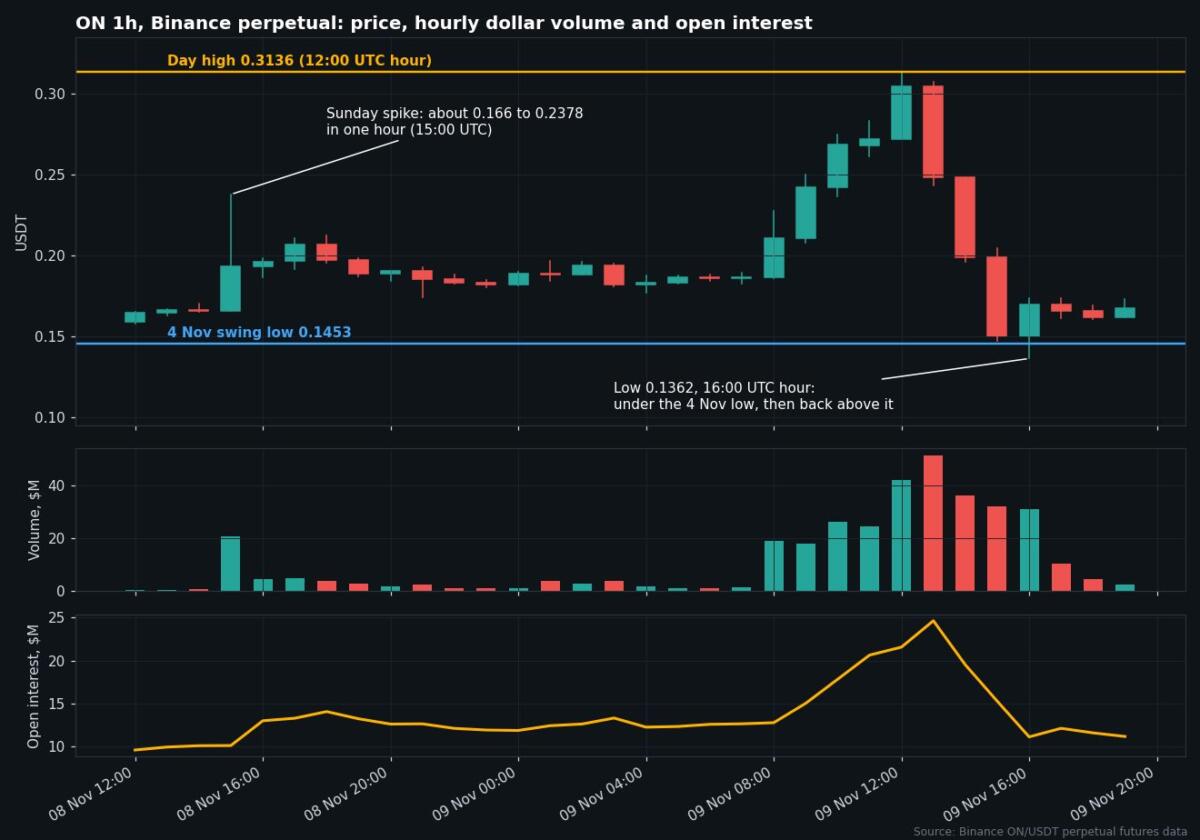
Orochi Network’s ON token fell 57%, from $0.3136 to $0.1362, within five hours on Monday, after climbing 68% earlier that morning. The Orochi Network crash left it near $0.17 by evening, lower than where the climb began.
Prices here come from Binance’s perpetual futures market, where almost all trading in ON happens. The run began at 08:00 UTC, with the token opening the hour at $0.1864. The 12:00 UTC hour produced the top. The 16:00 UTC hour produced the low, which sat below the $0.1453 floor set on 4 November, although price was back above that line before the hour ended. Open interest, meaning money riding on futures bets not yet closed, nearly doubled along the way. It was $12.7 million at 08:00 UTC and $24.6 million at 13:00 UTC, then only $11.1 million by 16:00 UTC, below where it started.
Traders paid a price to hold long bets at the top. Funding, a fee that one side of a perpetual contract pays the other every four hours, reached 0.0911% at the 12:00 UTC settlement, the highest of the eight settlements since Sunday noon. By 16:00 UTC it was 0.0230%.
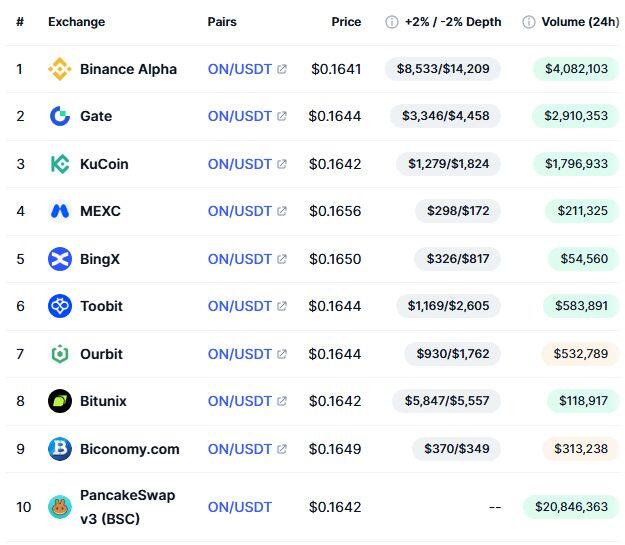
Binance’s ON contract traded more than $310 million on Monday, nearly twelve times the average of the nine days before. CoinMarketCap puts the whole token at about $33 million, so the day’s futures trading was roughly ten times its market value. The token’s spot markets, where coins change hands directly, did about $32 million between them over 24 hours, and $21 million of that sat in one PancakeSwap pool.
No Binance notice or Orochi post explains the Orochi Network crash
CryptoNewsLive searched Binance’s support centre for Orochi on Monday evening. It returned two announcements. One is the October 2025 notice that put ON on Binance Alpha and Futures. The other, dated 22 October 2026, set up two weekly trading competitions on Binance Alpha. The second one closed on 5 November at 13:00 UTC, four days before the spike.

The project’s own account posted at 09:43 UTC on Monday, in the middle of the climb. The post was about proving reserves, not about the token. The line below is from it.
An issuer proves that reserves cover every holder balance at every reserve update.
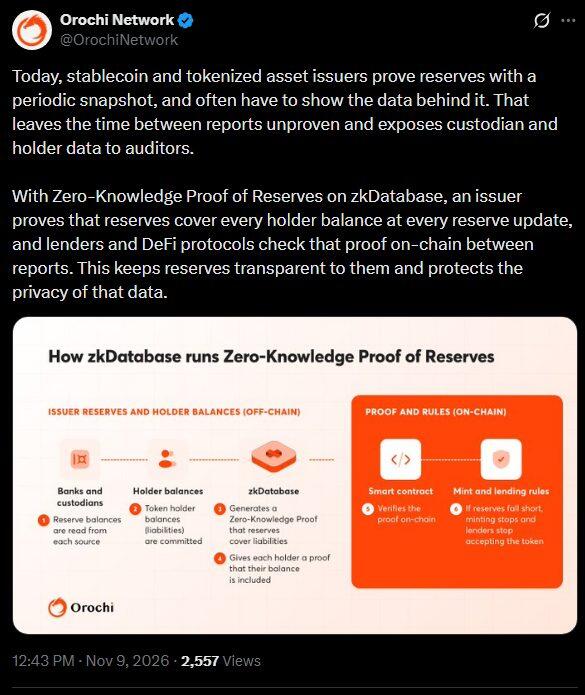
The post names no price, listing or token event. It also landed after the climb had started at 08:00 UTC.
The fourth spike in nine days
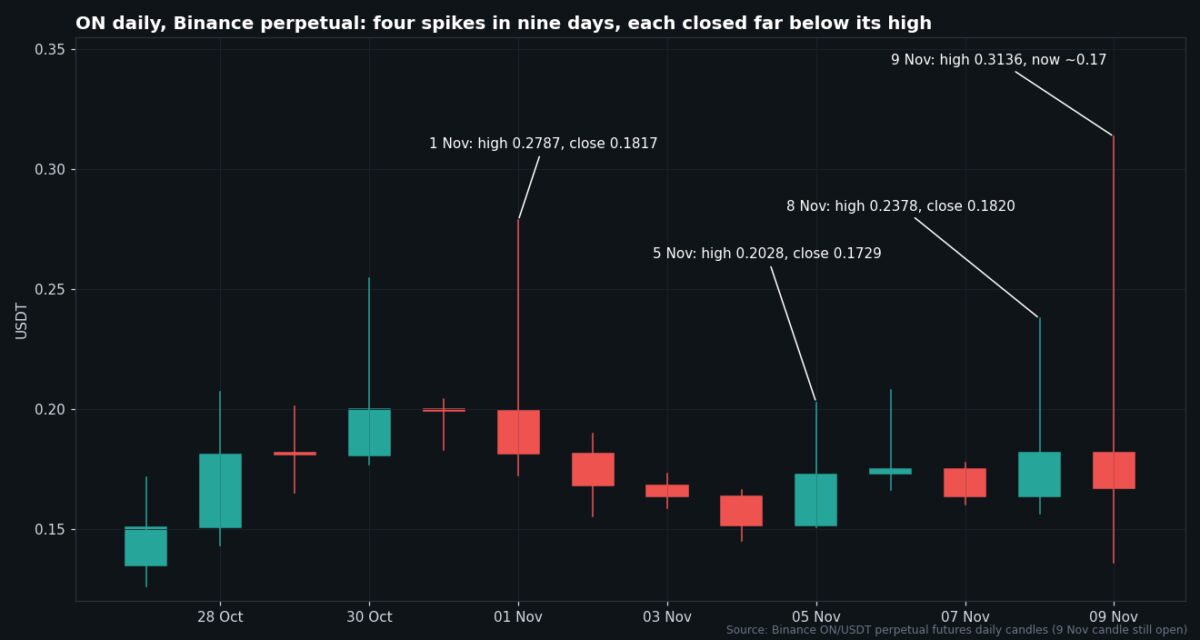
Monday’s Orochi Network crash was not the first reversal. On 1 November ON hit $0.2787 and closed the day at $0.1817. On 5 November it touched $0.2028 and closed at $0.1729. On Sunday 8 November it jumped from about $0.166 to $0.2378 in one hour, and the day ended at $0.1820. Each time the day closed far below its high. UnifAI’s token did the same on a bigger scale on 7 November, as CryptoNewsLive reported, and Pieverse moved the other way on Monday.
The two levels left on the chart
Two paths follow from the chart, and the data does not favour either. A daily close above $0.2378, Sunday’s high, has not happened since at least 29 October. A daily close under $0.1453, the 4 November low, would confirm the break that Monday’s wick only tested, and $0.1362 would be the next mark on the chart.
After the Orochi Network crash, ON sits about 62% below the $0.4477 record that CoinMarketCap lists from 7 August.