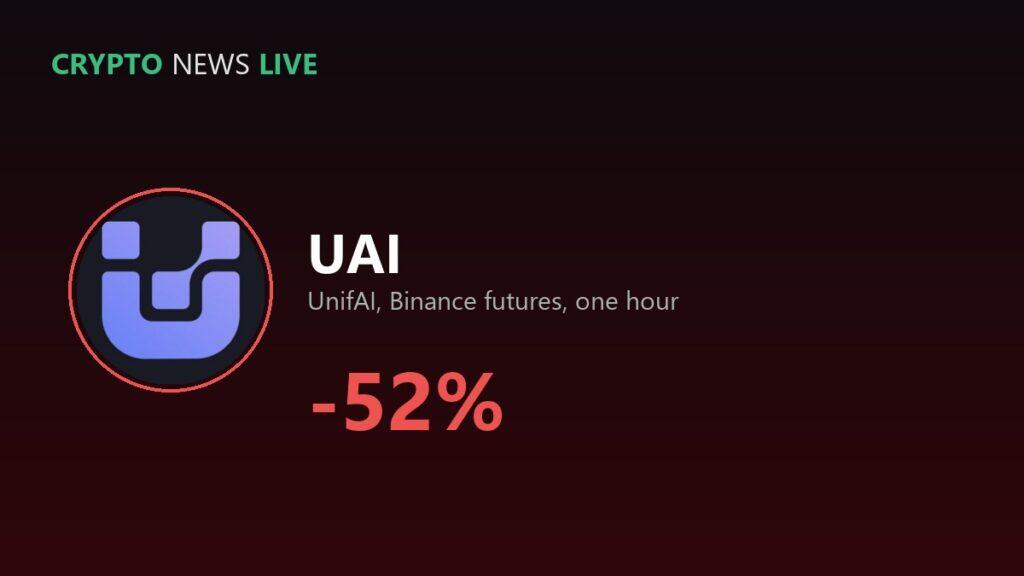
Between 18:00 and 19:00 UTC on 6 November, UnifAI’s token fell from $0.235 to $0.113 on Binance futures, a 52% drop, with $65 million of contracts traded. The UAI crash came about 15 hours after the token had started a climb of 166% from Thursday’s close. On Binance, UAI trades only as a futures contract.
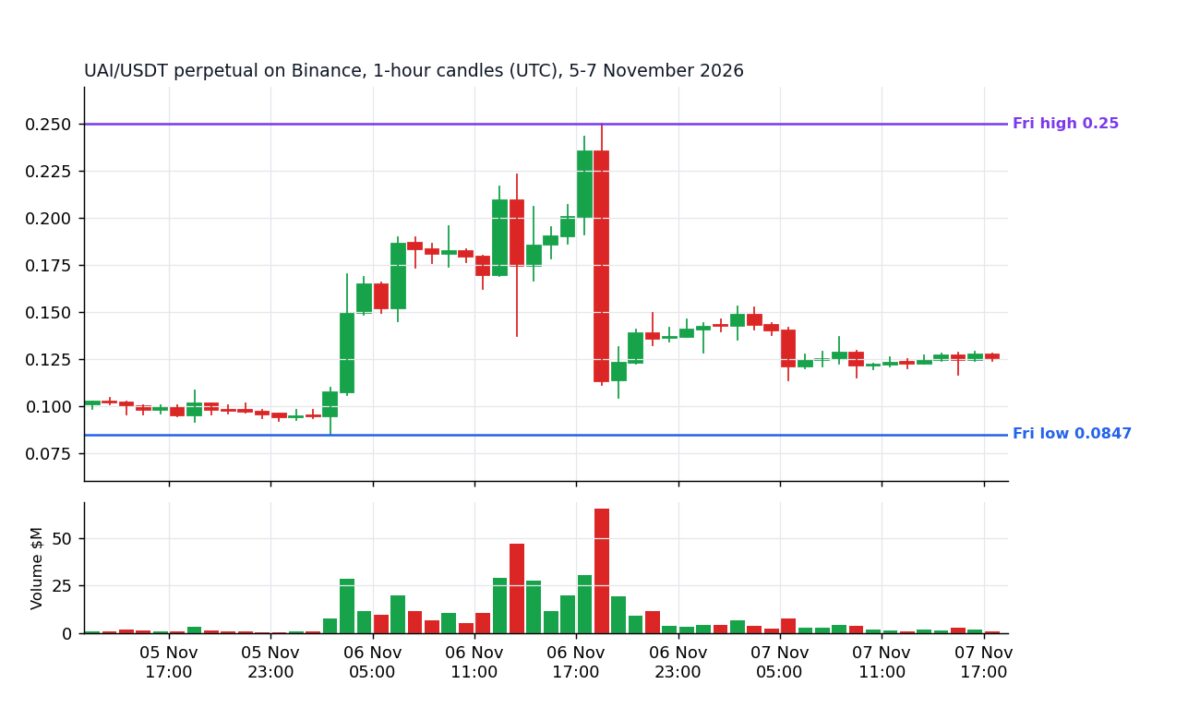
The UAI crash was not the first collapse that week. Anyone who bought the Friday rally had already seen the token lose almost half its value once.
The UAI crash was the second in six days
On 1 November UAI fell 47% in a day, from $0.307 to $0.163, and kept sliding to a low of $0.0777 on 4 November. At that low it was 91% under the all-time high of $0.8365 that CoinGecko lists for 12 September.
Friday’s rally began at 03:00 UTC, when UAI jumped from $0.107 to $0.15 in an hour. By the end of the day $406 million of UAI futures had traded on Binance, against $60 million on Thursday and $39 million on Wednesday. The jump from Thursday’s $0.094 close to Friday’s $0.25 high is the 166%.
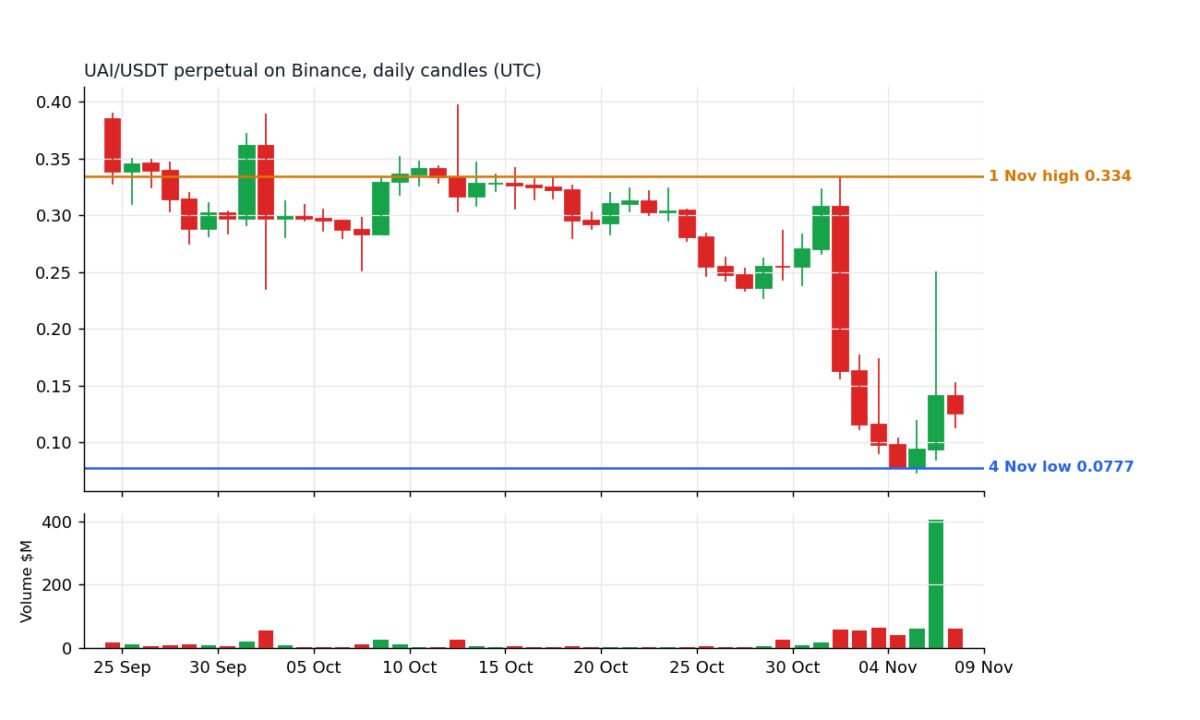
The climb, and the hour behind the UAI crash
Funding is a fee that traders on opposite sides of a futures contract pay each other every four hours. At 16:00 UTC on Friday it reached 0.03%, six times its usual 0.005%, with those betting on a rise paying those betting on a fall. Two hours later the 18:00 candle opened at $0.235, touched $0.25 and closed at $0.113.
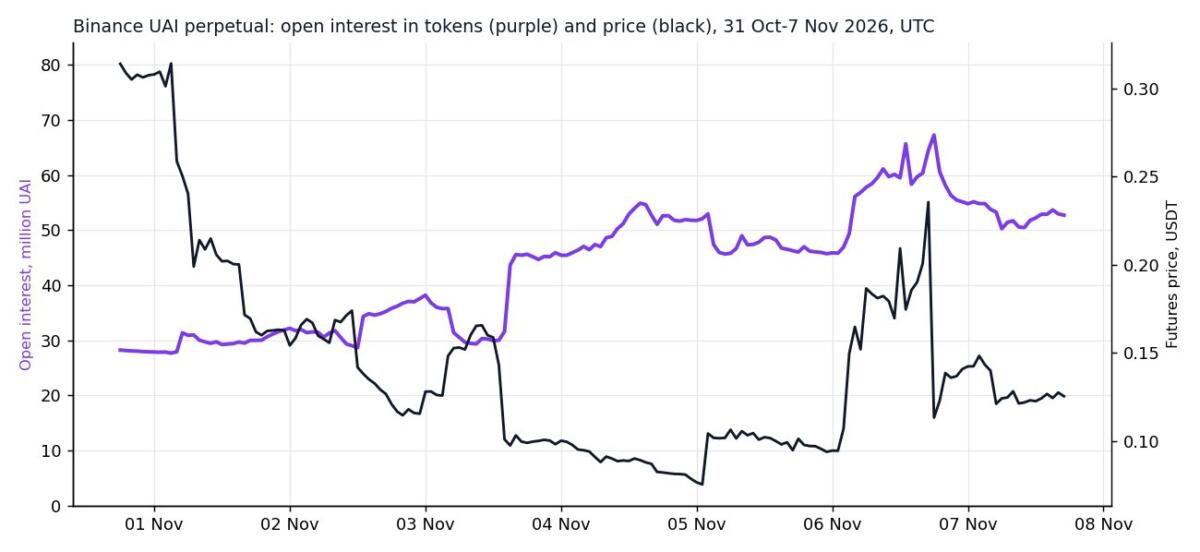
Open contracts did not shrink during the week. Open interest, the number of futures contracts still open, rose on Binance from about 28 million UAI on 31 October to a peak of 67 million on Friday, even though the token had lost more than half its price since 31 October. By Saturday afternoon it was 53 million. Binance’s data feed lists 239 million UAI in circulation, so the open contracts cover about a fifth of the supply.
Most of the trading happened on futures, not in the token itself. In the 24 hours to Saturday afternoon, UAI futures on Binance traded $181 million. The biggest spot market that CoinGecko lists, a PancakeSwap pool on BNB Chain, handled $13.5 million, and Gate, the largest exchange on the list, $3.7 million. So a price move in UAI is mostly decided by traders betting on direction with borrowed money, who can be forced out of their positions when it turns against them.
What UnifAI posted
The project’s X account posted five times between 1 and 6 November, and none of the posts mention a price, an exchange or a listing. The one from 15:45 UTC on Friday, two hours and 15 minutes before the 18:00 candle, is a short video that tells followers to “get your own UnifAI agent today.” The posts on 2, 3 and 4 November discuss what AI agents could do for DeFi users.

Where UAI sits on the chart
UAI trades near $0.125, inside the box on the four-hour chart between $0.1015 and $0.1452 that Friday’s rally left behind. A four-hour close above $0.1452 would make $0.25, Friday’s high, the next level. A four-hour close under $0.1015 would point to $0.0921, the bottom of the yellow box, and then to Friday’s low of $0.0847. Each reading lapses once price slips back into the box.
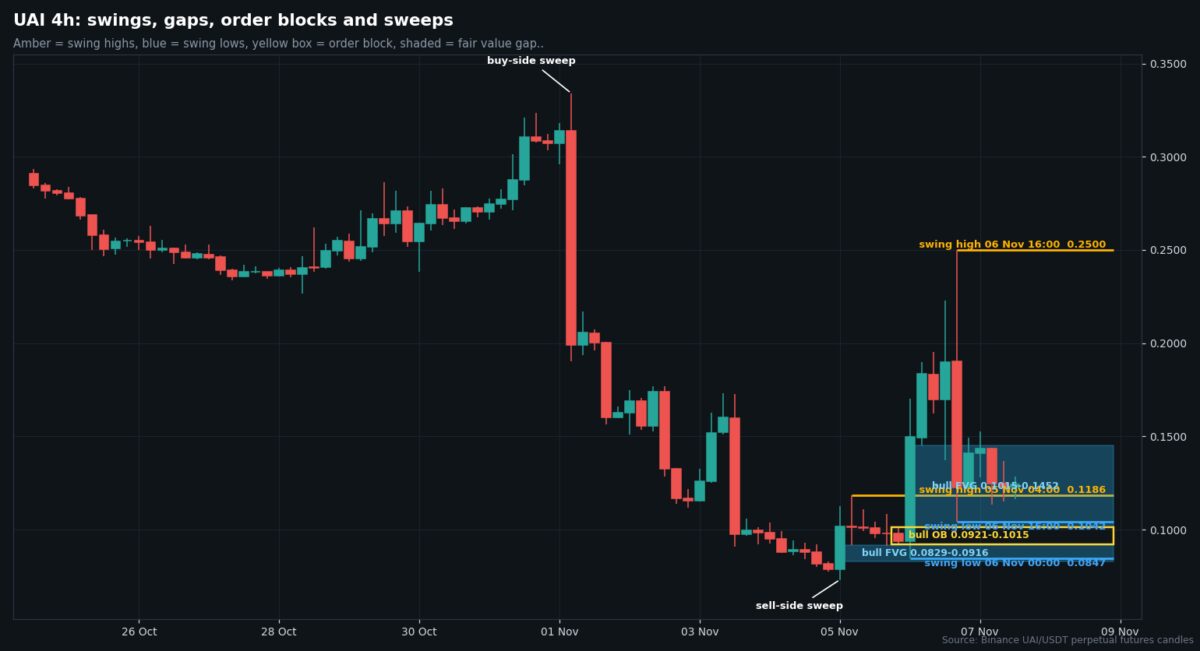
After the UAI crash and the week before it, the token at $0.125 is about 85% below the $0.8365 it reached on 12 September.