
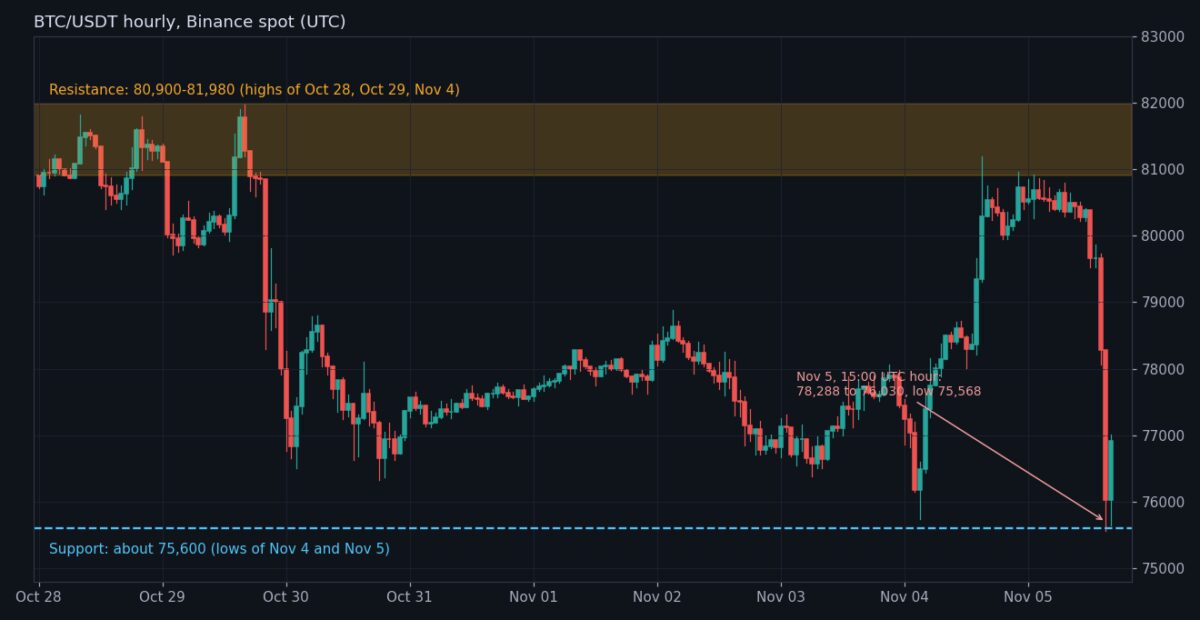
Bitcoin fell about 6% in roughly three hours on Thursday to $75,568, its lowest price since at least late September, in a Bitcoin chip selloff that began on Wall Street and spread to crypto. On Binance the price was near $80,400 at 12:00 UTC and had touched $75,568 by the end of the 15:00 UTC hour.
The drop wiped out the whole rally from election week. On Wednesday Bitcoin had climbed as high as $81,196 after the U.S. midterms, as we reported in our short squeeze piece.
It had spent Thursday morning quietly between $80,200 and $80,800 before the slide.
Why Bitcoin followed stocks lower
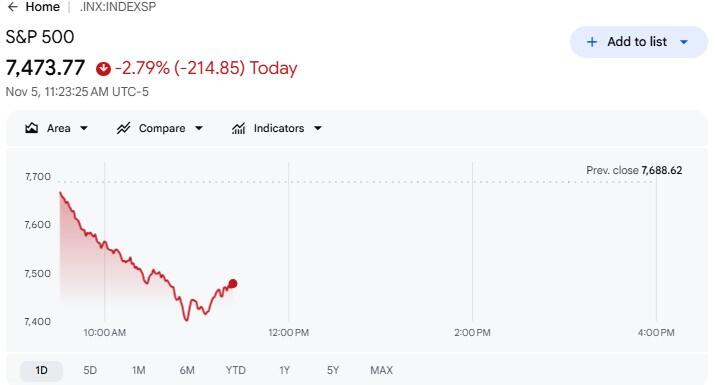
The trigger sat in the stock market, not in crypto. The Associated Press reported that Nvidia fell 6.3%, AMD 13.1% and CoreWeave 10% as AI chip shares extended their losses, and that the S&P 500 gave back its previous day’s rally, its best in three months.
The AP gave two reasons. Investors worry that building new AI data centers may slow because borrowing has become expensive. They also fear that the Democratic gains in the midterms could lead governments to pause data center construction.

Bitcoin began to slip around 12:00 UTC, well before Wall Street opened at 14:30 UTC, and the sharpest leg came in the 15:00 hour. By then Google Finance had the S&P 500 down 2.79% at 7,473.77. Bitcoin was down 4.6% on the day. Same direction, which is why a chip selloff matters to people who own no shares at all.
What the liquidation numbers show
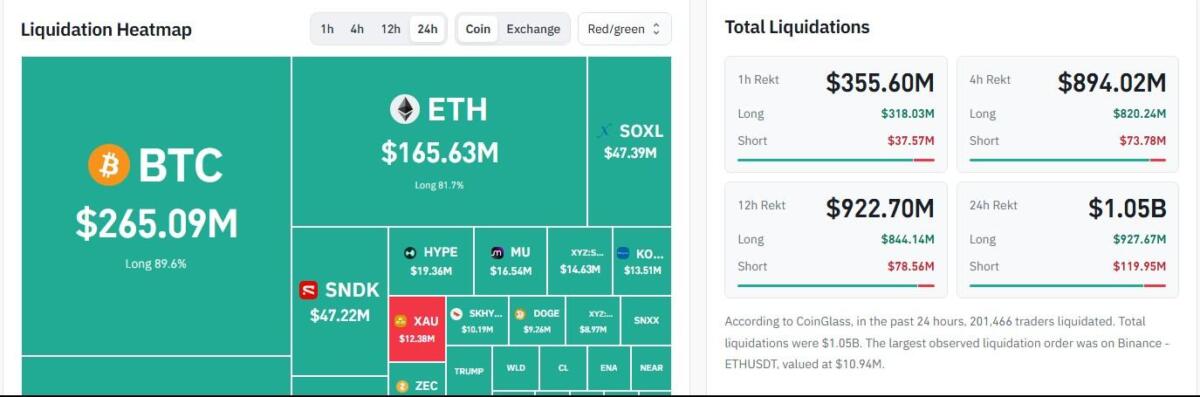
A liquidation happens when an exchange force-closes a leveraged trade because the trader no longer has enough money behind it. CoinGlass counted about $1.05 billion of liquidations across crypto in 24 hours, of which $927.67 million were long positions, meaning bets on a rise. Shorts lost $119.95 million.
Bitcoin alone accounted for $265.09 million, and 89.6% of it was longs. Ether followed with $165.63 million. In the latest hour alone about $355.6 million was liquidated, again mostly longs.
Wednesday had gone the other way. Our earlier count showed that shorts took the bigger loss during the squeeze, and traders who bought the breakout above $80,000 took it on Thursday.
Where Bitcoin goes from here
The price now sits between two lines on the chart above. The $75,600 area has held on two separate days, 4 November and 5 November, and the $80,900 to $81,980 band has turned the price back three times since 28 October. Bitcoin needs to climb back above that band for buyers to look in charge again, while a drop under the $75,568 low would put it below any daily low on Binance since at least 22 September.
A policy headline that did not help
A policy report from the night before did not stop the Bitcoin chip selloff. Late on Wednesday, journalist Eleanor Terrett reported that House Democrats are discussing a broader crypto market structure bill for the next Congress, citing three industry sources who spoke with Democratic staffers. No bill text has been released, and Republicans are calling it a “messaging bill,” she wrote.

For holders the practical point is plain: until the chip selloff ends, crypto is likely to keep taking its cue from them.