
No announcement from Bubblemaps explains why its BMT token has risen about 44% since Tuesday. The newest posts on the project’s X account, dated 29 October, are about a Polymarket drain. What Binance’s data does show is a BMT funding rate so negative that traders betting on a fall are paying to keep those bets open.
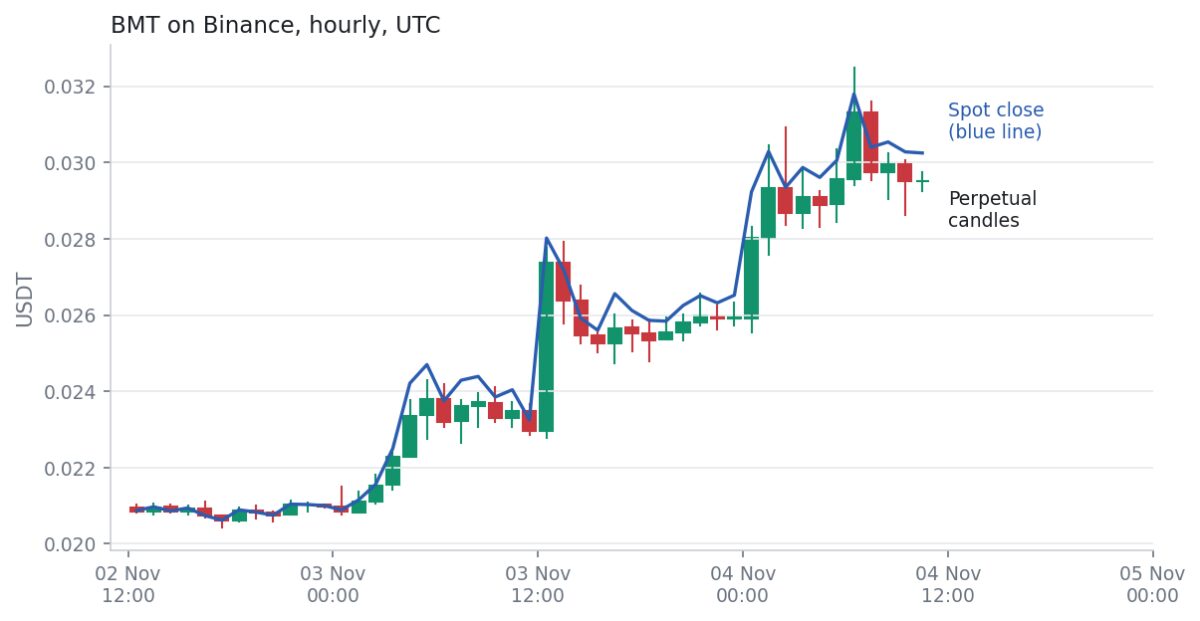
BMT, the token of the on-chain analytics platform Bubblemaps, opened Tuesday 3 November at $0.0210 on Binance spot. By 10:00 UTC on Wednesday it was changing hands near $0.0302, up about 44%. Its best price in that stretch came at 06:20 UTC, when spot touched $0.0329. That is still well under the $0.0494 the perpetual contract touched on Saturday 24 October, so the climb so far has won back only part of what the token gave up after that spike.
The BMT funding rate turned sharply negative on Tuesday
Binance’s BMT contract is a perpetual future, which has no expiry date. To keep its price close to the spot price, the exchange makes one side pay the other every four hours. That payment is the BMT funding rate. When it is negative, people holding short positions, bets that the price will fall, pay the people holding long positions.
From Tuesday morning they paid a lot. Every one of the 53 payments from 29 October at 03:00 UTC through Tuesday at 04:00 UTC was smaller than 0.26%. The payment at 08:00 UTC on Tuesday was -1.17%, and the BMT funding rate reached -1.32% at 04:00 UTC on Wednesday. Seven payments between 08:00 UTC Tuesday and 08:00 UTC Wednesday added up to -6.37%. A trader who stayed short through all seven paid about 6.4% of the position’s value in fees.
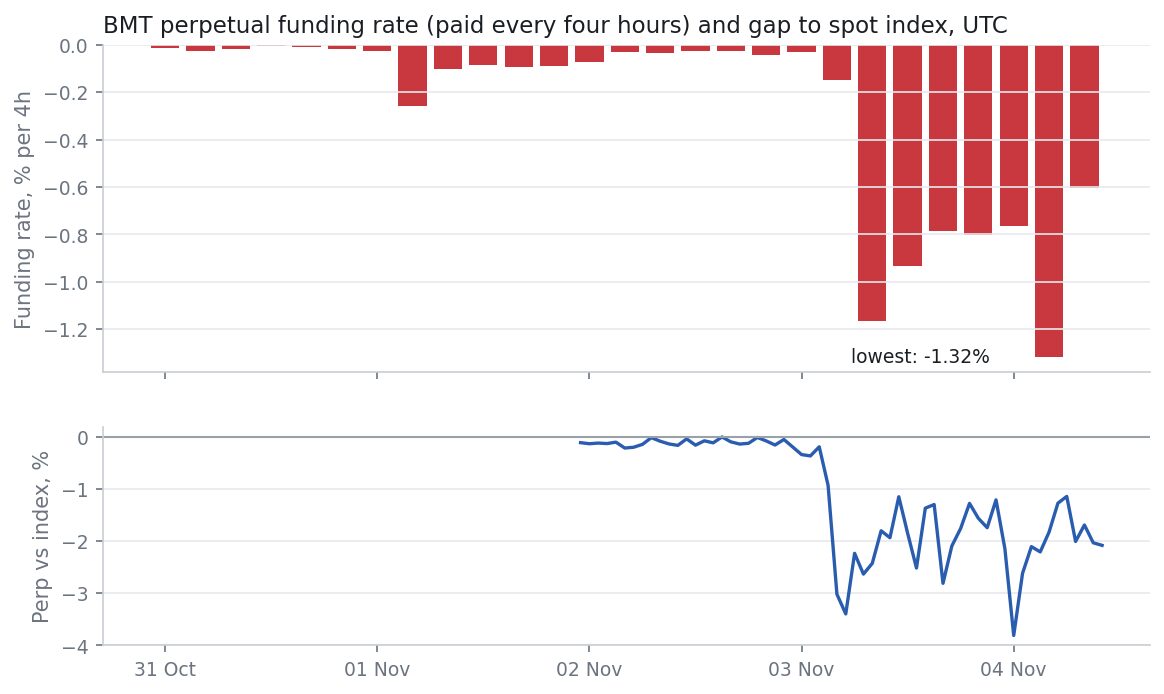
The same gap shows up in prices. Binance’s mark price for the contract was $0.0295 at 10:12 UTC on Wednesday, 2.1% under the index price of about $0.0302 that it builds from spot markets. The gap reached 3.8% during the 00:00 UTC hour. Spot and futures prices can part ways for hours on the same exchange, as the STX spike on Saturday showed.

Contracts opened as the price rose
Open interest, the number of contracts still open, nearly doubled in tokens. It stood at 130.4 million BMT, worth $2.74 million, at 00:00 UTC on Tuesday and at 256.4 million BMT, worth $7.59 million, at 10:00 UTC on Wednesday. Binance does not say how many of the new contracts are longs and how many are shorts, so the figure alone does not show which side added them.
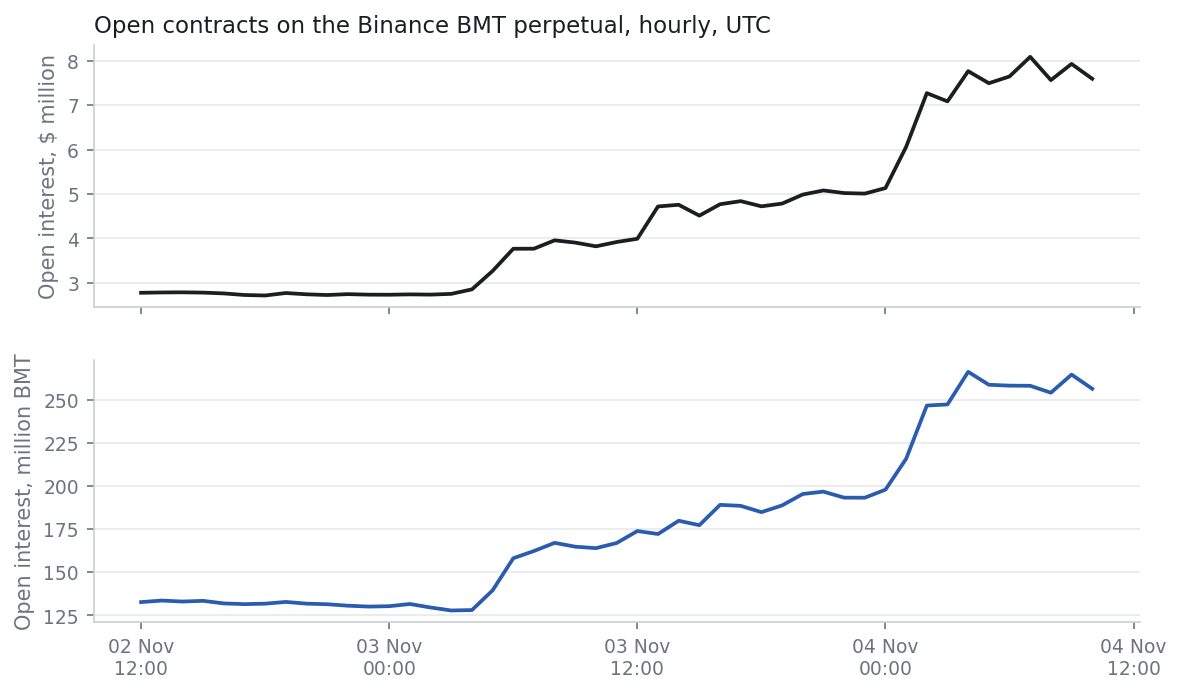
Most of the trading is in futures as well. The contract turned over $170.8 million in 24 hours to Wednesday morning, against $17.6 million on Binance spot, almost ten times as much. The Akedo contract also traded far more than its spot markets, as CryptoNewsLive reported on Monday. Open interest of $7.6 million is about a third of the $22.8 million market value Tokenomist reports for BMT, which is small enough for a few large orders to move the price.
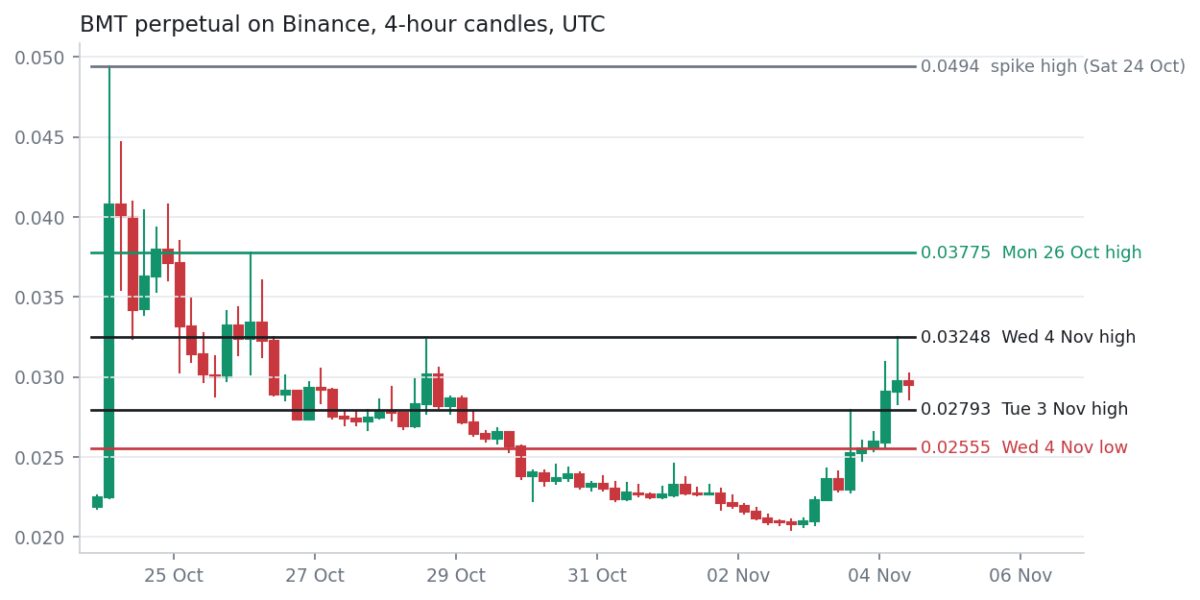
BMT levels after the 24 October spike
Four prices on the perpetual contract frame what happens next, and each is drawn on the chart below. Wednesday’s high is $0.03248, set in the 06:00 UTC hour. An hourly close above it, meaning the price at the end of an hour, would leave $0.03775, the high of Monday 26 October, as the next stop, and that path fails if price slips back under $0.03248. Tuesday’s high is $0.02793. An hourly close below it would point to $0.02555, Wednesday’s low, and that reading fails if the next hourly close is back above $0.02793. Bitcoin traded near $78,400 at the same time, above its 100-day average of about $76,800.
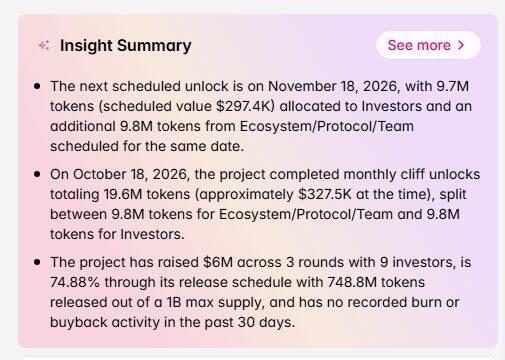
A token release is also due on Wednesday 18 November. Tokenomist lists 9.7 million BMT for investors and 9.8 million for the ecosystem, protocol and team, about 19.5 million in all, or roughly $590,000 at Wednesday’s price. The release on 18 October was 19.6 million tokens.
At the last reading the contract still traded under spot and the BMT funding rate was still negative, which means holders of shorts were still paying holders of longs.