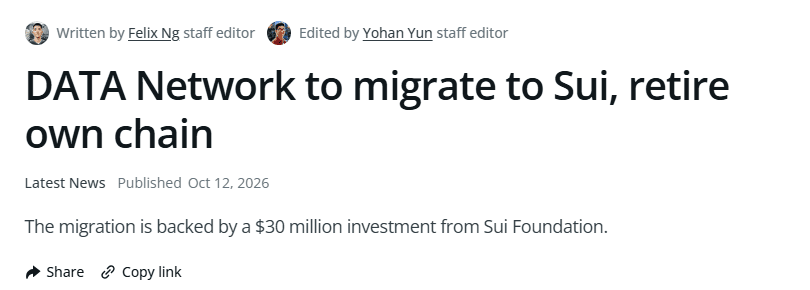
WAL closed Monday, October 12 down 8.3%. That was the day Walrus was named the default storage layer in a press release from DATA Network, posted around 03:05 UTC. The WAL price then sat still for about 45 hours.
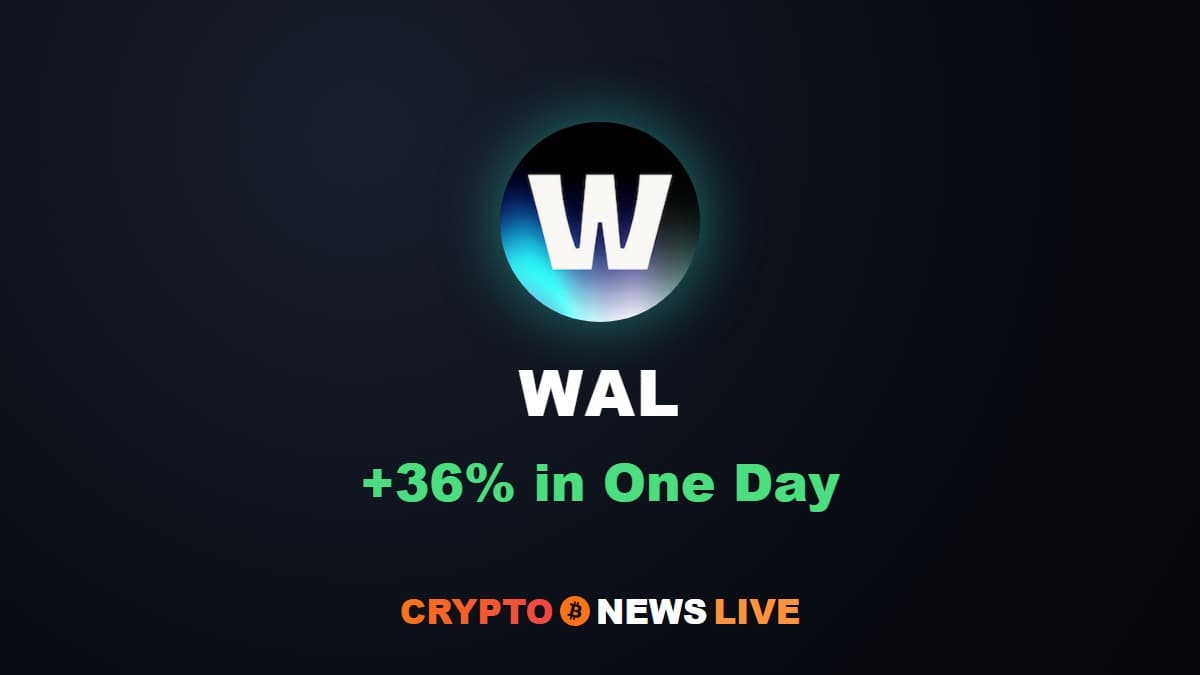
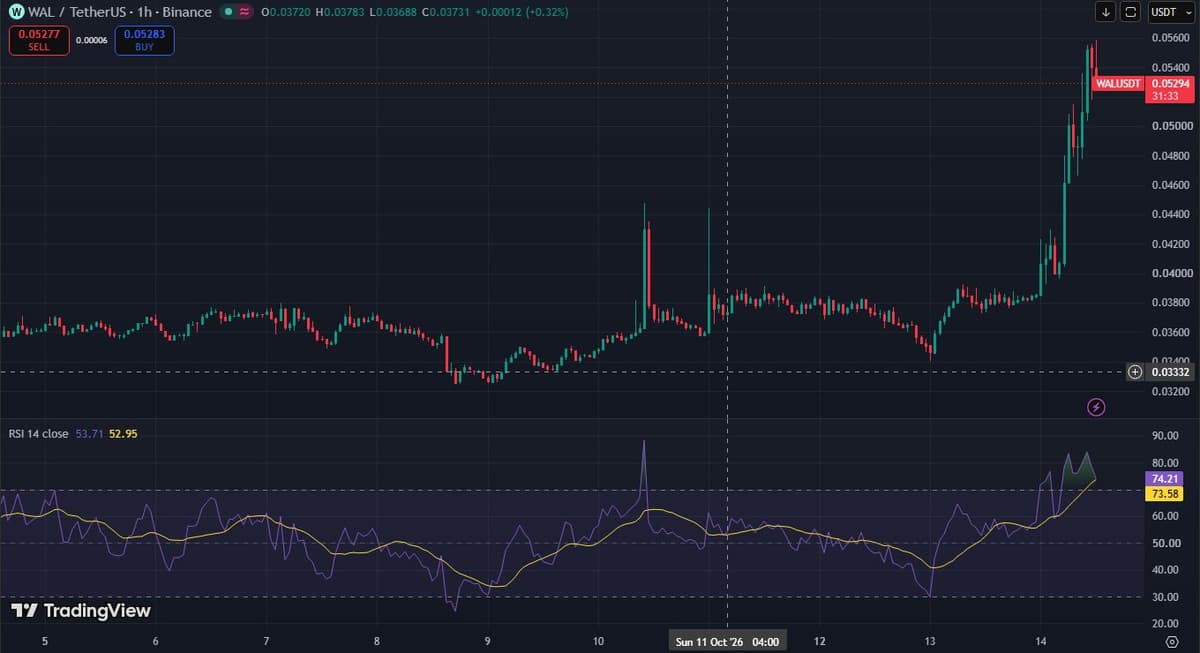
Wednesday, October 14 was different for the WAL price. At 00:00 UTC Binance’s WAL/USDT pair traded $820,000 in a single hour, against $70,000 the hour before. By 13:00 UTC the WAL price had printed a high of $0.05589 from an open of $0.03851, and Coinglass showed WAL up 36.13% over 24 hours at $0.052 as of about 13:45 UTC.
What the DATA Network Release Says Behind the WAL Price
DATA Network is the project formerly known as Story. The release says Sui Foundation is investing $30 million in it, which makes the foundation the network’s largest institutional holder. DATA Network will retire its own chain and run as a protocol on Sui, and $DATA carries over one to one.
Walrus gets one line of its own: it “becomes the default storage layer for applications operated by DATA Foundation.” The release adds that Trace, an onchain registry of rights-cleared AI training data with more than 250 million receipts, could use Walrus to keep an encrypted, immutable copy of contributed files.
No dates are given. The existing network keeps running until the upgrade is complete, and a timeline is promised before then.
The WAL Price Moved in Two Bursts on Wednesday
It began at 00:00 UTC. Binance’s public klines have that hour opening at $0.03851. It touched $0.04230 and closed at $0.04066. Upbit’s WAL/KRW pair, per its candle feed, traded 2.06 billion won in the same hour after 0.14 billion in the one before.
The WAL price faded. By 03:00 UTC the Binance hour had closed at $0.03999, below where the day had started its run.
The second burst was bigger. At 05:00 UTC the hour opened at $0.04072 and closed at $0.04614 on $2.32 million of turnover. The next hour closed at $0.05005 on $3.30 million, the busiest hour of the day so far. Upbit’s won pair did 6.11 billion in the 05:00 hour and 8.38 billion in the 06:00 hour, up from 0.62 billion at 04:00.
Both venues woke up in the same hours. Nothing we found from Walrus, DATA Foundation, Binance or Upbit is dated October 13 or 14 for WAL. Only the release is dated in that window, and it is 45 hours older than the first burst. Sui, the chain at the centre of the deal, was down about 1.5% on the day per its Binance daily candle on Wednesday afternoon UTC.
Futures Did Most of the Trading
That Coinglass page also showed $490.05 million of futures volume against $91.38 million in spot over 24 hours, about 5.4 times as much. Open interest across exchanges stood at $34.76 million, against a market cap of $134.55 million.
Binance’s own perpetual tells the same WAL price story in smaller numbers. Its hourly open interest history has the WAL contract at $2.91 million in notional value at 00:00 UTC and $11.21 million at 13:00 UTC. In coins that is 75.8 million WAL growing to 213.5 million.
Funding on the contract is paid every four hours, and the rate can go as low as -2%, per Binance’s funding info. In the funding history Wednesday opened at -0.0121%. Four hours on it was -0.1902%. The 08:00 print came in at -0.6321% and 12:00 at -0.7775%, which adds to -1.61% across four prints. Negative funding means short holders pay long holders. Our RLC and KAIA reports covered two earlier pumps where futures also did the heavy lifting.

WAL Price Levels After the Break Above the 20-Day High
Before this week the WAL price was a long way down. The daily candles on Binance put the top of this cycle at $0.1301 on Thursday, April 16 and the low at $0.0200 on Friday, August 14. It then built a slow base. Tuesday’s daily close was $0.03853. That sat over the 20-day average ($0.0357), the 50-day ($0.0307) and the 100-day ($0.0287), every one taken from closed Binance daily candles.
On the daily chart, RSI(14) read 59.7 at Tuesday’s close. TradingView’s live Wednesday reading was 75.4 at 13:42 UTC, measured on a candle that had not closed.
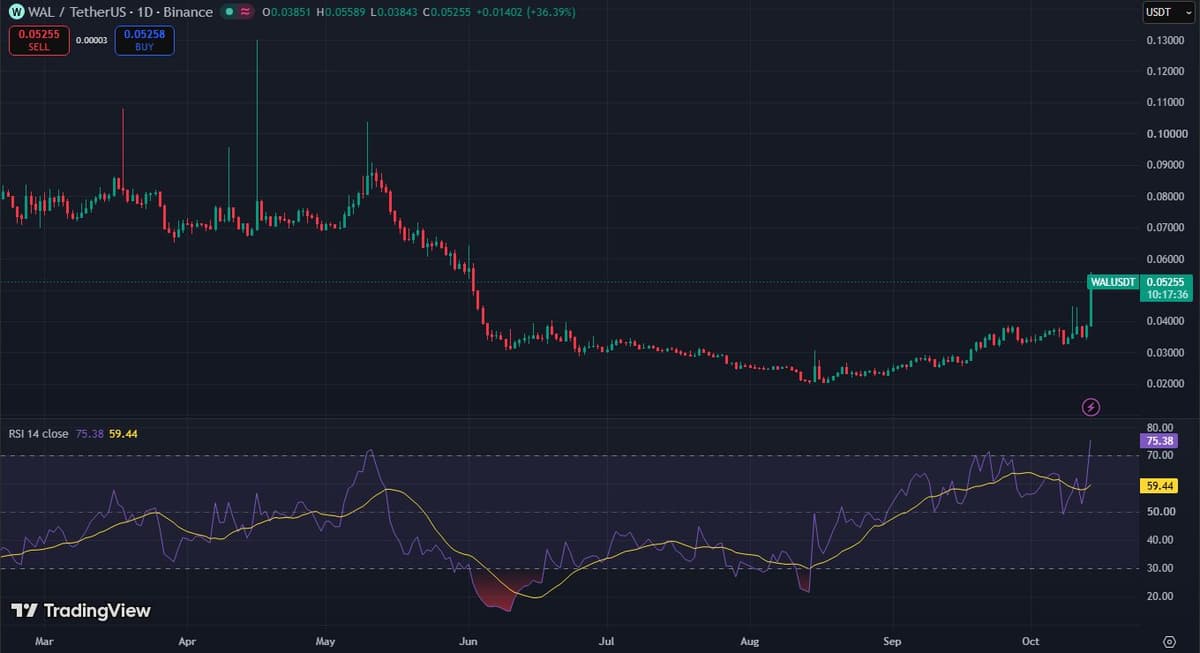
Regime: Bitcoin sits above its rising 100-day average, $82,913 against $73,476, and WAL is above its own 20-day high, a state our levels tool labels breakout.
Up case: a 1-hour close above $0.05499, the day’s high on Binance’s WAL perpetual as of 13:00 UTC, would be a new high for the month, and the tool finds no earlier price above it to point at. A 1-hour close back under $0.054715 cancels it.
Down case for the WAL price: a 1-hour close under $0.0434, the Monday, October 5 daily high, points to $0.03915 (Tuesday’s high) and then $0.03854 (the September 1 monthly high). A 1-hour close back over $0.043617 cancels that. At 13:00 UTC the WAL price sat 17.3% above the down trigger so the regime evidence sits with the up case until that gap closes.
The DATA Foundation says it will publish the upgrade timeline before the migration begins. Until a date appears, the move has only the October 12 release behind it, and it waited 45 hours to react.