Stacks’ STX token rose 21% in 24 hours to about 34 cents on Saturday, 31 October, the biggest gain among the top 100 coins by market value, according to CoinGecko. Bitcoin gained 1.2% over the same period.
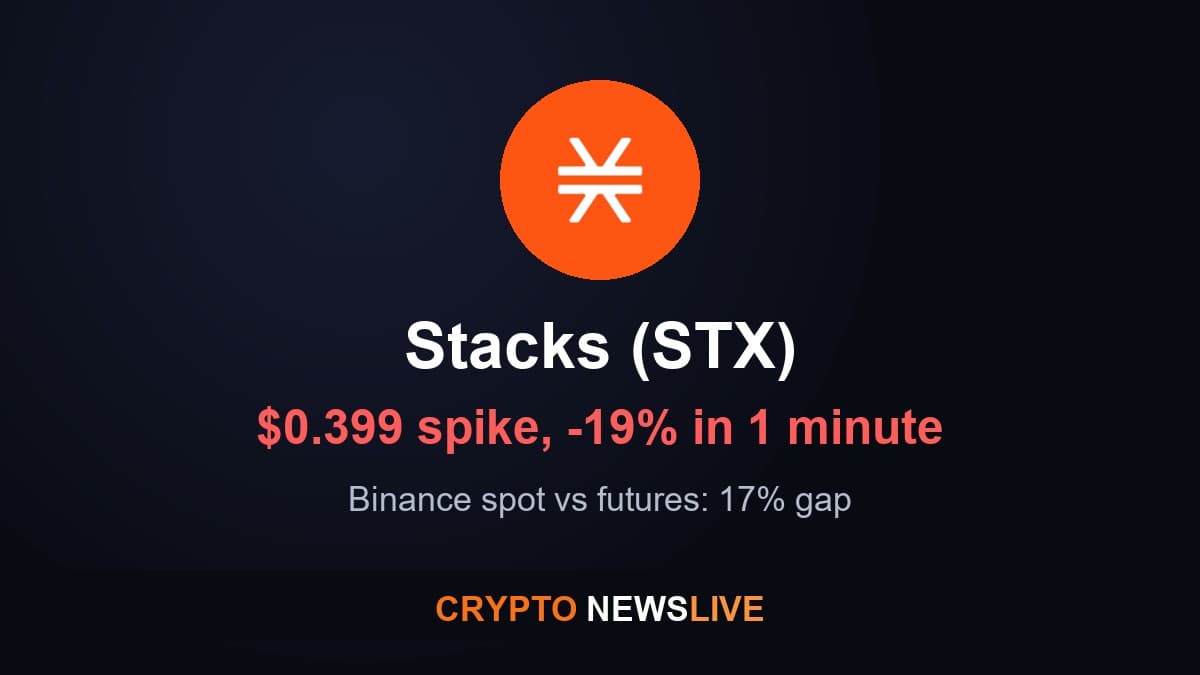
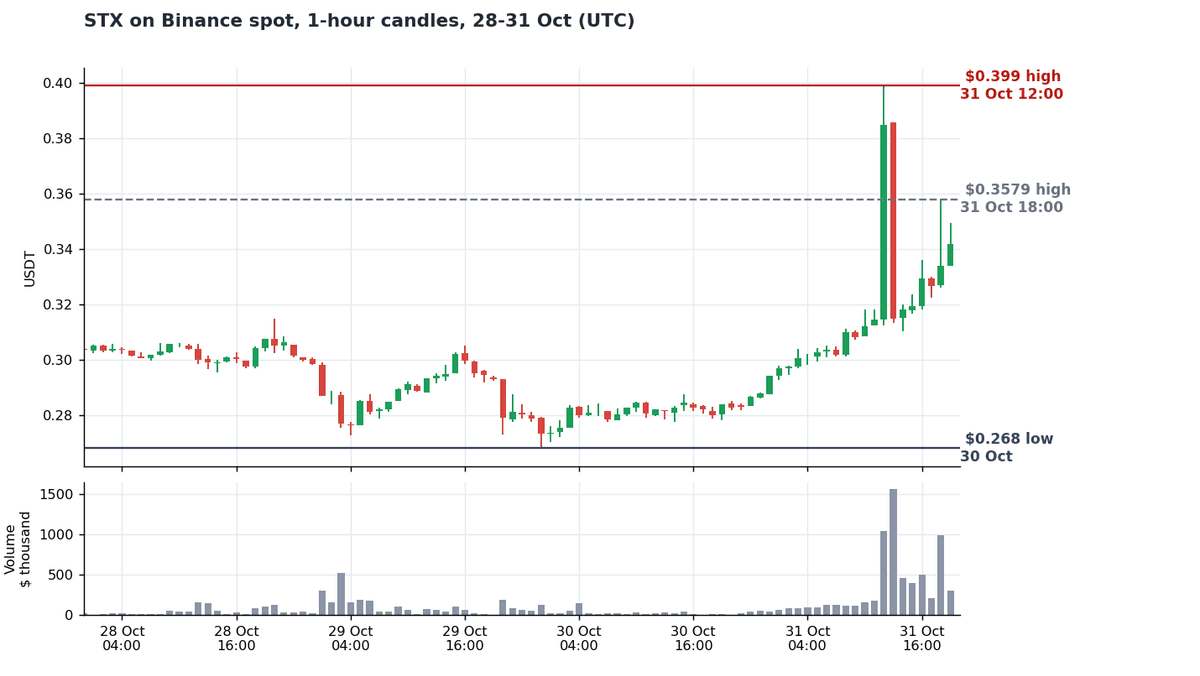
Much of the rise came in bursts, not a steady climb. The sharpest was on Binance’s spot market, where STX went from 32 cents at 12:30 UTC to a high of $0.399 at 12:50 UTC. At 13:00 UTC it dropped back to $0.3133 inside one minute, 19% below where that minute began. This STX spot spike unwound faster than it built.
A 40-cent print does not mean many buyers paid 40 cents. CoinGecko’s 24-hour high, which combines many exchanges, was $0.3558, well under what Binance’s spot market showed.
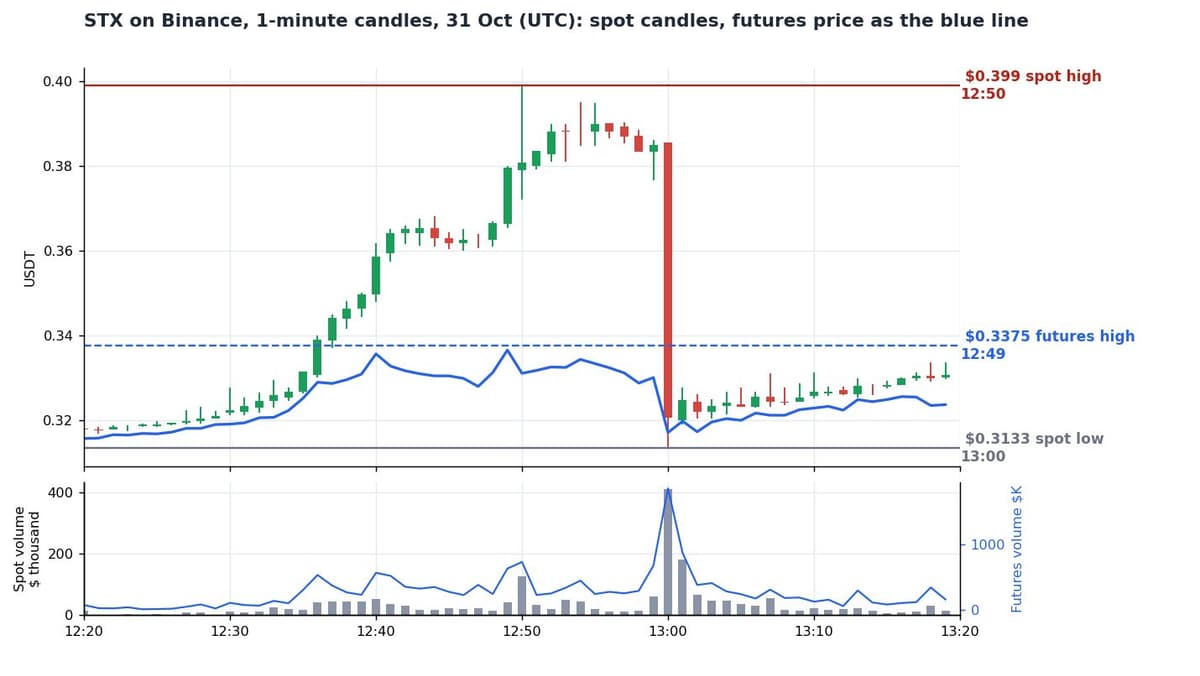
Binance futures never followed the STX spot spike
Binance also lists a STX futures contract, a product that tracks the same coin. The two prices normally sit within a fraction of a percent of each other, and at 12:20 UTC they were less than 1% apart. By 12:55 UTC the spot market closed the minute at $0.3899 while the futures closed at $0.3333, a gap of 17%. The futures price topped out at $0.3375 at 12:49.
The spot market was thin. Between 12:30 and 13:00 UTC about $946,000 traded on Binance spot, against $9.7 million on futures. The busiest spot minute, 12:50, saw $128,000 change hands. That is not much money behind the STX spot spike, a 24% jump in 20 minutes, and the minute of the reversal was the busiest of all, with $413,000 on spot and $1.8 million on futures.
Futures trading in STX has been heavier than spot all day. Binance’s 24-hour turnover was $47 million on futures, against $6 million on spot. The same imbalance showed up in BEAM’s rally on Binance earlier this week.
What Stacks posted on the day
Stacks has not linked the move to any announcement. Its X account had not posted on 31 October until 13:43 UTC, 43 minutes after the drop. That post and two at 14:27 UTC were about Bitcoin staking, and one of the 14:27 posts linked to the page for the next bond.
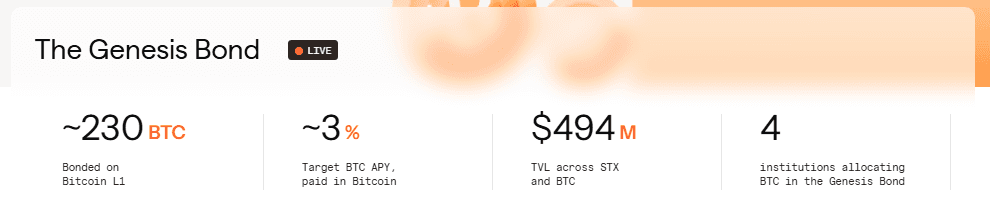
Stacks’ own institutional staking page lists its first bond, called the Genesis Bond, as live. It shows about 230 bitcoin bonded, a target yield of about 3% paid in bitcoin, $494 million of total value across STX and bitcoin, and four institutions taking part.
Another Binance token went through a sharper version of this swing this week. Our report on Quack AI covers a token that fell 85% from its high.
STX after the spike
STX closed Friday at $0.2878, after a low of $0.268 that day. It traded near $0.34 on Saturday evening after a second burst that reached $0.3579 at 18:00 UTC.
Futures pricing has turned cautious. Funding is a small fee that keeps a futures price close to the spot price, and on Binance it is settled every eight hours. It came in at -0.17% at 16:00 UTC, and the estimate for the next one is -0.27%. At a negative rate, the side holding bets on a fall is the one that pays. Open interest, the total value of futures positions not yet closed, was about $7 million.
After the STX spot spike, buyers who hold Friday’s $0.268 low give the rally a base, and $0.3579 and the $0.399 high are the two prices to clear. A drop back under $0.268 would erase the whole day’s gain and more. Stacks’ staking page is the place to check whether the bond figures change.