AAVE is down by 15% within one week, even though the loan value on Aave has only dropped by 1.6%, as per data from Binance and DefiLlama.
This gap will be analyzed using one of the borrowers, BTCS. This company is quoted at the Nasdaq stock exchange. From the quarterly report, BTCS showed that it owed $64.1 million to Aave on Nov. 9, 2026, with 46,676 ETH as the collateral under the Aave liquidation threshold. Loss sale of ETH is one of the ways of repaying the above loan according to the quarterly report.

How far the BTCS loan sits from the Aave liquidation threshold
Every loan at Aave will be assigned with the health factor or safety parameter. The health factor is the ratio between the amount of the collateral, discounted to the Aave liquidation threshold of 80 percent for ETH collateral as stated in the filing, and the amount of debt. If this ratio exceeds the level of 1.0, the loan will be regarded as healthy. Otherwise, the Aave platform will start selling off part of the collateral using smart contracts.
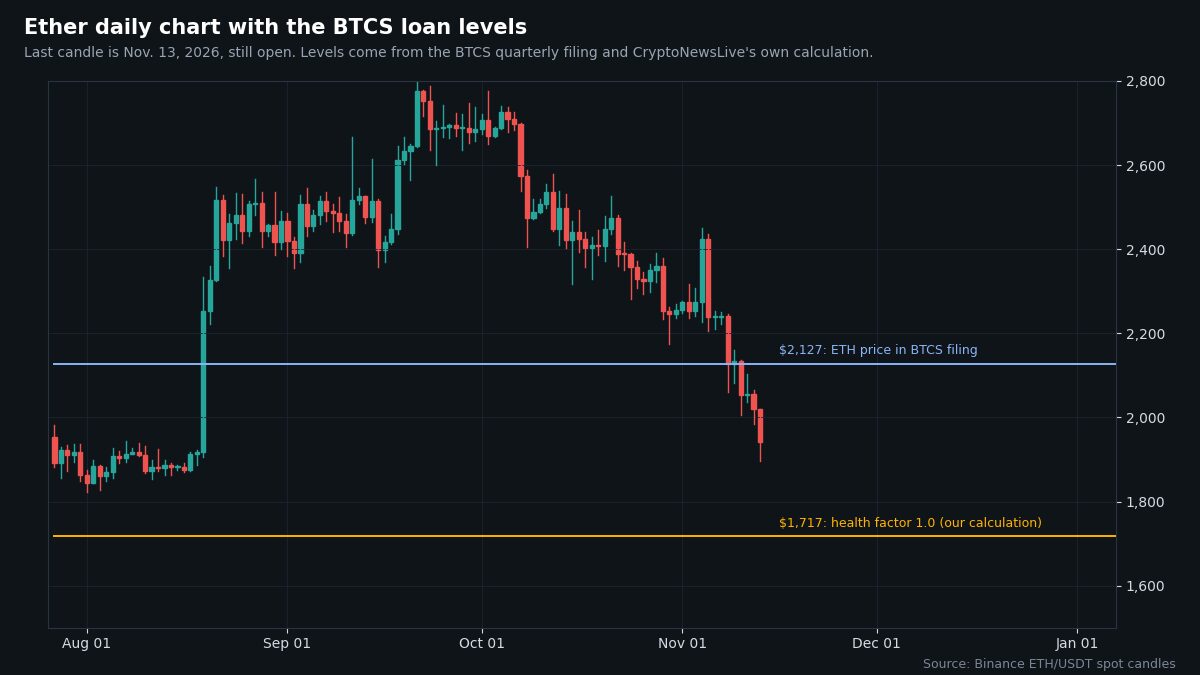
As seen from the values in the filing, 46,676 ETH with each one priced at $2,127 amounted to $99.3 million. When the product of that value is multiplied by 80% and the resulting figure is divided by $64.1 million, the health factor will be 1.24. Based on this calculation which is not revealed in BTCS’ report, the price of liquidation for the loan will be $1,717 for every ETH. On Nov. 13, ETH traded on Binance at $1,940, 11% above that price.
Without any change in the debt since November 9, the figure for the health factor would be about 1.13. Based on the information provided by the corporation, until November 11, the firm had not been liquidated; but it can decide to add collateral or reduce its borrowing since prices are declining.
AAVE has fallen faster than the lending behind it
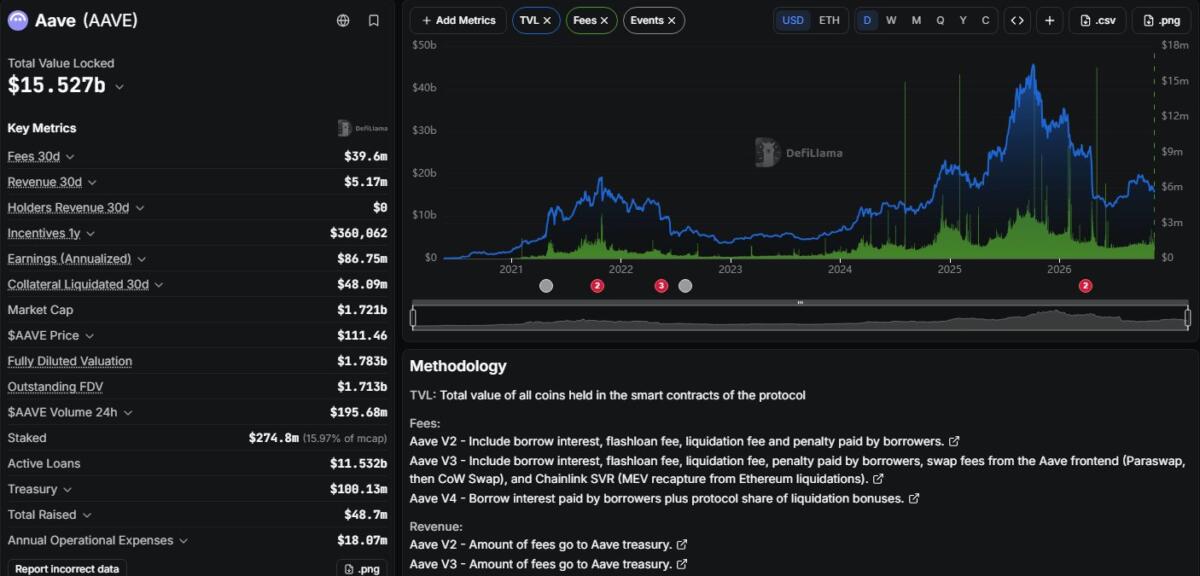
In addition, the total value that was locked on Aave on Nov. 6 was $16.20 billion while on Nov. 13 it was $15.53 billion, meaning that there was a drop of 4.2%. Based on DefiLlama, the number of active loans dropped from $11.72 billion to $11.53 billion. Furthermore, the market cap of the coin dropped by 13.5% from $1.99 billion to $1.72 billion on CoinGecko.
Little forced selling on Aave so far
Forced sales activity levels are low. According to DefiLlama, there has been liquidation of $48.09 million of collateral on Aave within the last 30 days, against $11.5 billion of loans.
Where AAVE stands against its 200-day average
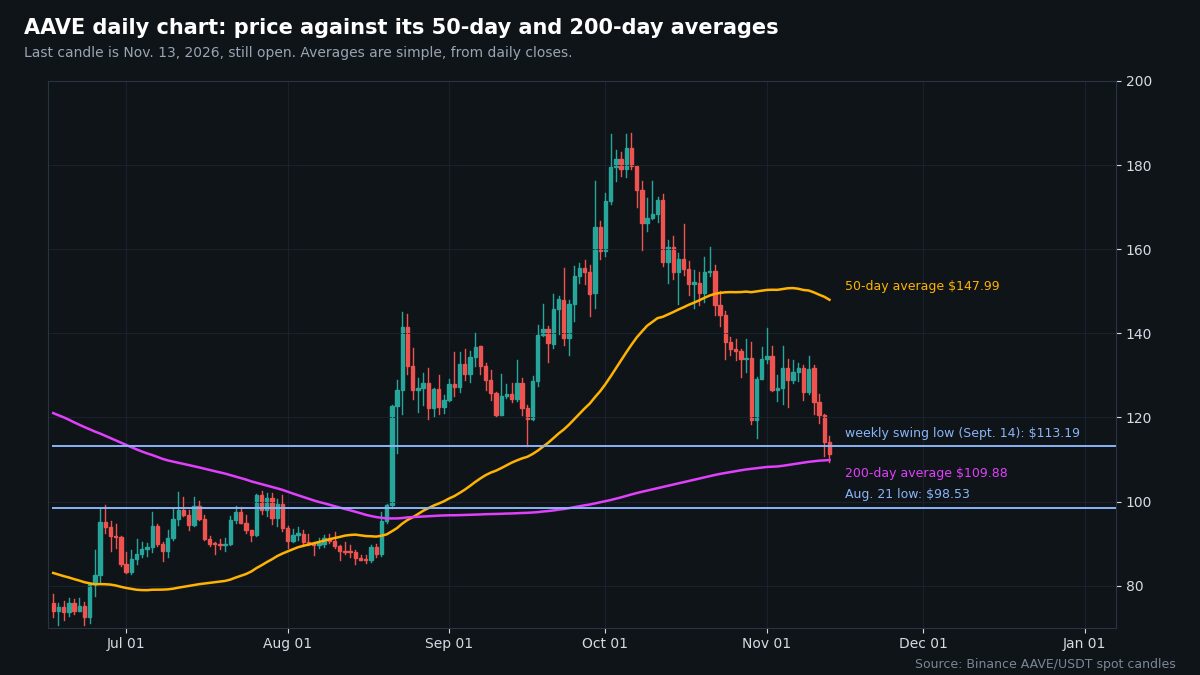
AAVE ended on November 12 at $114.07, which was its lowest closing price since August 20. On November 13, the price touched $109.33. The 200-day moving average is derived from the average of the 200-day closing price, resulting in an average of $109.88. This is the current price level that AAVE is testing.
The week of Nov. 9 also broke the $113.19 low from the week of Sept. 14, and that level now sits above the price. Below the 200-day average, the next marked low is $98.53 from Aug. 21. The 50-day moving average is much higher at $147.99.
What AAVE’s link to bitcoin and the filing leave open
AAVE is also riding along with Bitcoin. The correlation between the two over the past seven days is 0.71, and over 30 days is 0.64, based on Binance close. This is covered in our bitcoin under $70,000 report from Nov. 13.
Crypto is volatile, and there could be price swings both ways, causing losses for the holder. The filing only provides information about the debt and collateral position up until Nov. 9, and BTCS claims that they have since sold their ETH. How close the loan sits to the Aave liquidation threshold on Nov. 13 is an unknown variable.