
The SEC crypto custody proposal published October 1 would let registered investment advisers hold clients’ crypto assets themselves, but only after a long list of conditions. It would also let advisers and regulated funds use state trust companies as custodians.
This is a proposal, not a rule. The Commission’s own release says the public comment period runs 60 days after the proposing release is published in the Federal Register.
What The SEC Crypto Custody Proposal Changes
The Securities and Exchange Commission (SEC) proposed amendments under the Investment Advisers Act of 1940 and the Investment Company Act of 1940. They cover registered investment advisers and regulated funds, meaning registered investment companies and business development companies.
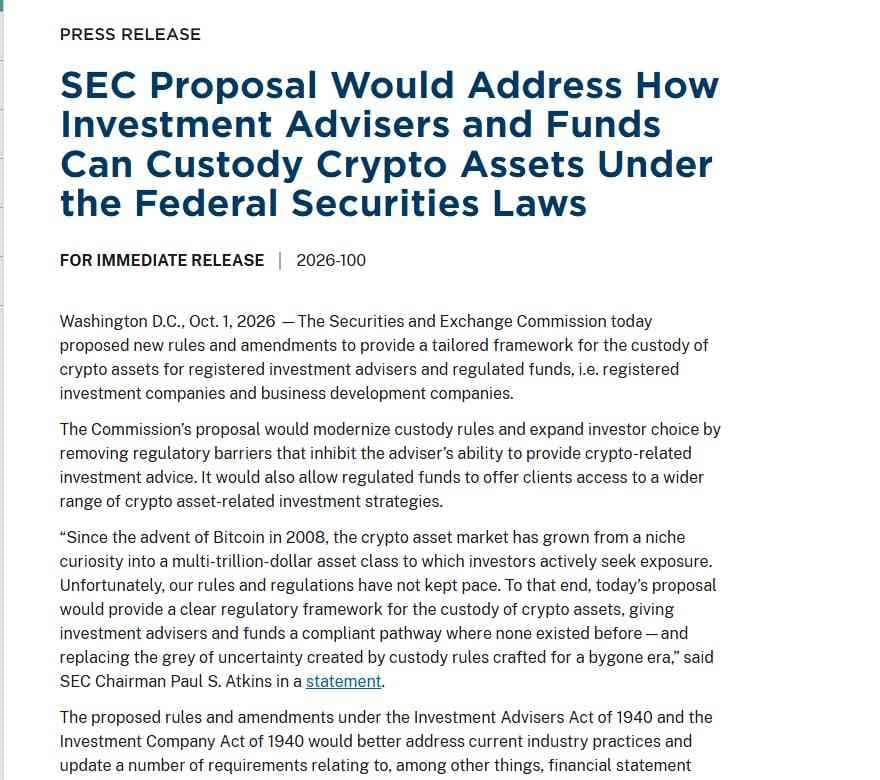
The problem, in the SEC’s own fact sheet, is availability. A permitted custodian “may not be readily available” for some crypto assets, and custodians that do offer crypto services have not been able to support every asset, especially new ones.
The proposal’s two main answers are adviser self-custody and state trust company custody. It also updates older custody rules that cover non-crypto assets.
The Conditions For Adviser Self-Custody
An adviser could hold a client’s crypto only if it first decides that no permitted custodian is available. It must repeat that finding every quarter.
The fact sheet then lists the safeguards. The adviser must document its expertise in safeguarding each crypto asset and review its systems at least annually. Those systems must cover private key management and require joint authorization of any crypto transaction by at least two people.
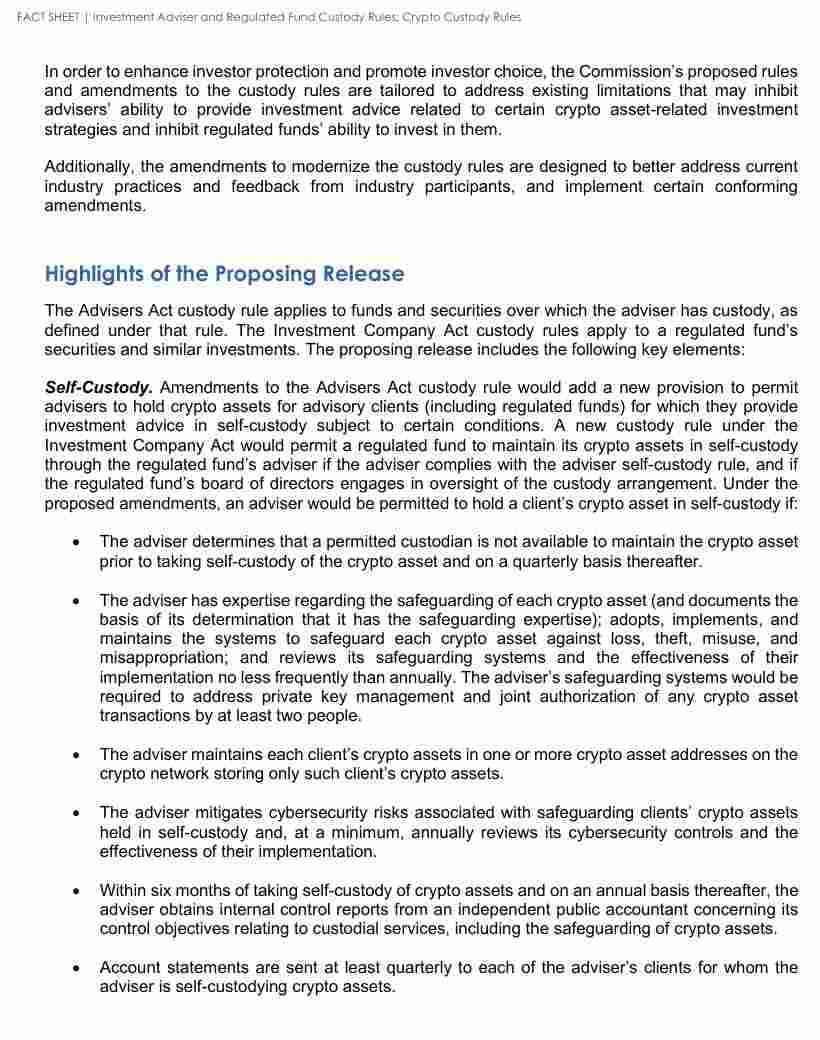
Client assets would have to sit in addresses holding only that client’s assets. Within six months of taking custody, and yearly after, the adviser must obtain an internal control report from an independent public accountant. Clients must get account statements at least quarterly.
The adviser and client would also agree in writing to treat each crypto asset as a “financial asset,” which brings extra protection under state law. For a regulated fund, the board must review the adviser’s no-custodian finding each quarter and decide yearly that the asset gets reasonable care.
The State Trust Company Route
The second path is simpler. Advisers and funds could use a state trust company, if they first form a reasonable belief, after due inquiry, that it is authorized by its state banking authority to provide crypto custody.
They must also review the trust company’s latest audited financial statements and internal control report. All client and fund crypto must be kept apart from the trust company’s own assets.
Records kept on a crypto network could count toward recordkeeping requirements, subject to conditions. Form ADV and Form N-CEN would also change to collect more on crypto custody and tokenized fund shares.
Peirce Wants A Different Name
Commissioner Hester Peirce welcomed the proposal and objected to one word. In her statement she wrote that the proposal’s “self-custody” is not true self-custody, because it describes advisers acting as custodians for clients. She said she would have preferred “shelf-custody.”
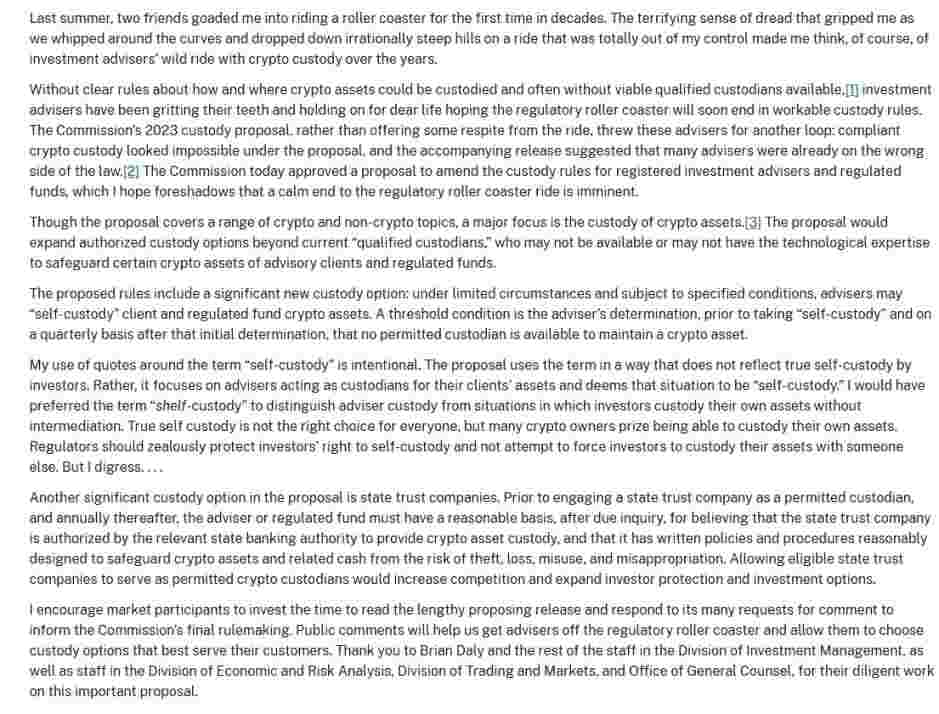
She also said the Commission’s 2023 custody proposal made compliant crypto custody “look impossible” and suggested many advisers were already breaking the rules. Her hope is that today’s text ends that.
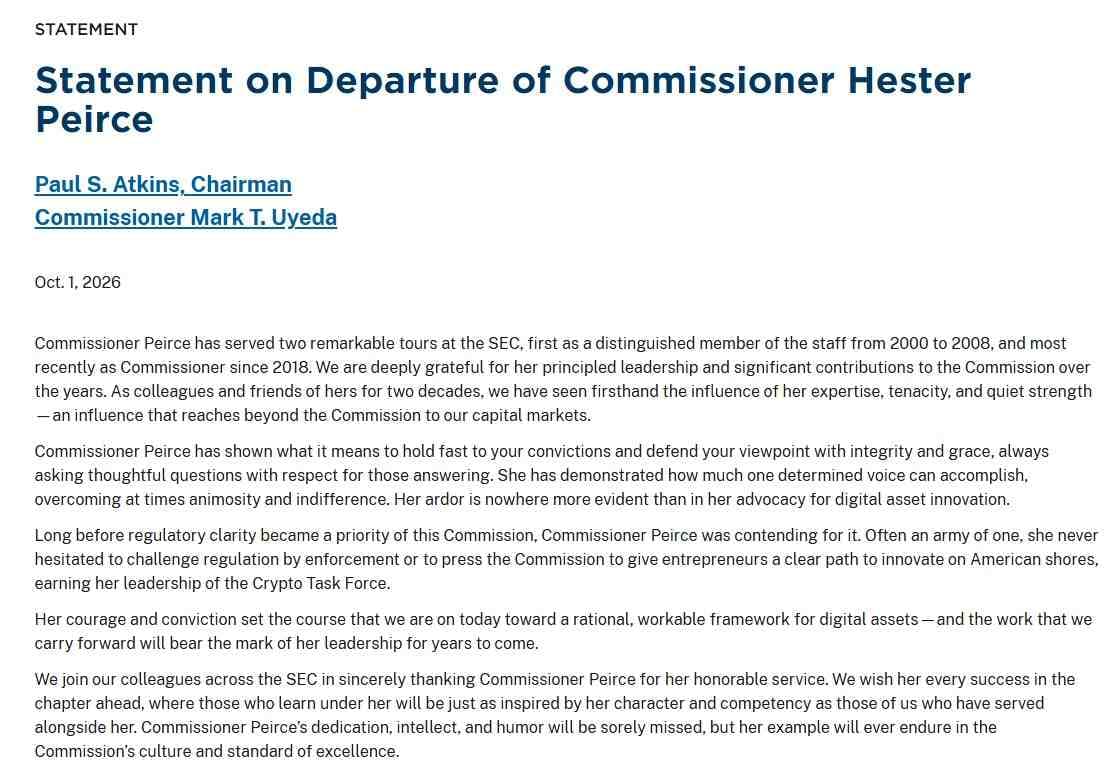
The same day, SEC Chairman Paul Atkins and Commissioner Mark Uyeda issued a joint statement on Peirce’s departure from the Commission. She has been a commissioner since 2018 and led its Crypto Task Force.
Where The Proposal Sits In The SEC’s Crypto Sequence
Atkins’ statement places the SEC crypto custody proposal inside a longer list. He cited a December 2025 no-action letter to the Depository Trust Company on tokenization, a January 2026 staff statement on tokenized securities, and an interpretation on which crypto assets are securities.
The list continues with an April staff statement on broker-dealer registration for tokenized-securities interfaces, August’s proposed Regulation Crypto Assets, and a recent Innovation Exemption for trading tokenized NMS stock. He added that “more regulatory proposals are on the horizon.”
What Happens Next
Peirce’s statement notes the rules would reach only crypto assets that are funds or securities. Crypto that is neither would sit outside them.
Nothing changes for advisers yet. The Commission must finish the 60-day comment period, review the responses and vote on a final rule.
Peirce asked market participants to read the proposing release and answer its requests for comment. Those answers will shape the final SEC crypto custody text.