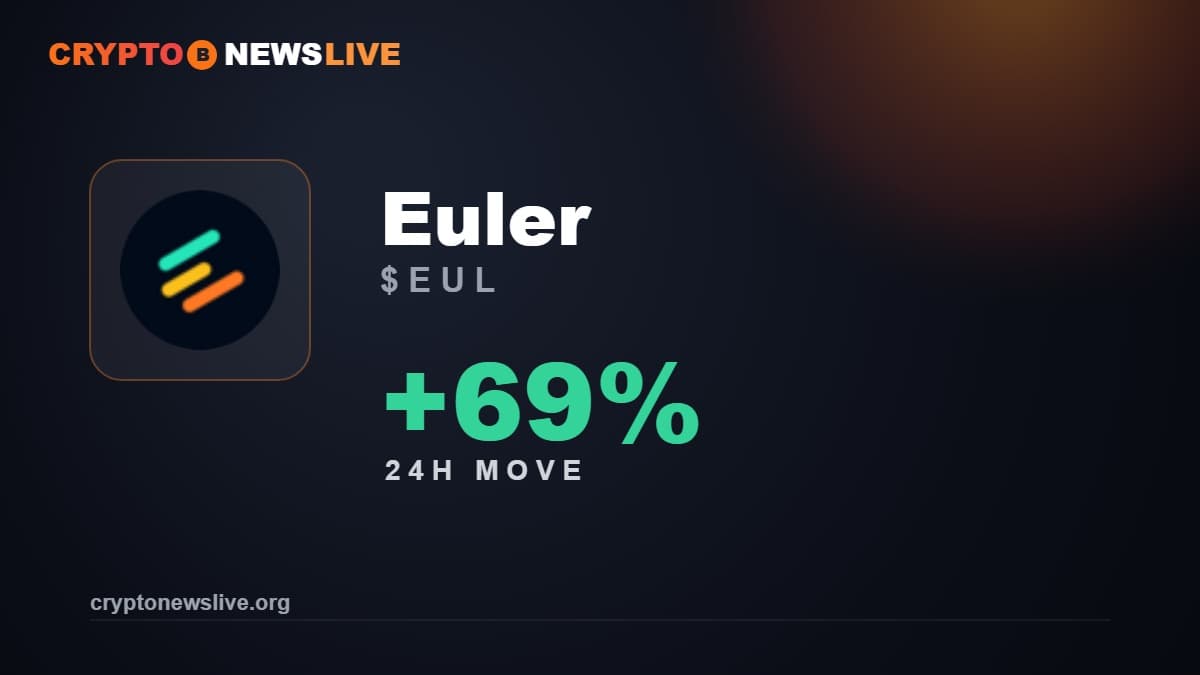
Euler ripped from about $1.40 to $2.69 in a matter of hours today. Most of that move happened before Upbit’s own market for the token had even opened.
A Listing Delayed by Two Hours, a Squeeze That Didn’t Wait
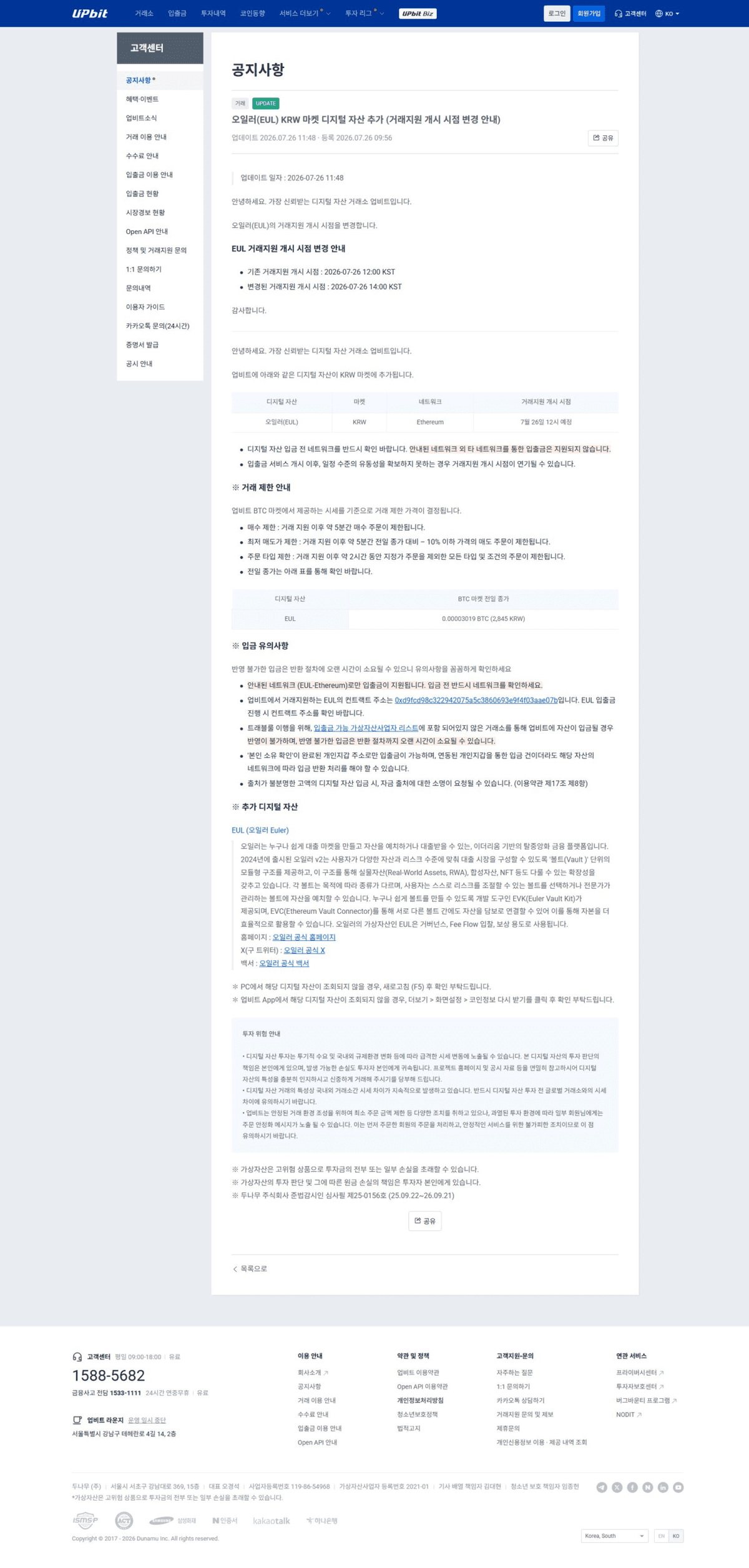
Upbit posted a notice on its own service center board at 09:56 KST on July 26 announcing EUL would join its KRW market. The exchange initially set a 12:00 KST start time, then quietly pushed it back. An update at 11:48 KST moved trading support to 14:00 KST instead, the kind of delay Upbit says happens when a market hasn’t confirmed enough liquidity yet. Upbit’s own notice lists the network as Ethereum and names the exact contract, 0xd9fcd98c322942075a5c3860693e9f4f03aae07b, which matches the verified EUL token contract on Etherscan.
Here’s the odd part. By the time that 14:00 KST clock actually struck, EUL had already done most of its climbing on Binance, Bybit and Bithumb.
CoinGecko’s own market feed shows the “Euler Listed on Upbit KRW Market” item logged around six hours before this check, and a separate “Significant Price Surge” flag about five hours before it, both ahead of Upbit’s delayed opening bell. Bithumb, a separate Korean exchange, already runs a live EUL/KRW pair carrying 17.3 percent of reported 24-hour volume, 47.4 million dollars worth. Binance alone accounts for close to 40 percent between its USDT and TRY pairs. Global traders bought the announcement. Upbit’s own order book was still catching up.
Shorts Paid For the Overshoot
Something else was loaded on this token going into today, and it wasn’t just spot buyers. Futures turnover hit $939.88 million in 24 hours against just 89.45 million dollars of spot volume on Coinglass, better than a 10-to-1 tilt toward leverage. Open interest jumped anywhere from 260% to over 2,160% across Binance, Bybit, Gate, and Bitget inside the same window.
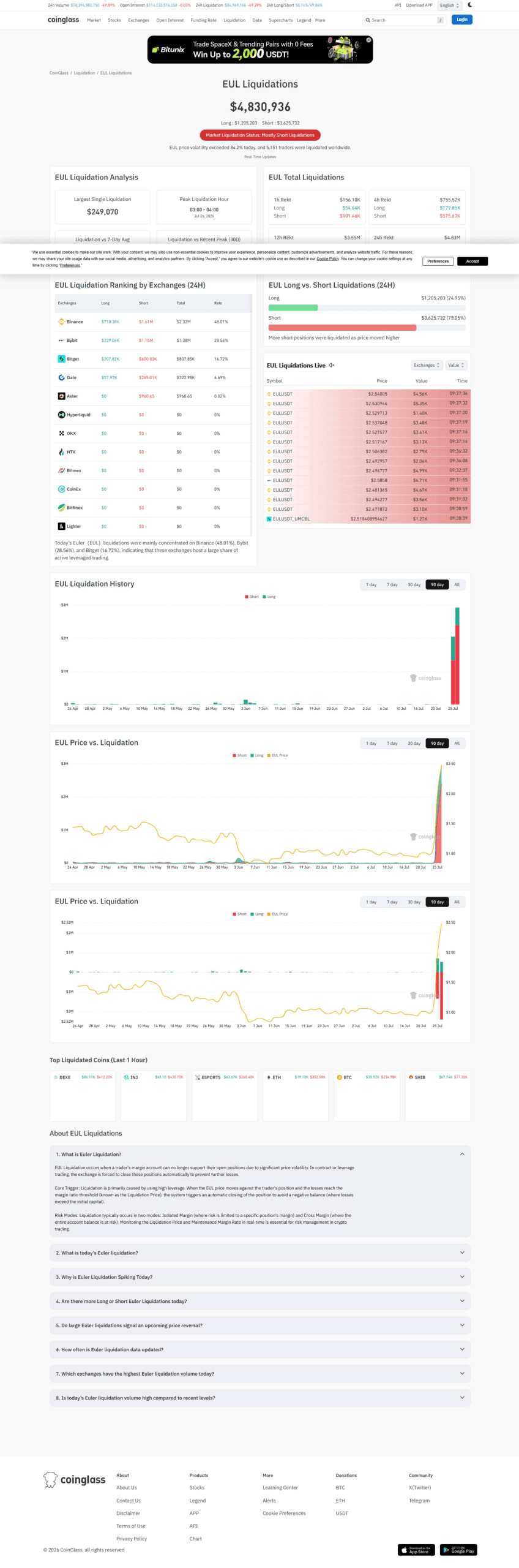
Then came the unwind. Coinglass logged $4.83 million in EUL liquidations over 24 hours, and three dollars out of every four came from short positions, not longs: 3.63 million short, 1.21 million long. Coinglass’s own dashboard labels the day “Mostly Short Liquidations.” 5,156 traders got caught worldwide. The single largest liquidation ran 249,070 dollars. Peak carnage landed between 03:00 and 04:00 UTC, a window that sits neatly between Upbit’s original notice and its delayed KRW launch, meaning the squeeze fired on the announcement itself, not on any liquidity Upbit had actually supplied yet.
Rewind three months and Upbit added Morpho to its own KRW market too, on July 25, one day earlier. Two DeFi lending governance tokens, same exchange, back to back. Korean retail appetite for lending-protocol names looks warmed up, not cold.
The Protocol Underneath Is Bigger Than the Ticker
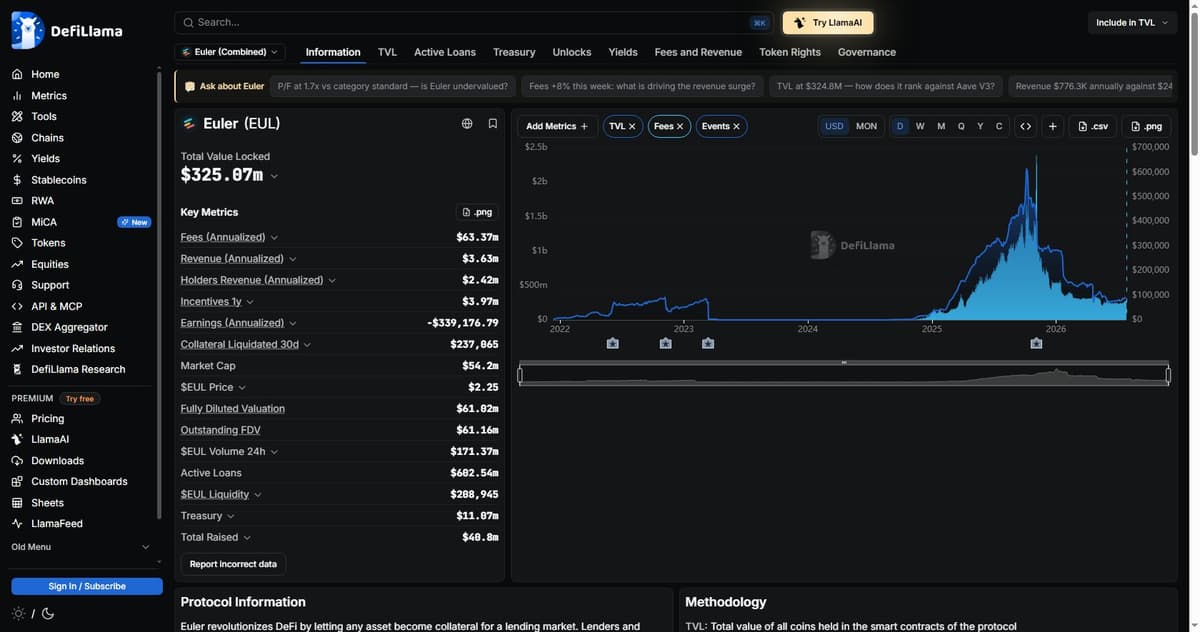
Strip away the listing noise and Euler’s balance sheet tells an odd story on its own. DeFiLlama puts total value locked at 325.07 million dollars against a token market cap sitting somewhere near $68.5M depending on the exact minute you check. Active loans through the protocol run $602.54M. Annualized fees land at 63.37 million dollars, revenue at 3.63M. That’s a protocol securing something like four to six times its own token’s market value, a gap that rarely shows up this wide on names CryptoNewsLive has covered before.
Circulating supply sits at 24.15 million EUL against a hard max of 27.18 million, near 89 percent already in float. That’s a thinner overhang than most tokens in this dump-heavy news cycle carry. No cliff, no scheduled unlock event tied to today.
One more thing worth putting on the record. Euler V1 lost $197M to a flashloan donate-function exploit back on March 13, 2023. DeFiLlama’s own hacks database shows 240 million dollars returned afterward, more than what was taken. Old history. Not today’s trigger. Still the first thing a lot of longtime DeFi users will think of when this ticker shows up trending again.
What Cuts Both Ways
If Upbit’s KRW liquidity keeps arriving through the rest of today and Korean retail follows the same script it ran on Morpho a day earlier, EUL has room before it even approaches resistance, because price still sits 83.9 percent under its July 2025 all-time high of $15.81. That’s a lot of chart between here and there.
If the squeeze was doing most of the lifting, though, the mechanical part of this move is close to finished. Short interest that gets liquidated stops being short interest. One-hour price action had already turned negative, down 1.4 percent, at the time of this check, the kind of early wobble that shows up when forced buying runs out before organic demand shows up to replace it.
Holder concentration adds a little texture to that risk. Etherscan’s own breakdown shows the top 100 wallets controlling 93.44 percent of supply, with 67 wallets tagged as “whale” holding 89.71 percent between them, a Gini score of 0.9884. Typical for a small-float governance token. Still worth knowing before chasing a green candle.
$EUL traded at $2.54 at the time of this check, up 69.3 percent on the day and 165.3 percent across seven, against a 24-hour range of $1.36 to $2.69. Whatever happens next probably gets decided by whether Upbit’s actual order book, now finally open, keeps pulling in the volume the announcement already promised.