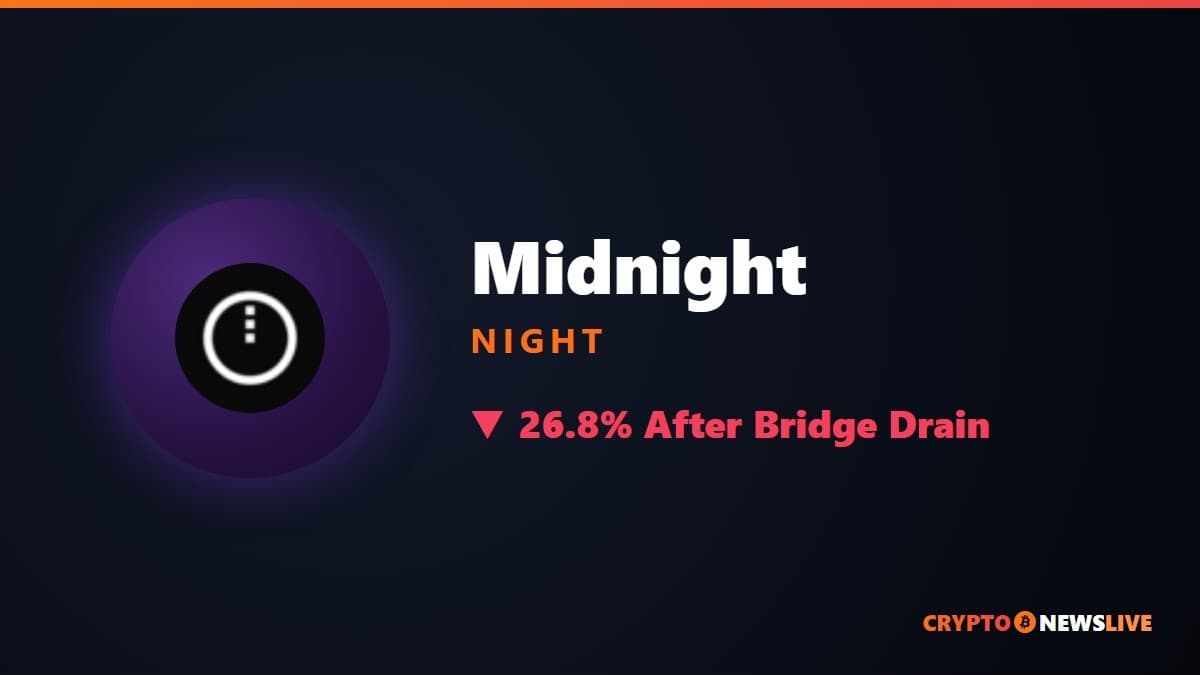
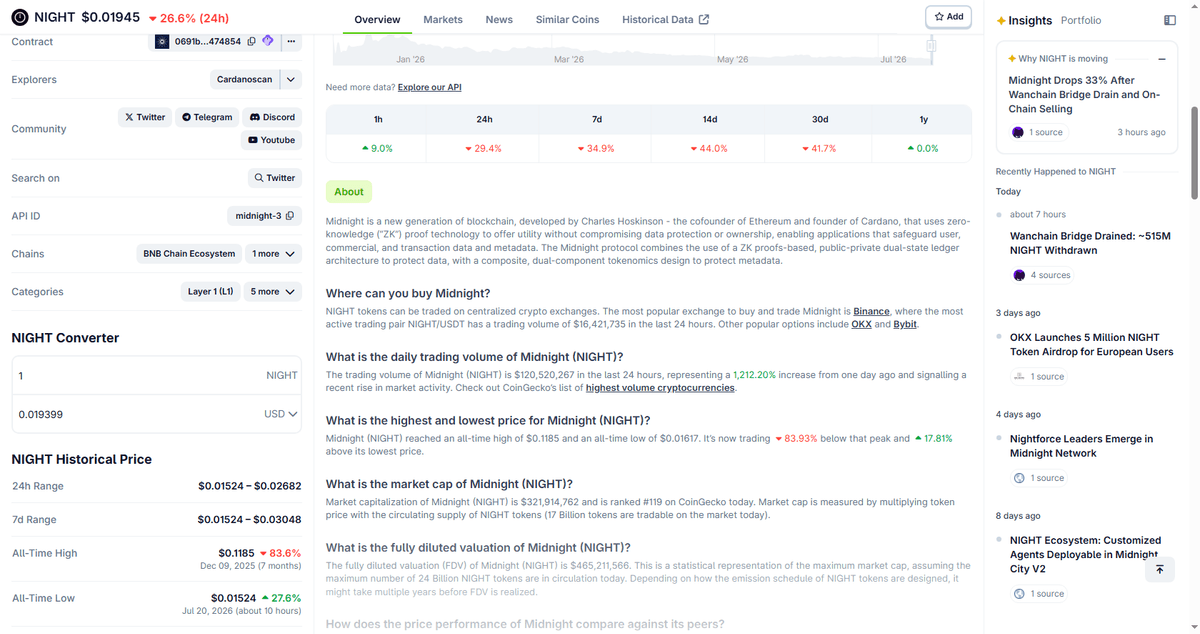
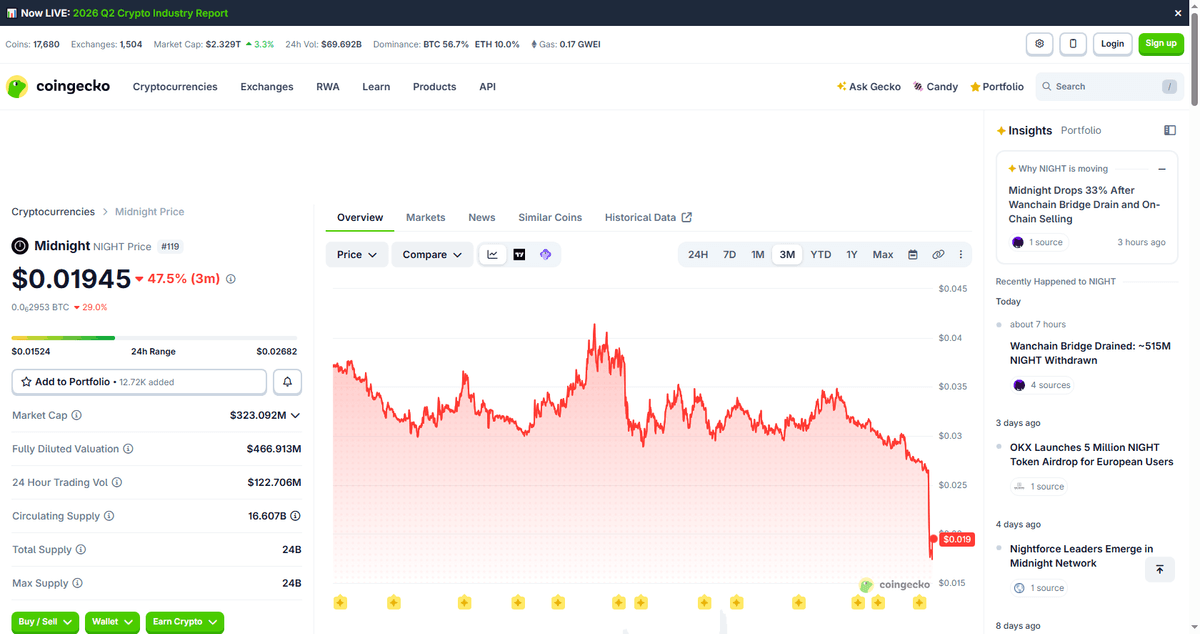
NIGHT is down 26.8% today, and the reason has nothing to do with Midnight’s own blockchain. It traces back eight minutes on a bridge contract most holders had never heard of.
Charles Hoskinson’s privacy-focused chain Midnight watched its native token crash from an intraday high of $0.02689 to a fresh all-time low near $0.01524, according to CoinGecko. The token last traded around $0.0194, down from roughly $0.0265 a day earlier. Seven-day losses sit at 33.5 percent, and daily trading volume jumped more than 800% to about 120 million dollars.
Blockchain security firm BlockSec first flagged the trigger through its Phalcon monitoring account. Wanchain’s Cardano-to-BNB Chain bridge, a contract funded back in December, released 515.206 million NIGHT tokens in four separate transfers. All four landed in the same wallet between 14:46 and 14:55 UTC on July 20. Eight minutes, roughly ten million dollars at the time, vanished off the bridge treasury.
What Actually Broke
BlockSec’s technical team, posting as Phalcon, pinned the root cause to something specific rather than a vague “exploit.” Their initial read: a non-injective signed-message encoding inside the bridge’s TreasuryCheck validator. The signed message gets built by concatenating fourteen variable-length fields with no delimiters between them, which means different sets of field values can produce the identical byte string, the identical hash, and therefore a reusable valid signature. In plain terms, the bridge’s own verification check could be fooled into treating a forged withdrawal as if it were a previously approved one.
A Wallet That Never Slowed Down
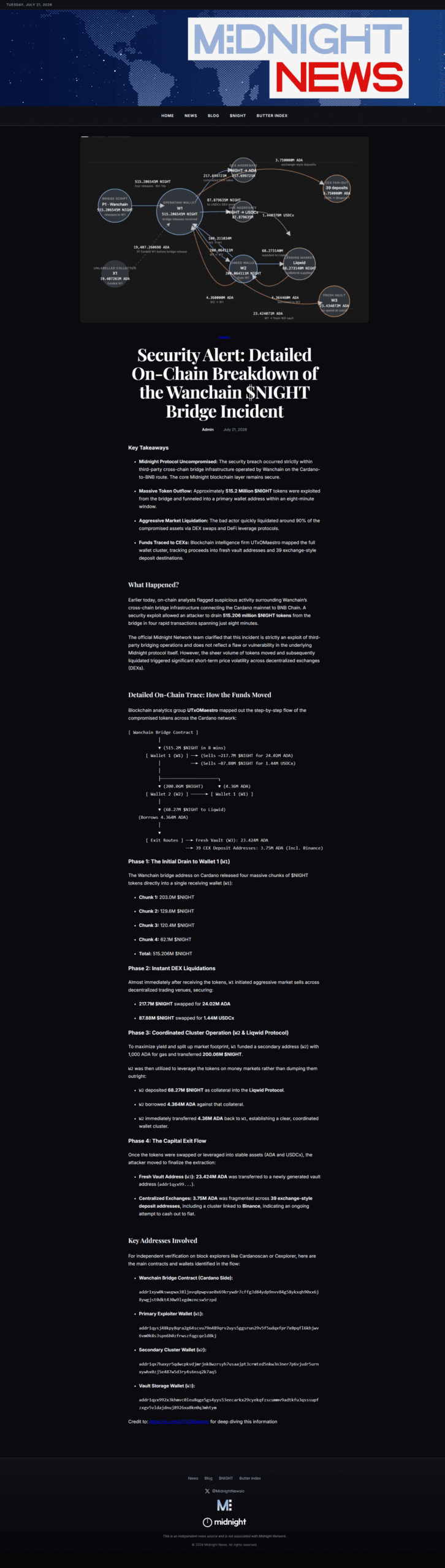
On-chain investigator UTxOMaestro mapped what happened next, and Midnight News (an independent fan outlet, unaffiliated with the network itself) republished the trace with wallet addresses attached. The receiving wallet, labeled W1, started selling almost immediately. Roughly 217.7 million NIGHT went out for 24.02 million ADA. Another 87.88 million NIGHT covered 1.44 million USDCx. Call it 300 million tokens converted before the wallet even paused.
It didn’t stop there.
W1 sent 200.06 million NIGHT to a second wallet, funded with 1,000 ADA for gas. That second wallet, W2, chose a different route. Instead of dumping everything, it deposited 68.27 million NIGHT into the Liqwid lending protocol as collateral and borrowed 4.364 million ADA against it, sending the proceeds straight back to W1. Same funding pattern, same timing, same eventual cash destination, a textbook two-wallet cluster according to the trace.
Cardanoscan Shows It Still Selling
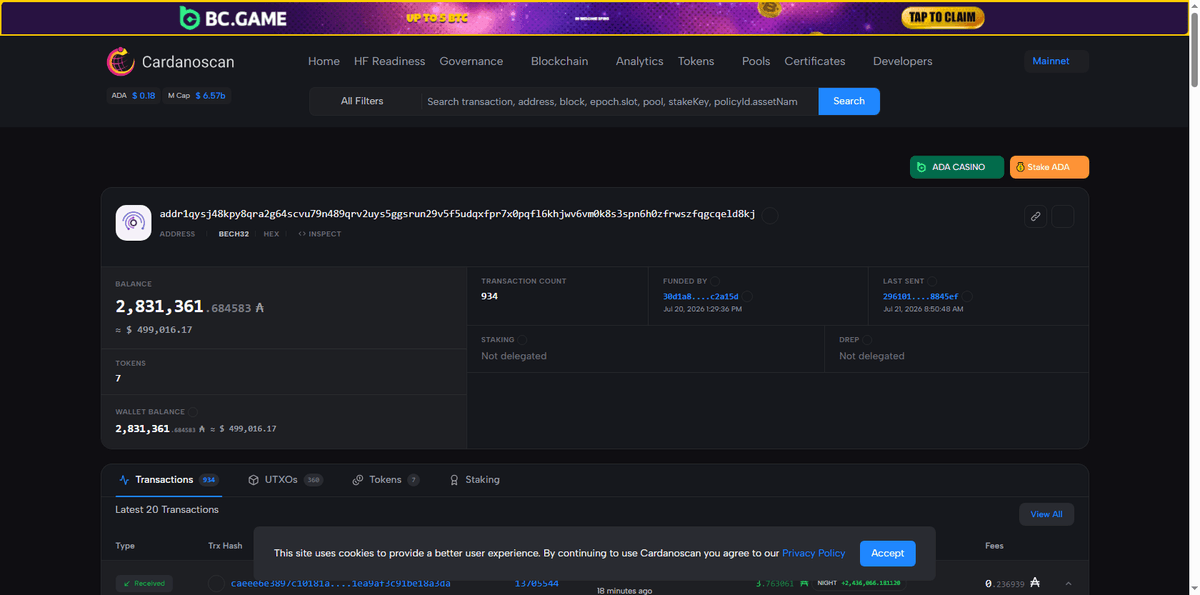
CryptoNewsLive checked wallet W1 directly on Cardanoscan rather than taking the secondhand trace at face value. The address held roughly 499,000 dollars spread across seven tokens and 934 transactions, and its funding record lines up with the July 20 timestamp investigators cited. More telling: the transaction log showed fresh NIGHT hitting a Minswap V2 order contract roughly every 90 seconds, as recently as eighteen minutes before this reporting.
Not finished. Not paused. Still going.
Some proceeds moved further still. The trace shows 23.424 million ADA routed to a fresh vault wallet, plus 3.75 million ADA fragmented across 39 exchange-style deposit addresses, several tied to Binance. Many small deposits instead of one large one is a pattern that usually points toward avoiding compliance triggers on the way to cashing out.
Wanchain Pulled Its Own Bridge
In a security notice posted on X, Wanchain confirmed the withdrawal and took its bridge offline. “We are aware of an incident affecting the Cardano to BNB Chain bridge, resulting in the withdrawal of NIGHT tokens from the bridge contract on Cardano,” the team wrote. “The Wanchain Bridge is currently unavailable to users.” No timeline for a fix or reimbursement plan was given.
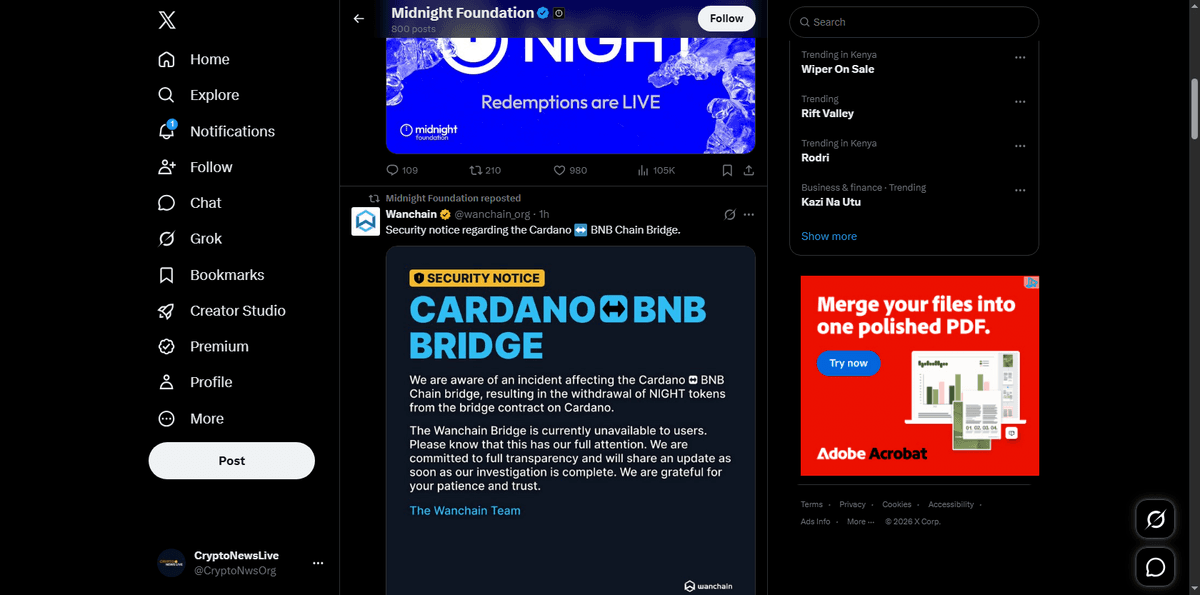
No word yet on reimbursement.
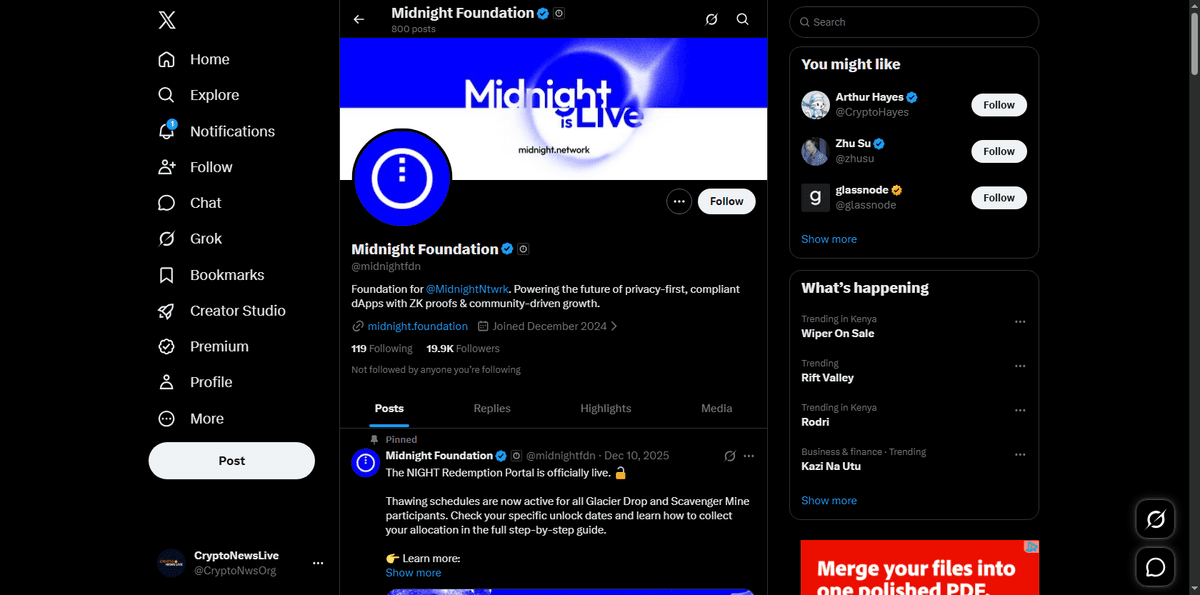
The Midnight Foundation moved fast too, and for good reason. “The incident is isolated to the Wanchain Cardano to BNB bridge and does not involve Midnight Network itself,” the foundation posted roughly six hours after the drain, adding that its protocol, validator network, consensus, and core infrastructure remain unaffected, per its own account.
Thin Pools Made It Worse
Liquidity tells its own story. NIGHT’s biggest Cardano pools, on SundaeSwap and WingRiders, hold nowhere near enough depth to absorb a coordinated 300 million token sale cleanly. The largest, a NIGHT/USDM pair, carries roughly $353,000 in liquidity, per DexScreener data pulled the same day. A ten-million-dollar attack landing on a market that thin explains why the price move looked so violent relative to the dollar amount stolen.
Not every signal points one direction, though. Buy and sell counts on those same secondary pools actually skewed toward buyers during the crash (423 buys against 259 sells on the top SundaeSwap pair), a sign some traders treated the drop as a chance to accumulate rather than a reason to flee. NIGHT still carries heavy exchange support too: Binance, Bybit, OKX, Kraken, HTX and several others handle the bulk of its volume, so the DEX-side selling had to work through arbitrage to drag those order books down rather than hitting them directly.
The Unsold Pile Is the Real Question
W2’s 68.27 million NIGHT still sits parked as Liqwid collateral, unsold as of this writing. If that position gets liquidated, or the wallet decides to cash out the rest, more selling pressure follows almost mechanically, since a comparable chunk of the original haul already proved the market cannot absorb it quietly. If it stays parked, and W1’s live trickle slows the way it has over the past hour, the worst of the overhang may already be behind NIGHT.
Midnight launched less than eight months ago, built around zero-knowledge tooling meant to shield transaction data on Cardano. None of that tech failed today. What failed was a signature check on a bridge holding hundreds of millions of dollars in someone else’s tokens, and how little liquidity was waiting on the other side when that check gave way.