Paul Atkins used the word blockchain in an SEC press release again this week. That is worth noticing on its own, since the agency he chairs is now rewriting rules that predate the internet.
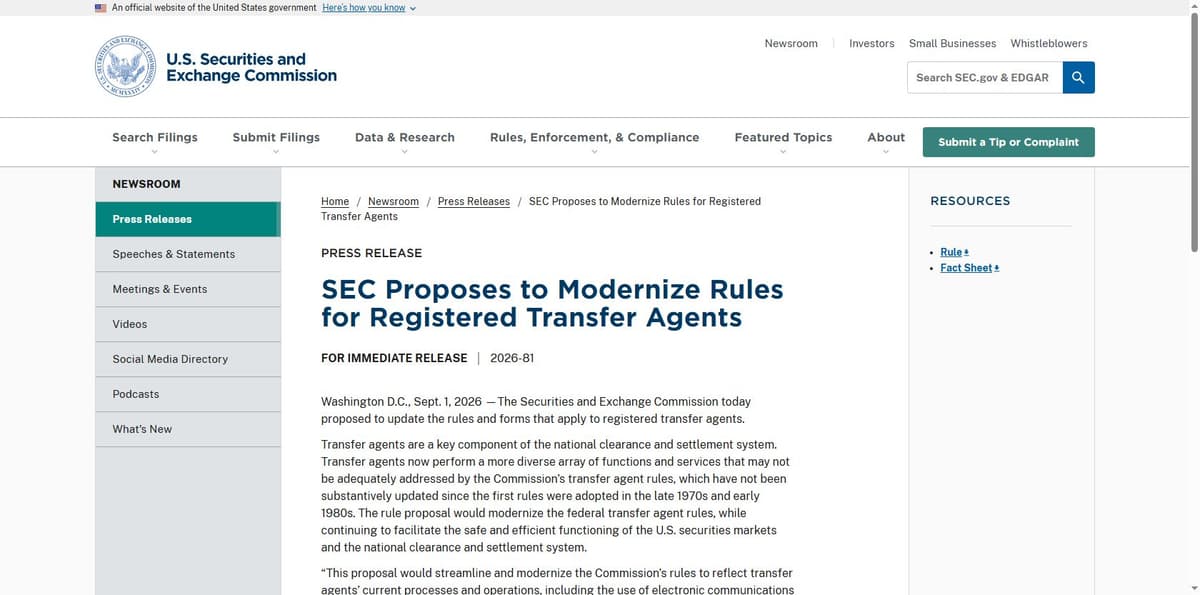
On Sept. 1, the Securities and Exchange Commission proposed the first real overhaul of its transfer agent rules since the late 1970s and early 1980s. Nobody outside a compliance department usually cares about transfer agent rules. This time, the reasoning behind them is the actual story.
Fifty-Year-Old Rules Meet A New Ledger
Transfer agents keep the official record of who owns what security. They process the issuance, cancellation, and transfer of both paper and electronic shares, sitting quietly underneath every stock trade that settles in the U.S. market.
The Commission adopted most of the current rulebook decades before a blockchain existed anywhere outside a research paper. That gap is exactly what got called out this week.
Atkins put the reasoning plainly in the release: the rewrite reflects transfer agents’ current processes and operations, “including the use of electronic communications and blockchain technology in connection with securities offerings and the transfer of shares.” That is a sitting SEC chairman naming blockchain as a reason a federal rule needs rewriting, not a hypothetical from an industry panel.
Jamie Selway, who runs the SEC’s Division of Trading and Markets, framed it as part of a wider pattern under Atkins. Good government, he said, “requires revisiting legacy rules and regulations” as technology and the competitive marketplace evolve.
What Actually Changes, Rule By Rule
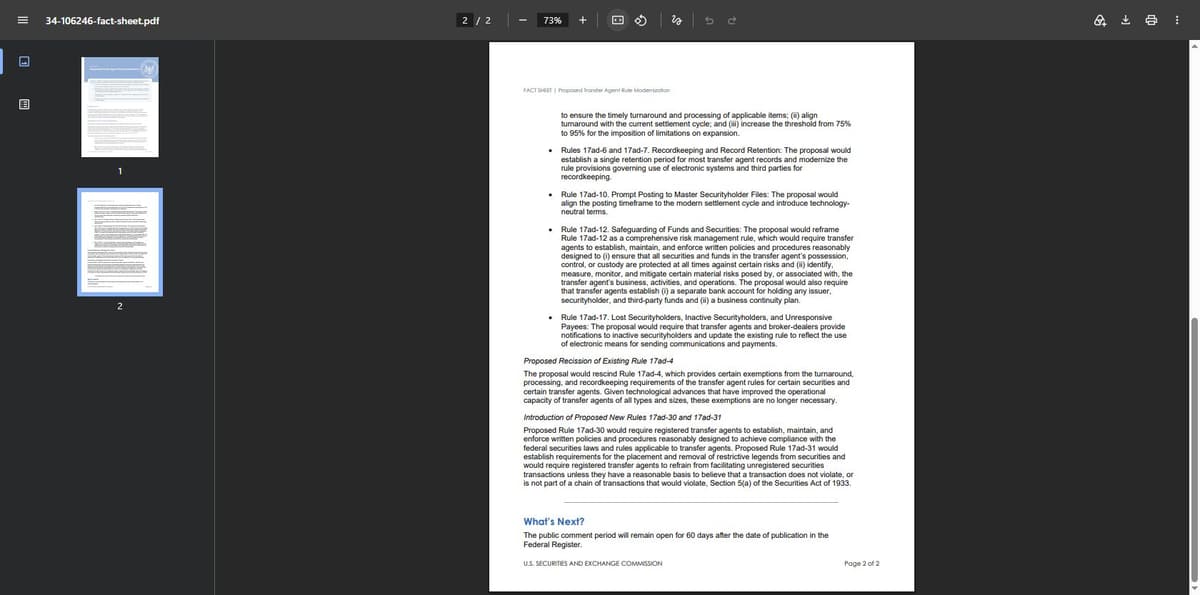
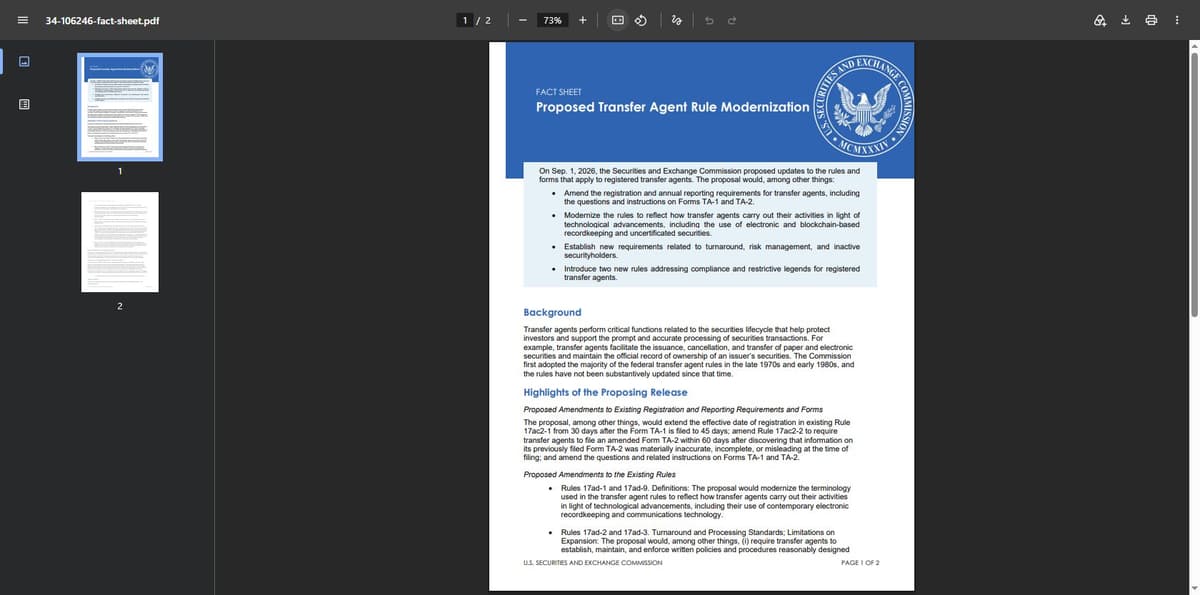
This isn’t a vague blockchain gesture bolted onto a press release. The SEC’s own fact sheet lays out specific numbered rules that transfer agents live under every day, and most of them move.
Rules 17ad-1 and 17ad-9 get their definitions modernized to reflect what the agency calls contemporary electronic recordkeeping and communications technology. Rule 17ad-12, the safeguarding rule, gets reframed entirely into a risk management requirement, forcing transfer agents to keep a separate bank account for client funds and maintain a real business continuity plan.
Two brand new rules show up as well. Proposed Rule 17ad-30 would make transfer agents build written compliance policies from scratch. Proposed Rule 17ad-31 goes further still, requiring a reasonable basis to believe a transaction doesn’t violate securities registration requirements before an agent helps move it, plus new standards for restrictive legends on securities, the exact kind of legend that currently makes tokenized shares awkward to move between wallets.
Rule 17ad-4, an older exemption rule, gets scrapped outright. The stated reasoning is blunt: technology has improved operational capacity across transfer agents “of all types and sizes,” so the old carve-outs don’t hold up anymore.
Industry Was Already Asking For This
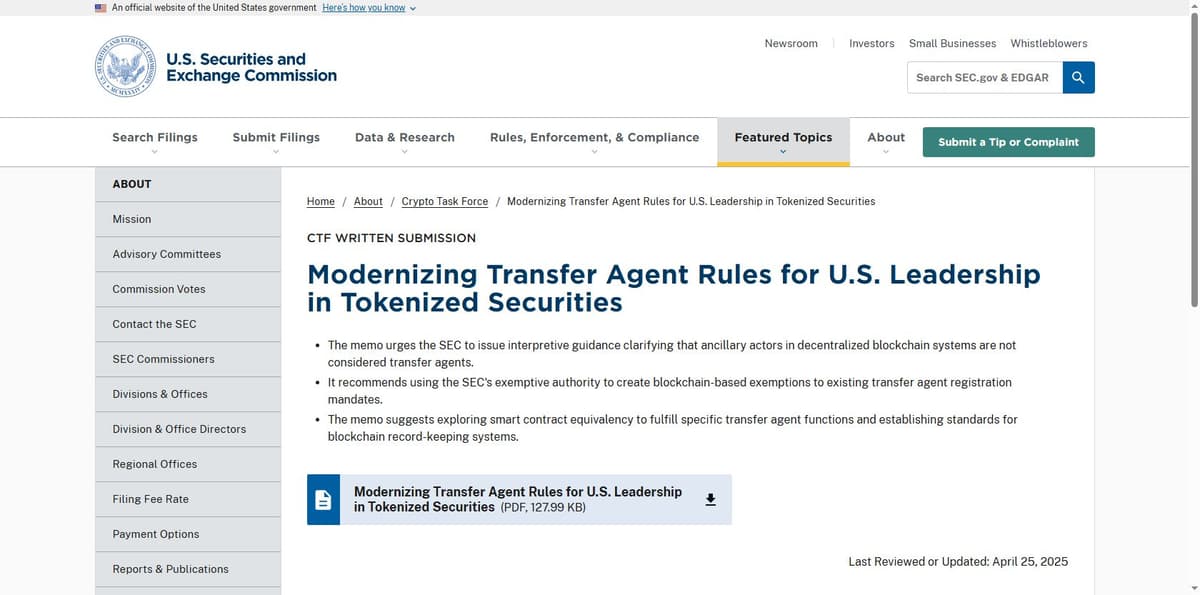
This didn’t come out of nowhere. Over a year before Atkins signed off on the proposal, the SEC’s own Crypto Task Force already had a memo sitting in its files titled “Modernizing Transfer Agent Rules for U.S. Leadership in Tokenized Securities.”
That April 2025 submission urged the Commission to clarify that ancillary actors in decentralized blockchain systems shouldn’t automatically count as transfer agents, and pushed for smart-contract equivalency standards for the recordkeeping function itself. A good chunk of that framing survives, almost intact, in this week’s proposal.
Sixteen months from ask to proposed rule is fast by SEC standards, honestly.
One Company Already Lives This Rule
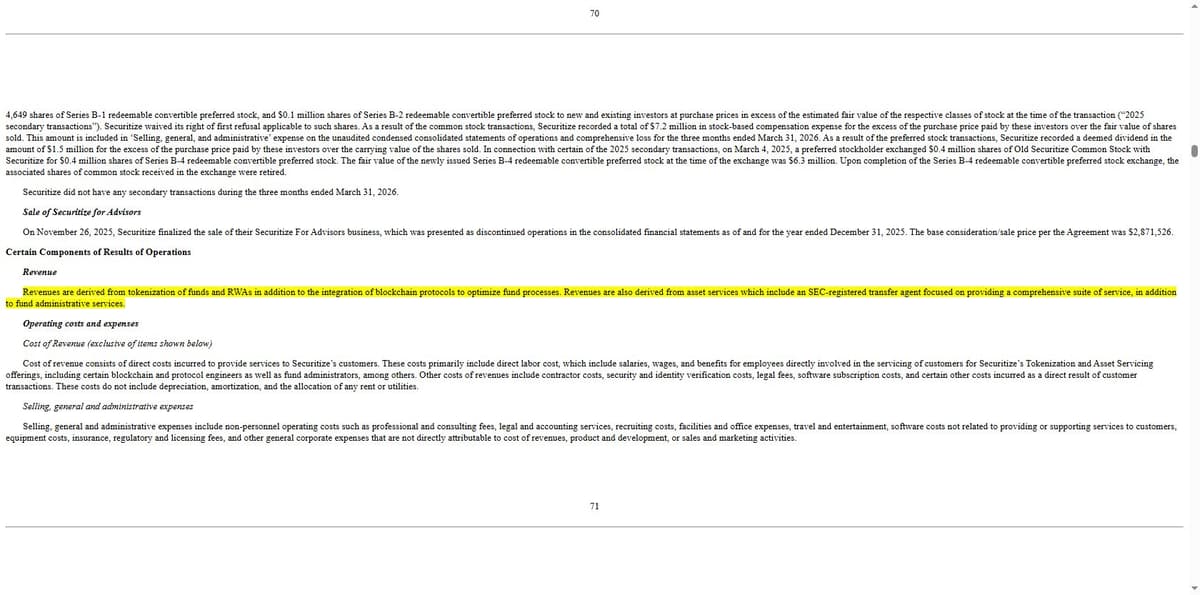
What a rewritten transfer agent rule actually means in practice is easiest to see through a company that already straddles both worlds. Securitize is registered with the SEC as a broker-dealer, an investment adviser, and, through its Securitize Transfer Agent LLC entity, an actual registered transfer agent.
Its own S-1 filing with the SEC states the company’s revenue comes “from tokenization of funds and RWAs in addition to the integration of blockchain protocols to optimize fund processes,” sitting right alongside its transfer agent business in the same paragraph. That’s the exact overlap this proposal is trying to write real rules around, not something regulators are theorizing about from a distance.
The Market The Rule Is Catching Up To
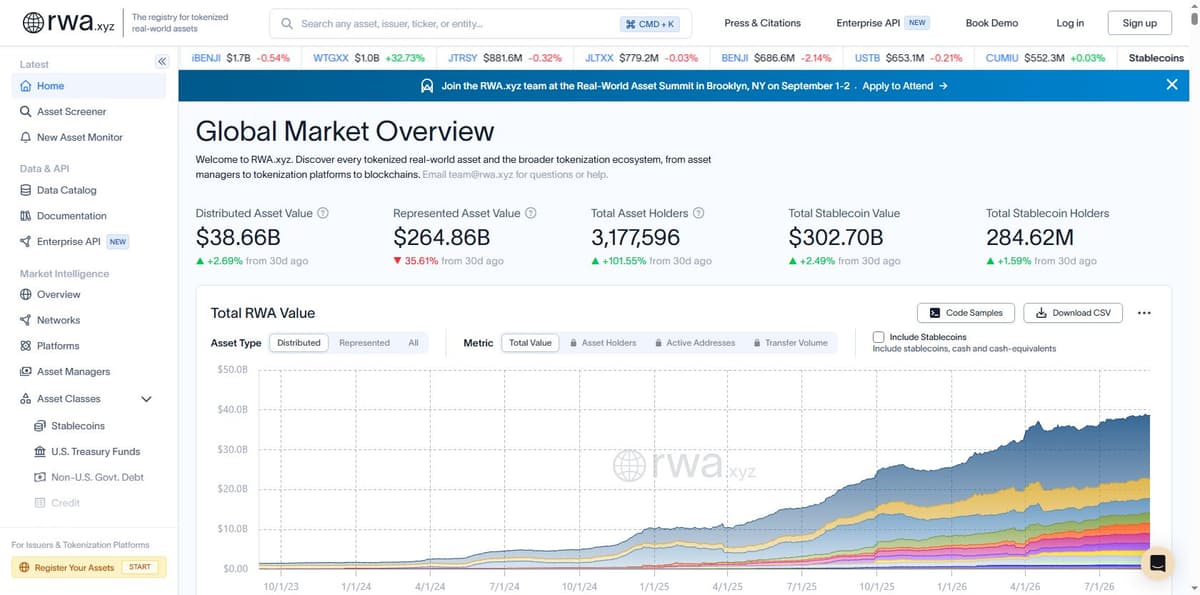
Real-world asset tokenization stopped being a fringe experiment a while back. RWA.xyz’s own tracker puts the value of tokenized real-world assets distributed on public blockchains at $38.66 billion this week, with the broader represented asset value the platform tracks at $264.86 billion. Both numbers were close to zero three years earlier on the same chart.
That growth happened mostly inside a legal gray zone, with issuers leaning on interpretive guidance and no-action relief instead of rules actually written for the job. A transfer agent rulebook that assumes blockchain exists changes that calculus for every issuer weighing whether to tokenize shares next.
Sixty Days, Then A Fight Over Details
The rule is a proposal, not a finished one. Comments stay open for 60 days after Federal Register publication, and transfer agent rulemakings tend to draw detailed pushback from an industry that already knows exactly which line items cost real money to implement.
The turnaround threshold change alone, moving the limitations-on-expansion trigger from 75% to 95%, will matter more to a mid-size stock plan administrator than any blockchain language ever will. But the blockchain language is what got a sitting SEC chairman’s name attached to a fifty-year-old rulebook this week, and that’s the part worth watching from here.