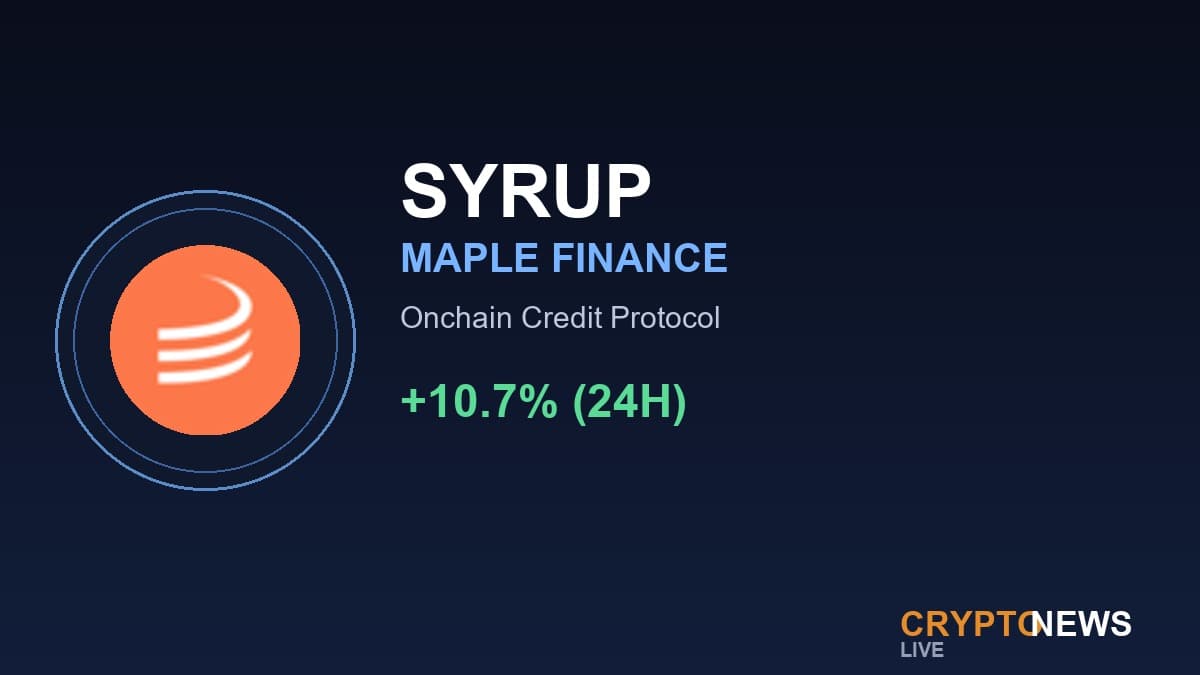
$SYRUP just did something Bitcoin, Ethereum and Solana all failed to do today. It went up.
Maple Finance’s governance token climbed roughly 10.7% in 24 hours to $0.214, pushing its 30-day gain past 38% while Bitcoin slipped 0.76%, Ethereum dropped over 2% and XRP fell nearly 3% on the same clock. That is not sector rotation. That is one token being repriced on its own merits, and the paper trail points to a specific hour.
A Wall Street Name Put SYRUP on a Very Short List
At 8:22 PM UTC on September 1, Arca co-founder and CIO Jeff Dorman posted a thread titled “The New Crypto All-Star Tokens”, naming exactly four assets he considers to have crossed from speculative governance chips into something closer to equity in a functioning business: Ethena, Maple, Aave, and one more. Maple made the cut for a specific mechanical reason, not vibes.
Dorman wrote that Maple “operates an on-chain asset-management and lending platform” and has “increasingly tied the token to protocol economics through revenue-funded buybacks and distributions to stakers,” calling it “a particularly useful example” of a protocol that looks “less like a speculative crypto application and increasingly like an on-chain financial-services company with recognizable revenues, margins and capital-allocation decisions.”
That post went out roughly 18 hours before SYRUP’s price action shifted from a flat, boring base into the vertical move visible on the chart below. Timing alone does not prove causation. But a widely-read institutional voice naming a mid-cap token by ticker, hours ahead of a breakout, on a thesis the token can actually back up with numbers, clears the bar for a real trigger rather than background noise.
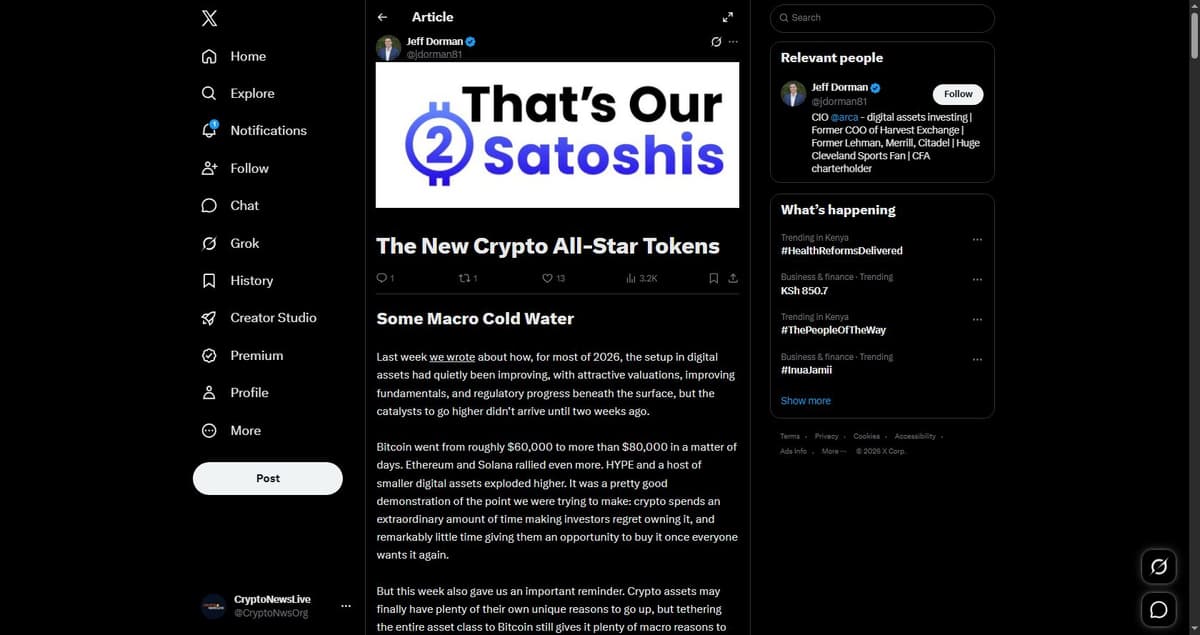
Jeff Dorman (Arca) on X, September 1, 2026, naming Maple Finance among crypto’s “all-star tokens” for its revenue-funded buyback mechanics.
The Buyback Machine Behind the Thesis
Dorman was not describing a plan. He was describing something already running. Under governance proposal MIP-021, Maple routes a slice of monthly net protocol revenue, 10% below a $1.5 million threshold and 20% above it, straight into open-market SYRUP purchases.
The most recent completed round bought 852,840 SYRUP for 136,768 USDT at an average price of $0.1604, according to on-chain buyback data tracked and posted by researcher Keno (@kenodnb) on X, who has logged the program’s full history back to August 2025. Earlier rounds bought at $0.15, $0.2649, $0.4173 and $0.4273, meaning the mechanism has quietly been buying more tokens as the price fell. That is the opposite of a hype-driven scheme. It is a formula executing regardless of sentiment.
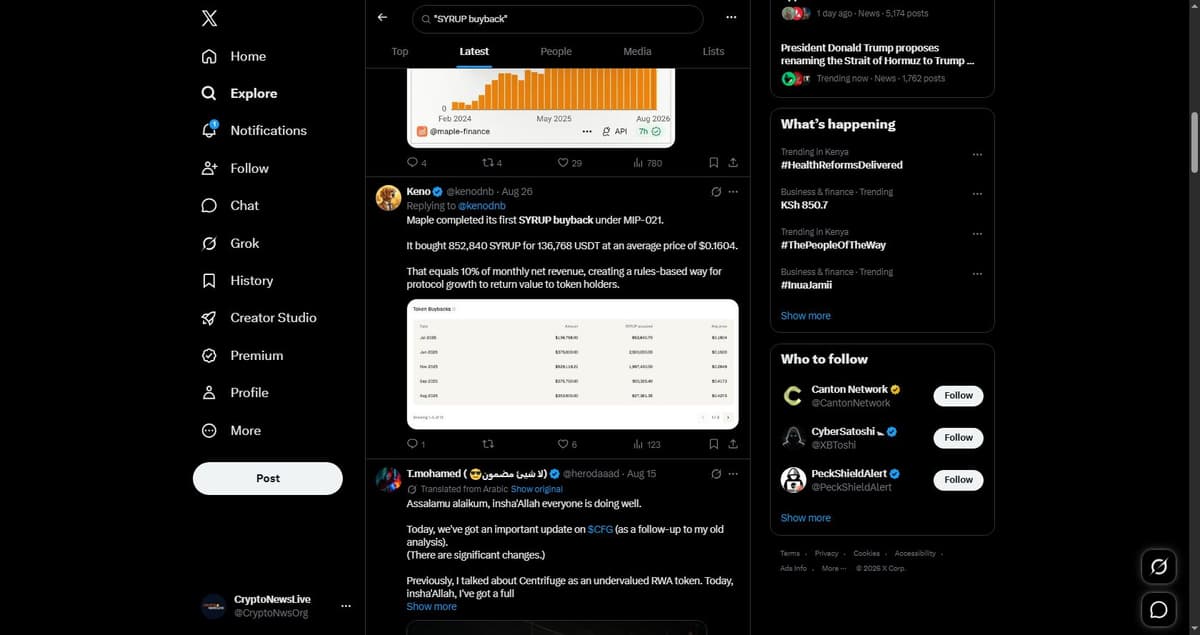
On-chain buyback history for SYRUP under MIP-021, shared by @kenodnb on X, showing five completed monthly rounds and their average purchase prices.
The Business Underneath Actually Grew
Feed the buyback and you need revenue, and Maple has that too. DeFiLlama lists Maple’s total value locked at $2.953 billion, sitting near its all-time high on a chart that was under $500 million as recently as early 2025. Active loans on the platform total $1.822 billion. Thirty-day protocol fees run $10.35 million, generating $1.29 million in revenue and $129,467 earmarked directly for holders, the exact pool the buyback formula draws from.
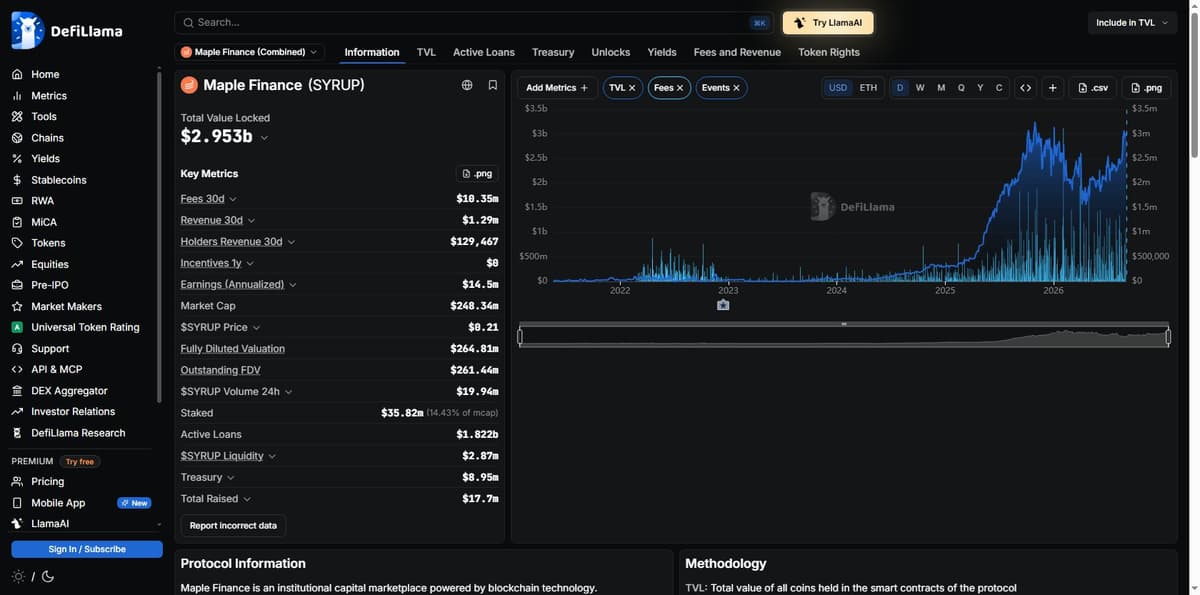
DeFiLlama, Maple Finance protocol page, TVL and revenue metrics pulled September 2, 2026.
Put the token price against that TVL line and the divergence is the real story hiding under the daily percentage. SYRUP is still roughly 67% below its all-time high of $0.6532 set in June 2025. The protocol carrying it is worth more than it has ever been.
Where the Volume Actually Trades
None of this is happening on some thin, easily-gamed pool. CoinGecko lists 59 separate SYRUP trading pairs across Binance, Coinbase, OKX, Bybit, Upbit, Kraken, KuCoin, Bitget, Gate and MEXC, all carrying real, verifiable order book depth. Binance alone clears more than $6 million in daily SYRUP volume across its USDT, USDC and TRY pairs. The largest on-chain DEX pool, a Uniswap v4 pair on Ethereum, trades under $500,000 a day by comparison, under 3% of the total. This is a centralized-exchange story almost entirely, which matters because it rules out a thin-liquidity wash-trading pump as the explanation.
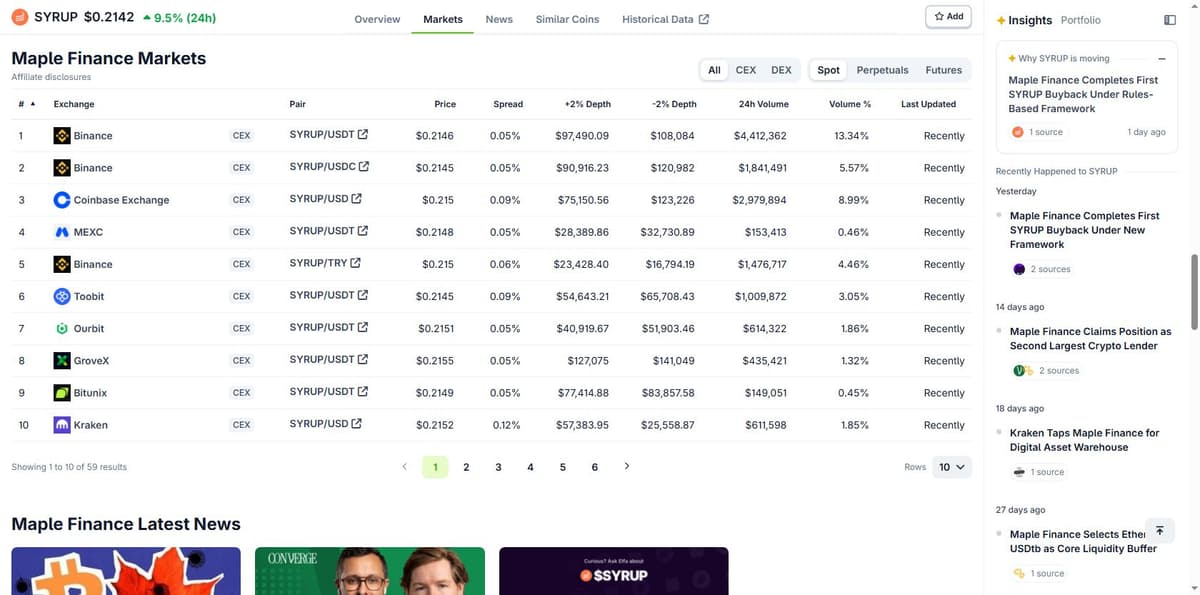
CoinGecko Markets tab for Maple Finance (SYRUP), showing the top 10 of 59 listed trading pairs, screenshotted September 2, 2026.
What the Chart and the Futures Positioning Say
The hourly chart on Binance shows a textbook base-and-breakout. SYRUP chopped sideways between $0.17 and $0.185 for roughly two days, a range that quietly absorbed sell pressure, then broke above $0.20 on rising volume before printing a high near $0.223 and settling around $0.214. That is a markup phase following an accumulation range, not a single news-driven spike candle.
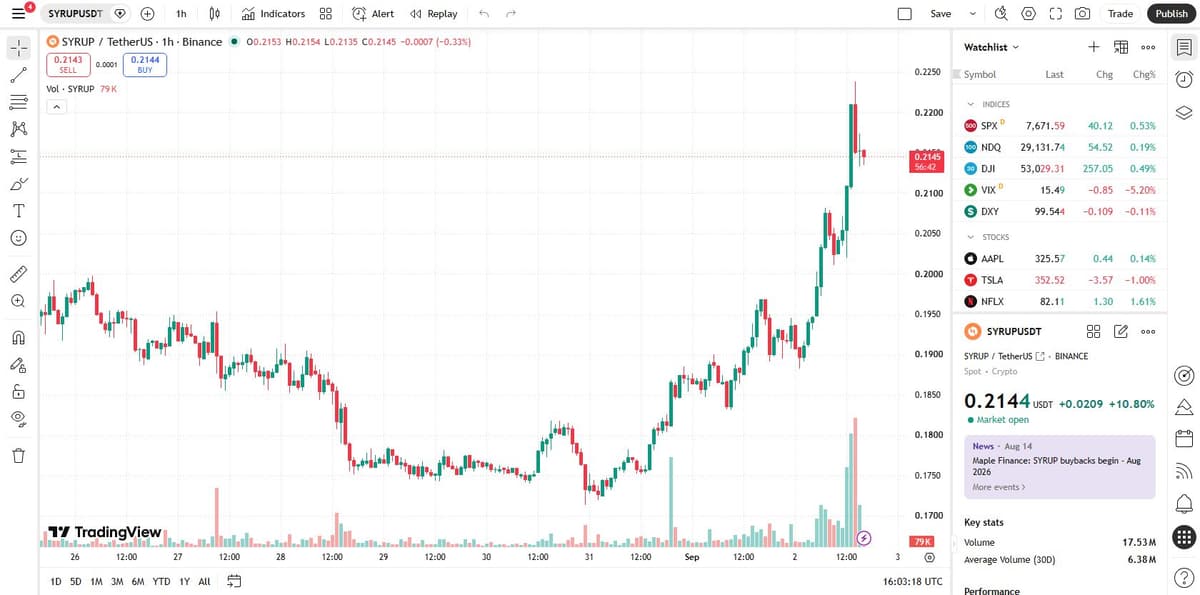
TradingView, SYRUP/USDT on Binance, 1-hour candles, screenshotted September 2, 2026, showing the breakout above the $0.17-$0.185 base.
Derivatives data backs the spot-led read. Coinglass shows open interest at $30.39 million with Binance’s long/short account ratio at a mild 1.06 and top traders at 1.42, tilted long but nowhere near a crowded, squeeze-prone extreme. Twenty-four hour liquidations were close to balanced, $18.86K in longs against $16.25K in shorts. There is no forced-buying mechanism inflating this number. Buyers are simply showing up.
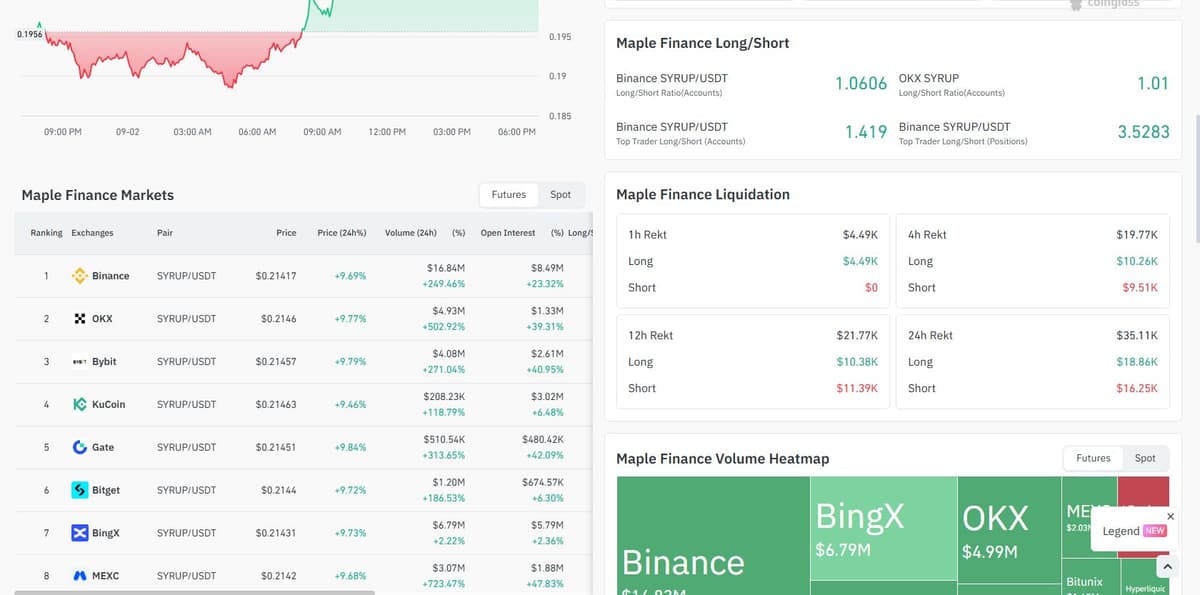
Coinglass, Maple Finance (SYRUP) derivatives dashboard, open interest and long/short data, screenshotted September 2, 2026.
The Part That Still Cuts Both Ways
A formula-driven buyback funded by real revenue is a genuinely rare mechanism in this market. It is also not a guarantee. The buyback size scales with net revenue, so a slowdown in Maple’s institutional lending volume would shrink the monthly purchase automatically, removing the exact tailwind that is doing work today. SYRUP’s own three-year range, from an all-time low of $0.0852 to a high six times higher, is proof the token can move hard in either direction once a narrative fades.
For now, the mechanism is intact, the revenue backing it is growing, and a name-brand allocator just told a large audience why that combination matters. Whether that holds past the next monthly buyback print is the only real open question left on the table.