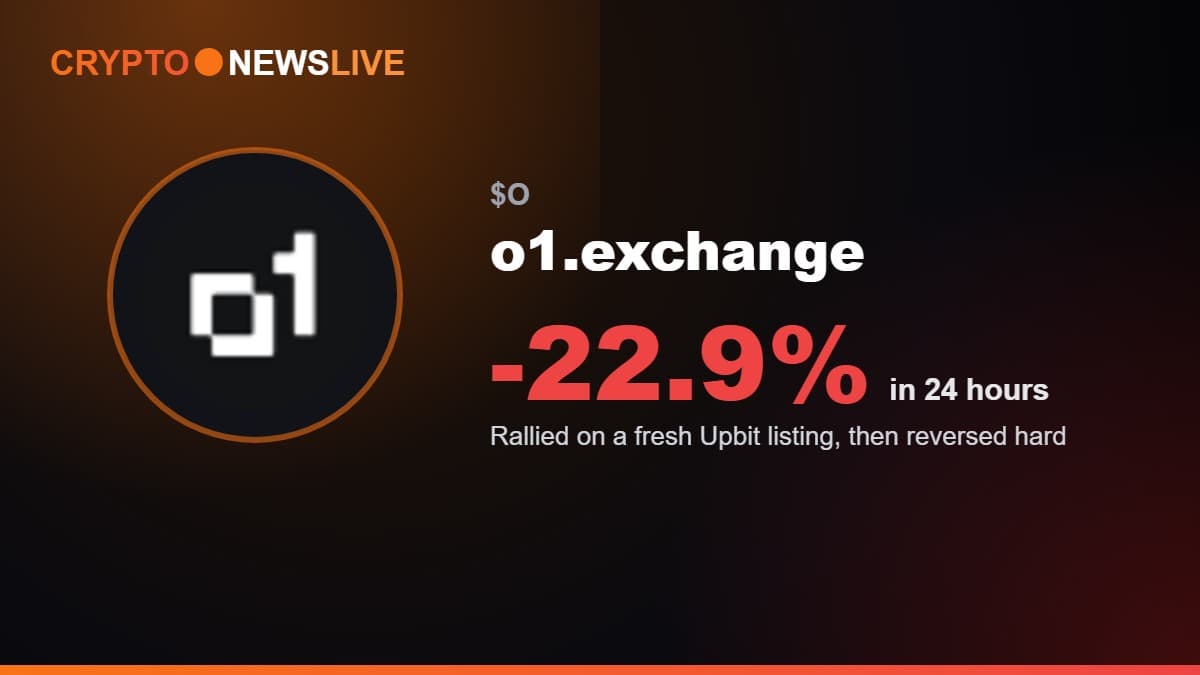
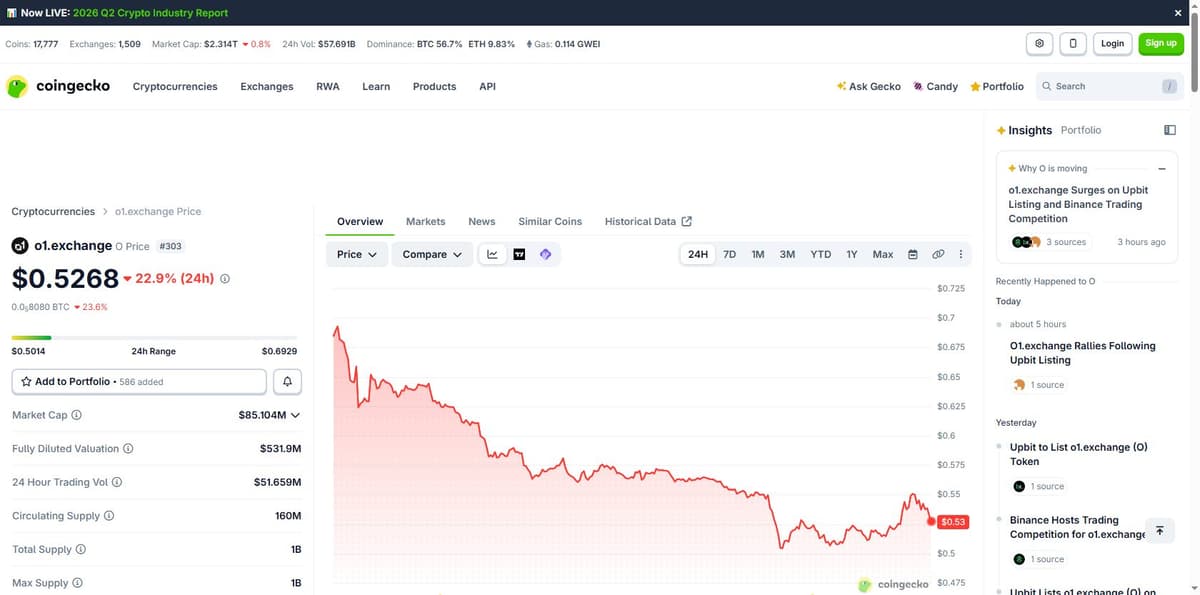
o1.exchange price action gave holders whiplash overnight. The token rallied to a 24 hour high of $0.6929 within hours of a fresh Upbit listing, then handed almost all of it back.
It sits at $0.5268 now, down 22.9% on the day.
The obvious read is sell the news. Look at Binance’s own contest rules instead, and a cleaner mechanism turns up: the exchange built an incentive structure that pays people to buy and gives them no reason to hold.
Binance Only Rewards the Buy Side
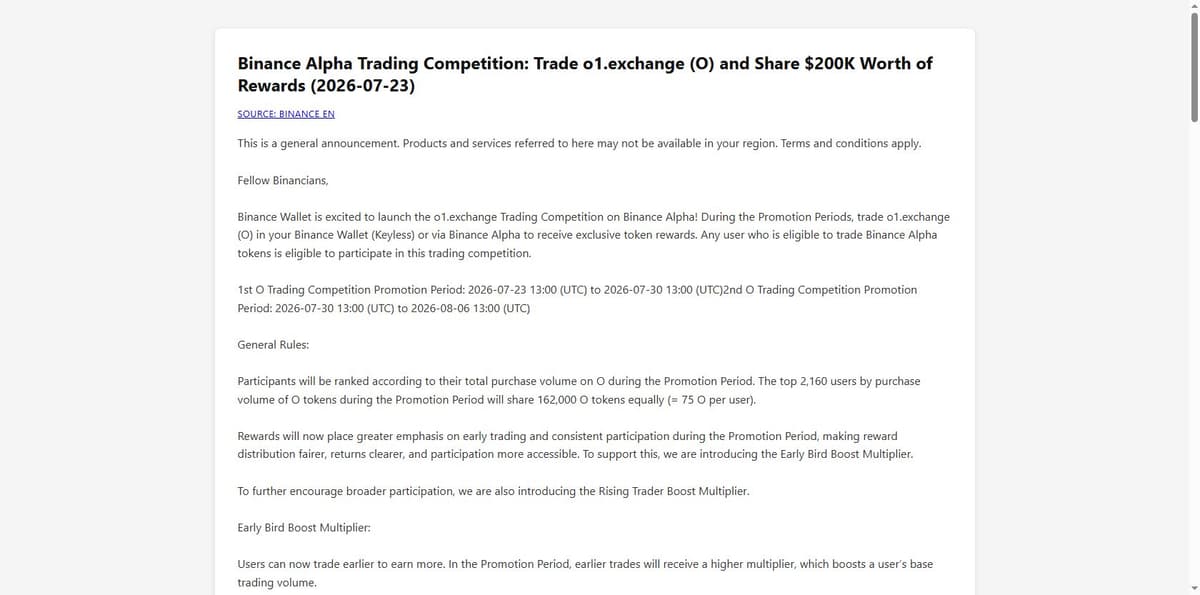
Binance Wallet launched an Alpha trading competition for O at 13:00 UTC on July 23, the same day Upbit announced its own listing. $200,000 in O tokens went up for grabs, split among the top 2,160 traders ranked by purchase volume. Read the fine print and one line does the real work: selling is excluded from the ranking entirely.
Only buys count.
A 3.0x Early Bird Boost Multiplier applied to Day 1 and Day 2 trades alone, tripling the effective volume of anyone buying inside the first 48 hours of promotion. Binance’s own announcement, dated July 23, 2026, lays out the full schedule: 3.0x on days one and two, dropping to 2.5x, then 2.0x, sliding down to 1.0x by day seven.
That is a contest built to front-load buying pressure into the first two days. Once a trader’s purchase volume gets logged for the ranking, holding the token does nothing for the reward and exposes them to price risk for zero additional upside. The rational move is to buy early, lock in a ranking spot, and sell. A lot of traders appear to have reached that exact conclusion inside about 20 hours.
The Upbit Listing Fired the Same Day
Upbit’s own announcement, first reported by PANews, said the Korean exchange would list O against KRW, BTC and USDT pairs, with trading opening at 15:00 local time on July 23. Deposits and withdrawals went live within two hours of announcement. Upbit still carries the single biggest share of O’s reported volume today, worth close to $33 million in the past day alone, 52.68% of it by CoinGecko’s own market tally.
Two catalysts landed on the same calendar day. A trading contest engineered to front-load buys, and a top-tier exchange listing. Same 24 hours, no coincidence. Together they explain the spike to $0.6929. Neither explains why holders needed a reason to sell just as fast.
Almost None of This Trades On-Chain
o1.exchange’s token lives on Base, and its biggest on-chain pool sits on Aerodrome: roughly $1.94 million in liquidity, $1.59 million in trading volume over 24 hours. Compare that to close to $65 million changing hands across Upbit, Gate, DigiFinex, HTX, LBank, Bitget and Coinbase combined. On-chain trading accounts for something like 2 percent of total volume here. This is a centralized-exchange story, not a decentralized one.
The Aerodrome pool still tells a consistent story on its own: 3,683 buys against 6,530 sells in the past 24 hours, a real skew toward selling rather than the roughly even split a wash-trading bot tends to produce. Genuine distribution, just a small slice of the total.
Five Wallets Hold 84% of the Supply
o1.exchange has 13,939 holders on Base, which sounds broad until the concentration numbers land. The top five wallets hold 84% of the one billion token max supply. The top ten hold 96.08%. BaseScan’s own Gini score for the distribution comes out to 0.9892, about as concentrated as a token gets.
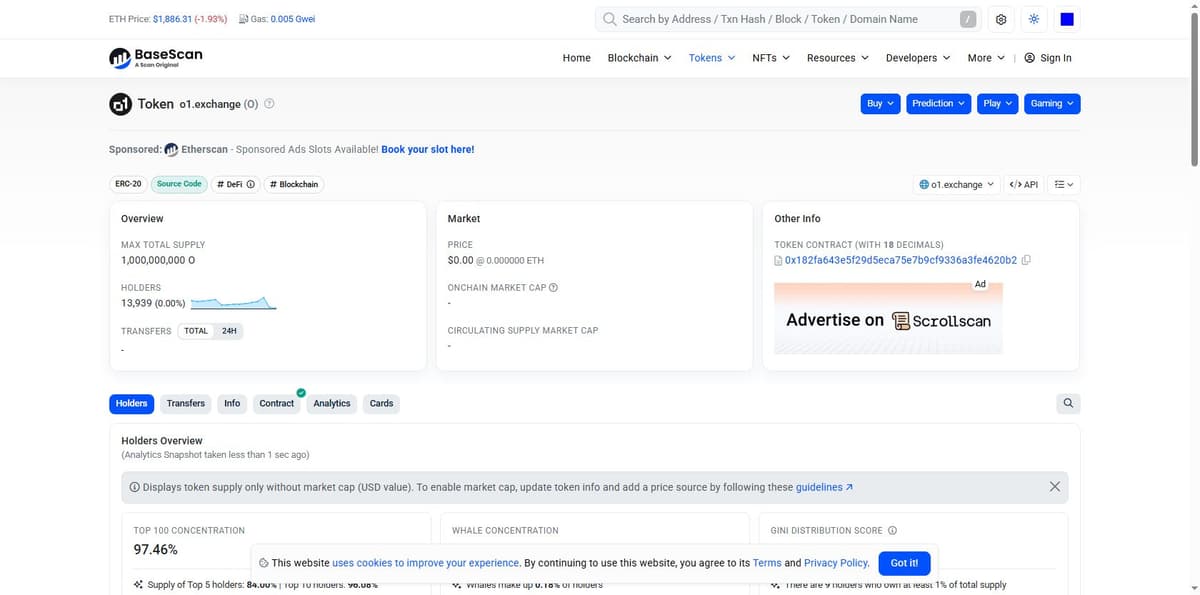
The single largest wallet, holding 22% of supply, is a multisig-style contract that has not moved in 43 days, so it is not today’s seller. It is still the reason O trades with only 160 million of its 1 billion tokens actually circulating, a sixth of supply against a fully diluted value north of $530 million. That gap did not cause one day’s crash by itself. It does explain why a token this thin can swing 22% in either direction on a contest and a listing.
Round Two Starts July 30
Binance’s contest runs in two windows. The first promotion period closes July 30 at 13:00 UTC. A second one opens the same hour and runs through August 6, with its own 3.0x Early Bird multiplier resetting on day one. If the mechanism behind this week’s reversal is real, it repeats on schedule: another front-loaded rally, another shot at the same whiplash, in six days.