
Bitcoin is sitting in the low $60,000s and the price chart looks calm enough. But the stablecoin data behind that calm is still pointing down.
Binance holds roughly $41.2 billion in USDT spread across ERC-20 and TRC-20 networks, per CryptoQuant data published June 10. The headline number sounds big. It is not the story.
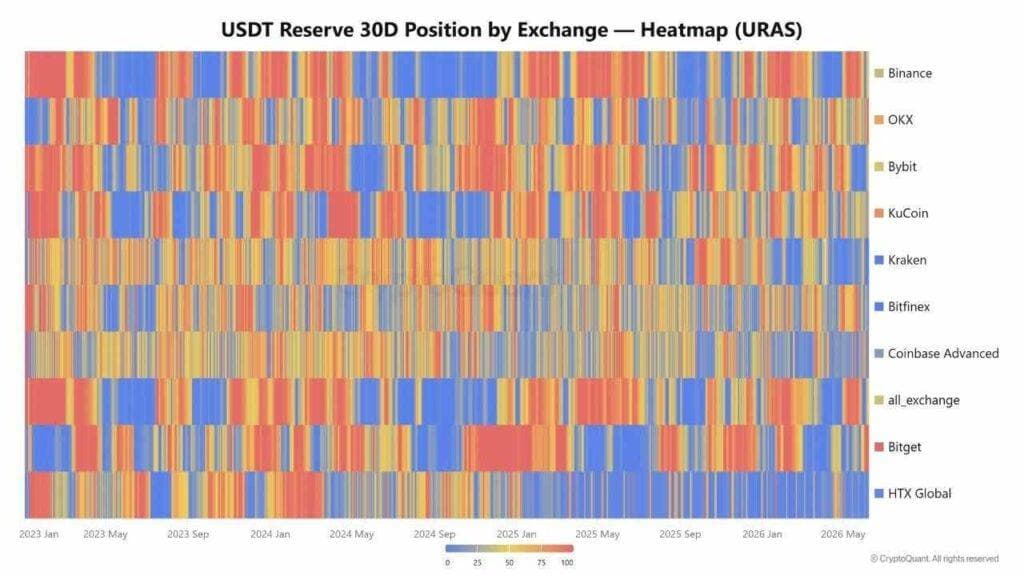
Source: CryptoQuant — USDT Reserve 30D Position by Exchange (URAS Heatmap)
The ERC-20 book has dropped 2.3% over the past 30 days. It now sits at just the 23.5th percentile of its monthly range. That is institutional money. TRC-20 represents retail. The split between the two chains tells you exactly who is pulling funds and who is holding.
For a retail crypto trader watching BTC from Nairobi or Lagos, this distinction matters. TRC-20 USDT is the default stablecoin for low-fee transfers across African exchanges. When retail inflows on TRC-20 drop, the demand signal from that segment of the market goes quiet too.
The Outflow That Defined Late May
Late May was when the real damage happened. The 7-day moving average of ERC-20 netflows on Binance fell to negative $215 million — what CryptoQuant’s framework classifies as a STRONG_CAPITAL_EXIT reading. That was the most intense outflow reading of the current market cycle.
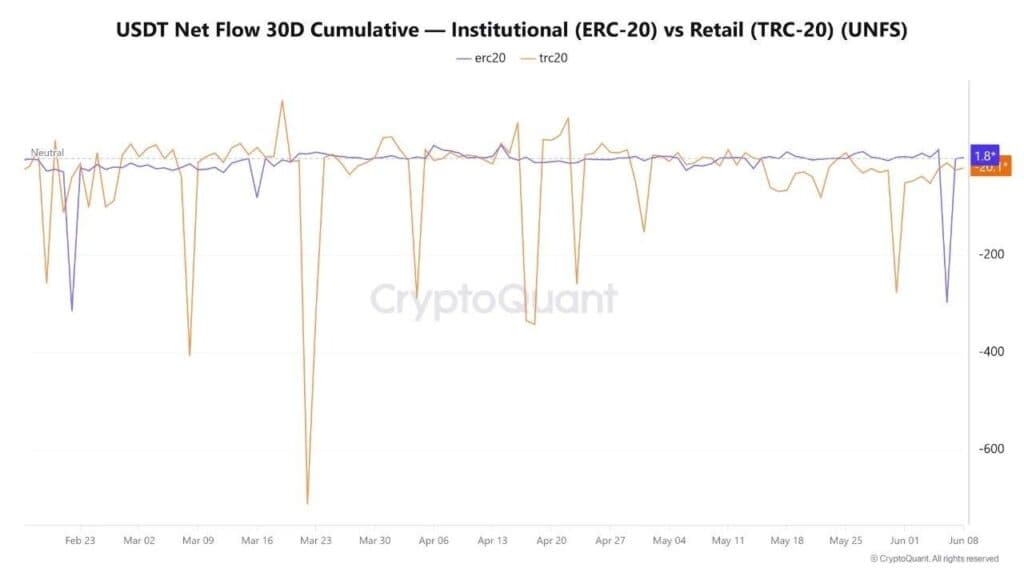
Source: CryptoQuant — USDT Net Flow 30D Cumulative, Institutional (ERC-20) vs Retail (TRC-20)
Early June brought a brief shift. The MA7 flipped to positive $120 million on June 5. That is the number that caused some excitement. It did not last. By June 8 it had cooled back to neutral.
The reserve is still down nearly 12.4% from its December 2025 peak of $43.9 billion. The capital that exited during the correction has not come back.
What the Heatmaps Show Across Exchanges
Zoom out and the picture holds across every major venue. OKX, Bybit, and Bitfinex are all in mild distribution on a 30-day basis. The net flow heatmap below shows the broad pattern: red dominates recent columns across most exchanges.
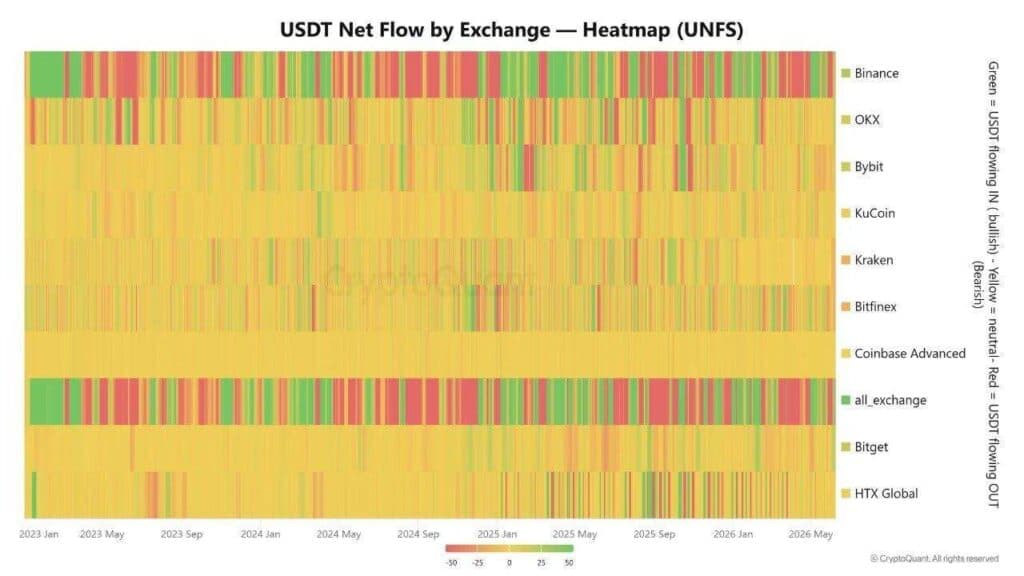
Source: CryptoQuant — USDT Net Flow by Exchange Heatmap (UNFS). Green = inflow (bullish), Red = outflow (bearish).
KuCoin and Bitget are accumulating on TRC-20. Their combined reserve sits near $465 million. That number is structurally too small to move the broader market. The accumulation signal from those two exchanges does not offset what is leaving Binance.
Binance processes a different order of magnitude in USDT volume. What happens there sets the floor. Right now that floor is still soft.
Seven-Day Flows Confirm the Same Story
The 7-day cumulative netflow chart adds precision to the monthly picture. The most recent bar on the ERC-20 side is sitting at negative $3.8 million. The TRC-20 bar is at negative $20.1 million. Both chains are in net outflow right now.
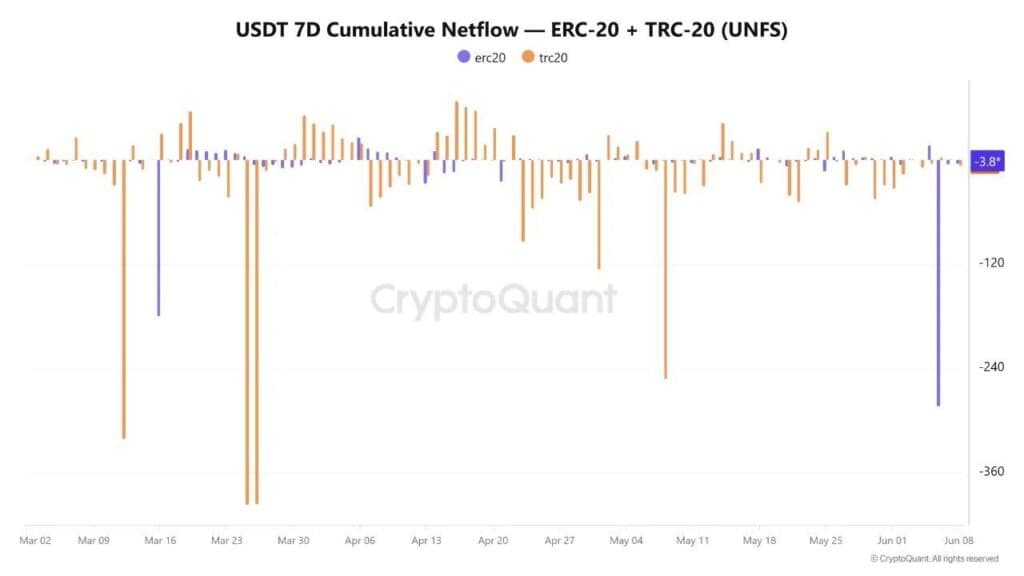
Source: CryptoQuant — USDT 7D Cumulative Netflow, ERC-20 + TRC-20 (UNFS)
The June 8 readings represent a fresh outflow spike on both chains simultaneously. The ERC-20 bar in particular posted one of its steeper single-period drops of the past three months.
That kind of two-chain synchronized outflow suggests coordinated positioning across both institutional and retail segments. Both sides pulled at the same time. That does not happen at the start of an accumulation cycle.
Recovery Needs One Thing Binance Does Not Have Yet
The threshold is simple. Binance’s USDT reserve needs to reclaim its 30-day moving average with sustained positive daily flows before the liquidity base for a BTC recovery is intact.
That average is currently sitting above the live reserve figure. Closing that gap requires inflows, not just a pause in outflows. The early June positive reading on June 5 was a pause. It reversed within three days.
Ki Young Ju, CEO of CryptoQuant, has consistently tied stablecoin reserve trends at major exchanges to forward price conditions. The current reading does not point to imminent upside. It points to a market that stopped falling. Those are different things.
Until the reserve rebuilds with conviction, the stablecoin floor under BTC remains incomplete. The market is not crashing. It is not yet loading either.