Something happened to Bedrock’s BR token in the last 24 hours. The price jumped 21.2% to $0.1676, adding millions in market capitalization in a single session. No announcement. No press release. Just a sudden move that put BR on trending lists and sent traders scrambling to figure out what they missed.
Here is what they probably missed: fourteen hours before the price started moving, an unlabeled GitHub account committed code to the Bedrock-Technology repository with the message “deploy suniBTC.” That is a new product, a wrapped Bitcoin derivative built on Babylon’s staking protocol. It has not launched publicly yet. But the commit was visible to anyone watching the repo, and someone noticed.
That part of the story is straightforward. The rest of it is harder to explain.
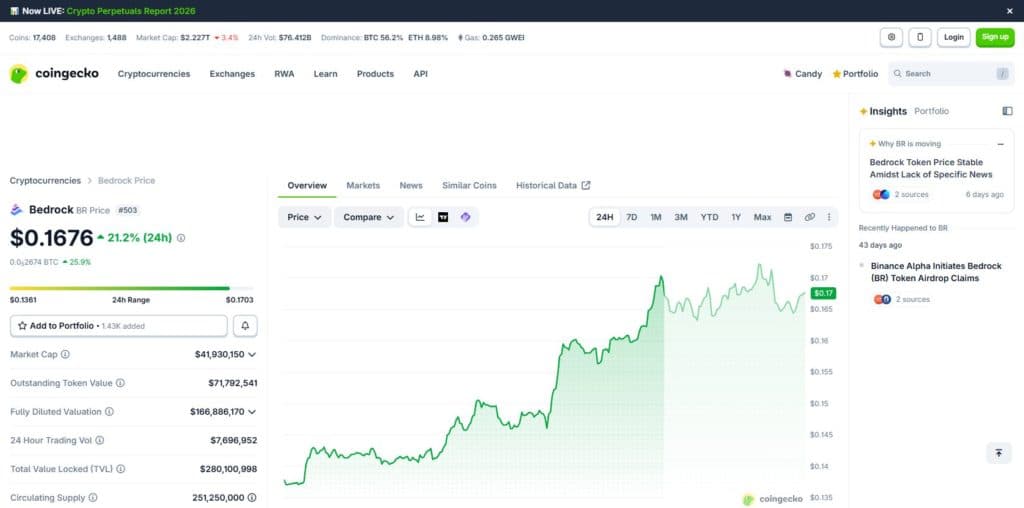
Source: CoinGecko — BR token overview, price $0.1676, +21.2% in 24h
A $280 Million Protocol That Pays Its Token Holders Nothing
Bedrock is not a small project. According to DeFiLlama, the protocol holds $280.58 million in total value locked across 19 chains. Its core products are uniBTC (a Bitcoin liquid restaking token built on Babylon), uniETH (an Ethereum liquid staking token), and uniIOTX for the IoTeX ecosystem. The protocol has been audited twice, by PeckShield and BlockSec. Its GitHub shows 818 commits to the uniBTC repository alone, with the most recent commit landing five hours before this article was written.
The protocol generates real fees. DeFiLlama shows $1.43 million in annualized fees and revenue of $157,348 in the most recent reported quarter. Those are not phantom numbers. Real users are depositing real assets and paying to do so.
None of that money reaches BR token holders.
DeFiLlama’s income statement shows five consecutive quarters with Holder Revenue listed as $0. The most recent quarterly breakdown: $316,000 gross fees, $277,000 in costs, $39,000 gross profit, and zero passed to token holders. Bedrock uses a vote-escrow model called veBR, where BR is locked 1:1 to receive governance rights. Governance rights without economic returns are just votes on decisions that do not pay you.
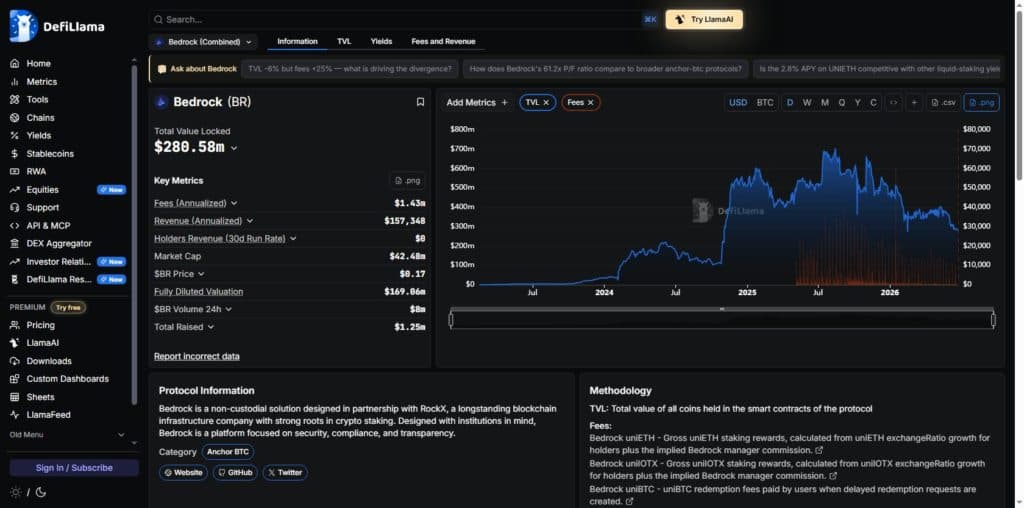
Source: DeFiLlama — TVL $280.58M, Fees $1.43M annualized, Holder Revenue $0
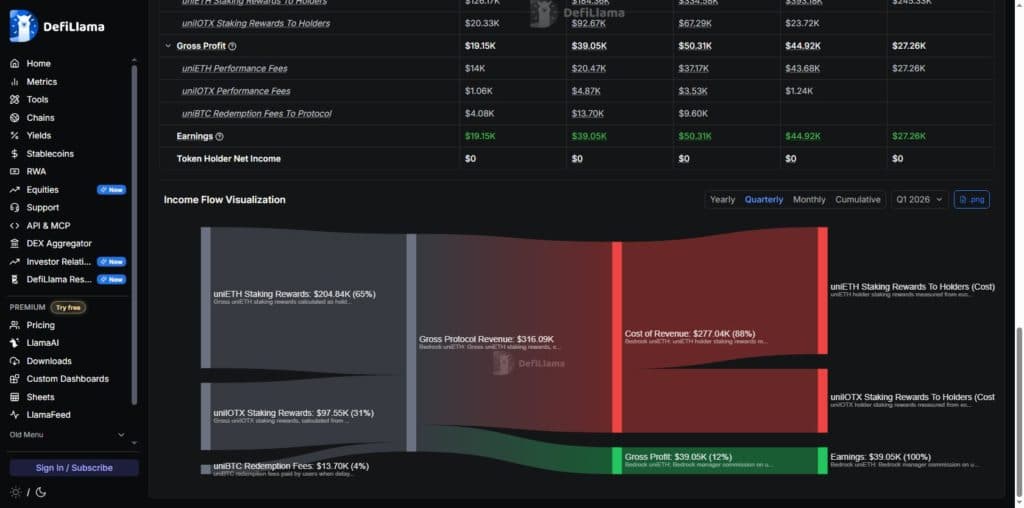
Source: DeFiLlama — Q1 2026 income flow: Gross $316K → Gross Profit $39K → Token Holder Net: $0
At current prices, BR’s circulating market cap sits at roughly $42 million. Against annualized revenue of approximately $629,000 (extrapolating the most recent quarter), that implies a price-to-revenue multiple of around 67x on circulating market cap, or 224x on fully diluted value. Token Terminal confirmed it has no financial data for this project, so these are calculated figures based on DeFiLlama sources.
The Volume That Is Not What It Looks Like
CoinGecko reports $7.7 million in 24-hour trading volume for BR. That sounds like genuine market activity. It is mostly not.
Exchange data shows that LBank alone accounts for 74.53% of that volume. LBank is a smaller centralized exchange with a documented history of inflated volume metrics. The actual decentralized exchange activity tells a different story. On DEX Screener, the primary BR trading pair on PancakeSwap V3 shows $896,000 in total liquidity and just $10,000 in 24-hour volume. Across all DEX pools, real on-chain volume sits around $135,000, which is roughly 1.8% of the CoinGecko headline number.
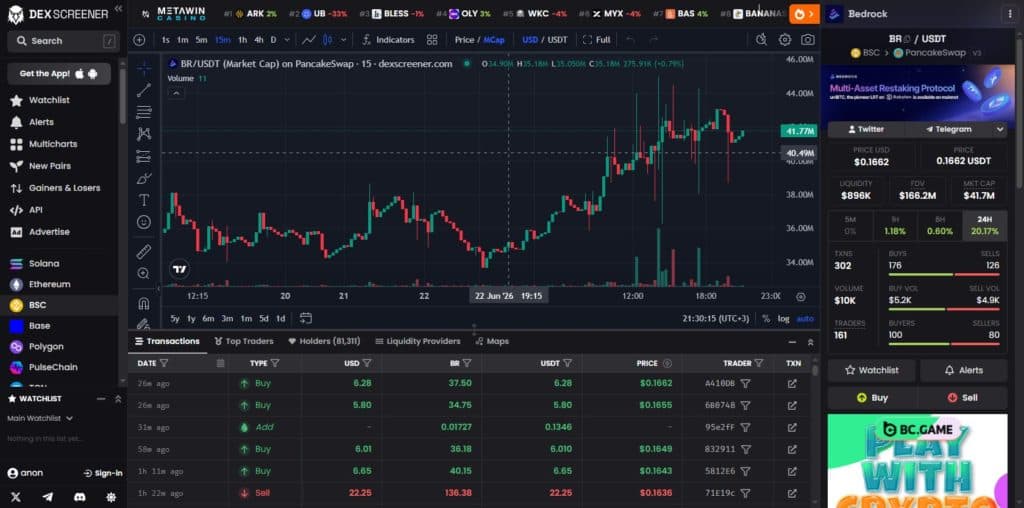
Source: DEX Screener — PancakeSwap V3 BR/USDT: $896K liquidity, $10K 24h DEX volume
This does not mean BR cannot be traded. It means the $7.7 million headline figure is mostly centralized exchange activity concentrated on one platform, sitting on top of thin real liquidity.
The Wallet Data
BSCScan shows 80,568 total holders for BR. The concentration numbers are extreme.
The Gini distribution score is 0.9996. A Gini coefficient of 1.0 represents a theoretical state where a single entity holds everything. Bedrock is at 0.9996. The top 100 wallets hold 99.59% of all BR. The top five wallets alone control 74% of total supply.
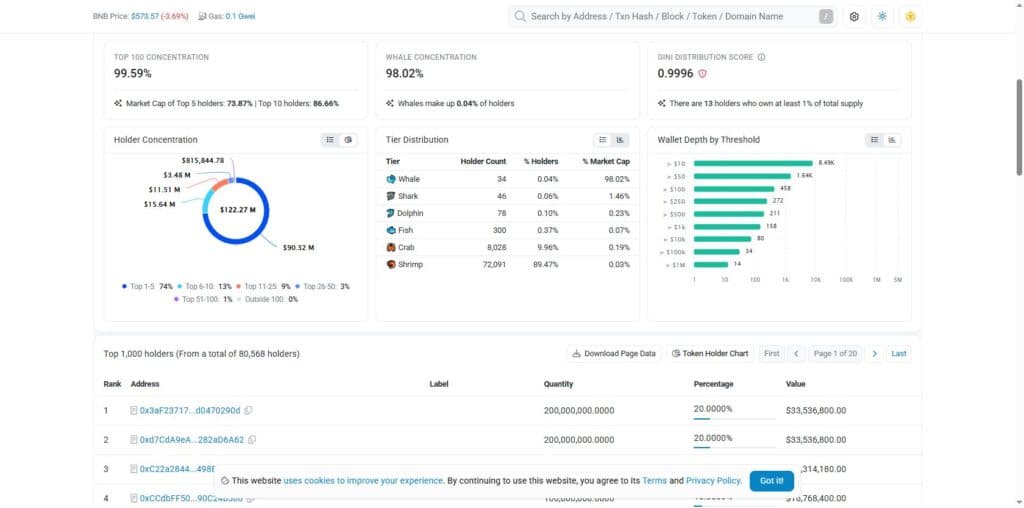
Source: BSCScan — Gini 0.9996, Top 100 concentration 99.59%, Whale concentration 98.02%
Here is where it gets specific. From the BSCScan holders page:
• Rank 1: 200,000,000 tokens (20.00% of total supply). No label.
• Rank 2: 200,000,000 tokens (20.00% of total supply). No label.
• Rank 3: 145,000,000 tokens (14.50% of total supply). No label.
• Rank 4: 100,000,000 tokens (10.00% of total supply). No label.
• Rank 5: 93,750,000 tokens (9.375% of total supply). No label.
The top two wallets each hold more BR than the protocol’s entire reported circulating supply of 251,250,000 tokens. Together they hold 400 million tokens, 60% more than the circulating supply. Neither wallet carries any BSCScan label. They are not tagged as team wallets, treasury wallets, vesting contracts, or exchange hot wallets. They are just addresses.
The first labeled exchange wallet appears at rank 7 (Gate.io) and rank 8 (Bybit). Rank 29 is notable: the Binance Alpha 2.0 Router Proxy, which connects to the Binance Alpha airdrop program that began distributing BR tokens 43 days ago.
The Supply Problem
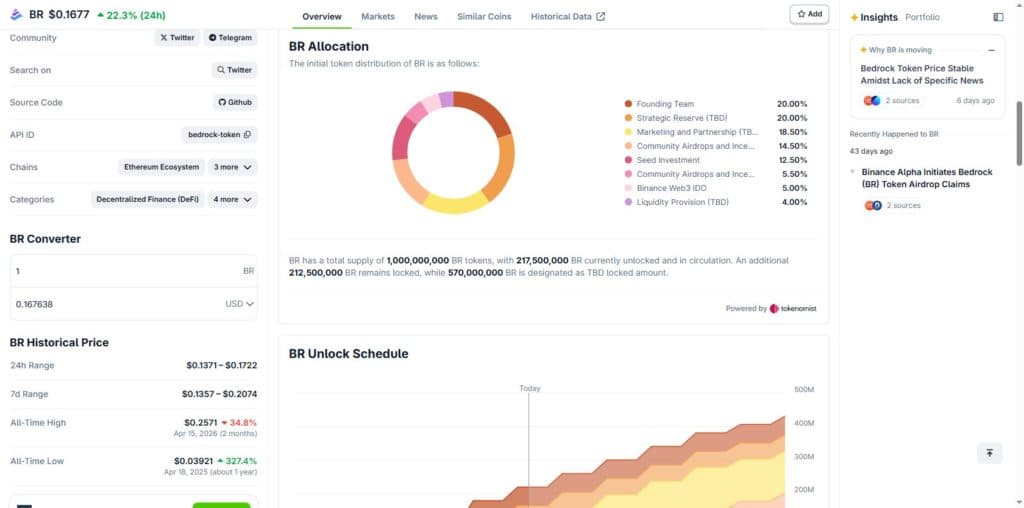
Source: CoinGecko — BR tokenomics: 570M tokens in TBD locked categories with no disclosed unlock schedule
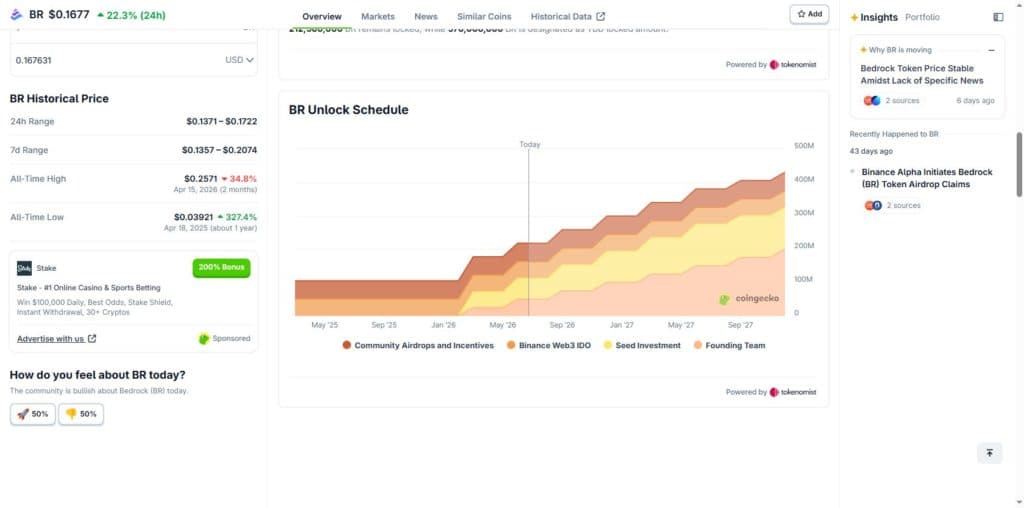
Source: CoinGecko — Unlock schedule: Strategic Reserve, Marketing, Liquidity allocations show no dates
CoinGecko’s tokenomics data shows that 570 million of the 1 billion total BR supply is classified as “TBD locked.” This includes the Strategic Reserve allocation (20% of total supply), Marketing allocation (18.5%), and Liquidity Provision (4%). These three categories have no disclosed unlock schedule. No dates. No vesting terms. No public commitment on when or if these tokens will enter circulation.
The token allocations that do have schedules (Founding Team at 20%, Seed Investment at 12.5%, Binance IDO at 5%) show unlock dates extending through September 2027. The 57% that has no schedule represents more than 2.2x the current circulating supply with no timeline attached.
What the suniBTC Commit Actually Means
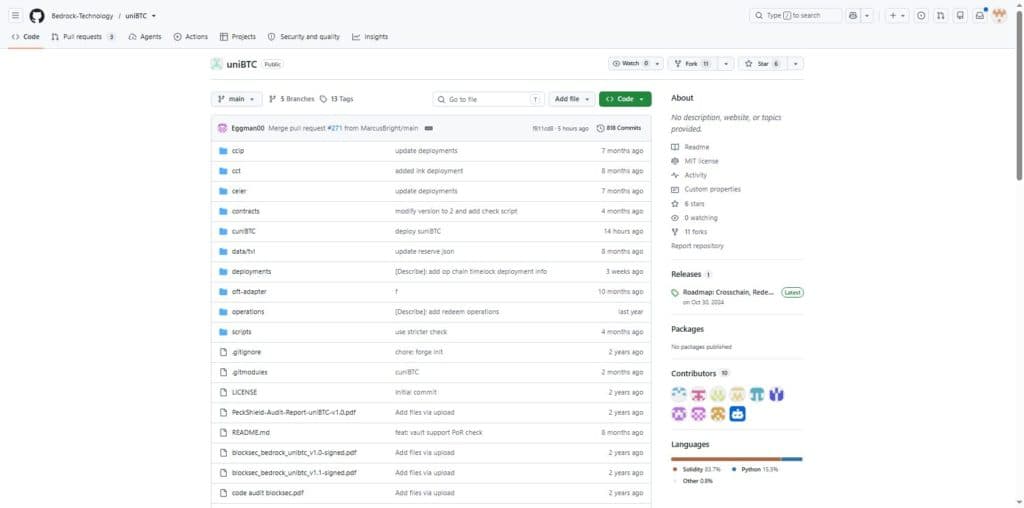
Source: GitHub — Bedrock-Technology/uniBTC: “deploy suniBTC” commit from 14 hours ago
The GitHub commit that likely triggered today’s price action was a deployment message for suniBTC. Based on the code structure in Bedrock’s repository, this appears to be an extension of the uniBTC product, possibly a new wrapped Bitcoin instrument with different yield parameters layered on top of Babylon’s Bitcoin staking infrastructure. Babylon has been one of the more closely watched Bitcoin DeFi protocols in 2026, and any expansion of uniBTC into new product territory carries real narrative weight.
Whether suniBTC launches successfully and whether it adds meaningful TVL to Bedrock’s existing $280 million are open questions. A GitHub commit is not a product launch. It is a signal that something is being prepared.
The Numbers Together
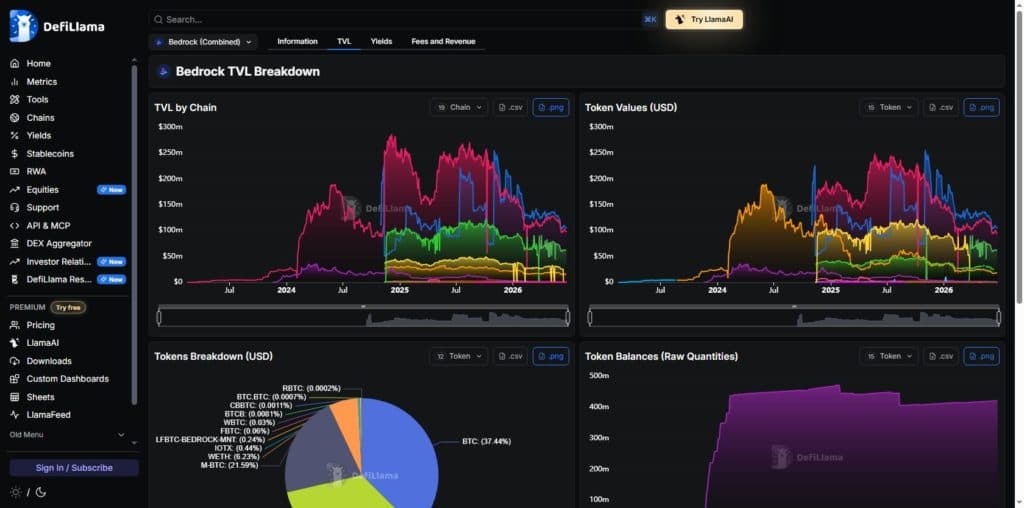
Source: DeFiLlama — TVL breakdown: BTC 37.44%, M-BTC 21.59%, WETH 6.23% across 19 chains
Bedrock has built something that functions at the infrastructure level. The TVL is real, spread across 19 chains and denominated substantially in Bitcoin (37.44% of TVL). The code is actively maintained. The audits are from credible firms. The team, though anonymous in terms of BSCScan wallet labels, has shipped working products.
The BR token exists in a different reality. Holders receive no protocol revenue. The supply structure places 57% of tokens in categories with no unlock timeline. Two of the largest wallets, each holding 20% of total supply, have no identifying labels anywhere on-chain. The primary decentralized trading venue has $896,000 in liquidity. And the Gini score of 0.9996 is not a measurement error, it is a near-complete picture of token concentration.
The 21% move today may be the suniBTC signal. It may be Binance Alpha airdrop mechanics. It may be something that does not show up in any of these data sources. What the on-chain data does not show is a market where price discovery is happening across a broad base of token holders with meaningful economic stakes in the protocol’s actual performance.